The Green Legend: 15 Fascinating Facts About St. Patrick’s Day
St. Patrick's Day has grown from a quiet religious observance into a global celebration of Irish culture, music, and heritage. From the saint's surprising British origins to the modern traditions of green rivers and orbiting space celebrations, the history behind March 17th is full of unexpected twists. Discover fifteen fascinating facts about St. Patrick, leprechaun folklore, and how this iconic holiday conquered the world.
1. St. Patrick Was Not Actually Irish
Despite being the patron saint of Ireland, Saint Patrick was actually born in Roman Britain during the late fourth century. At around sixteen years old, he was kidnapped by Irish raiders and transported to Ireland to work as an enslaved shepherd. He spent six grueling years tending livestock in the countryside before escaping back to his family in Britain. Following his return, he experienced a religious calling that urged him to go back to the island where he had been held captive. He eventually returned to Ireland as a missionary, devoting the remainder of his life to converting the native Celtic population to Christianity.
2. The Original Color Associated with Him Was Blue
Long before green became synonymous with the Emerald Isle, the saint was traditionally associated with a specific shade of light sky blue. Known as "St. Patrick's Blue," this royal shade featured prominently on early Irish flags, military uniforms, and official heraldic crests. King George III established the Order of St. Patrick in 1783, designating sky blue as the official color of the knightly order. Green only gained dominance during the 1798 Irish Rebellion, when republicans adopted the vibrant color to contrast against British blue and red. Over time, the association with green solidified as Ireland's lush landscapes earned it the global nickname of the Emerald Isle.
3. Snakes Never Actually Lived in Ireland
Popular folklore credits Saint Patrick with driving every slithering serpent out of Ireland during a 40-day fast atop a mountain. However, scientific evidence confirms that post-glacial Ireland never had native snakes to begin with. During the last Ice Age, the chilly waters surrounding the island made it impossible for cold-blooded reptiles to migrate from continental Europe. Scholars believe the famous snake legend is actually an allegory for Patrick eradicating pagan practices and Druidic worship from the country. Today, Ireland remains one of the very few landmasses on Earth—alongside Antarctica and New Zealand—completely devoid of wild snake species.
4. The First Recorded Parade Took Place in Florida
While many assume the tradition of St. Patrick's Day parades originated in Dublin, the earliest recorded procession actually occurred in North America. Historical records from a Spanish colony indicate that a parade took place in 1601 in what is now St. Augustine, Florida. The event was organized by a Spanish colony's Irish vicar, Ricardo Artur, who directed artillery fires and a festive procession in honor of San Patricio. Boston later hosted the first American-Irish parade in 1737, while New York City followed suit with its own celebration in 1762. Ireland did not host its first official state-sponsored parade until 1931 in Dublin.
5. It Was Strictly a Dry Holiday in Ireland for Decades
Modern revelers often associate March 17th with flowing pints of stout, but for most of the twentieth century, St. Patrick's Day in Ireland was strictly sober. Between 1903 and 1970, Irish law designated the day as a solemn religious holiday, requiring all public houses and taverns to remain closed. Families spent the morning attending church services and the afternoon sharing quiet meals at home. The only place in the country legally permitted to sell alcohol on March 17th was the annual Dublin Dog Show. The law was finally overturned in 1970 to help boost tourism, transforming the quiet holy day into a major global festival.
6. Chicago Colors Its River Green with Eco-Friendly Dye
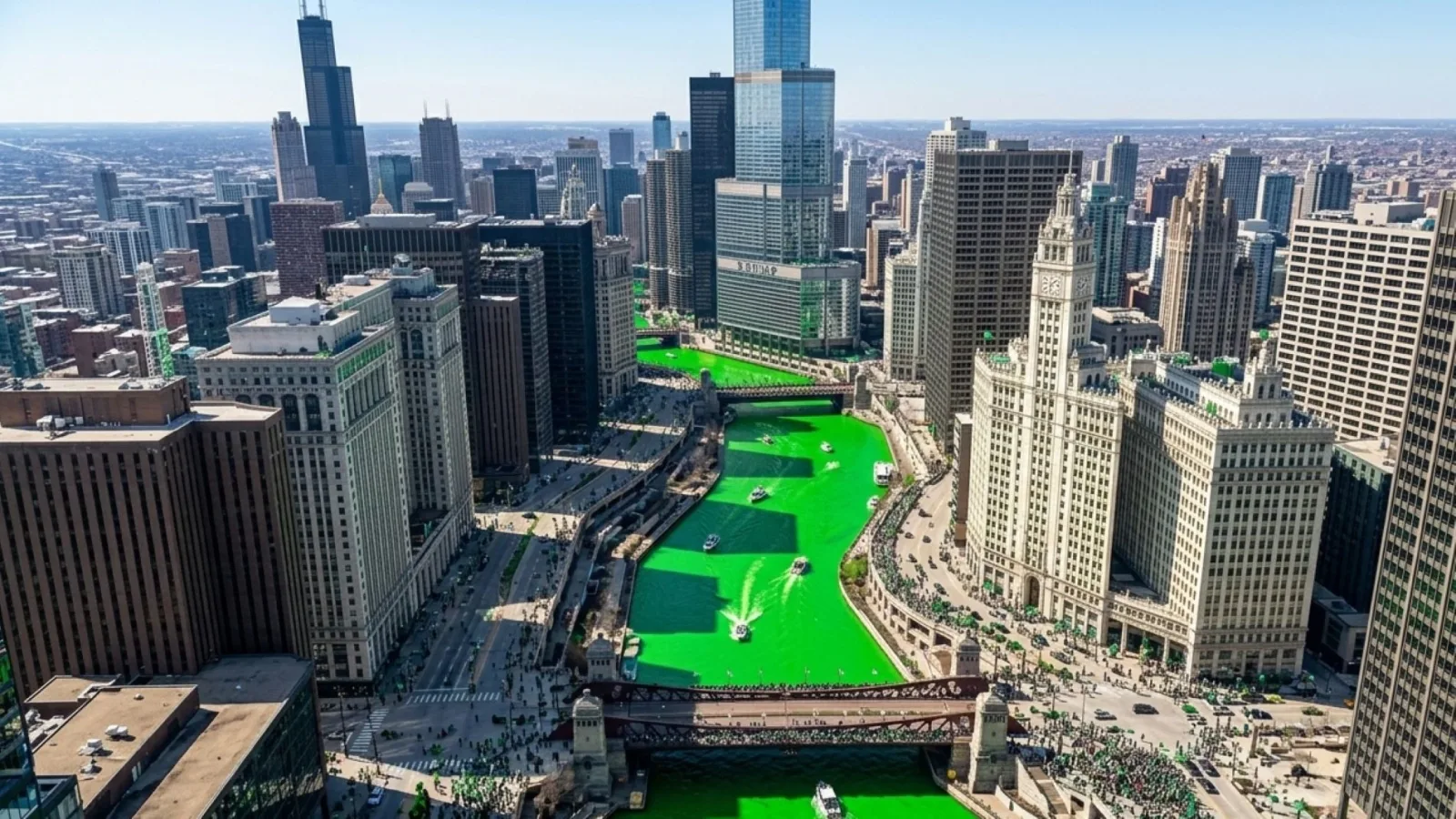
Every year since 1962, the city of Chicago transforms its central waterway into a brilliant emerald ribbon to mark the holiday. The tradition began by accident when local plumbers used vegetable-based fluorescein dye to trace illegal sewage discharges into the river. Recognizing how vibrant the water turned, union organizers realized the dye could create a dramatic spectacle for the annual St. Patrick's Day parade. Today, the Chicago Journeymen Plumbers Local 130 uses forty pounds of an environmentally secret, orange powder that turns bright green upon contacting water. The spectacular transformation lasts for several hours and draws hundreds of thousands of spectators to the riverbanks every spring.
7. The Shamrock Was Used as an Educational Metaphor
The three-leafed clover, or shamrock, stands as one of the most recognizable emblems of Irish culture and St. Patrick's legacy. Legend holds that the saint used the native plant as a practical visual aid when explaining the complex Christian doctrine of the Holy Trinity. He demonstrated how three distinct leaves could grow from a single stem, illustrating how the Father, Son, and Holy Spirit exist as one God. While the shamrock is widely loved, the harp—not the clover—remains the official emblem of the Republic of Ireland. Nevertheless, wearing a freshly plucked shamrock on one's lapel remains a beloved custom during holiday mass services across Ireland.
8. Corned Beef and Cabbage Is an Irish-American Invention
Millions of revelers sit down to a dinner of corned beef and cabbage on March 17th, believing it to be a traditional Irish feast. In reality, historic Irish diets primarily featured salt pork, bacon, potatoes, and cabbage because beef was far too expensive for ordinary working families. When impoverished Irish immigrants arrived in New York City in the nineteenth century, they settled alongside Jewish communities on the Lower East Side. Finding salted brisket at kosher butchers to be affordable and remarkably similar to cured pork, they adopted it as their staple meat. The combination of Jewish corned beef with boiled cabbage quickly became an iconic symbol of Irish-American heritage.
9. Global Consumption of Guinness Skyrockets on March 17th
For the world's most famous Irish brewery, St. Patrick's Day represents the busiest drinking day of the entire year. On an average day, consumers around the globe drink approximately 5.5 million pints of Guinness stout. That figure more than doubles on March 17th, soaring to an astounding 13 million pints worldwide. Achieving the perfect pour for a pint of the dark, nitrogenated beer requires a specific two-stage technique that takes precisely 119.5 seconds. From Dublin to Tokyo, pub-goers celebrate by enjoying the creamy, dark brew served at its ideal temperature.
10. Rebellious History Turned Green into a Symbol of Defiance
The shift from blue to green as Ireland's dominant national color was deeply rooted in eighteenth-century political rebellion. When British authorities formed the Order of St. Patrick in 1783, they selected blue to represent loyalty to the British Crown. In response, the Society of United Irishmen adopted green during the 1798 uprising as an explicit symbol of political independence and Irish identity. Rebels wore green ribbons, uniforms, and shamrocks on their hats, giving rise to the famous folk ballad "The Wearing of the Green." This powerful anti-colonial symbolism permanently tied the color green to the nation's struggle for self-determination.
11. Astronauts Have Celebrated St. Patrick's Day in Earth Orbit
The festive spirit of St. Patrick's Day has transcended planetary boundaries and reached low Earth orbit aboard the International Space Station. In 2011, American astronaut Cady Coleman played a 100-year-old flute belonging to the Irish group The Chieftains while floating in zero gravity. Two years later, Canadian astronaut Chris Hadfield donned a green sweater and recorded himself singing classic Irish songs high above Earth. Hadfield also captured stunning photographs of Ireland from the space station windows, posting them online with festive holiday greetings. These orbital celebrations demonstrate how global and far-reaching the cultural holiday has truly become in the modern era.
12. March 17th Marks the Saint's Death, Not His Birth
Unlike many secular holidays that celebrate a historic figure's birthday, St. Patrick's Day honors the date of the patron saint's death. Religious tradition holds that Patrick passed away on March 17th in the year 461 at Saul, Downpatrick, in Northern Ireland. In Christian liturgy, the date of a saint's death is considered their heavenly birthday, marking their passage into eternal life. Because his exact birth date was never recorded in historical manuscripts, early church scholars focused solely on commemorating his passing. Downpatrick Cathedral remains a popular pilgrimage site where visitors pay homage at what is believed to be his final burial place.
13. The Pinching Tradition Originated as an American Myth
If you forget to wear green on March 17th, you might end up getting pinched by enthusiastic friends, but this custom is entirely American. The quirky practice stems from early American folklore surrounding leprechauns, the mischievous solitary fairies of Irish legend. Popular myth claimed that wearing green rendered a person completely invisible to these magical, pinching creatures. People began pinching anyone not wearing green as a playful reminder that invisible leprechauns would otherwise do the same. While the tradition caught on quickly across North America, it remains largely unknown to people born and raised in Ireland.
14. Saint Patrick Was Born with a Completely Different Name
The world's most famous Irish saint was not named Patrick at birth by his Roman-British parents. Historical texts indicate that he was originally given the Celtic name Maewyn Succat upon his birth in late fourth-century Britain. It was only after he escaped Irish captivity and entered the priesthood that he assumed the Latin name Patricius. The name Patricius translates roughly to "father of the people" or "nobleman," reflecting his elevated religious duties. When translated into the Irish language, Patricius evolved into Pádraig, which eventually became Anglicized as Patrick.
15. New York City Hosts the World's Largest St. Patrick's Day Parade
While Dublin hosts a world-class multi-day festival, the largest St. Patrick's Day parade on the planet takes place in New York City. The NYC parade was first held on March 17, 1762, by Irish soldiers serving in the British military stationed in the American colonies. Today, the massive procession marches up Fifth Avenue, featuring over 150,000 active participants including marching bands, bagpipers, and civic groups. The parade draws an estimated two million spectators along the route each year and relies entirely on volunteers without corporate sponsors. It stands as both the oldest and largest civilian parade in the world, celebrating centuries of Irish culture and heritage.
Sources & References
This AI-assisted post was rigorously curated and fact-checked for accuracy by:
 Martin Roháček
How fun was this article? 🤔
Tap a star to rate it
🧠 Quiz: How closely were you paying attention?
10 questions — all answers are in the article above!
Enjoyed these facts? There's more! 💌
Fresh fun facts in your inbox. No spam, ever.