The Historic Rivalry: 15 Fascinating Facts About the Oxford and Cambridge Boat Race
First contested in 1829, the Oxford and Cambridge Boat Race stands as one of the world's oldest and most intense collegiate sporting rivalries. Every spring, over a quarter of a million spectators crowd the banks of the River Thames to watch student-athletes battle across four miles of unforgiving, choppy water. From sinking boats and rogue protest swimmers to Hollywood stars and legendary judging blunders, this iconic regatta is packed with extraordinary history. Discover the surprising secrets, bizarre scandals, and deep traditions behind Britain's ultimate rowing showdown.
1. The Rivalry Was Sparked by Two Harrow Schoolmates in 1829
Charles Merivale of Cambridge and Charles Wordsworth of Oxford had been close friends while attending Harrow School together. In 1829, Wordsworth challenged Merivale to a rowing contest on the River Thames at Henley, establishing what would become one of the world's oldest sporting rivalries. Merivale accepted, and Oxford won the inaugural match comfortably in front of twenty thousand spectators. What began as an informal challenge between two academic chums rapidly transformed into an annual national spectacle. Today, the historic event stands as a cornerstone of British athletic tradition, drawing elite student-athletes from around the globe.
2. The Iconic Blue Shades Have Sacred Collegiate Roots
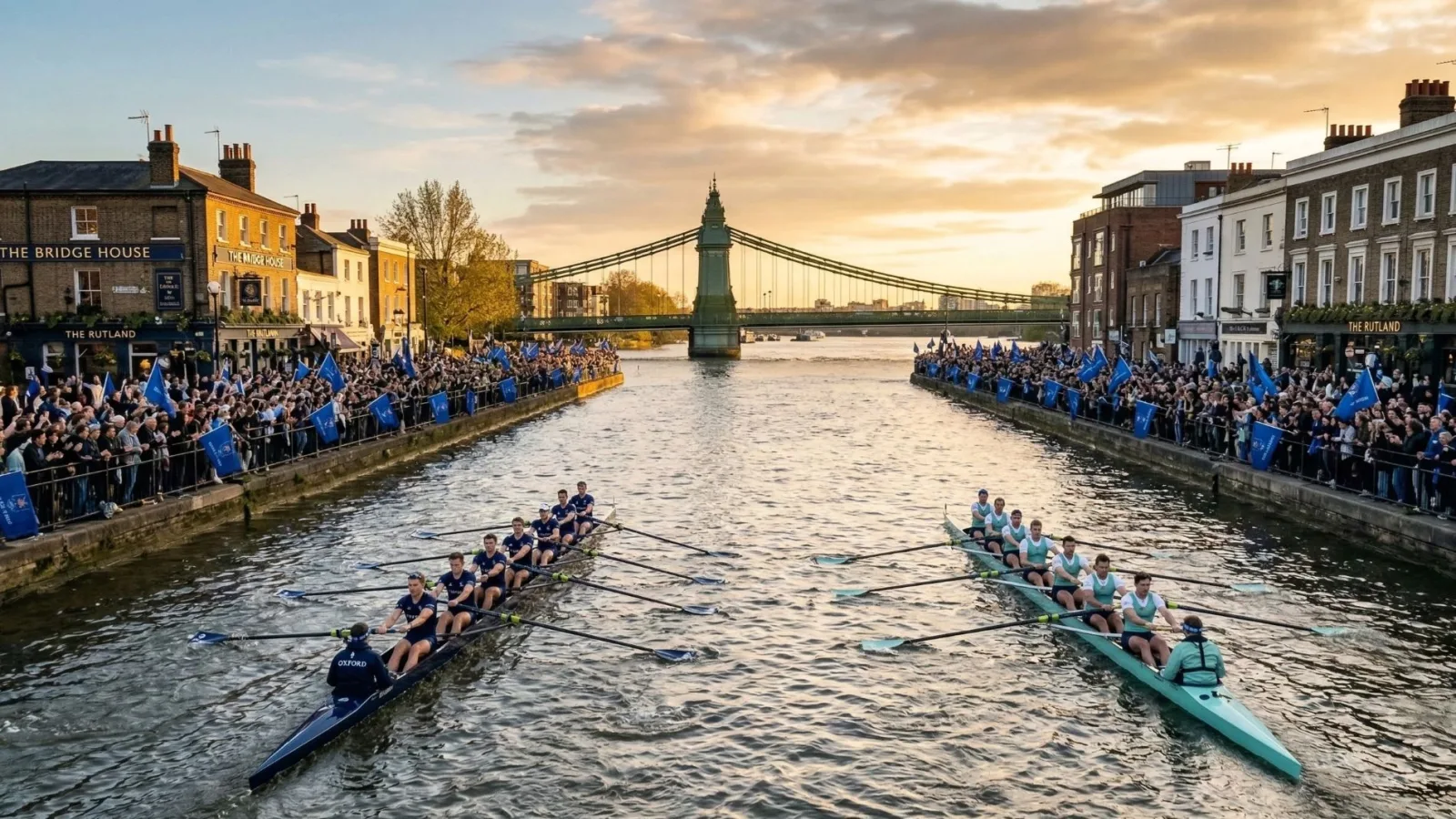
Spectators easily distinguish the two crews by their signature attire, with Oxford wearing dark blue and Cambridge clad in light blue. During the inaugural 1829 race, Oxford chose dark blue because five members of their eight-man crew attended Christ Church College, whose official color was dark blue. Cambridge initially rowed in pink sashes during that first contest, only adopting their famous light blue hue for the second race in 1836. Legend holds that a Cambridge rower attached a light blue ribbon from Eton College to the bow of their boat for good luck. The contrasting shades of blue have remained unbroken symbols of institutional pride for nearly two centuries.
3. The Championship Course Is Twice as Long as an Olympic Race
Unlike standard modern rowing events that cover a straight two-kilometer distance, the Boat Race takes place over a grueling four-and-a-quarter-mile stretch. Known as the Championship Course, this demanding route runs along the tidal River Thames from Putney to Mortlake in West London. Rowers must complete more than six point eight kilometers of intense physical exertion while navigating unpredictable currents and sharp river bends. The extreme endurance required means that competitors often burn over six hundred calories during the twenty-minute ordeal. Winning requires not just raw muscular strength, but immense strategic stamina to endure the grueling length.
4. A Sovereign Coin Toss Dictates Crucial River Navigation
Before the race begins, the umpires hold an official coin toss using an original 1829 gold sovereign coin to decide station placement. The winning captain gets to choose between the Middlesex bank on the north side or the Surrey bank on the south side. This choice carries enormous tactical weight because the Championship Course features major bends that favor different sides at distinct points. The Surrey side offers a significant advantage along the long middle bend near Hammersmith, whereas Middlesex provides an early lead around Fulham. A clever coxswain can use their chosen station to force their opponents into disadvantageous water.
5. Unforgiving Thames Waves Have Sunk Boats Multiple Times
The tidal nature of the Thames makes it susceptible to heavy wind, churning water, and sudden swells that can easily swamp low-slung rowing shells. Throughout the history of the event, there have been six official sinkings during official race conditions. The most infamous incident occurred during the stormy 1912 race when both the Oxford and Cambridge boats filled with water and sank completely. The race umpire was forced to declare the contest void and re-stage the entire match the following Monday. Another memorable sinking happened in 1978 when Cambridge swamped near Barnes Bridge, leaving Oxford to row on to victory alone.
6. A Near-Blind Octogenarian Judge Sparked the Infamous 1877 Tie
The 1877 race produced the only official dead heat in the history of the event, but the outcome was shrouded in intense controversy. The official finish judge, a former waterman named John Phelps, reportedly announced that the boats crossed the line dead level, adding the absurd detail that they were separated "by a distance." Rumors quickly spread that Phelps was over seventy years old, blind in one eye, and had allegedly fallen asleep under a tree near the finish line. Spectators and journalists were outraged by the chaotic decision, which left both university crews deeply unsatisfied. The public backlash was so severe that officials immediately introduced permanent wooden finish posts to prevent future judging disputes.
7. Women Were Originally Judged on Aesthetic Grace Rather Than Speed
When the Women's Boat Race was first established in 1927, society viewed head-to-head competitive rowing as unladylike and physically dangerous for women. As a result, the female crews were forbidden from racing side-by-side along the river. Instead, Oxford and Cambridge rowed the course separately on alternate days, with judges scoring them on technical style and visual elegance alongside their raw time. The women were required to wear restrictive heavy skirts, and their events received minimal attention or financial support from the universities. It took decades of persistent activism for the women to shed these patronizing restrictions and gain equal athletic status.
8. True Equality Was Finalized with Mirrored Races in 2015
For almost ninety years, the Women's Boat Race was relegated to a smaller, quieter course upstream at Henley-on-Thames. That historical disparity finally ended in 2015 when the women's event was given equal standing alongside the men's race. Female rowers moved to the full four-and-a-quarter-mile Championship Course on the Thames, competing on the very same day and under identical broadcast coverage. The historic shift brought massive global media attention and equal funding to female student-athletes. Today, millions of viewers tune in to watch both the men's and women's eights battle on equal footing across the famous West London waters.
9. The 1987 Oxford Mutiny Inspired a Hollywood Film
In 1987, the Oxford boat club experienced a dramatic internal revolt led by a group of top-tier American oarsmen. The elite international recruits rebelled against head coach Dan Topolski over his grueling land-training regimen and controversial crew selection choices. When the coach refused to yield to their demands, five American athletes staged a full-scale walkout just weeks before race day. Forced to field a cobbled-together crew of reserve rowers, Topolski managed to coach the underdogs to a miraculous victory against Cambridge in heavy rain. The sensational crisis made international headlines and was later immortalized in the book and feature film True Blue.
10. Hollywood Star Hugh Laurie Was Once an Elite Cambridge Rower
Long before achieving global stardom as television's Dr. Gregory House, actor Hugh Laurie was an elite rower at Cambridge University. In 1980, Laurie sat in the bow seat for the Cambridge crew during a fiercely contested Boat Race that they ultimately lost by a mere five feet. Rowing ran deep in Laurie's family, as his father, Ran Laurie, won an Olympic gold medal in the coxless pairs at the 1948 London Games after rowing for Cambridge himself. Hugh trained up to eight hours a day while studying archaeology and anthropology at Selwyn College. Though his acting career eventually took center stage, Laurie frequently credits his time on the water for teaching him lifelong discipline.
11. A Rogue Protest Swimmer Halted the 2012 Contest
The 2012 race suffered one of the most shocking disruptions in sporting history when a lone protester swam directly into the path of the speeding boats. Demonstrator Trenton Oldfield swam out into the middle of the river to protest against perceived elitism in British society. Race umpire Sir Matthew Pinsent was forced to halt the contest immediately to avoid the dangerous possibility of an oar striking the swimmer's head. After a tense thirty-minute delay, the crews were restarted, but Oxford broke an oar blade shortly after in a collision with Cambridge. The chaotic event ended with a Cambridge victory, while Oldfield was arrested and subsequently sentenced to six months in prison.
12. Extra Muscle Mass Holds a Proven Statistical Edge
In high-level rowing, physical leverage and mass can provide a decisive mechanical advantage over long, punishing distances. Statistically, the heavier crew wins the men's Boat Race more than sixty percent of the time. Because weight plays such a vital role in boat speed, the official pre-race weigh-in is a heavily publicized event conducted weeks before the race. Journalists and analysts scrutinize every kilogram, comparing the total crew weights to predict which boat will power through the choppy Thames water. Conversely, coxswains must remain as light as possible, adhering to a strict minimum weight limit of fifty-five kilograms.
13. Global Crises Are the Only Force Capable of Halting the Tradition
Since becoming an annual fixture in 1856, the Boat Race has proven remarkably resilient against political and social upheaval. The event has only ever been officially cancelled during major global crises that made hosting impossible. The First World War and Second World War caused long hiatuses, though unofficial wartime races were occasionally held outside London. In 2020, the event was cancelled due to the global COVID-19 pandemic, marking the first time in seventy-five years it failed to run. The following year, the race moved temporarily to the River Great Ouse in Ely without spectators before returning to its London home.
14. Umpires Are Strictly Selected from Veteran "Old Blues"
To ensure absolute fairness and expert understanding of the river's complex rules, the race is officiated exclusively by former competitors. Known as "Old Blues," these umpires are alumni who previously earned their university sporting colors by rowing in the main race. The role alternates every single year between an Oxford alumnus and a Cambridge alumnus to maintain structural neutrality. Navigating launch boats right alongside the racing shells, the umpire must make split-second decisions on steering warnings and equipment clashes. Their unique insider perspective allows them to manage heated rivalries with authoritative calm.
15. The Winning Coxswain Is Traditionally Thrown into the Thames
Immediately after crossing the finish line at Mortlake, the exhausted winning crew celebrates with an unusual and wet tradition. The rowers join forces to hurl their coxswain headfirst into the chilly, murky waters of the River Thames. As the smallest member of the team who directs steering and calls tactical moves without pulling an oar, the coxswain receives this ceremonial dunking as a badge of victory. Despite the muddy water and health warnings regarding Thames pollution in recent years, the ritual remains a beloved post-race highlight for television cameras. Afterwards, the team unites to lift the famous trophy while their drenched coxswain dries off.
Sources & References
This AI-assisted post was rigorously curated and fact-checked for accuracy by:
 Martin Roháček
How fun was this article? 🤔
Tap a star to rate it
🧠 Quiz: How closely were you paying attention?
10 questions — all answers are in the article above!
Enjoyed these facts? There's more! 💌
Fresh fun facts in your inbox. No spam, ever.