1. The Architects of Total Football
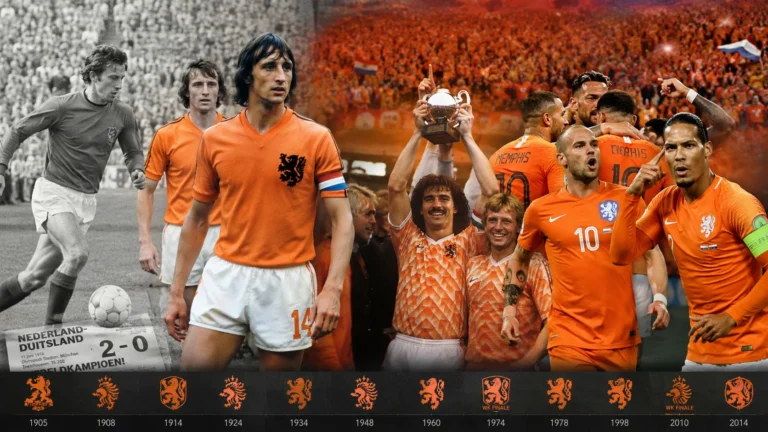
In the 1970s, the Dutch national team completely revolutionized the entire global sport by introducing a brilliant tactical theory known as Total Football. Pioneered by legendary coach Rinus Michels and executed perfectly by captain Johan Cruyff, this system required every single outfield player to be highly adaptable. If a defender moved forward to attack, an attacker would instantly drop back to cover the empty defensive space. This highly fluid, completely interchangeable system deeply terrified and completely dismantled rigid opposing defenses.
2. The Royal Obsession with Orange
While the official flag of the Netherlands consists of horizontal red, white, and blue stripes, the national soccer team completely ignores these colors. They are globally recognized for wearing incredibly bright, vibrant orange kits, earning them the famous nickname Oranje. This massive aesthetic choice is a direct historical tribute to the royal family of the nation, the House of Orange-Nassau, which has served as a unifying political and cultural symbol for the Dutch people for centuries.
3. The Greatest Team to Never Win a World Cup
The Dutch team holds an incredibly frustrating and deeply tragic global record. They are universally considered by sports historians to be the absolute greatest national team to have never won a FIFA World Cup. Despite reaching the grand final match a staggering three separate times in their history, in 1974, 1978, and 2010, they suffered devastating, heartbreaking defeats in every single appearance, cementing their legacy as the ultimate runners-up of international soccer.
4. The Invention of the Cruyff Turn
During the 1974 World Cup, Dutch legend Johan Cruyff executed a completely unprecedented, highly deceptive dribbling move against a deeply confused Swedish defender. Feigning a massive forward pass, Cruyff brilliantly dragged the ball entirely behind his own standing leg and instantly accelerated in the complete opposite direction. This single, beautifully fluid motion was heavily broadcast around the globe and is now permanently taught in every soccer academy on the planet as the Cruyff Turn.
5. The Rebel With Two Stripes
Johan Cruyff was not just a tactical genius; he was a highly stubborn businessman. During the 1974 World Cup, the official Dutch national team jersey was manufactured by Adidas, heavily featuring their iconic three stripes down the sleeves. Cruyff, however, had a massive, highly lucrative personal sponsorship deal with their absolute biggest rival, Puma. He completely refused to wear the three stripes, successfully forcing the national federation to specially design a unique, custom jersey for him that featured only two stripes.
6. The Surinamese Connection
A massive portion of the overwhelming success enjoyed by the Dutch national team is deeply owed to the historical integration of highly talented players with roots in Suriname, a former Dutch colony in South America. In the 1980s and 1990s, legendary global superstars like Ruud Gullit, Frank Rijkaard, Clarence Seedorf, and Edgar Davids brought an entirely new level of explosive athleticism and technical brilliance to the squad, completely dominating European football.
7. Their Only Major Trophy is Euro 1988
Despite completely dominating the tactical landscape of global soccer for decades, the Netherlands only has a single piece of major international silverware resting in their trophy cabinet. They finally conquered their massive tournament curse by winning the 1988 UEFA European Championship hosted in West Germany. This legendary squad completely dominated the tournament, successfully proving that their beautiful, attacking style of play could actually result in a major championship.
8. Marco van Bastens Impossible Volley
The 1988 European Championship final against the Soviet Union provided the world with arguably the greatest goal ever scored in the history of international tournaments. Dutch striker Marco van Basten received a massive, highly lofted cross that appeared to be completely sailing out of bounds. Standing at a mathematically impossible, incredibly tight angle, he violently smashed a first-time volley directly over the goalkeeper and into the back of the net, instantly securing global footballing immortality.
9. Edgar Davids and His Iconic Goggles
Midfielder Edgar Davids was heavily known as the Pitbull due to his highly aggressive, deeply tenacious tackling abilities. However, he is most visually remembered for being the only elite player to permanently wear highly tinted, wraparound protective glasses during massive international matches. He suffered from glaucoma, which required him to completely protect his sensitive eyes from harsh stadium lights and physical impacts, inadvertently turning him into a massive, instantly recognizable global fashion icon.
10. The Flying Dutchman Header
During the opening match of the 2014 World Cup, the Netherlands faced off against the defending champions, Spain. In a completely breathtaking moment of athletic brilliance, Dutch striker Robin van Persie sprinted onto a massive, long-distance pass. Instead of bringing the ball down with his feet, he completely launched his entire body horizontally through the air, heading the ball perfectly over the stranded Spanish goalkeeper. The cinematic goal instantly went viral and earned him the eternal nickname The Flying Dutchman.
11. The Penalty Goalkeeper Substitution
Dutch coach Louis van Gaal executed one of the most brilliant, highly arrogant tactical moves in World Cup history during the 2014 quarter-finals against Costa Rica. With the highly tense match ending in a draw and heading directly to a penalty shootout, van Gaal used his absolute final substitution to remove his starting goalkeeper in the 120th minute. He brought on backup keeper Tim Krul entirely because Krul was statistically better at saving penalties. The massive gamble worked perfectly, and Krul saved two shots to win the match.
12. Wesley Sneijder Holds the Cap Record
Earning a single cap, which represents an official appearance for a national team, is the ultimate dream of any professional player. Elite midfield playmaker Wesley Sneijder holds the absolute, undisputed record for the most appearances in the history of the Dutch national team. Over a massive fifteen-year international career spanning from 2003 to 2018, Sneijder represented his country an astonishing 134 times, completely surpassing legendary goalkeeper Edwin van der Sar.
13. A Devastating Missing Era
Following a highly successful third-place finish at the 2014 World Cup, the Dutch team fell into a sudden, historically disastrous massive slump. A highly chaotic string of terrible management decisions and an aging roster resulted in the Netherlands completely failing to qualify for both the 2016 European Championship and the 2018 World Cup. This massive absence from the global stage deeply shocked the footballing world and forced the entire Dutch federation to completely rebuild their youth academies.
14. The Fierce German Rivalry
The absolute most intense, deeply passionate rivalry in Dutch football is entirely directed at their immediate neighbors, Germany. Stemming from deep historical and political tensions following World War II, the rivalry perfectly spilled over onto the soccer pitch. The pinnacle of this massive feud occurred during the highly contentious 1974 World Cup final, where West Germany deeply broke Dutch hearts. Whenever these two massive footballing nations play each other today, it is universally considered one of the fiercest spectacles in global sports.
15. The Symbol of the Lion
Alongside the iconic orange jerseys, the crest worn directly over the hearts of the Dutch players features a massive, highly stylized lion. This regal symbol is heavily derived from the historic coat of arms of the Dutch Republic. In recent years, the national federation made a brilliant, highly celebrated update to the crest for the highly successful Netherlands womens national team, officially replacing the traditional male lion with a fierce, roaring lioness to perfectly represent their distinct achievements.