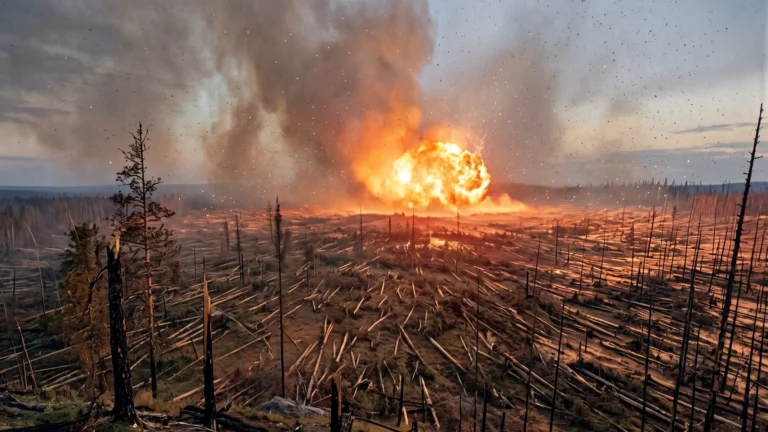
1. The Explosion Was 1,000 Times More Powerful Than the Hiroshima Bomb
The sheer energetic output of the Tunguska Event is almost impossible for the human mind to fully comprehend. Scientists estimate the blast yielded between 10 and 15 megatons of energy, making it roughly 1,000 times more powerful than the atomic bomb dropped on Hiroshima. This unprecedented release of destructive kinetic force instantly flash-fried the environment, acting as a terrifying reminder of our planet’s vulnerability to cosmic impacts.
2. Over 2,150 Square Kilometers of Forest Were Instantly Flattened
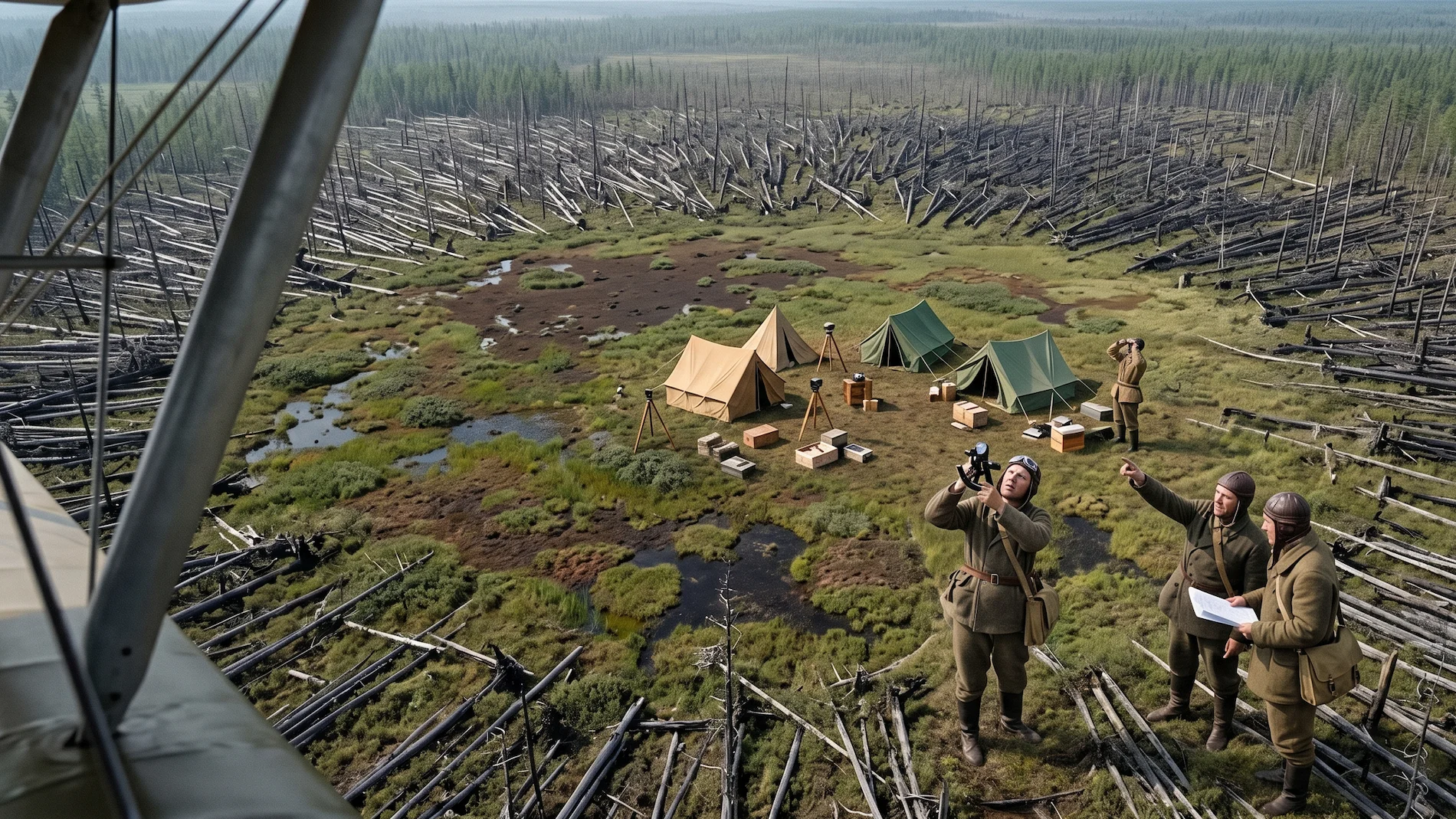
The physical aftermath of the explosion resulted in one of the largest ecological devastation zones ever recorded in modern history. The massive atmospheric shockwave violently flattened an estimated 80 million trees across more than 2,150 square kilometers of dense Siberian taiga. Aerial photographs taken decades later revealed that the stripped, dead trees were blown entirely flat in a radial pattern, pointing perfectly away from the explosion’s geographic epicenter.
3. Initial Researchers Were Baffled by a Total Lack of an Impact Crater
When scientists finally managed to reach the desolate epicenter, they expected to find a massive, gaping crater consistent with a colossal meteorite strike. Instead, they were entirely baffled to discover absolutely zero trace of an impact crater or any large meteoritic fragments at ground zero. The dead, charred trees standing perfectly upright directly beneath the blast site only deepened the mystery, leaving early researchers scrambling for a logical geological explanation.
4. The Blast Was Likely Caused by a Cosmic Airburst
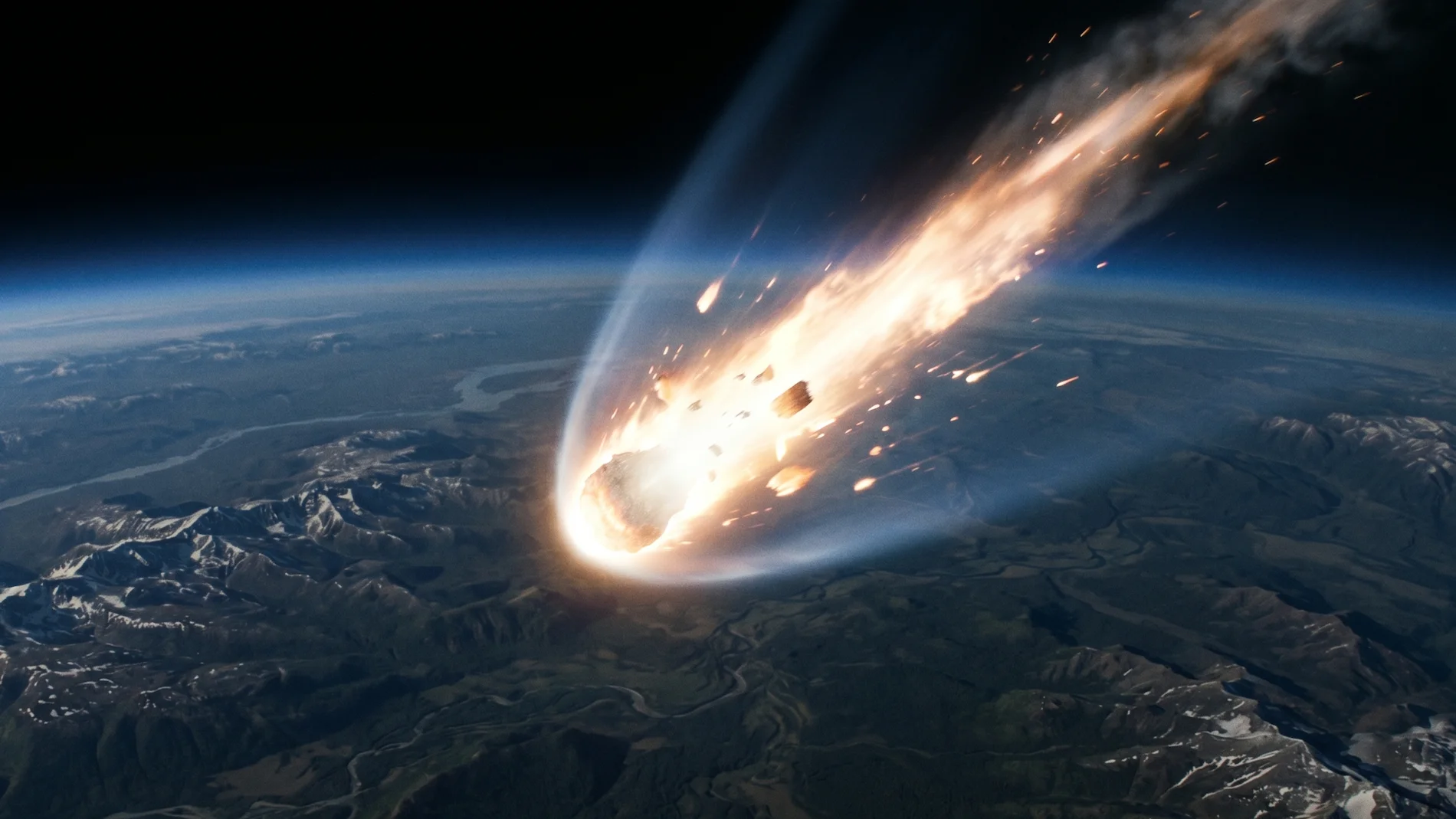
Modern astronomers and physicists have largely solved the mystery of the missing crater through the scientific theory of a cosmic airburst. It is now widely accepted that a small asteroid or comet, roughly 160 to 200 feet across, entered Earth’s atmosphere at a staggering 33,500 miles per hour. The immense aerodynamic pressure and intense friction caused the icy or rocky body to violently detonate miles above the surface, unleashing its destructive energy without ever touching the ground.
5. Indigenous Evenki People Provided Terrifying Eyewitness Testimonies
The remote region was primarily inhabited by the indigenous Evenki people, nomadic reindeer herders who provided some of the most chilling and valuable eyewitness accounts of the disaster. They described seeing a “second sun” tearing across the morning sky, followed by deafening thunderclaps and a wave of intense heat that knocked people off their feet miles away. Tragically, the blast instantly incinerated hundreds of their reindeer and destroyed numerous Evenki encampments, leading many to believe a vengeful fire god had descended to Earth.
6. The Area Remains Remote and Challenging for Scientific Expeditions
Even today, the Tunguska epicenter is located deep within the Krasnoyarsk Krai region, a notoriously unforgiving and isolated expanse of central Siberia. The incredibly harsh terrain consists of dense, mosquito-infested taiga, treacherous bogs, and freezing temperatures that make logistical planning an absolute nightmare. This extreme remoteness is the primary reason scientific expeditions remain highly challenging, heavily limiting the amount of continuous modern research that can be physically conducted on-site.
7. The First Expedition Was Delayed for 19 Years
Because the explosion occurred in such an isolated location during a turbulent period in Russian history, it took nearly two decades for scientists to formally investigate. The outbreak of World War I, followed by the bloody Russian Revolution and the ensuing civil war, completely halted any scientific curiosity about the distant blast. It wasn’t until 1927 that Russian mineralogist Leonid Kulik finally led the very first official expedition to navigate the harsh Siberian wilderness and meticulously document the flattened forest.
8. Atmospheric Pressure Waves Circled the Globe Twice
The concussive force of the high-altitude detonation was so immensely powerful that it literally sent shockwaves rippling across the entire planet’s atmosphere. Barometric instruments located as far away as Washington D.C. and London recorded massive spikes in atmospheric pressure shortly after the explosion. Incredibly, scientists determined that these invisible, high-energy acoustic waves possessed enough kinetic momentum to travel entirely around the Earth not just once, but twice before completely dissipating.
9. Night Skies Glowed Across Europe and Asia for Days
Following the terrifying blast, people living thousands of miles away in Europe and western Asia experienced a deeply unsettling celestial phenomenon. The high-altitude explosion injected millions of tons of pulverized ice, dust, and atmospheric gases directly into the upper stratosphere. This reflective debris effectively caught the sun’s rays over the horizon, creating glowing night skies so brilliantly illuminated that people in London and Paris could reportedly read newspapers outdoors at midnight for several consecutive days.

10. The Heat Could Be Felt More Than 40 Miles Away
Although the cosmic body never physically struck the ground, the blinding thermal radiation it released was horrifyingly intense. Witnesses located at the Vanavara trading post, over 40 miles away from the epicenter, reported feeling as if their shirts had suddenly caught on fire. The blistering wave of heat was strong enough to cause severe flash burns and shatter glass windows across massive distances, perfectly illustrating the terrifying reach of a megaton-level airburst.
11. Microscopic Diamonds Were Found in Tree Resin
While large meteorites were never discovered, modern scientists have found subtle, microscopic evidence of a cosmic visitor trapped within the Siberian ecosystem. Chemical analyses of tree resin extracted from the blast zone revealed tiny traces of meteoric dust, high levels of iridium, and microscopic diamonds called lonsdaleite. These rare nanodiamonds only form under the incredibly extreme pressures and temperatures associated with violent cosmic impacts, proving that an extraterrestrial object was indeed pulverized in the sky above.
12. Seismic Vibrations Were Registered in the United Kingdom
The Tunguska Event was not merely an atmospheric spectacle; it aggressively shook the very bedrock of the Earth. The massive transfer of kinetic energy from the airburst slammed into the Siberian crust, generating powerful seismic waves that perfectly mimicked a devastating natural earthquake. Seismographs as far away as the United Kingdom and continental Europe easily detected the tremors, cementing the sheer scale of the geological disruption caused by the exploding bolide.
13. A Mysterious Lake May Actually Be an Impact Crater
While the consensus points to an airburst with no primary crater, a controversial theory suggests that nearby Lake Cheko might be a physical remnant of the event. A team of Italian geologists proposed that a large, dense fragment of the asteroid survived the high-altitude explosion and smashed into the earth to form the unusually deep, conical lake. However, Russian scientists strongly dispute this hypothesis, arguing that sediment core samples from the lakebed prove the body of water is actually thousands of years older than the 1908 blast.
14. The Blast Pattern Resembled a Giant Butterfly
When Kulik and subsequent researchers painstakingly mapped the colossal zone of flattened trees, they noticed the destruction was not perfectly circular. The devastating atmospheric shockwave actually radiated outward in a highly distinct, symmetrical butterfly shape. This unique geometric footprint helped modern physicists mathematically calculate the precise trajectory, speed, and 45-degree angle of descent of the cosmic body before it violently self-destructed in the atmosphere.
15. It Remains the Largest Impact Event in Recorded History
Despite the terrifying barrage of comets and asteroids that bombarded our planet millions of years ago, Tunguska holds a special place in modern science. It officially stands as the absolute largest impact event on Earth within recorded human history. This unique status forces astronomers and planetary defense experts to rigorously study the 1908 disaster, using it as the ultimate baseline for understanding the catastrophic threat posed by near-Earth objects.
Sources and References
- NASA (History Division): https://www.nasa.gov/history/115-years-ago-the-tunguska-asteroid-impact-event/
- NASA (Earth Observatory Science): https://science.nasa.gov/earth/earth-observatory/a-cosmic-explosion-over-siberia-154488/
- National Geographic: https://www.nationalgeographic.com/science/article/little-asteroid-big-fireball