The Radiant Citadel: 15 Fascinating Facts About Amber Fort
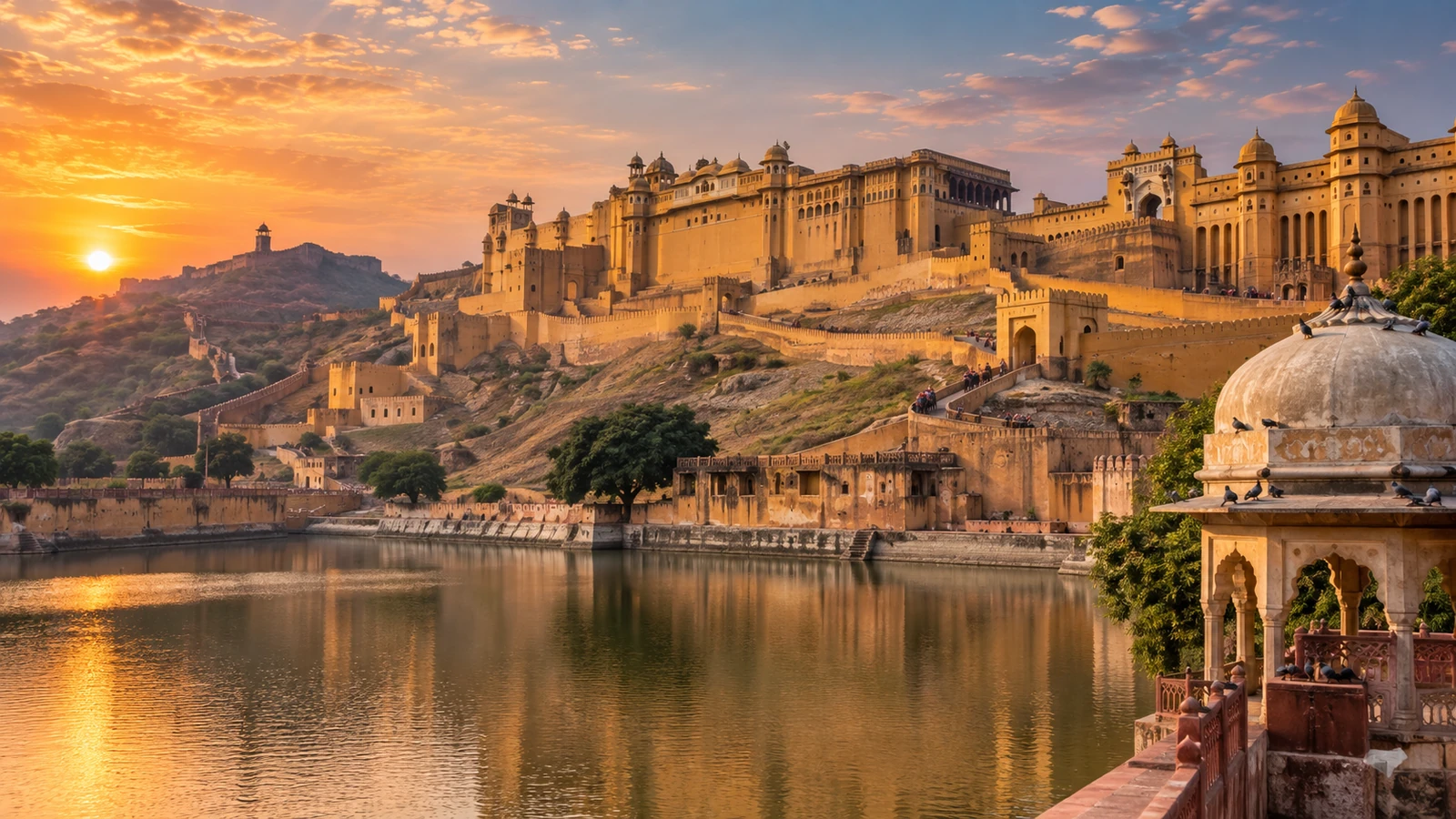
Perched high atop the Aravalli hills overlooking Maota Lake, Amber Fort is one of India's most spectacular royal strongholds. Built in the late 16th century by Raja Man Singh I, this magnificent palace complex served as the capital of the Kachhwaha Rajputs before Jaipur was founded. From mirror-laden palaces and subterranean escape tunnels to ancient eco-friendly cooling systems, Amber Fort blends defensive martial engineering with breathtaking artistic luxury. Discover the compelling history and secret wonders behind Rajasthan's most iconic UNESCO World Heritage site.
1. The Founding Citadel of the Kachhwahas
Long before Jaipur was envisioned as Rajasthan's "Pink City," the ancient town of Amer served as the bustling seat of the Kachhwaha Rajputs. Raja Man Singh I began constructing the impressive Amber Fort in 1592 atop the rugged Cheel ka Teela (Hill of Eagles). Built over the remains of an earlier 11th-century structure, the fortress served as both a formidable defensive stronghold and a lavish royal residence. It remained the official power center of the kingdom until Maharaja Sawai Jai Singh II founded Jaipur in 1727 and moved his court down to the plains. Today, Amber Fort stands as a testament to centuries of royal Rajput governance, strategy, and architectural grandeur.
2. The Glittering Illusion of the Sheesh Mahal
The Sheesh Mahal, or Mirror Palace, is arguably the most famous hall inside the Amber Fort complex. Built under the direction of Maharaja Jai Singh I in the 17th century, its walls and vaulted ceilings are embedded with thousands of tiny, convex glass mirrors imported from Belgium and glassmakers in South Asia. In ancient times, when night fell, the royal ladies would light just a single candle or oil lamp, creating a mesmerizing effect that mimicked a night sky full of twinkling stars. The clever placement of the concave mirrors also helped radiate warmth inside the chamber during cold winter nights. This remarkable architectural feat combined exquisite artistic luxury with practical winter heating for the royal family.
3. A Subterranean Escape Tunnel to Jaigarh Fort
Hidden beneath the cobblestones and passageways of Amber Fort lies an extraordinary subterranean tunnel connecting it directly to Jaigarh Fort. Stretching roughly two kilometers through the rugged Aravalli hills, this fortified secret tunnel served as a secure evacuation route for the royal family during times of siege. Beyond serving as an escape passage, the tunnel allowed troops to move undetected between the residential palace and the heavily fortified military outpost above. Today, parts of this historic underground passage have been restored and reopened to the public, offering visitors a chilling glimpse into ancient defensive strategy.
4. The Harmonious Fusion of Rajput and Mughal Aesthetics
The architecture of Amber Fort represents one of the finest surviving examples of Indo-Islamic synthesis in India. Because Raja Man Singh I was a trusted general in the Mughal Emperor Akbar's military, he integrated distinct Mughal design elements into traditional Hindu Rajput architecture. Visitors can observe red sandstone and pure white marble structures adorned with Persian-style charbagh layouts alongside Hindu decorative motifs like lotus flowers and elephant trunks. The interior murals feature rich vegetable dyes depicting traditional floral patterns seamlessly blended with Islamic geometric grids. This harmonious architectural fusion reflected the deep diplomatic and political alliance between the Kachhwaha rulers and the Mughal Empire.
5. The Four Distinct Courtyards of Royal Life
Amber Fort is uniquely structured around four vast, contiguous courtyards, each designated for specific state functions and palace activities. The first courtyard, Jaleb Chowk, served as the military assembly area where victorious armies returning from battle displayed their plunder. The second courtyard houses the grand public audience hall, while the third contains the private royal apartments and peaceful landscaped gardens. The fourth and innermost courtyard was the zenana, or women's quarters, carefully designed so the king could visit any of his wives without the others knowing. Each courtyard is separated by monumental gateways, creating a layered journey from public power to private royalty.
6. The Mysterious Origins of the Sila Devi Temple
Nestled near the Ganesh Pol entry within the fort's primary courtyard stands the revered Sila Devi Temple, dedicated to the goddess Kali. According to local lore, Raja Man Singh I suffered a defeat against King Kedar of Bengal and prayed to Goddess Kali for victory. The goddess appeared in his dream, commanding him to retrieve her idol from the bed of the Sea of Jessore (present-day Bangladesh) and install it in his citadel. Man Singh successfully recovered a massive stone slab from the sea, had it carved into the idol of Sila Devi, and consecrated the temple in 1604. To this day, the temple remains an active place of worship, attracting thousands of pilgrims during the annual Navratri festival.
7. The Floating Saffron Garden of Maota Lake
At the base of Amber Fort lies Maota Lake, an essential water source that also features a stunning artificial island known as Kesar Kyari, or the Saffron Garden. Constructed in a star-shaped geometric pattern reminiscent of Persian paradise gardens, it was originally planted with exotic saffron plants brought from Kashmir. The royal family intended for the fragrance of blooming saffron to drift up the cliffside into the palace chambers above. Although Jaipur's warm climate proved difficult for long-term saffron cultivation, the island continues to be planted with vibrant seasonal flowers. Viewed from the high ramparts of the fort, Kesar Kyari appears to float effortlessly on the calm waters of the lake.
8. An Ingenious Ancient Cooling and Water Supply Network
Designing a palace atop an arid hill required revolutionary hydraulic engineering to supply water and keep interiors comfortable during scorching summer months. Builders constructed a multi-tiered water lifting system using bullock-driven pulleys and leather buckets to raise water hundreds of feet from Maota Lake into large storage tanks at the top of the fort. From these reservoirs, water flowed through concealed clay pipes and marble channels throughout the palace walls and floors. This continuous movement of water cooled the surrounding air, creating an early form of eco-friendly air conditioning throughout the private apartments. The system highlighted the advanced engineering capabilities of Rajput architects long before modern climate control existed.
9. The Iconic Ganesh Pol and Its Secret Royal Viewpoints
The Ganesh Pol is perhaps the most celebrated and intricately decorated gateway within the entire Amber Fort complex. Built between 1611 and 1667 by Mirza Raja Jai Singh, this majestic three-story portal serves as the grand entrance to the royal family's private court. Above the central arch sits a beautifully painted fresco of Lord Ganesha, crafted using natural vegetable and mineral pigments that remain vibrant to this day. The top floor of the gateway features delicate lattice work marble screens known as jharokhas, through which royal women could privately observe public court proceedings held in the courtyard below without being seen.
10. The Optical Illusion of the "Magic Flower" Marble Relief
Located inside the Sheesh Mahal courtyard carved into the base of a white marble pillar is a world-famous relief known as the "Magic Flower." At first glance, the intricate carving appears to be a simple arrangement of flowers and foliage. However, by strategically covering different parts of the carving with your hands, seven distinct images emerge: a fish tail, a lotus flower, a cobra, an elephant trunk, a lion's tail, a cob of corn, and a scorpion. This masterwork of optical illusion demonstrates the unbelievable technical skill and playful artistry of 17th-century Rajput sculptors. It remains one of the most photographed and beloved architectural details inside the fort.
11. The Natural Air Conditioning of Sukh Niwas
Directly opposite the Sheesh Mahal across a formal garden lies the Sukh Niwas, or the Hall of Pleasure. Constructed from pure sandalwood and inlaid marble, this hall was designed specifically as a cool retreat for the Maharajas during Rajasthan's sweltering summer months. Water from upper reservoirs was engineered to flow through an open marble channel running straight through the center of the room before cascading into the garden outside. Breeze passing over this cool running stream dramatically lowered the temperature inside the chamber, while doors crafted from aromatic sandalwood perfumed the air. This ingenious natural air-conditioning system allowed the royal family to endure extreme desert heat in total luxury.
12. UNESCO Recognition Among Rajasthan's Hill Forts
In 2013, Amber Fort achieved global recognition when UNESCO designated it a World Heritage Site as part of the "Hill Forts of Rajasthan" group. This prestigious listing includes six majestic forts across Rajasthan, celebrated for their military defense architecture, urban planning, and artistic patrons. UNESCO highlighted Amber Fort's exceptional adaptation to the natural terrain of the Aravalli Range and its historic role as a political center. The designation recognized not just the main palace complex, but also the surrounding defensive walls that stretch for miles across the surrounding mountaintops. This international honor has cemented Amber Fort's status as a priceless global cultural treasure.
13. The Grandeur of Suraj Pol and Jaleb Chowk
Visitors entering Amber Fort typically arrive through the Suraj Pol, or Sun Gate, which faces east toward the rising sun. Historically, this monumental gateway was reserved exclusively for the king and his royal entourage when entering the citadel following military victories. The gate opens directly into Jaleb Chowk, a massive central courtyard that served as the primary gathering space for soldiers, royal bodyguards, and parade formations. In its imperial heyday, returning armies displayed captured treasures and prisoners of war in Jaleb Chowk before the assembled court. Today, this expansive plaza serves as the main welcome courtyard for thousands of travelers arriving from around the world each day.
14. The Regal Halls of Public and Private Audience
Amber Fort houses two distinct administrative halls that governed the affairs of state: the Diwan-i-Aam and the Diwan-i-Khas. The Diwan-i-Aam, or Hall of Public Audience, features a double row of forty noble columns topped with intricately carved elephant-shaped brackets. Here, the Maharaja sat on an elevated platform to hear the grievances and petitions of his general populace. In contrast, the Diwan-i-Khas, or Hall of Private Audience, was a much more intimate, lavishly decorated chamber reserved for secret political negotiations, foreign ambassadors, and elite nobles. Both halls reflect the duality of Rajput kingship—balancing accessibility to subjects with high-stakes imperial diplomacy.
15. The Intricate Marble Screens of Suhag Mandir
Positioned directly above the Ganesh Pol entry is the Suhag Mandir, a sacred chamber reserved exclusively for the royal ladies of the court. The hall features fine marble lattice screens, or jaalis, carved with extraordinary precision from single slabs of stone. These delicate screens allowed the royal women, who observed strict purdah (seclusion), to look down upon celebratory rituals, festivals, and military parades without being visible to the crowds outside. Beyond their privacy function, the tiny openings in the marble lattice acted as natural wind conduits, cooling the breezes that swept through the elevated palace chamber. Suhag Mandir showcases how Rajput architecture seamlessly merged social custom, privacy, and architectural comfort.
Sources & References
This AI-assisted post was rigorously curated and fact-checked for accuracy by:
 Martin Roháček
How fun was this article? 🤔
Tap a star to rate it
🧠 Quiz: How closely were you paying attention?
10 questions — all answers are in the article above!
Enjoyed these facts? There's more! 💌
Fresh fun facts in your inbox. No spam, ever.