
The Deep-Sea Fisher: 15 Fascinating Facts About Anglerfish
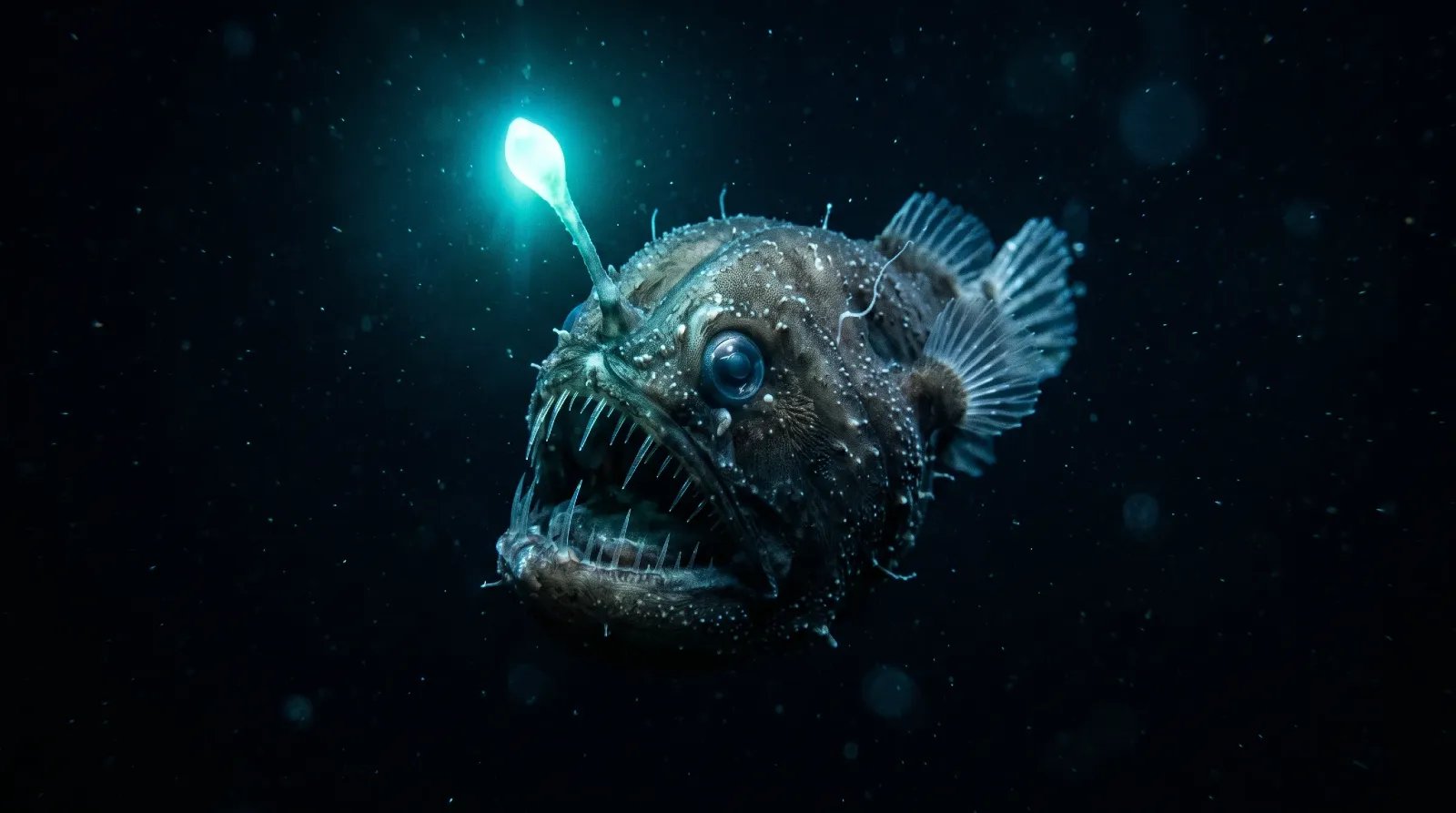
The anglerfish is the stuff of nightmares: a jagged-toothed predator that hunts in total darkness with a glowing lure growing from its head. Its love life is even stranger, as some males fuse permanently to their partners and become little more than living sperm banks. Here are the surprising facts about the strangest fish of the deep sea.
1. They carry their own fishing rod.
Anglerfish get their name from the way they hunt. The first spine of their dorsal fin has evolved into a long, flexible "rod" called the illicium, tipped with a fleshy lure called the esca. The fish wiggles the lure to attract curious prey, then snaps it up when it comes close enough.
2. The lure glows thanks to bacteria.
In deep-sea anglerfish, the lure contains colonies of bioluminescent bacteria that produce light. In the pitch-dark depths, the glowing esca is irresistible to small fish and other animals. Young anglerfish are not born with these bacteria and appear to pick them up from the water around them.
3. Some males fuse permanently to the female.
In several deep-sea species, a tiny male finds a female and bites into her body. Over time, their tissues and blood vessels fuse together, and the male loses most of his organs except those he needs to produce sperm. He spends the rest of his life attached to her as a permanent mate, a strategy known as sexual parasitism.
4. A female can carry several males at once.
In some species, a single female can have more than one male fused to her body at the same time. This guarantees she will always have a mate ready when she releases her eggs, which is a big advantage in the vast, empty darkness of the deep sea, where finding a partner is extremely difficult.
5. Their immune systems allow the fusion.
In most animals, fusing two bodies together would trigger a violent immune reaction, as happens when an organ transplant is rejected. A 2020 study found that anglerfish that use sexual parasitism have lost key parts of their adaptive immune system. This allows the female's body to accept the male without attacking him.
6. Males can be tiny compared with females.
Deep-sea anglerfish show some of the most extreme size differences between males and females in the animal kingdom. In one species, females commonly reach around 77 centimetres in length, while males grow to only about 16 centimetres. In another, Photocorynus spiniceps, adult males measure just 6 to 7 millimetres, making them among the smallest known vertebrates.
 Marine and Freshwater Animals
Twenty-five animals of the sea and rivers, from the largest creature ever to exist to a seahorse dad, each linked to its full 15-fact article.
See All Facts
7. They can swallow prey twice their own size.
Food is scarce in the deep sea, so anglerfish cannot afford to let a meal escape. Their jaws and stomachs are extremely stretchy, and their bones are thin and flexible. This allows them to swallow prey up to twice as large as their own bodies.
8. Their teeth work like a one-way door.
Anglerfish have long, needle-like teeth that point inwards. The teeth can fold backwards to let prey slide into the mouth, but they spring back up to stop it from escaping. Once something has been caught, there is little chance of it getting out again.
9. Not all anglerfish live in the deep sea.
There are hundreds of anglerfish species, and many live in shallow water. These include frogfishes, which lurk on coral reefs, batfishes and the large anglerfish of European coasts. Many use their fins to "walk" across the sea floor rather than swim.
10. One of them is a popular seafood.
The large anglerfish of the genus Lophius, sold as monkfish or goosefish, is prized for its firm, sweet meat, which is sometimes called "poor man's lobster". Only the tail is usually eaten. Its huge head and gaping mouth are so unappetising that it is often removed before the fish reaches the market.
11. They live in near-total darkness.
Deep-sea anglerfish live hundreds or even thousands of metres below the surface, where sunlight never reaches and the water is near freezing. The pressure is crushing, and food is extremely scarce. Their slow, energy-saving lifestyle and glowing lures are adaptations to these extreme conditions.
12. Some lures use smell instead of light.
Not all anglerfish lures glow. In some shallow-water species, the lure looks like a small worm, shrimp or fish, and it may twitch convincingly in the water. Others are thought to release chemicals that attract prey through smell.
13. A mating pair was not filmed alive until 2018.
Because deep-sea anglerfish live in such remote places, they are rarely seen alive. In 2018, scientists released the first-ever footage of a deep-sea anglerfish pair, with the tiny male attached to the female, recorded by a submersible off the Azores in the Atlantic. The video revealed glowing fin rays that had never been seen before.
14. They have been around for tens of millions of years.
The anglerfish group as a whole dates back to at least the age of the dinosaurs. The deep-sea anglerfishes and their unusual habit of sexual parasitism are thought to have evolved during the Eocene epoch, more than 30 million years ago, in a rapid burst of new species.
15. They starred in a famous animated film.
Many people's first encounter with an anglerfish was in Pixar's "Finding Nemo" (2003), in which Marlin and Dory are chased through the dark by a fearsome anglerfish with a glowing lure. The scene captured the creepy beauty of the deep sea and made the anglerfish one of the best-known deep-sea animals in the world.
Sources & References
This AI-assisted post was rigorously curated and fact-checked for accuracy by:
 Martin Roháček
How fun was this article? 🤔
Tap a star to rate it
🧠 Quiz: How closely were you paying attention?
10 questions — all answers are in the article above!
Enjoyed these facts? There's more! 💌
Fresh fun facts in your inbox. No spam, ever.


