The Radical Rationalist: 15 Fascinating Facts About Baruch Spinoza
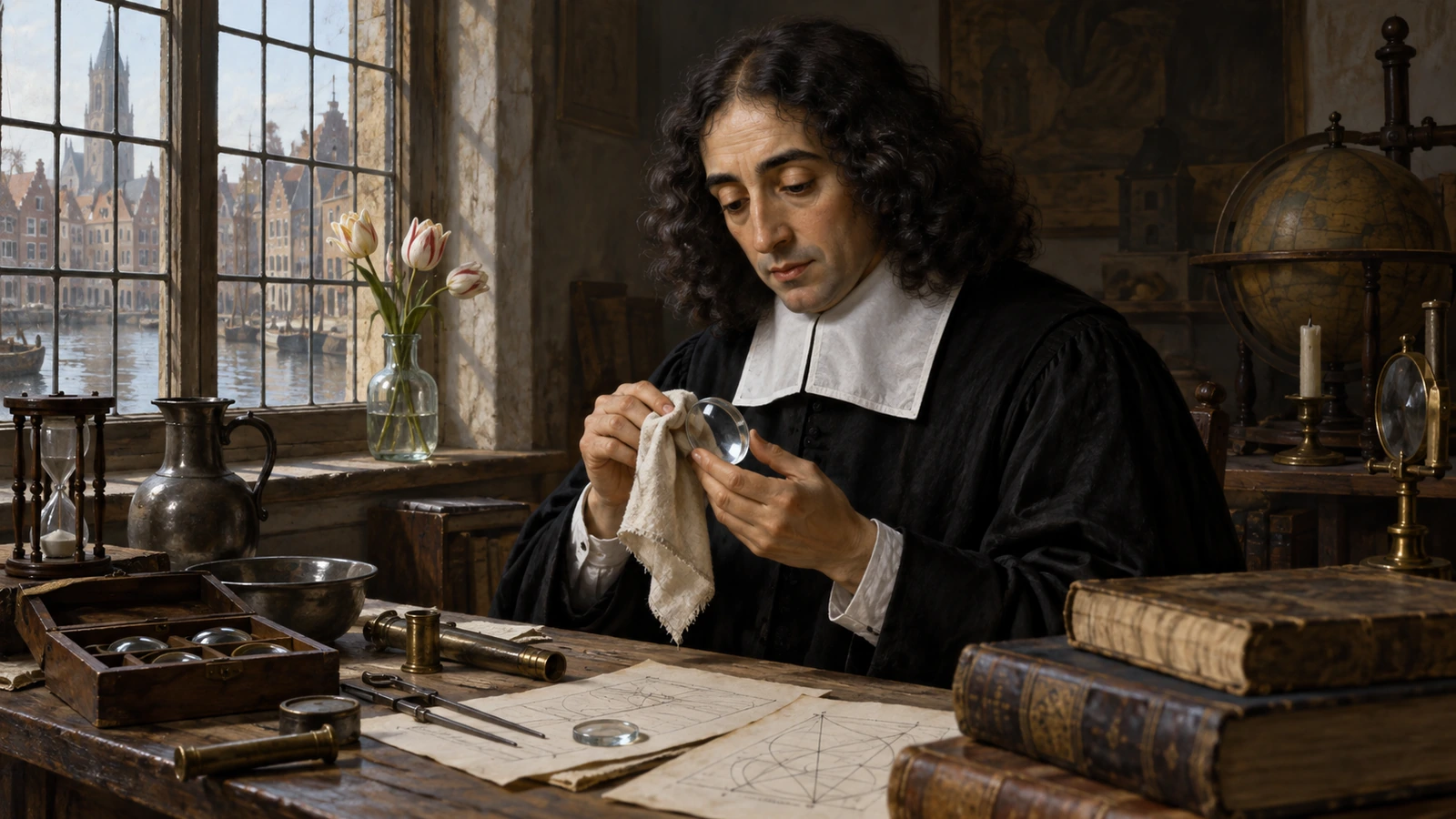
Baruch Spinoza was one of the most daring and revolutionary philosophers of the 17th century, laying the foundation for the Enlightenment and modern secular democracy. Excommunicated from his Jewish community at just 23 for his unorthodox views, he chose a life of quiet independence, earning a living grinding optical lenses rather than accepting cozy academic positions. Spinoza shattered traditional theology by equating God with the natural universe, arguing that true freedom comes through reason rather than divine command. From surviving an assassination attempt to inspiring Albert Einstein centuries later, here are 15 fascinating facts about the renegade thinker who reshaped Western thought.
1. Excommunicated with Unprecedented Harshness
In 1656, the 23-year-old Baruch Spinoza was hit with the harshest writ of excommunication, or herem, ever issued by Amsterdam’s Portuguese-Jewish congregation. Church leaders accused him of abominable heresies and monstrous acts, officially cursing him by day and night, in sleeping and waking. Members of the community were strictly forbidden from speaking to him, reading his writings, or coming within four cubits of him. Rather than appealing the decision or recanting his views, Spinoza calmly accepted the ban and permanently severed ties with the synagogue. He even changed his first name from the Hebrew Baruch to the Latinate Benedictus, both meaning blessed.
2. He Maintained His Independence as a Lens Grinder
To preserve his absolute intellectual freedom, Spinoza refused financial backing from wealthy patrons and turned down lucrative academic appointments. Instead, he made a modest living as an artisan, grinding and polishing optical lenses for microscopes and optical telescopes. His technical work in optics was highly respected, bringing him into contact with elite scientists like Christiaan Huygens. However, this craft came with a fatal cost, as inhaling fine glass dust over two decades severely damaged his respiratory system. Modern medical historians believe this constant exposure directly caused the chronic pulmonary illness that ended his life at just 44 years old.
3. Equating God with the Universe (Deus Sive Natura)
Spinoza turned traditional Western theology on its head by arguing that God and the physical universe were one and the same entity. He coined the famous Latin phrase Deus sive Natura, which translates to God or Nature, asserting that God is not a distinct, supernatural creator sitting above creation. In his view, God possesses infinite attributes, and everything that exists in the physical world is simply a manifestation or mode of this single, ultimate substance. This radical pantheism stripped away traditional concepts of divine providence, answered prayers, and miracles, which horrified orthodox Christian and Jewish authorities alike.
4. Writing Philosophy Like Euclidean Geometry
Spinoza’s masterwork, Ethics, is written using an extraordinary mathematical structure known as the geometric method (more geometrico). Modeled directly on Euclid’s Elements, the book presents philosophical arguments starting with formal definitions and self-evident axioms, followed by numbered propositions, proofs, and corollaries. Spinoza believed that metaphysical truth could be deduced with the same logical certainty and detachment as geometric theorems. Readers are forced to move step-by-step through his logic, assessing his conclusions about human nature and God without relying on emotional intuition. This rigid structure makes Ethics one of the most uniquely formatted works in intellectual history.
5. His Masterpiece Was Published Posthumously
Recognizing that publishing his complete philosophical system would invite severe persecution or imprisonment, Spinoza kept Ethics hidden in his desk drawer during his lifetime. When he realized his health was rapidly failing in early 1677, he entrusted his trusted circle of friends with the manuscript and instructions for its release. Following his death in February 1677, his friends secretly edited and published the work under the title Opera Posthuma, omitting Spinoza’s name on the title page to protect the printer. Despite these precautions, civil authorities across Europe quickly identified the author and banned the book as blasphemous and dangerous.
6. Turning Down a University Chair to Stay Free
In 1673, the Elector Palatine offered Spinoza the prestigious Chair of Philosophy at the University of Heidelberg, guaranteeing him total academic liberty. However, the offer came with a subtle caveat: Spinoza was expected not to disturb the publicly established religion of the state. Recognizing that such a condition would inevitably restrict his ability to seek and speak the truth, Spinoza politely declined the offer. He wrote in response that he had never sought public teaching and preferred the peaceful, solitary life of an independent thinker over institutional status. This decision reaffirmed his lifelong devotion to intellectual independence at any financial cost.
 Philosophers Through the Ages
From wrestling rings and pirate kidnappings to sword duels and secret brotherhoods, the greatest thinkers in history led lives as dramatic as their ideas. Explore the surprising human stories behind the brilliant minds who shaped Western and Eastern philosophy.
See All Facts
Philosophers Through the Ages
From wrestling rings and pirate kidnappings to sword duels and secret brotherhoods, the greatest thinkers in history led lives as dramatic as their ideas. Explore the surprising human stories behind the brilliant minds who shaped Western and Eastern philosophy.
See All Facts
7. Pioneering Modern Biblical Criticism
In 1670, Spinoza anonymously published the Tractatus Theologico-Politicus, a revolutionary treatise that pioneered modern biblical criticism. He argued that the scriptures should be analyzed as historical documents written by human authors in specific cultural contexts, rather than literal, divine dictation. Spinoza asserted that miracles were merely natural events that ancient people did not yet scientifically understand, and that theological dogmas were often used by rulers to control citizens. The book provoked immediate outrage across Europe, leading to quick bans by both Calvinist and Catholic authorities, who branded it the work of the devil.
8. Radical Determinism and the Rejection of Free Will
Spinoza rejected the concept of free will, arguing instead for a system of absolute causal determinism. In his view, humans believe they possess free will simply because they are conscious of their desires, but completely ignorant of the underlying causes that drive those desires. Everything in the universe—from the trajectory of a falling stone to human thoughts and decisions—occurs out of absolute mathematical necessity according to natural laws. However, Spinoza argued that true human freedom does not mean acting without cause, but rather understanding the deterministic forces that govern reality through reason.
9. A Revolutionary Theory of Human Emotions
In Ethics, Spinoza offered a surprisingly modern, psychological analysis of human emotions, which he termed affects. He posited that emotions are not sinful supernatural temptations, but natural biological responses that either increase or decrease an individual's power to persist in existence. Spinoza categorized emotions into passive passions, which control us when we lack clear understanding, and active emotions, which arise when we understand reality clearly. By transforming passive suffering into rational comprehension, Spinoza argued, individuals can liberate themselves from emotional bondage and achieve mental peace.
10. Albert Einstein Was His Greatest Modern Admirer
Centuries after his death, Spinoza found one of his most famous champions in theoretical physicist Albert Einstein. When asked by a rabbi whether he believed in God, Einstein famously cabled back that he believed in Spinoza's God, who reveals Himself in the lawful harmony of all being, not in a deity who concerns Himself with the fates and doings of mankind. Einstein repeatedly credited Spinoza’s worldview with inspiring his own scientific perspective, viewing nature's rigid laws as the ultimate expression of the divine. The physicist even kept a portrait of Spinoza on his study wall and penned a poem in his honor.
11. The "God-Intoxicated Man" Called an Atheist
Throughout his life and long after his death, Spinoza was frequently condemned as a dangerous, immoral atheist. Yet, romantic poet Novalis famously coined the phrase the God-intoxicated man to describe Spinoza because his philosophy was utterly saturated with the idea of the divine. Far from rejecting God, Spinoza saw God everywhere, refusing to separate the sacred from the mundane reality of nature. The accusation of atheism stemmed primarily from his rejection of a personal, anthropomorphic deity who performs miracles and judges human behavior. For Spinoza, true piety meant understanding and accepting nature as it truly is.
12. Championing Freedom of Speech and Democracy
Spinoza was one of the earliest and most articulate defenders of modern secular democracy and freedom of speech in Western philosophy. In his Tractatus, he explicitly argued that the ultimate goal of the state is not to dominate citizens through fear, but to preserve their natural liberty and safety. He insisted that a sovereign government cannot control an individual's inner thoughts, and attempting to suppress free expression only breeds hypocrisy, rebellion, and instability. Spinoza's political theory argued that a democratic republic is the most natural form of government, directly influencing Enlightenment thinkers and modern constitutional systems.
13. Fighting for His Inheritance Only to Give It Away
When Spinoza’s father passed away, his half-sister tried to legally deprive him of his fair share of the family inheritance, leveraging his controversial religious reputation against him. Spinoza took the dispute to court and fought vigorously until he won his legal rights to the estate. However, immediately after securing the ruling and proving his point about justice, Spinoza voluntarily surrendered the entire inheritance to his sister, keeping only a single bed and curtain for himself. This act demonstrated that his legal battle was never about material wealth, but entirely about upholding ethical principles and justice.
14. Surviving a Dagger Attack by a Fanatic
Spinoza’s controversial departure from orthodox Judaism made him a target for religious zealots long before his major works were published. According to early biographers, a fanatic armed with a dagger attempted to assassinate Spinoza outside a synagogue or theater in Amsterdam. Spinoza managed to dodge the blow, escaping with only a slash through his cloak rather than a fatal wound. Instead of discarding the damaged garment, Spinoza kept the torn, dagger-pierced coat in his closet for the rest of his life as a stark physical reminder of the deadly dangers of religious fanaticism.
15. A Quiet Death and an Unlikely Resting Place
Spinoza died peacefully on February 21, 1677, in his rented rooms in The Hague at the age of 44, accompanied only by his physician friend, Lodewijk Meyer. His landlord and landlady had gone to church, and upon returning, found the great philosopher had succumbed to his long-standing lung ailment. Despite being excommunicated by the Jewish community and branded a dangerous heretic by Christian authorities, Spinoza was buried in the churchyard of the Christian Nieuwe Kerk in The Hague. Six mourning coaches filled with prominent scholars, statesmen, and friends followed his casket, honoring the humble lens grinder whose ideas would reshape human thought.
Sources & References
This AI-assisted post was rigorously curated and fact-checked for accuracy by:
 Martin Roháček
How fun was this article? 🤔
Tap a star to rate it
🧠 Quiz: How closely were you paying attention?
10 questions — all answers are in the article above!
Enjoyed these facts? There's more! 💌
Fresh fun facts in your inbox. No spam, ever.