The Golden Shrine of Jerusalem: 15 Fascinating Facts About the Dome of the Rock
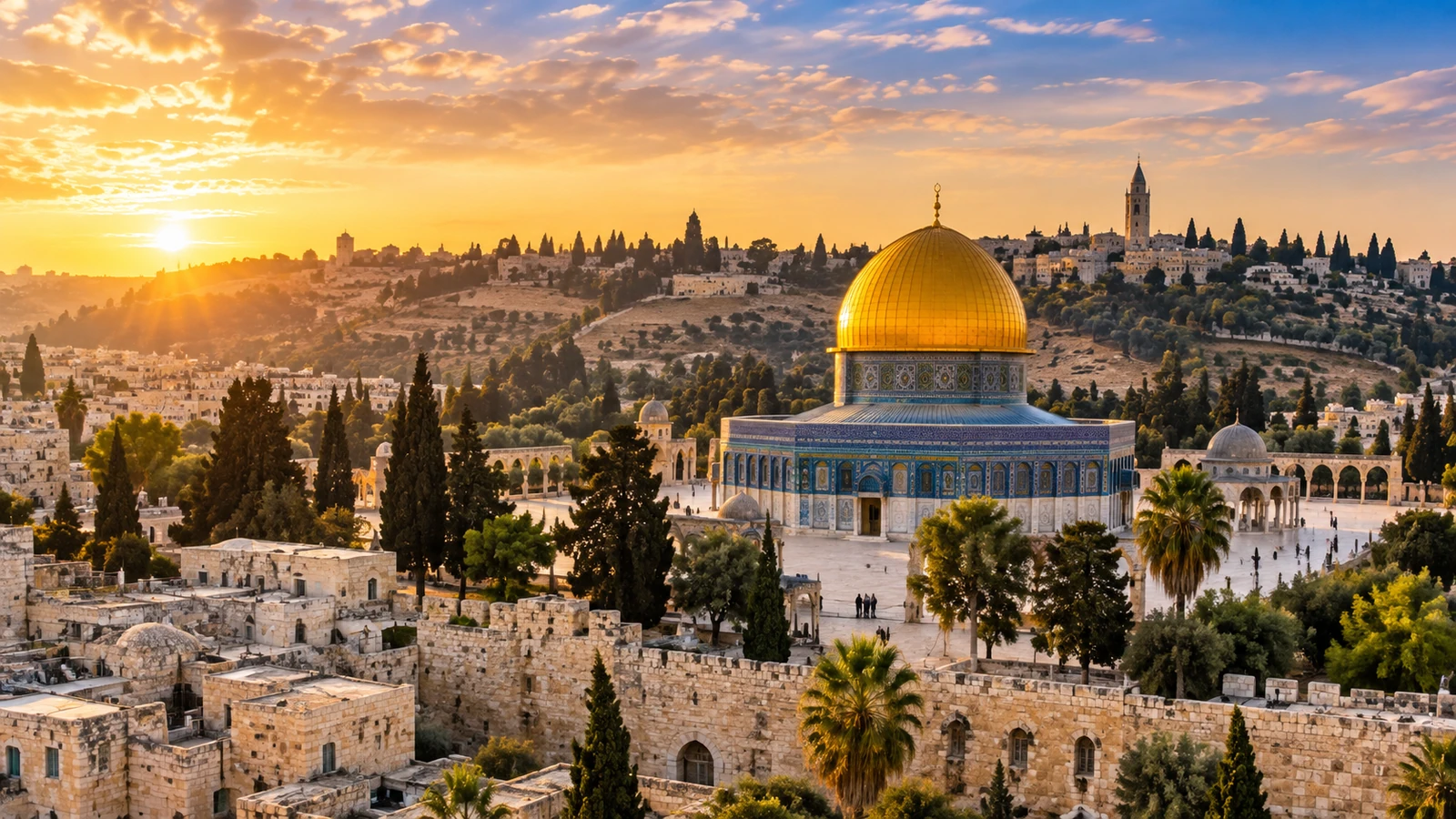
Perched atop Jerusalem's Temple Mount, the Dome of the Rock is one of the world's most recognizable architectural landmarks. Completed in 691 CE by the Umayyad Caliphate, this stunning octagonal structure is the oldest surviving Islamic monument on Earth. Beyond its dazzling golden roof and vibrant blue ceramic tiles lies a sacred crossroads of Jewish, Christian, and Islamic history. From ancient holy bedrock to Crusader Knights and royal sacrifices, here are 15 fascinating facts about the Dome of the Rock.
1. It Is Technically a Shrine, Not a Mosque
While frequently misidentified as a mosque, the Dome of the Rock is officially classified as an Islamic shrine or commemorative monument. Built by the Umayyad Caliph Abd al-Malik between 688 and 691 CE, it was not designed to accommodate large congregational Friday prayers. Instead, congregational worship takes place at the nearby Al-Aqsa Mosque located on the same elevated plateau. The shrine was constructed primarily to protect and honor the sacred rock exposed at its center. Today, it stands as the oldest surviving piece of Islamic architecture in the entire world.
2. The Sacred Foundation Stone Lies at Its Center
Enclosed within the shrine's central rotunda is the Foundation Stone, known as Even HaShetiya in Judaism and al-Sakhrah in Islam. According to Talmudic tradition, this exposed piece of limestone bedrock is the exact spiritual epicenter where God created the universe. It is also historically venerated as the site of the Holy of Holies within Solomon's Temple and the Second Temple. In Jewish tradition, this is where Abraham prepared to sacrifice his son Isaac, making it the supreme direction toward which Jews around the globe face during prayer. For centuries, this single physical location has served as an anchor for divine narrative across Abrahamic faiths.
3. It Marks the Site of the Prophet Muhammad's Ascension
For Muslims, the shrine holds profound spiritual importance associated with the miraculous Isra and Mi'raj, or Night Journey. Islamic tradition recounts that Prophet Muhammad traveled overnight from Mecca to Jerusalem on the heavenly steed Buraq. From the surface of the sacred rock, he ascended through the seven heavens to converse directly with God and earlier prophets. This extraordinary event established Jerusalem as the third-holiest city in Islam, following Mecca and Medina. A small depression in the rock is traditionally revered by some pilgrims as an imprint left behind during the ascension.
4. A Mysterious Cavern Lies Beneath the Rock
Directly underneath the sacred bedrock lies a natural cave known as Bir al-Arwah, or the "Well of Souls." Accessible via a staircase cut into the stone, this cavern features a small chamber with a hollow floor that produces an echo when struck. Medieval folklore suggested that the souls of the departed gathered in this subterranean chamber while awaiting the Day of Judgment. During the 19th century, early European treasure hunters and biblical scholars speculated that hidden chambers beneath the cavern might conceal the lost Ark of the Covenant. Despite numerous theories, formal archaeological excavation inside the cave remains strictly prohibited to preserve the sacred site.
5. A Jordanian King Sold Personal Property to Gild the Roof
The dazzling gold exterior that dominates Jerusalem's skyline today is the result of a remarkable royal sacrifice in the 20th century. By the late 1980s, the shrine's lead-covered roof had fallen into severe disrepair, allowing rainwater to damage the internal structure. To fund a comprehensive restoration, King Hussein of Jordan sold one of his private homes in London for $8.25 million. The funds paid for 80 kilograms of 24-karat gold leaf, which was fused onto brass panels manufactured in Ireland. Completed in 1994, this renovation restored the dome's historical radiance, ensuring it shines intensely under the Mediterranean sun.
6. The Iconic Blue Exterior Tiles Were Added by an Ottoman Sultan
Visitors who admire the vibrant blue ceramic tiles decorating the outer walls are looking at an Ottoman enhancement rather than the original 7th-century finish. Originally, the exterior was adorned with shimmering glass mosaics, much like the preserved interior arcades. However, centuries of exposure to wind, rain, and snow severely weathered the original artwork. In 1545, Sultan Suleiman the Magnificent ordered a massive restoration, replacing the damaged mosaics with tens of thousands of hand-painted Iznik ceramic tiles. Featuring intricate calligraphic scripts and floral arabesques, these cobalt and turquoise tiles became the defining visual identity of the landmark.
7. Early Inscriptions Inside Explicitly Address Jesus and Mary
The interior octagonal arcade contains 240 meters of gold calligraphic inscriptions, representing the oldest surviving Quranic inscriptions in existence. Strikingly, the chosen verses extensively reference Jesus (Isa) and his mother Mary (Maryam). The text affirms Jesus as an honored messenger and prophet of God while rejecting the concept of the Trinity. Historians note that when the shrine was built in 691 CE, Jerusalem was predominantly a Christian city filled with monumental churches. The Caliph deliberately displayed these verses to present Islam's theological stance on Jesus to the local population and visitors.
8. Its Mathematical Proportions Mirror Classical Byzantine Architecture
The design of the shrine displays extraordinary geometric harmony derived from Late Roman and Byzantine engineering. The diameter of the central dome is approximately 20 meters, which exactly matches the height of the supporting drum and the length of each octagonal outer wall. This 1:1 structural ratio creates a perfectly balanced space where a sphere could theoretically fit inside the central rotunda. Architectural historians believe the Umayyad builders intentionally modeled these dimensions on the nearby Church of the Holy Sepulchre. By matching and refining Byzantine geometry, the architects created a monument intended to rival the magnificent structures of the Christian empire.
9. Roman and Byzantine Columns Were Recycled for Its Construction
If you examine the interior arcades closely, you will notice that no two stone columns are entirely identical. The Umayyad builders utilized a practice known as spolia, which involved salvage and reuse of architectural elements from fallen Roman and Byzantine structures across the Levant. Because these recycled marble and porphyry columns came from different classical buildings, they varied significantly in height and thickness. To create a uniform visual level, ancient stonemasons crafted customized bases and capitals of different sizes beneath each pillar. This creative recycling preserved antiquity's finest craftsmanship while integrating classical heritage into Islamic art.
10. The Knights Templar Mistook It for Solomon's Temple
When Christian Crusaders captured Jerusalem in 1099, they misidentified the octagonal shrine as the original Temple of Solomon. Rechristening the building as the Templum Domini (Temple of the Lord), they placed a Christian cross atop the dome and converted the rock into an altar. The newly founded order of warrior monks, the Knights Templar, established their headquarters nearby and adopted the shrine as their central emblem. Returning to Europe, the Templars designed dozens of round churches modeled directly on the shrine's unique architecture. Notable examples of this inspiration include the famous Temple Church in London and the Church of the Holy Sepulchre in Cambridge.
11. Its Dome Features a State-of-the-Art Double-Shell Design
The iconic dome is not a solid masonry vault, but rather an ingenious double-shell wooden construction. The inner ceiling is a wooden dome decorated with ornate, gilded floral plaster work visible from the interior floor. The outer shell is completely separate, elevated on a framework to give the building an imposing external height without disrupting interior proportions. This air gap between the inner ceiling and outer roof serves a crucial practical function by insulating the building against Jerusalem's extreme temperature shifts. Furthermore, the light wooden construction significantly reduced weight, preventing structural collapse during seismic events.
12. The Interior Contains Zero Depictions of Living Beings
In accordance with Islamic religious principles regarding sacred spaces, the artwork inside contains no human or animal figures. Instead, master artisans created over 1,200 square meters of glittering glass and mother-of-pearl mosaics featuring botanical motifs. The designs include intricate vines, palm trees, acanthus leaves, and stylized jewels reminiscent of Byzantine and Sasanian royal crowns. These royal crowns depicted in the mosaics symbolized the political and spiritual triumph of Islam over the prevailing empires of the era. The result is a mesmerizing visual environment focused entirely on abstract beauty, nature, and divine majesty.
13. Ancient Legends Claimed the Rock Tried to Fly to Heaven
A popular medieval legend among pilgrims claimed that the central rock possessed miraculous qualities. According to folklore, when Prophet Muhammad began his heavenly ascension, the rock attempted to follow him into the sky. The legend states that the Archangel Gabriel reached down and held the stone in place, leaving a deep handprint embedded in the limestone surface. For centuries, visitors sought out this depression on the western side of the rock. While modern scholars recognize the stone is securely connected to the underlying bedrock, this colorful tale captured the imagination of travelers for generations.
14. It Has Engineering That Survived Major Earthquakes
Jerusalem is situated near the Dead Sea Transform fault zone, exposing the city to periodic major earthquakes throughout history. Over the past 1,300 years, catastrophic tremors destroyed many historical structures across the region, including severe damage to the nearby Al-Aqsa Mosque on multiple occasions. Remarkably, the core octagonal structure of the shrine has remained intact since the 7th century. Its octagonal outer wall grid and lightweight timber dome distributed seismic energy efficiently during tremors. While major earthquakes in 746, 1033, and 1927 required repairs to mosaics and plaster, the fundamental architectural framework never collapsed.
15. Diplomatic Custodianship Remains Under the Kingdom of Jordan
Despite being located within Jerusalem, overall religious administration of the shrine is governed by an international agreement known as the Status Quo. Under this arrangement, the Hashemite Kingdom of Jordan acts as the official custodian of the Islamic holy sites on the Temple Mount, known locally as Haram al-Sharif. The Jordanian Ministry of Awqaf manages daily operations, maintenance, and security within the complex. This historical role was reaffirmed in the 1994 peace treaty between Israel and Jordan, preserving a delicate diplomatic balance at one of the world's most contested religious sites.
Sources & References
This AI-assisted post was rigorously curated and fact-checked for accuracy by:
 Martin Roháček
How fun was this article? 🤔
Tap a star to rate it
🧠 Quiz: How closely were you paying attention?
10 questions — all answers are in the article above!
Enjoyed these facts? There's more! 💌
Fresh fun facts in your inbox. No spam, ever.