The Radical Modernist: 15 Fascinating Facts About Georgia O'Keeffe
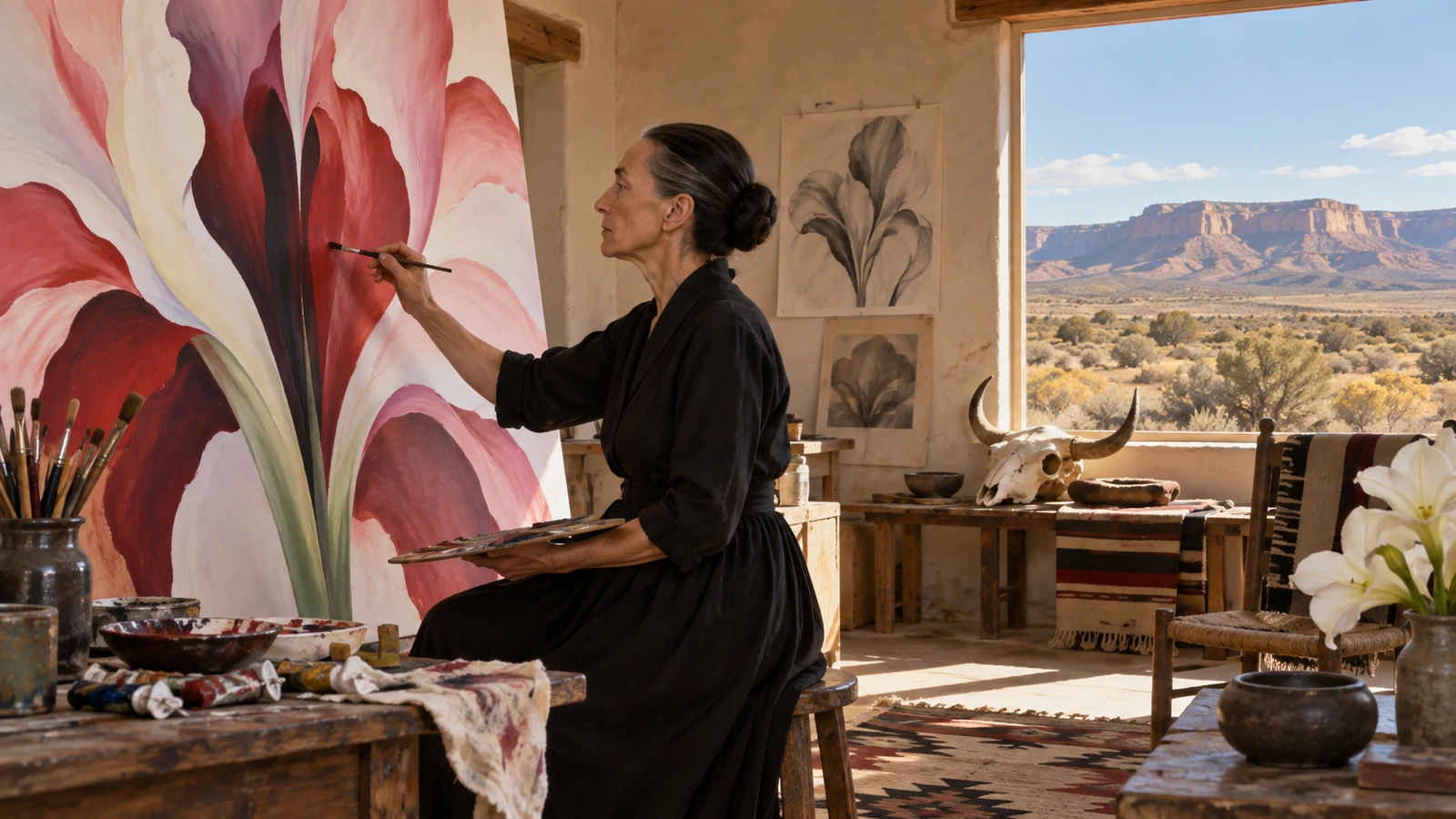
Georgia O'Keeffe reshaped 20th-century American art through her bold color palettes, pioneering abstraction, and monumental depictions of nature. Renowned for her close-up floral canvases, stark desert landscapes, and architectural urban scenes, she forged an independent aesthetic that defied the expectations of her era. From setting record-breaking auction sales to adapting her creative practice during vision loss, her legacy remains legendary. Discover the remarkable life, artistic philosophy, and hidden truths behind the Mother of American Modernism.
1. She Was the First Woman Honored with a MoMA Retrospective
In 1946, the Museum of Modern Art in New York City held a retrospective exhibition dedicated entirely to Georgia O'Keeffe's artwork. This landmark event marked the very first time MoMA had ever hosted a solo retrospective for a female artist. By that time, O'Keeffe was already recognized as one of the defining figures of American modernism. The show featured decades of her work, including her radical abstract compositions, New York cityscapes, and vivid Southwestern landscapes. The critical acclaim from the exhibition permanently cemented her status in the canon of modern art history.
2. She Decisively Rejected Freudian Interpretations of Her Flowers
Georgia O'Keeffe is world-famous for her magnified close-up paintings of flowers, such as irises, poppies, and calla lilies. Male art critics, heavily influenced by Sigmund Freud's psychoanalytic theories during the 1920s, frequently interpreted these blossoms as sexual metaphors. O'Keeffe vehemently denied these readings throughout her lifetime, arguing that critics were projecting their own thoughts onto her canvases. She explained that she magnified flowers simply to force busy urbanites to take the time to truly look at them. Despite her persistent explanations, the sexualized interpretation remained a stubborn myth in popular culture.
3. She Was a Trailblazer in Painting New York Skyscrapers
Although widely associated with desert landscapes, O'Keeffe lived in New York City during the 1920s and painted its booming skyline. Moving into the Shelton Hotel in 1925—then one of the tallest residential skyscrapers in the world—offered her breathtaking vantage points. She captured the dizzying heights, stark geometry, and dramatic shadows of the metropolis in paintings like Radiator Building — Night, New York. Many critics warned her that skyscrapers were an inherently masculine subject for an artist, but she ignored them and produced some of the most memorable depictions of urban modernity. Her architectural works showed her incredible versatility before she fully embraced the American West.
4. Her Work Set a Record for the Most Expensive Painting by a Female Artist
In November 2014, O'Keeffe's 1932 painting Jimson Weed/White Flower No. 1 was auctioned at Sotheby's for an astounding $44.4 million. This sale shattered the previous world record for a work of art by a female artist, which had stood at $11.9 million. Sold on behalf of the Georgia O'Keeffe Museum to benefit its acquisitions fund, the piece exemplified her stunning mastery of form and light. The purchase demonstrated that her market value could rival her premier male modernist contemporaries. To this day, the historic sale remains a high-water mark for women in the visual arts.
5. She Designed Her Own Minimalist Wardrobe and Wore Black and White
O'Keeffe was renowned not only for her canvas work but also for her distinct personal aesthetic and sartorial choices. She favored stark, unadorned clothing—primarily in black and white—and often sewed her own tailored garments with meticulously neat stitching. Her minimalist style was an extension of her artistic philosophy, cutting away unnecessary ornamentation to focus on form and functional elegance. Photographs taken by her contemporaries show her wearing crisp white silk shirts, simple black dresses, and structured wraps. Her iconic look made her a favorite subject for renowned photographers throughout the 20th century.
6. The New Mexico Desert Transformed Her Life and Artistic Direction
O'Keeffe first visited New Mexico in the summer of 1929, an experience that permanently altered the trajectory of her career. Enchanted by the vast desert light, stark clay cliffs, and open skies, she began spending every summer there before permanently moving in 1949. She established two homes in Northern New Mexico: Ghost Ranch and a historic adobe house in Abiquiú. The dramatic terrain provided endless inspiration, prompting her to shift away from Manhattan's claustrophobic concrete canyons. She famously remarked that as soon as she saw New Mexico, she knew it was "her country."
7. She Transformed Scavenged Animal Bones into Sacred Art
During her long walks across the arid New Mexico landscape, O'Keeffe routinely gathered weathered rocks, bleached bones, and animal skulls. She saw profound beauty in these sun-bleached remnants, viewing them as symbols of the enduring desert spirit rather than symbols of decay. In canvases like Cow's Skull: Red, White, and Blue, she placed these stark bone structures against abstract backgrounds. By isolating and framing these found objects, she transformed skeletal remains into majestic icons of American identity. Her bone paintings became some of the most enduring and recognizable images in 20th-century art.
8. Her Professional and Personal Partner Was Photographer Alfred Stieglitz
In 1916, pioneering photographer and gallery owner Alfred Stieglitz became the first person to exhibit O'Keeffe's abstract charcoal drawings. The two launched a passionate personal relationship and eventually married in 1924, forming one of the most famous dynamic partnerships in modern art. Stieglitz promoted her relentlessly, exhibiting her work annually in his New York galleries and taking over 300 portraits of her. However, O'Keeffe maintained strict artistic independence, refusing to let Stieglitz direct her style or dictate her creative choices. Their complex relationship endured until his death in 1946, balancing deep artistic influence with fiercely defended autonomy.
9. She Switched to Sculpture and Pottery After Losing Her Eyesight
In the 1970s, O'Keeffe began suffering from central macular degeneration, a condition that severely impaired her central vision and peripheral sight. Undeterred by the loss of her vision, she adapted her creative methods rather than retiring from art altogether. With the help of assistants, she turned her tactile energy toward working with clay, producing three-dimensional ceramic sculptures. She also continued creating works in charcoal and watercolor, relying on her sharp tactile memory and refined instinct for form. Her determination to make art into her late nineties demonstrated an extraordinary creative resilience.
10. She Embarked on Extensive World Travel Well into Her Late Eighties
Although deeply attached to her desert home, O'Keeffe developed a passion for international travel later in life. Starting in her sixties and continuing through her eighties, she journeyed across the globe, visiting Japan, India, Peru, Egypt, and Europe. During a 1959 flight around the world, looking down at cloud formations from high altitude inspired a famous series of monumental sky paintings, including Sky Above Clouds IV. She embraced new cultures and landscapes with the same intense curiosity she applied to desert bones and blossoms. Her late-life travels broadened her artistic perspective long after she had achieved international fame.
11. She Was an Early Pioneer of Pure Abstraction in American Art
Long before abstract expressionism swept the American art scene in the mid-20th century, O'Keeffe was experimenting with non-representational forms. In 1915, while working as a young art teacher in South Carolina, she created a series of radical charcoal drawings that abandoned realism entirely. She sought to express internal emotions and musical rhythms through pure lines, shapes, and tonal values. These pioneering abstract drawings shocked and intrigued the art world when Stieglitz first displayed them. Her early work established her as one of the genuine forebears of abstract art in North America.
12. Her New Mexico Residences Are Preserved as National Historic Landmarks
O'Keeffe's beloved homes at Ghost Ranch and in the village of Abiquiú have been meticulously preserved to reflect how she lived and worked. The Abiquiú home, an 18th-century ruin that she spent years restoring, features her studio, garden, minimalist furnishings, and extensive collection of smooth river rocks. Today, the Georgia O'Keeffe Museum offers guided tours of the Abiquiú property, which was designated a National Historic Landmark in 1998. Walking through these preserved spaces offers visitors a rare, tangible sense of her disciplined daily lifestyle and creative vision. The desert surroundings remain largely unchanged from when she painted them.
13. She Fiercely Resisted Being Labeled a "Female Artist"
Throughout her career, O'Keeffe strongly resisted any attempt to categorize her work under the umbrella of gender. When critics or feminists attempted to claim her as a pioneering "woman artist," she insisted that she was simply an artist whose work should stand on its own merits alongside male peers. She resented the gendered lenses through which critics interpreted her paintings, refusing to participate in all-women exhibitions. Her insistence on equality without patronizing labels challenged the male-dominated art world to evaluate her strictly by the caliber of her talent. This uncompromising stance carved out new space for future generations of artists.
14. She Was Inspired by Music and Japanese Printmaking
O'Keeffe's artistic philosophy was heavily shaped by her studies under Arthur Wesley Dow at Columbia University's Teachers College. Dow introduced her to the principles of Japanese art, emphasizing composition, harmonious space filling, and simplified lines rather than copying nature directly. She was also profoundly interested in the concept of synesthesia—the idea that visual art could evoke musical sensations. Titles of her early works, such as Music, Pink and Blue No. 2, explicitly linked auditory experience with visual form. This synthesis of Japanese design principles and musical abstraction laid the foundation for her mature style.
15. She Lived to Age 98 and Left a Transcendent Modernist Legacy
Georgia O'Keeffe lived an extraordinary life that spanned almost a century, passing away in Santa Fe in 1986 at the age of 98. In accordance with her final wishes, her body was cremated, and her ashes were scattered over the vast desert landscape surrounding Ghost Ranch. Over her seven-decade career, she reshaped the landscape of modern American art, bridging the gap between realism and abstraction. She was awarded the Presidential Medal of Freedom in 1977 and the National Medal of Arts in 1985. Today, her legacy lives on through her iconic works and the Georgia O'Keeffe Museum in Santa Fe, New Mexico.
Sources & References
This AI-assisted post was rigorously curated and fact-checked for accuracy by:
 Martin Roháček
How fun was this article? 🤔
Tap a star to rate it
🧠 Quiz: How closely were you paying attention?
10 questions — all answers are in the article above!
Enjoyed these facts? There's more! 💌
Fresh fun facts in your inbox. No spam, ever.