15 Surprising Facts About Georgia, USA
The U.S. state of Georgia has a canyon enlarged by nineteenth-century farming, floating islands of peat, and a room sealed until the year 8113. Its stories also reveal the sailing ship behind an early steamship milestone, an accountant behind a famous logo, and the research hidden inside ancient shell rings.
1. Georgia's Little Grand Canyon grew out of badly eroded farmland
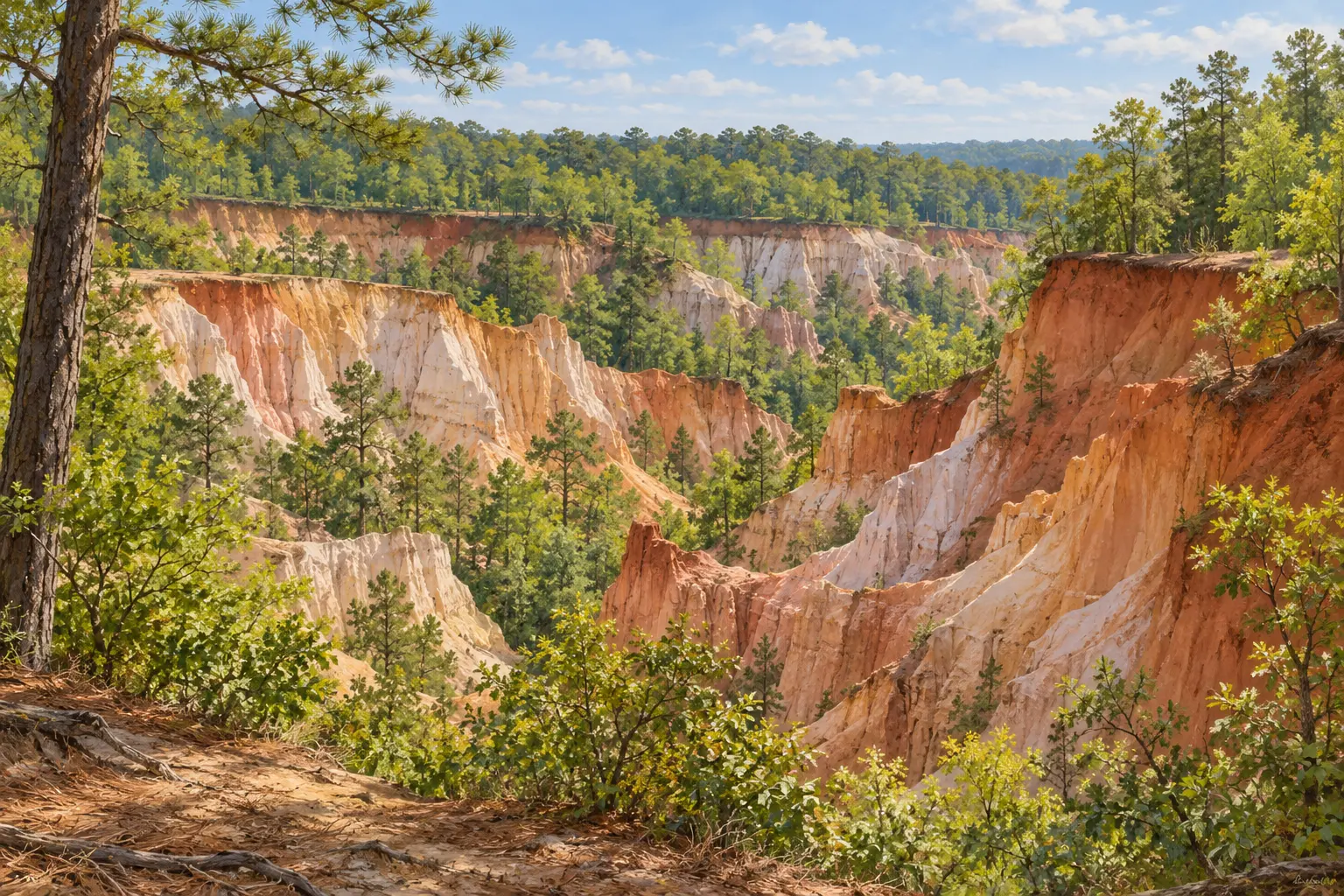
Providence Canyon's colorful gullies look like an ancient desert spectacle, but their dramatic growth is closely linked to nineteenth-century land clearing and farming. Removing forest cover exposed soft sediments to uncontrolled runoff, and small channels developed into deep gullies. Some now reach about 150 feet. The layers themselves are millions of years old; the rapid enlargement of the canyon is a much more recent story. It is a striking landscape that also records the consequences of losing protective soil cover.
2. A pioneering Atlantic steamship crossing depended mainly on sails
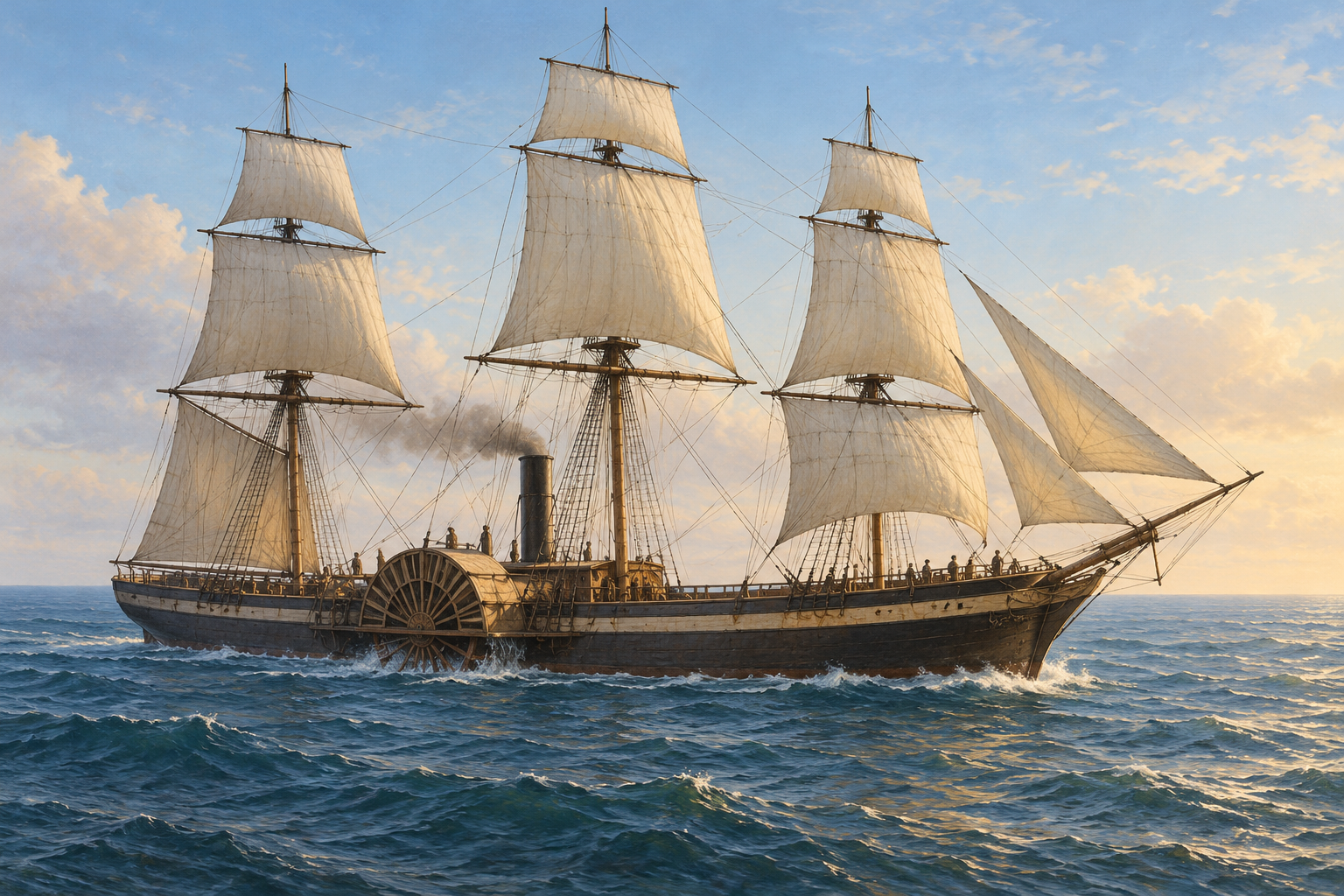
SS Savannah left its namesake Georgia port in May 1819 and reached Liverpool the next month, becoming famous for an early transatlantic voyage by a steam-equipped ship. It was a hybrid, carrying both sails and paddlewheels; its engine operated for only about 80 hours during the crossing. The venture was not a commercial success, and the vessel was later converted back into a sailing ship. The milestone belongs to the experimental transition between technologies, rather than a fully steam-powered Atlantic service.
3. Girl Scouts began in Savannah with eighteen girls and a carriage-house clubhouse
Juliette Gordon Low organized the movement's American beginnings in Savannah in 1912. The official founding date, March 12, marks the registration of eighteen girls in two patrols, after informal gatherings and recruitment around the city. The birthplace museum identifies that registration meeting with the Louisa Porter Home; the new clubhouse was a carriage house behind the Andrew Low House, made available by the tenants. A national organization grew from a small group learning knots, reciting its promise and sharing milk and crackers.
4. The Peach State helped build a major blueberry industry from wild plants
Georgia's peach identity can overshadow a remarkable blueberry-breeding story. University of Georgia researchers developed commercial varieties from native rabbiteye blueberry selections, with Thomas Brightwell laying important foundations in the mid-twentieth century. Later breeders expanded the work, and a variety named Brightwell honored his contribution. UGA's program has released more than fifty varieties over the decades. The berries reaching markets represent generations of selection for regional growing conditions, not simply the large-scale harvesting of unchanged wild bushes.
5. Martin Luther King Jr.'s birth certificate originally said Michael
The Atlanta-born civil rights leader entered the official record as Michael King. His birth certificate was filed under that name in April 1934 and amended in July 1957 to list Martin Luther King Jr. His father also moved from Michael toward the name Martin Luther, with the change becoming established around his 1934 European journey. The King Papers editors trace a gradual family history behind the familiar name, rather than a single tidy childhood naming ceremony preserved in the records.
6. Parts of the Okefenokee's landscape can float
In the Okefenokee Swamp, mats of peat can rise into floating formations called batteries. Grasses and flowers colonize them, and some eventually support trees, developing into islands known locally as houses. The swamp's mix of open water, wet prairies and wooded areas is constantly changing. Fire is another part of that history: during dry periods it can consume peat and reshape habitats. The seemingly permanent ground in this Georgia wetland is sometimes a movable layer of accumulated plant material.
 You might also like
Thirty Seconds in Tombstone: 15 Fascinating Facts About the Gunfight at the O.K. Corral
7. Colonial Georgia prohibited slavery before reversing the policy
Georgia's Trustees secured a parliamentary ban on slavery in 1735, linking their plans for small farms with colonial defense and economic policy. Settlers who wanted an enslaved labor force campaigned against the restriction, while illicit importation undermined it. The ban was overturned, with slavery permitted from January 1, 1751. Plantation interests rapidly gained power. This early reversal is essential to understanding how a colony established under one labor policy became part of the slaveholding plantation South.
8. An accountant gave Coca-Cola its name and flowing script
John S. Pemberton created the drink served at Atlanta's Jacobs' Pharmacy in 1886, but another person shaped its identity. His accountant Frank Robinson proposed the name Coca-Cola, believing the paired Cs would work well in advertising, and wrote it in Spencerian script. The familiar lettering therefore grew from bookkeeping and promotional judgment as well as Pemberton's pharmacy work. The brand's corporate history also records the early use of free-drink coupons, showing how marketing accompanied the recipe from the beginning.
9. Atlanta's enormous Civil War painting was repackaged as a Confederate victory
The Battle of Atlanta cyclorama was painted in Milwaukee in 1886 for northern audiences. Promoter Paul Atkinson later had Confederate prisoners repainted to look like fleeing Union soldiers and advertised the work in the South as a Confederate victory. During restoration in the 1930s, the figures became Confederate prisoners again. The battle itself had been a Union success. The changing uniforms make the giant painting an unusually concrete example of how commercial promotion and sectional loyalties reshaped the presentation of history.
10. An Atlanta runway crosses above an interstate highway
Hartsfield-Jackson's fifth runway, opened in 2006, required extraordinary bridge engineering across Interstate 285. The project included structures carrying both the runway and a taxiway over the road, accommodating the concentrated loads of large aircraft while preserving a major highway corridor below. For motorists, one part of the crossing resembles a tunnel beneath the airport landscape. The arrangement stacks two transportation systems on the same ground: highway traffic underneath, with aircraft using the runway above.
11. A bomber jettisoned a hydrogen bomb near Tybee Island after a collision
In February 1958, a B-47 bomber collided with an F-86 fighter near the Georgia coast. The bomber remained flyable but was badly damaged, and its pilot received permission to jettison the weapon it carried before attempting to land. The bomb fell into Wassaw Sound near Tybee Island. Searchers failed to recover it, and the Air Force declared it irretrievably lost that April. Later official investigations revisited the incident, turning an emergency flight decision into a long-running coastal history story.
12. Sapelo's ancient shell rings contain clues to a year-round community
On Sapelo Island, three large shell rings preserve deposits from people living on the Georgia coast thousands of years ago. Researchers examined shell growth bands and oxygen-isotope patterns to investigate when shellfish were collected. Their findings support at least some year-round occupation. Two rings accumulated substantially through everyday food consumption, while other areas suggest episodes of larger-scale processing. The rings are evidence of complex community life, and their formation cannot be reduced confidently to a single feast or a simple rubbish pile.
13. Etowah's ancient marble figures still carried traces of paint
Excavations at Etowah in the 1950s uncovered an extraordinary pair of seated marble figures, representing a man and a woman, with traces of their original paint. They came from a burial context within a major Mississippian town near present-day Cartersville. The sculptures show how much artistry accompanied the earthen mounds, farming and political life of these communities. Their surviving color also challenges the assumption that an ancient carved stone object must always have looked like bare white marble.
14. The D on an old American gold coin can mean Dahlonega
Long before Denver used D as its mint mark, the letter identified coins made at the U.S. branch mint in Dahlonega, Georgia. That mint operated from 1838 to 1861, processing gold from a rush that preceded California's famous discovery. The boom drew miners into Cherokee territory and intensified pressures leading to forced removal. A small letter on a coin therefore connects north Georgia's geology and federal manufacturing with the profound human consequences of the rush for gold.
15. A Georgia university sealed a room for people living in the year 8113
Oglethorpe University's Crypt of Civilization was sealed in 1940 with instructions to remain closed until May 28, 8113. Behind its welded stainless-steel door is a room-sized record of twentieth-century life: microfilmed texts, recordings and everyday objects, including Lincoln Logs and a Donald Duck doll. President Thornwell Jacobs wanted distant descendants to have the detailed evidence he found lacking for ancient societies. The ambitious archive imagines an audience more than six thousand years beyond its own time.
How did these facts land?
Know someone who'd love these facts? Share them 👇