1. They Are Apes, Not Monkeys
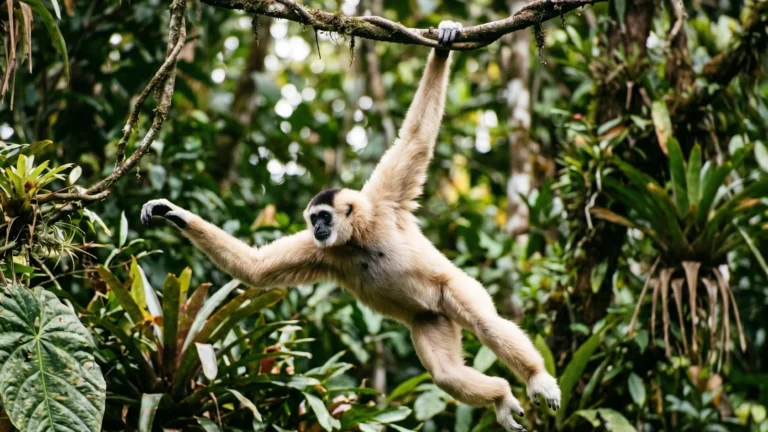
When observing a gibbon swinging through the trees, most people immediately assume they are looking at a monkey. In biological taxonomy, gibbons are actually true apes. The easiest way to tell the difference between a monkey and an ape is to look for a tail. Like chimpanzees, gorillas, orangutans, and humans, gibbons completely lack a tail. They rely entirely on their extreme sense of balance and specialized anatomy to navigate the high forest canopy without the need for a prehensile appendage.
2. The Absolute Masters of Brachiation
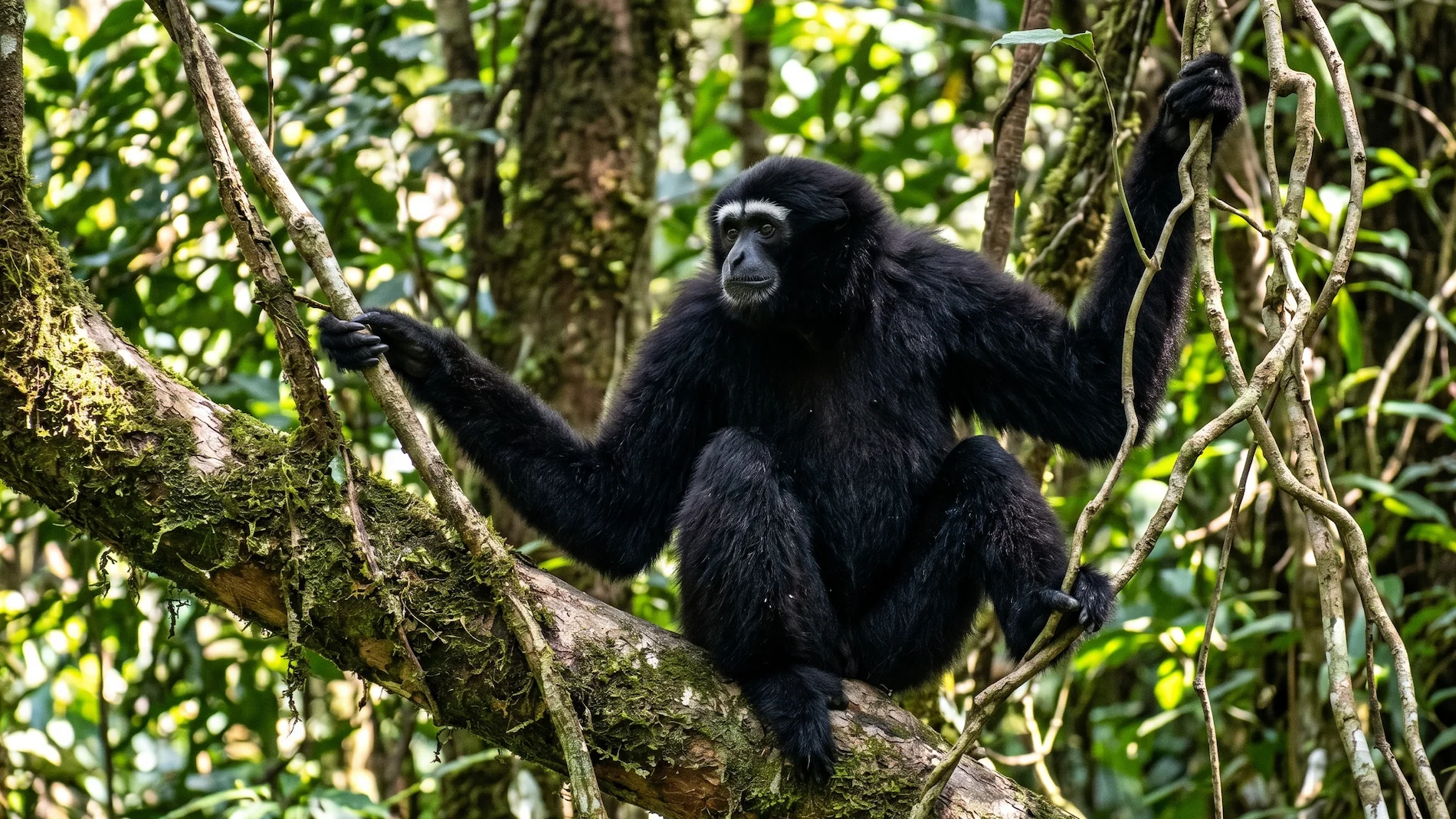
Gibbons are globally renowned for their incredible method of locomotion known as brachiation. This means they travel by swinging gracefully from branch to branch using only their arms. They are the fastest and most agile of all tree-dwelling, non-flying mammals. A healthy adult gibbon can launch itself across gaps as wide as fifty feet in a single bound and can easily reach swinging speeds of up to thirty-five miles per hour through the dense jungle foliage.
3. Their Wrists Are Biological Marvels
To survive the massive physical stress of high-speed swinging, gibbons have evolved a highly unique anatomical feature that no other ape possesses. Their wrists feature a specialized ball-and-socket joint, functionally similar to a human shoulder joint. This brilliant evolutionary adaptation allows their hands to rotate almost completely around without twisting the bones of their arms, drastically reducing the physical strain on their joints and preventing severe shoulder dislocations during their high-speed acrobatics.
4. They Walk on Two Legs
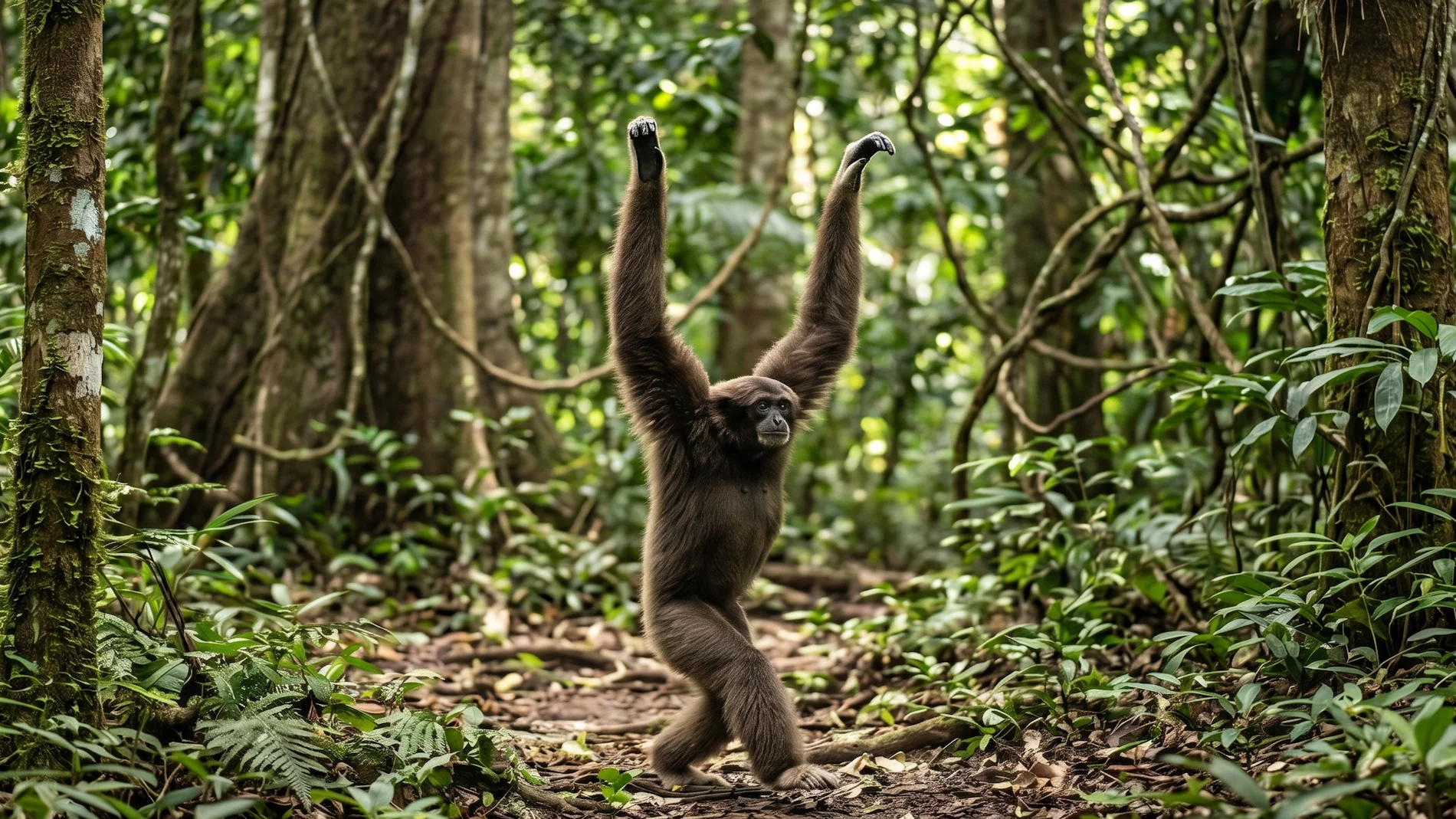
While they spend the vast majority of their lives in the trees, gibbons occasionally need to cross thick branches or travel briefly across the forest floor. When they do, they are completely bipedal, meaning they walk upright on two legs just like humans. Because their arms are so incredibly long and heavy, walking upright can be awkward. To maintain their center of gravity and prevent themselves from falling face-first, they hilariously hold their long arms straight up above their heads for perfect balance.
5. They Have the Longest Arms of Any Primate
The physical proportions of a gibbon are completely bizarre when compared to the rest of the animal kingdom. Relative to their overall body size, gibbons possess the longest arms of any primate on the planet. If a human being had the exact same physical proportions as a typical gibbon, their arms would easily drag on the floor while standing perfectly upright. This massive arm span is the key evolutionary trait that allows them to swing so effortlessly.
6. They Sing Complex Morning Duets
Gibbons are some of the most vocal land mammals on Earth. Every single morning, mated pairs climb to the very highest points of the forest canopy to perform a loud, complex, and beautifully synchronized musical duet. These echoing songs can last for over half an hour and can be heard over two miles away. The singing serves a highly practical purpose, allowing the couple to establish their physical territory, strengthen their emotional bond, and warn rival gibbons to stay away from their fruit trees.
7. The Siamang Possesses a Giant Throat Sac
The siamang is the absolute largest species of gibbon and is easily recognizable by a massive, hairless pouch of skin located directly under its chin. This highly specialized anatomical feature is called a gular sac. When the siamang prepares to sing, it inflates this sac with air until it becomes incredibly huge, frequently expanding to the exact same size as the animal’s entire head. The sac acts as a massive biological resonating chamber, completely amplifying their calls through the dense jungle.
8. They Mostly Mate for Life
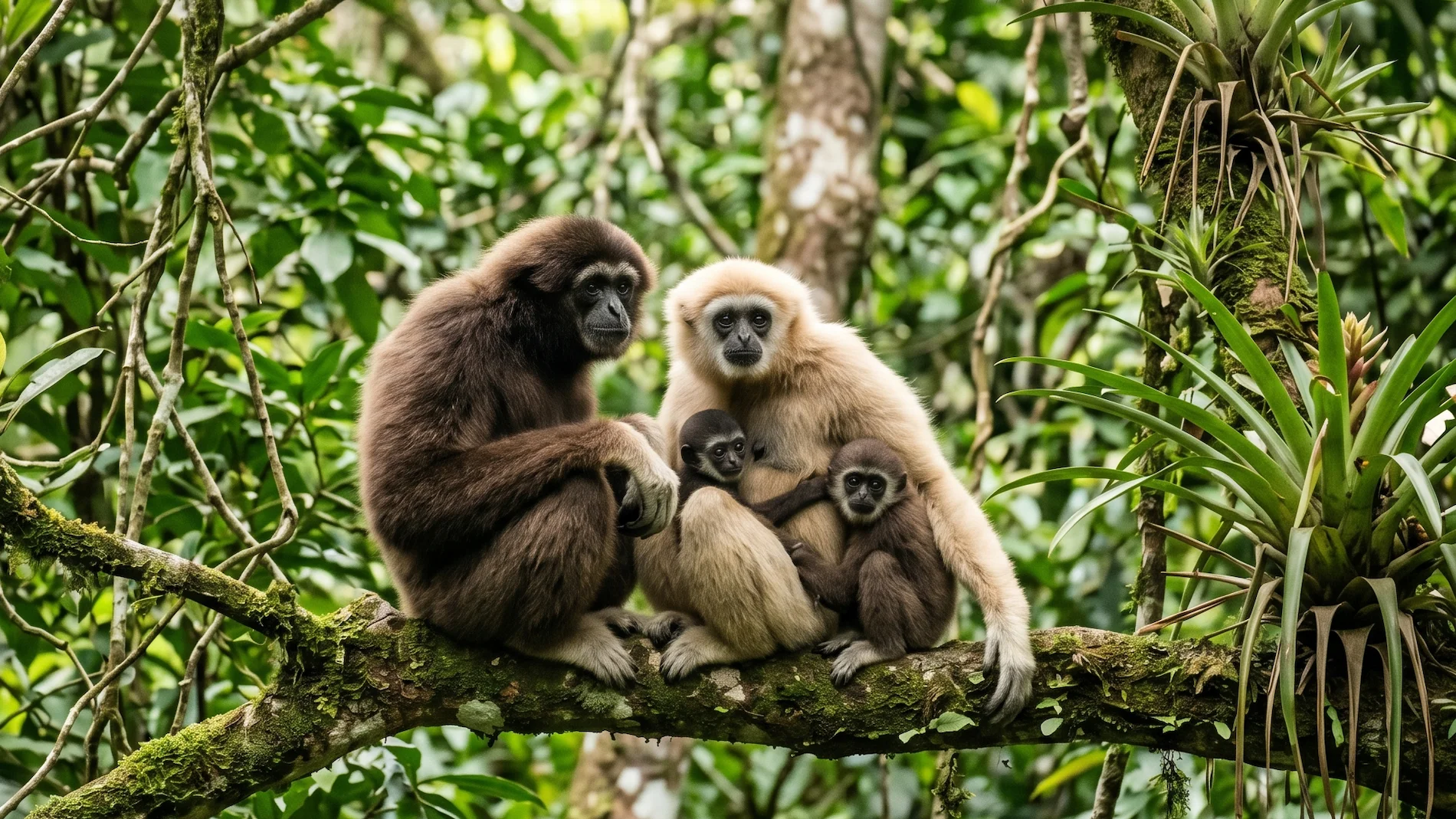
In the deeply complex social world of primates, strict monogamy is incredibly rare. Gibbons, however, are a notable exception to this biological rule. The vast majority of gibbon species form highly committed, long-term pair bonds that can last for their entire lives. A typical gibbon family unit looks surprisingly similar to a human nuclear family, consisting of an adult male, an adult female, and their dependent offspring living peacefully together in a highly defined territory.
9. Singing Replaces Physical Grooming
For chimpanzees and baboons, spending hours physically picking through each other’s fur is the primary method for maintaining peace and strengthening social bonds. Because gibbons are significantly smaller and highly active, they do not have the time to sit and groom each other all day. Evolutionary biologists believe that their elaborate, synchronized morning songs essentially replaced physical grooming. The act of singing perfectly together creates the exact same neurological bonding effects as physical touch.
10. They Suffer High Rates of Broken Bones
Living a life of extreme, high-speed aerial acrobatics comes with a massive physical cost. While gibbons are incredibly graceful, they are not perfect, and a single dead branch snapping can lead to a catastrophic fall. Biological surveys of wild gibbon skeletons have revealed a shockingly high rate of healed bone fractures. Researchers estimate that up to one third of all adult gibbons living in the wild have survived and successfully healed from a severe, bone-breaking fall during their lifetime.
11. They Have Built-In Seat Cushions
Unlike great apes that construct elaborate nests out of leaves and branches every single night, gibbons sleep completely exposed on high, narrow tree branches. To do this comfortably, they have evolved tough, thickened pads of heavily calloused skin on their rumps known as ischial callosities. These built-in biological seat cushions allow the gibbons to sit firmly and sleep perfectly upright on hard wooden branches for hours without losing circulation in their legs or slipping off in the night.
12. They Are Deeply Afraid of Water
Like many other species of apes, gibbons have a severe, instinctual aversion to deep water and simply cannot swim. Their bodies are completely devoid of buoyant fat, possessing extremely dense muscle mass and heavy bones designed entirely for swinging. If a gibbon falls into a deep river, it will instantly sink like a stone. Because of this fatal biological limitation, wide rivers frequently act as massive, impassable geographical barriers that separate entirely different species of gibbons from one another.
13. The Skywalker Hoolock Gibbon
In 2017, scientists exploring the remote, high-altitude forests of southwestern China discovered a completely new, previously unknown species of gibbon. The researchers noticing the white eyebrows and specific facial markings decided to name the new primate the Skywalker hoolock gibbon. The scientific name, Hoolock tianxing, literally translates to heavens movement, but the brilliant research team officially acknowledged they chose the name because they were massive fans of the Star Wars film franchise.
14. They Are Classified as Lesser Apes
In the scientific hierarchy of primates, the ape family is split into two distinct categories. Chimpanzees, gorillas, orangutans, and humans are officially classified as the great apes due to their massive physical size and highly complex cognitive abilities. Gibbons belong to their own separate family called Hylobatidae, and are universally referred to as the lesser apes. Despite the slightly derogatory name, they are simply smaller, faster, and much more specialized for an entirely arboreal lifestyle.
15. The Hainan Gibbon is the Rarest Primate
The gibbon family includes the absolute most critically endangered primate species on the entire planet. The Hainan gibbon, endemic to a single, tiny patch of forest on Hainan Island in China, was driven to the absolute brink of total extinction due to rampant logging and illegal poaching. At its lowest point in the 1970s, less than ten individuals remained alive. Thanks to extreme, highly aggressive conservation efforts, the population has slowly stabilized, but still hovers at only around three dozen individuals in the entire world.