
The Lawgiver King: 15 Fascinating Facts About Hammurabi
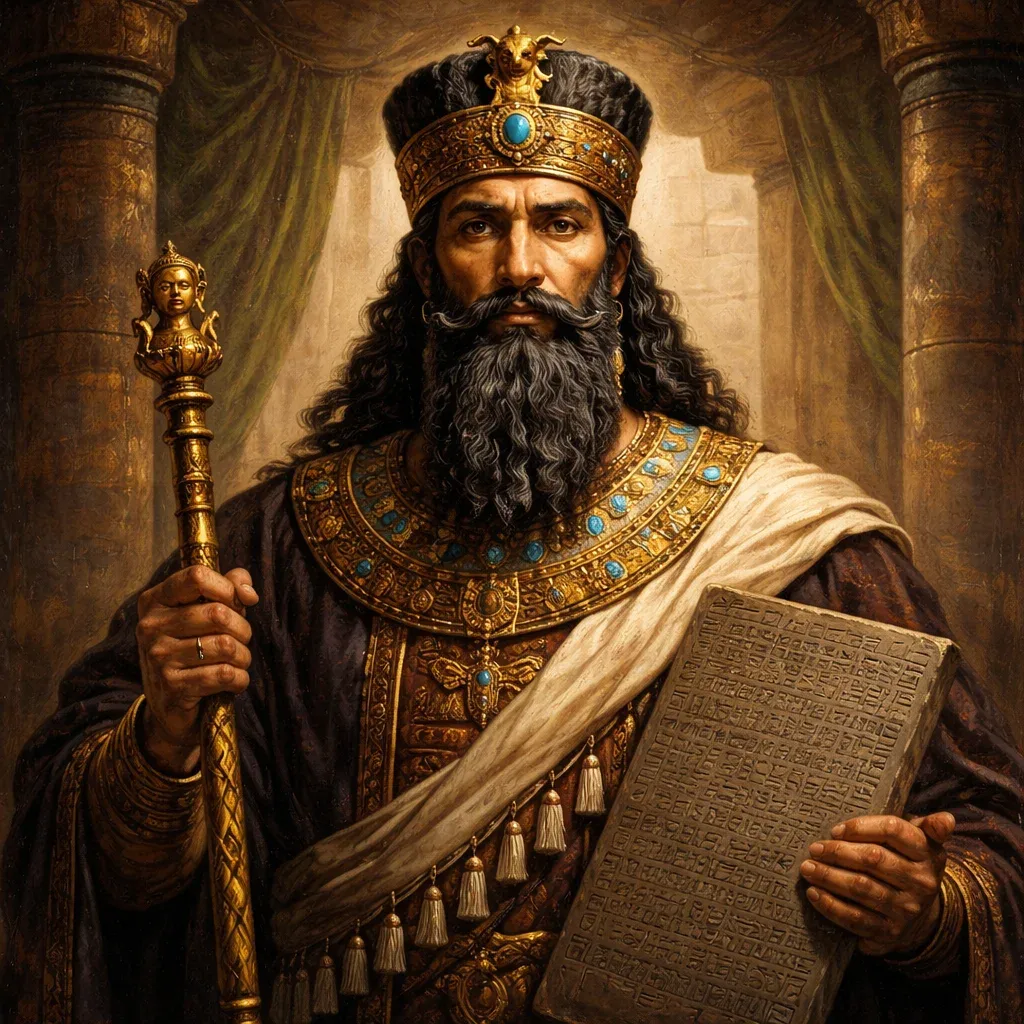
King Hammurabi of Babylon is best remembered as one of antiquity's greatest lawgivers, but his legacy extends far beyond the carved black stele that bears his name. From pioneering statutory legal codes and masterminding early hydrological warfare to micromanaging his empire's daily economy, Hammurabi transformed a modest city-state into a dominant Mesopotamian superpower. Although celebrated for his famous principle of an eye for an eye, his legal systems and political maneuvers were far more complex, ruthless, and revolutionary than traditional history books reveal. Here are 15 fascinating facts about Hammurabi, his ancient laws, and his lost empire.
1. He Was Not the First Ruler to Write a Law Code
While King Hammurabi is often remembered as the father of statutory law, his famous code was far from the first written legal system in human history. The Code of Ur-Nammu, established around 2100 BCE by the Sumerian ruler of Ur, predated Hammurabi’s legal text by approximately three centuries. Other earlier codes, such as the laws of Lipit-Ishtar and the Laws of Eshnunna, also provided clear legal precedent in ancient Mesopotamia. Rather than inventing legal codification from scratch, Hammurabi compiled, organized, and refined centuries of existing legal customs into a unified national text. By standardizing these traditions, he effectively transformed local tribal customs into a coherent imperial legal policy across his expanding empire.
2. The Famous Stele Was Stolen as War Booty and Found in Iran
Although Hammurabi erected his massive black stone stele in the Mesopotamian heartland, modern archaeologists actually discovered it hundreds of miles away in Susa, Iran. Around 1158 BCE, roughly six centuries after Hammurabi's death, the Elamite king Shutruk-Nakhunte raided the city of Babylon during a devastating military invasion. The Elamite conqueror looted the heavy stone monument and carried it back to his royal capital of Susa as a prized war trophy. In fact, Shutruk-Nakhunte even erased a portion of the text on the monument to carve his own royal inscription, though he never finished the task. French archaeologists led by Jacques de Morgan finally unearthed the famous stele in three large fragments during excavations at Susa in 1901.
3. The "Eye for an Eye" Principle Depended Entirely on Social Class
The famous doctrine of lex talionis, or retributive justice, was not applied equally to every citizen within the Babylonian Empire. Hammurabi's legal system divided society into three rigid classes: patricians, commoners, and enslaved people. Severe physical retaliation, such as taking an eye for an eye or a tooth for a tooth, applied exclusively when a noble harmed a victim of equal social status. If a nobleman blinded or broke the limb of a commoner, the perpetrator did not suffer corporal punishment but was simply required to pay a designated fine in silver. Should a noble harm an enslaved person, the offender merely paid half the slave's purchase value directly to the owner as compensation.
4. Cheating Tavern Keepers Faced Execution by Drowning
In ancient Babylon, beer was a staple beverage for daily nutrition, and the state took its quality control and pricing extremely seriously. Hammurabi's code strictly regulated the price and strength of ale, imposing severe penalties on dishonest alewives and tavern owners. If a female tavern keeper watered down her beer, charged inflated prices, or accepted silver instead of grain during harvest season, the law commanded officials to throw her into the river to drown. Furthermore, taverns were seen as potential hubs for political subversion and criminal conspiracy. If an alewife allowed outlaws to congregate in her establishment without reporting them to royal officials, she faced the death penalty.
5. He Used Water as a Devastating Military Weapon
Hammurabi was a brilliant strategist who frequently weaponized the waters of the Euphrates River to crush rival city-states. During his military campaigns against southern cities like Larsa and Isin, he constructed massive dams upstream to cut off essential water supplies. This tactic deprived enemy populations of drinking water and dried up the irrigation canals needed for their crops, starving the cities into submission. Alternatively, once the upstream reservoirs were filled, Hammurabi would breach the dams suddenly to release catastrophic flash floods downstream. These artificial deluges destroyed enemy defensive fortifications and inundated agricultural fields, making water one of his most lethal tools of conquest.
6. Builders Were Held Personally Liable with Lethal Consequences
The Code of Hammurabi contained some of the earliest recorded building codes, holding architects and construction workers directly accountable for their craftsmanship. If a contractor constructed a house poorly and the structure collapsed, killing the owner, the law dictated that the builder himself must be executed. The principle of retributive justice extended even further down the family line to protect property rights. If the structural collapse resulted in the death of the homeowner’s son, the law mandated the execution of the builder’s own son. If the collapse destroyed personal property without killing anyone, the builder was obligated to rebuild the house entirely at his own expense and replace all damaged goods.
7. He Claimed the Gods Personally Mandated His Laws
To ensure absolute obedience from his subjects, Hammurabi framed his legal code as a divine decree rather than a human political creation. At the top of the seven-foot black diorite stele, a detailed bas-relief carving depicts Hammurabi standing humbly before Shamash, the Mesopotamian god of justice and the sun. In the relief, Shamash sits on a throne and presents Hammurabi with the staff and ring, traditional symbols of royal authority and divine justice. By visually connecting his authority to the sun god, Hammurabi convinced his subjects that violating royal law was an act of direct blasphemy against heaven. The extensive epilogue of the code explicitly warns that any future ruler who alters or erases the laws will be cursed by the gods with plague, famine, and destruction.
8. He Micromanaged Every Detail of His Empire via Letters
Surviving clay cuneiform tablets reveal that King Hammurabi was an obsessive administrator who micromanaged the day-to-day operations of his realm. Hundreds of letters written directly in his hand demonstrate that he personally oversaw trivial local matters across distant provinces. He frequently wrote to provincial governors complaining about the poor quality of royal sesame oil, ordering the clearing of clogged irrigation ditches, or demanding explanations for delayed sheep shearing. Hammurabi even personally investigated claims of official corruption, bribed witnesses, and land disputes among lower-class citizens. This intense central oversight allowed him to maintain firm political control over a newly conquered, highly volatile empire.
9. Accusers Faced the Death Penalty if They Failed to Prove Their Case
To prevent malicious accusations and perjury from overwhelming the court system, Hammurabi’s code established an exceptionally strict burden of proof. The very first law listed in the entire code states that if a man accuses another of a capital crime but cannot provide sufficient evidence, the accuser himself must be put to death. This severe policy ensured that citizens only brought serious, verifiable claims before royal judges. Similarly, if a witness offered false testimony during a capital trial, that witness faced execution under the exact same penalty the accused would have suffered. By making false claims a life-or-death risk, the code discouraged frivolous lawsuits and revenge accusations.
10. Difficult Cases Were Decided Through the "Ordeal by Water"
When judges faced complex legal disputes with conflicting testimony and no physical evidence, they relied on a ritual known as the Ordeal by Water. Suspects accused of witchcraft, treason, or marital infidelity were forced to jump into the sacred Euphrates River to let the river god determine their guilt. It was believed that the divine river would sink and drown the guilty while floating and saving the innocent. If the suspect survived the turbulent waters and reached the shore safely, they were declared innocent, and the false accuser was promptly executed. Surprisingly, survivors were even awarded the property of their defeated, executed accusers as compensation for enduring the terrifying ordeal.
11. The Code Established Some of the World's First Wage Standards
Hammurabi recognized that economic stability was vital to imperial security, so he incorporated fixed wage structures into his laws. The code specified minimum daily wages for various skilled and unskilled professions across the empire. Field laborers, ox drivers, herdsmen, and woodworkers were guaranteed specific amounts of grain or silver per day worked. The law also capped the daily rental fees for essential agricultural equipment like draft oxen, farm wagons, and riverboats to protect poor farmers from predatory pricing. By creating standardized wages and equipment rental rates, Hammurabi attempted to prevent economic exploitation and maintain a stable, productive labor force.
12. He Betrayed His Closest Ally to Mastermind His Empire
Hammurabi’s path to supreme power was defined by cold political calculation and treacherous diplomatic maneuvers. Early in his reign, Hammurabi formed a critical military alliance with King Zimri-Lim of Mari, a powerful city-state located along the Euphrates trade routes. For decades, Zimri-Lim provided military troops, intelligence, and supplies that helped Hammurabi defeat mutual enemies like the Elamites and Larsa. However, once Hammurabi had secured dominance over southern Mesopotamia, he turned his army against his faithful ally. In 1761 BCE, Hammurabi invaded Mari, sacked its city walls, looted its vast treasury, and burned Zimri-Lim’s legendary royal palace to the ground.
13. Babylonian Women Possessed Surprising Legal Rights
While ancient Babylonian society was undeniably patriarchal, Hammurabi’s legal code granted women a surprising degree of formal legal protection and economic autonomy. Women were permitted to own, inherit, buy, and sell real estate independently of their husbands or male relatives. They could also operate independent businesses, work as merchants, and initiate formal divorce proceedings under specific circumstances such as spousal neglect or cruelty. If a husband fell ill or suffered a chronic disease, the code strictly forbade him from abandoning his wife, requiring him to maintain her financially for life. Furthermore, if a husband died, his widow was legally entitled to retain her marriage dowry and secure a portion of her late husband's estate.
14. The Seven-Foot Monument Was Carved in the Shape of a Giant Index Finger
The physical design of Hammurabi's famous law stele was intentionally crafted to serve as a powerful visual symbol of royal authority. Standing over seven feet tall and sculpted from a single slab of dark, highly polished diorite, the stone naturally resembles a giant index finger pointing toward the heavens. Historians and art theorists believe this specific shape was chosen to represent the king physically pointing out the divine law to his subjects. The smooth surface below the top relief is densely covered with over 4,000 lines of cuneiform text written in the Akkadian language. Designed to be displayed publicly in major city temples, the intimidating monument visually projected order across the kingdom even to citizens who could not read.
15. His Empire Collapsed Quickly After His Death Under His Son's Reign
Despite Hammurabi’s administrative genius and military success, the mighty empire he constructed collapsed within a single generation following his death in 1750 BCE. His son and successor, Samsu-iluna, inherited a vast kingdom that was fundamentally unstable and deeply resentful of central Babylonian rule. Almost immediately, southern cities like Larsa, Ur, and Uruk launched widespread rebellions to regain their independence. Samsu-iluna spent his entire reign fighting constant civil wars, economic decline, and invasions from neighboring Kassite tribes. Within decades, Babylon lost control over most of its southern territories, reducing Hammurabi’s once-mighty empire back to a small, localized regional state.
Sources & References
This AI-assisted post was rigorously curated and fact-checked for accuracy by:
 Martin Roháček
How fun was this article? 🤔
Tap a star to rate it
🧠 Quiz: How closely were you paying attention?
10 questions — all answers are in the article above!
Enjoyed these facts? There's more! 💌
Fresh fun facts in your inbox. No spam, ever.