
15 Surprising Facts About Horseshoe Crabs
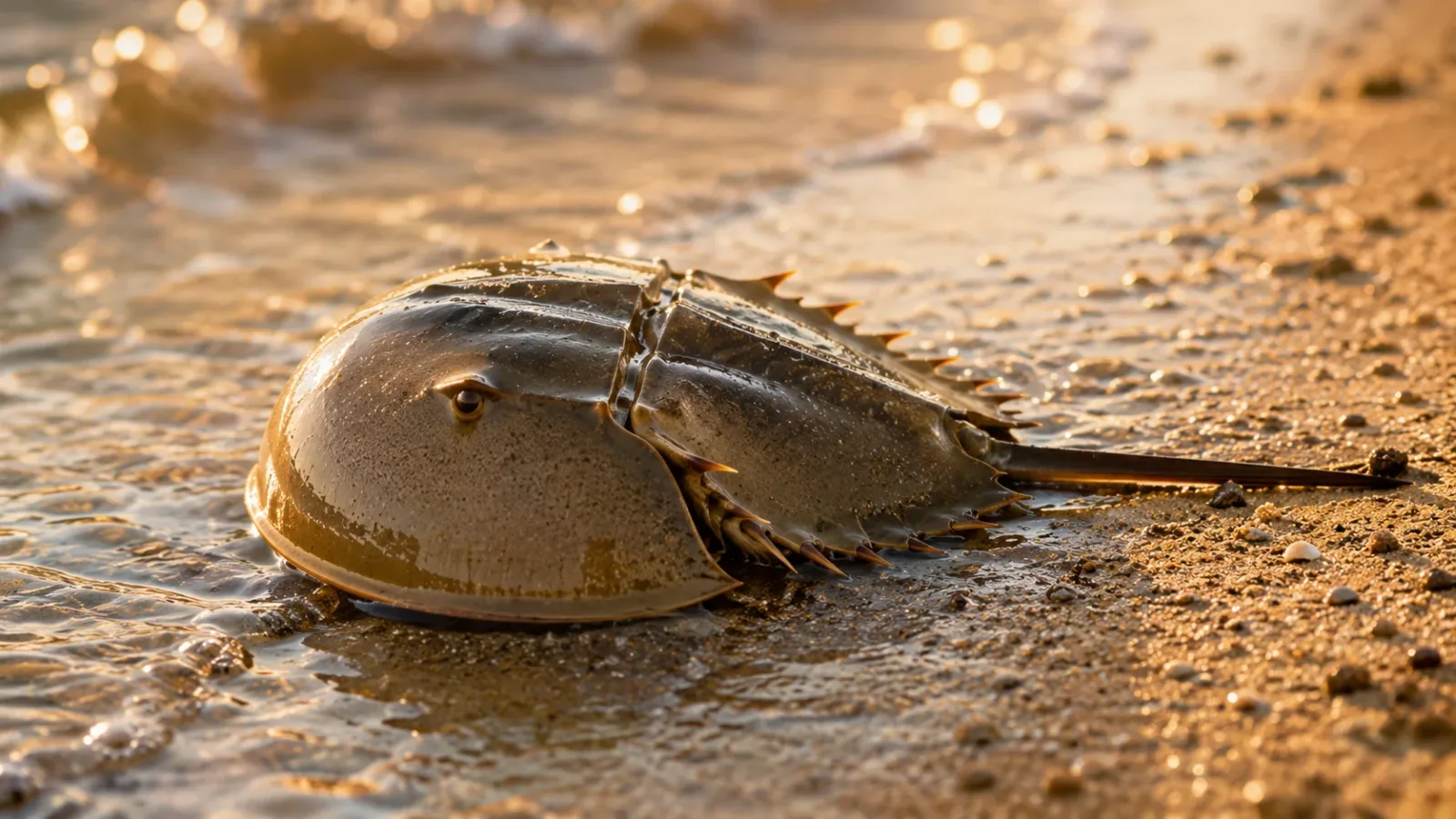
Horseshoe crabs are quiet, armored marine animals that make their homes along shallow coastal waters and sandy beaches. Despite looking like creatures from a science fiction movie, they are common visitors to the shorelines of North America and parts of Asia. With their hard, helmet-like shells and long, pointed tails, they have survived largely unchanged for millions of years. Discover the trusted, curious truths behind these resilient and highly useful ocean dwellers.
1. They Are Not Actually Crabs
Despite their common name and hard outer shells, horseshoe crabs are not true crabs at all. In the scientific world, true crabs and lobsters belong to a group called crustaceans. Horseshoe crabs are actually part of a different subphylum called Chelicerata. This means their closest living relatives are land-dwelling arachnids, such as spiders, scorpions, and ticks, rather than the true crabs you might find in a tide pool.
2. They Are Older Than Dinosaurs
These animals are frequently referred to as “living fossils” because their basic body design has remained largely the same for hundreds of millions of years. Fossil records show that the ancestors of modern horseshoe crabs were swimming in the oceans around 445 million years ago. This means they existed long before the first dinosaurs walked the Earth and have successfully survived several major global extinction events.
3. Their Blood is Bright Blue
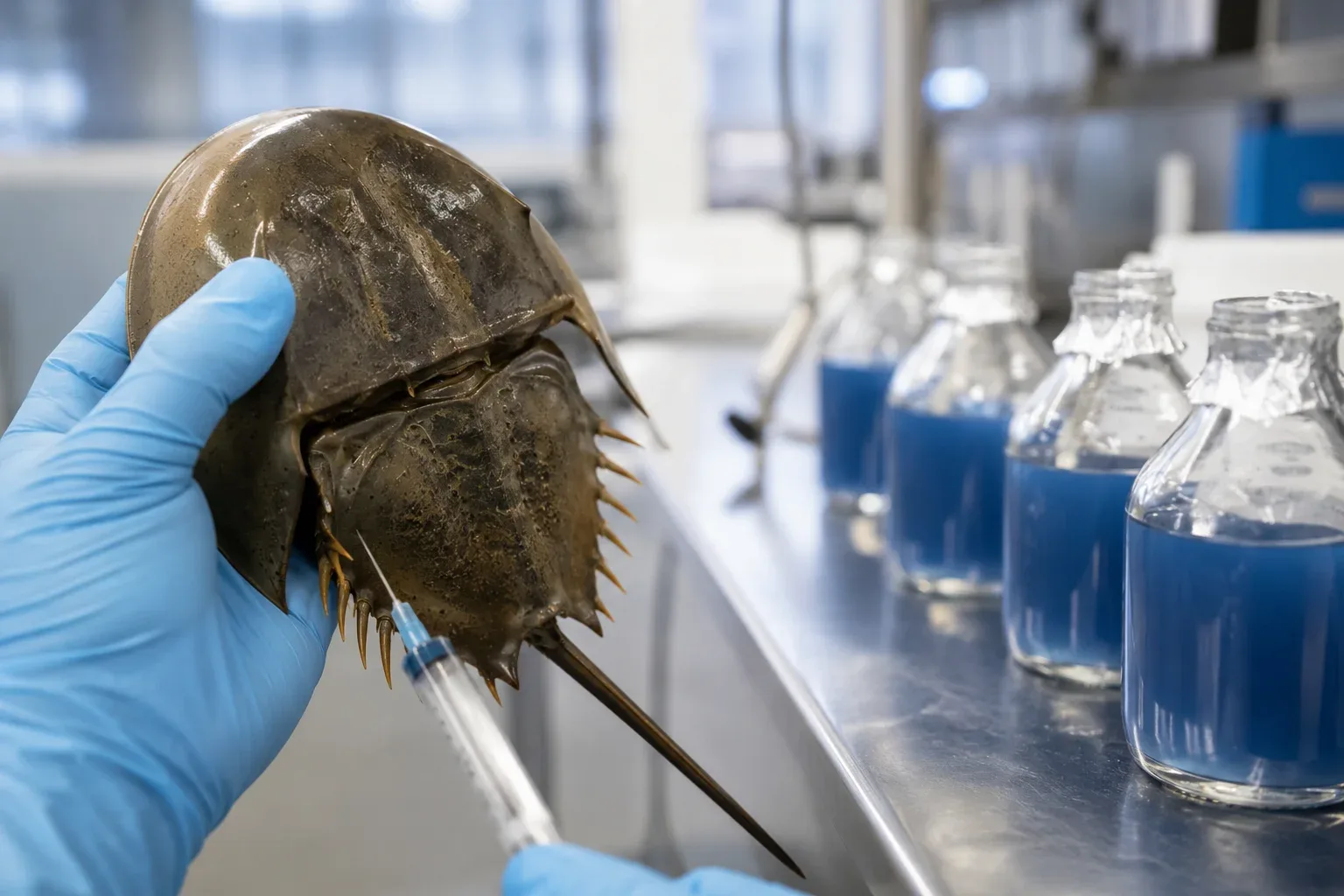
When humans and most other mammals get a scrape, the blood that appears is red because it relies on iron to carry oxygen throughout the body. Horseshoe crabs have a completely different internal chemistry. Their blood contains a protein called hemocyanin, which uses copper rather than iron to transport oxygen. When this copper-based blood is exposed to the air, it turns a distinct, bright blue color.
4. They Help Keep Human Medicine Safe
The blue blood of the horseshoe crab contains a special chemical substance that is highly sensitive to dangerous bacterial toxins. Medical researchers use a test derived from this blood, known as the LAL test, to ensure that vaccines, intravenous drugs, and implantable medical devices like pacemakers are completely free of harmful bacteria. Anyone who has ever had a medical injection has benefited from the horseshoe crab.
5. They Have Nine Different Eyes
While they might look like they have poor vision under that heavy shell, horseshoe crabs actually have a complex visual system composed of nine separate eyes. The two large, obvious compound eyes on the sides of their shell are primarily used for finding mates. They also have a cluster of smaller eyes near the front of their shell that are sensitive to ultraviolet light, plus additional light receptors situated along their tails to help them sense the time of day.
6. Their Tails Are Not Weapons
Many beachgoers are intimidated by the horseshoe crab’s long, stiff tail, assuming it is a venomous stinger or a sharp weapon. In reality, the tail, which is officially called a telson, is completely harmless. Because the crab’s heavy shell makes it quite clumsy, it frequently gets flipped upside down by strong ocean waves. It uses the rigid tail purely as a lever to push against the sand and flip itself right-side up.
 Marine and Freshwater Animals
See All Facts
Marine and Freshwater Animals
See All Facts
7. They Swim Upside Down
While adult horseshoe crabs spend most of their time acting like heavy tanks, slowly crawling along the ocean floor, the younger crabs have a different way of getting around. Juvenile horseshoe crabs frequently swim through the water completely upside down. They use the flapping motion of their specialized gills to propel themselves backward and navigate through the water before they grow too heavy to do so easily.
8. They Chew Their Food With Their Legs
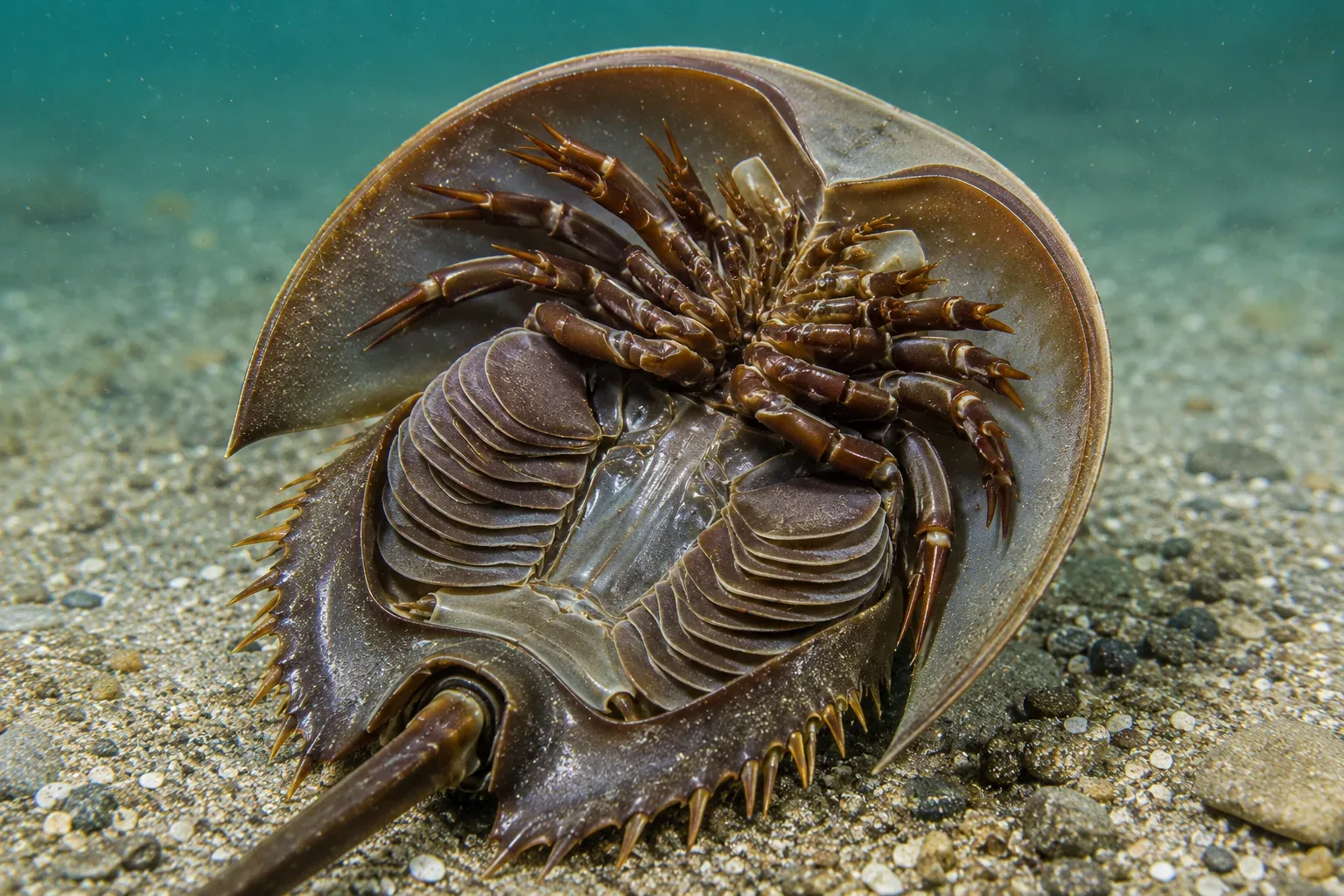
Because they do not have jaws or teeth like many other animals, eating requires a bit of multitasking. The horseshoe crab’s mouth is located right in the center of its underside, surrounded by its legs. The upper parts of these legs are lined with thick, hard bristles. When the crab finds a tasty sea worm or clam, it uses the base of its walking legs to crush and grind the food into small pieces before pushing it into its mouth.
9. They Breathe Through “Book Gills”
To absorb oxygen from the ocean water, horseshoe crabs use a set of specialized breathing organs located on their undersides. These organs are made up of dozens of thin, overlapping flaps of tissue that look very similar to the turning pages of a book, earning them the name “book gills.” The crab constantly flaps these gills to keep fresh water flowing over them, and they also use them to help propel themselves along the sea floor.
10. Females Are Noticeably Larger
When observing a pair of horseshoe crabs on the beach, it is usually very easy to tell which one is the male and which is the female. In this species, the females grow to be significantly larger and heavier than the males. A fully grown female can measure up to 19 inches long from head to tail, while the males typically stop growing around 14 to 15 inches long.
11. They Molt Up to 17 Times
Because their thick, rigid outer shells cannot grow or stretch, a horseshoe crab must periodically shed its shell to get bigger. This process is called molting. The crab forms a new, soft shell underneath the old one, then crawls out of a slit in the front of the hard shell. It takes about 10 years and up to 17 separate molting cycles for a young horseshoe crab to finally reach its full adult size.
12. They Follow the Moon to Breed
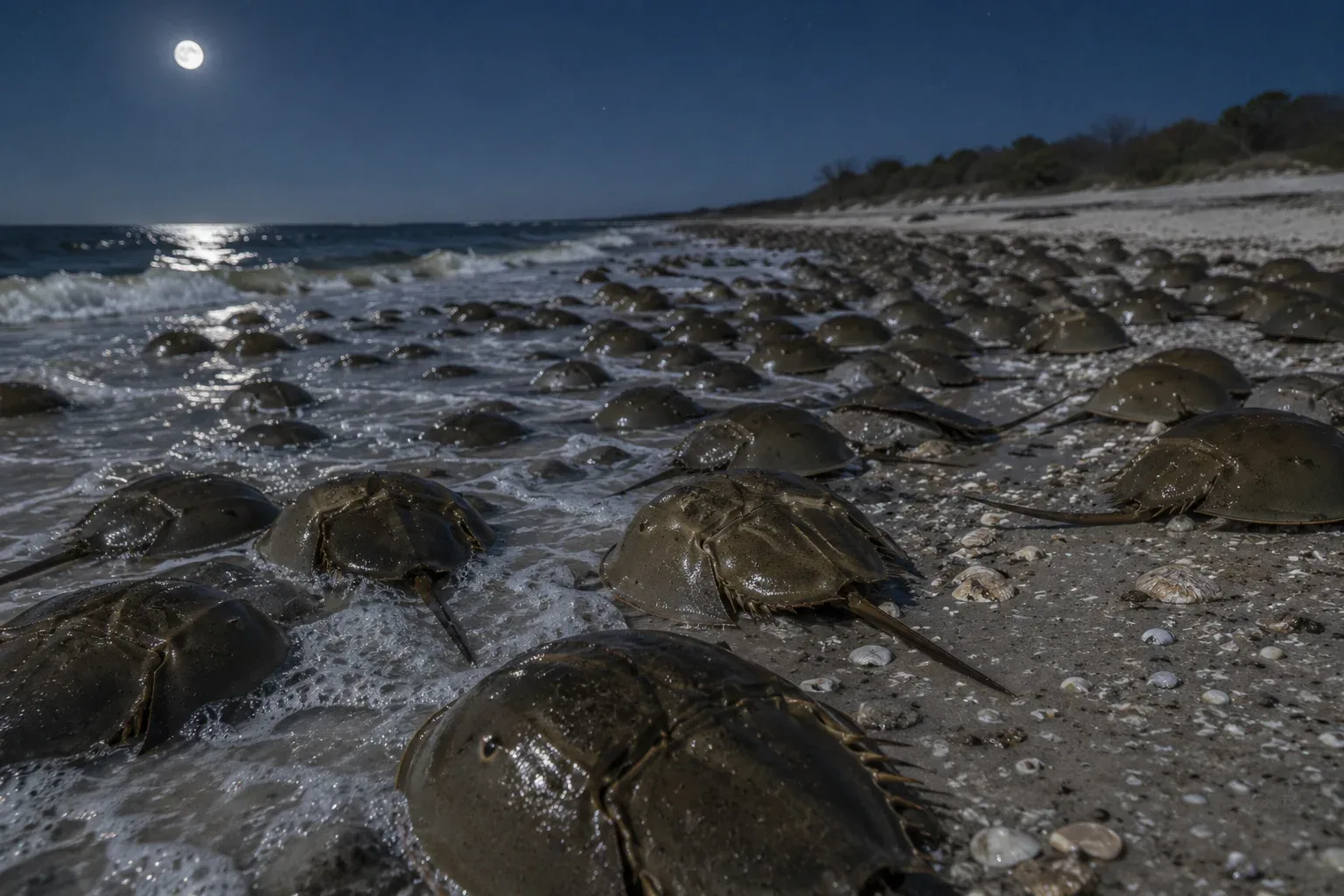
Horseshoe crabs have a highly synchronized breeding schedule that relies heavily on the lunar cycle. During the spring and early summer, they wait for the highest tides, which occur during the new and full moons. Under the cover of darkness, tens of thousands of crabs will crawl out of the ocean and onto sandy beaches at the exact same time to safely bury their eggs at the high-water mark.
13. Their Eggs Fuel Migrating Birds
The massive spawning events of the horseshoe crab are a critical part of the coastal food web. A single female can lay tens of thousands of tiny, green eggs in the sand. Every year, huge flocks of migrating shorebirds, such as the Red Knot, time their long journeys perfectly to arrive on the beaches just as the crabs are spawning. The fat-rich eggs provide the exact fuel the birds need to finish flying to the Arctic.
14. They Keep the Ocean Floor Tidy
When they are not migrating to the beaches to breed, horseshoe crabs are busy acting as the cleaning crew of the shallow seas. They spend their nights slowly digging through the sand and mud on the ocean floor. Their constant plowing turns over the sand, keeping the sediment healthy, while they hunt for their favorite meals of marine worms, small clams, and bits of algae.
15. They Are Completely Harmless to Handle
Despite their somewhat spiky appearance and their relation to scorpions, horseshoe crabs are gentle creatures that pose no threat to humans. They do not bite, they do not sting, and they have no venom. If you ever find one stranded upside down on the beach, it is safe to help it out. Experts recommend gently picking them up by the sides of their main shell—never by the tail—and simply turning them back over toward the water.
Sources & References
This AI-assisted post was rigorously curated and fact-checked for accuracy by:
 Martin Roháček
How fun was this article? 🤔
Tap a star to rate it
🧠 Quiz: How closely were you paying attention?
10 questions — all answers are in the article above!
Enjoyed these facts? There's more! 💌
Fresh fun facts in your inbox. No spam, ever.