
1. They Are in a Family of Their Own
In the scientific classification of birds, most species share a family tree with dozens of close cousins. The ibisbill is so structurally and genetically distinct that scientists placed it into its own exclusive family, Ibidorhynchidae. While it shares some distant evolutionary history with oystercatchers and avocets, there is no other bird on Earth quite like it, and it has no subspecies.
2. The Name is Slightly Misleading
When you hear the name “ibisbill,” you might assume this bird is closely related to the long-legged ibises found in tropical wetlands. In reality, the two birds are entirely unrelated. The name simply comes from a case of convergent evolution; the ibisbill developed a long, downward-curving red beak that happens to look almost exactly like the beak of an ibis, which it uses for a similar style of foraging.
3. They Are Masters of Stony Camouflage
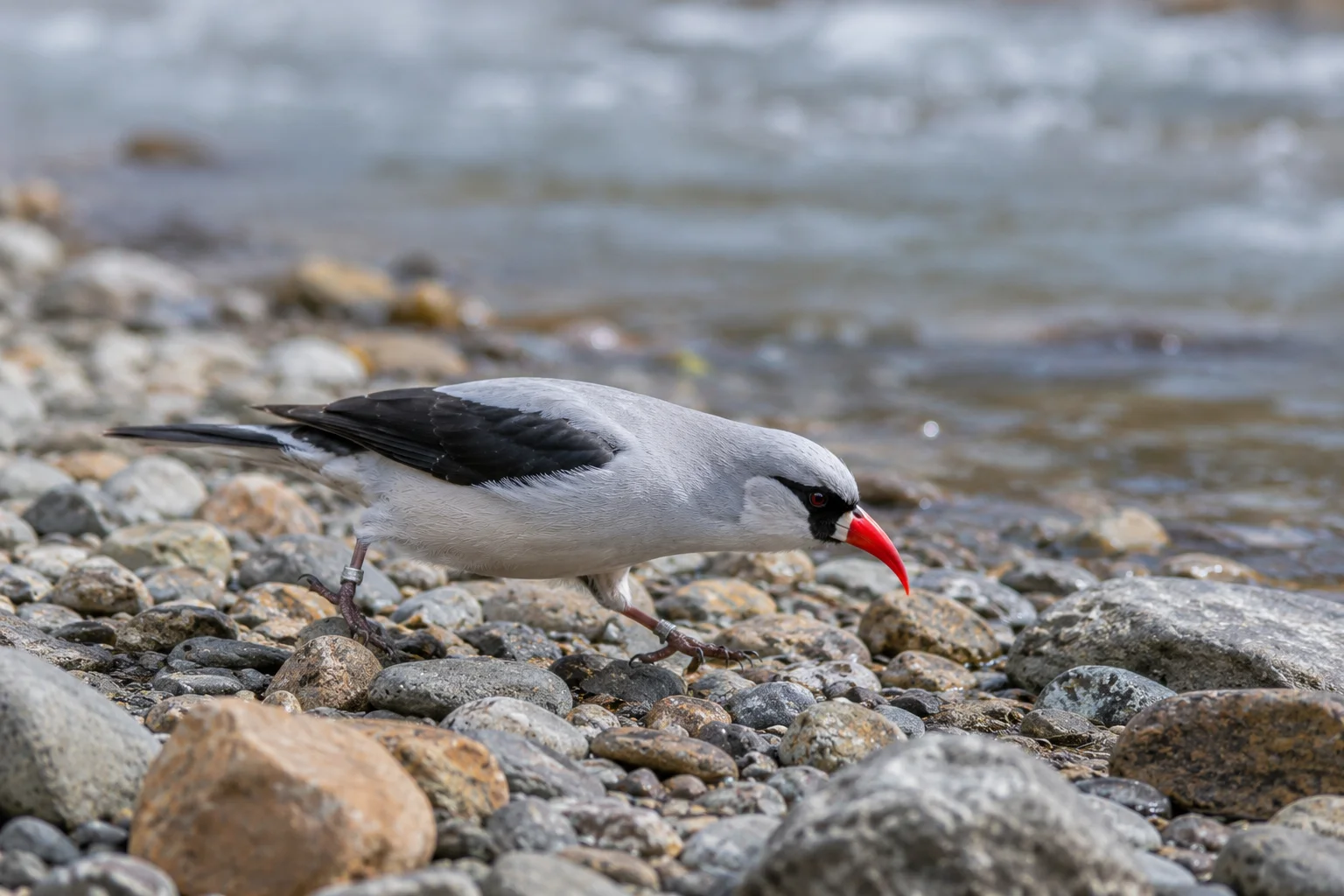
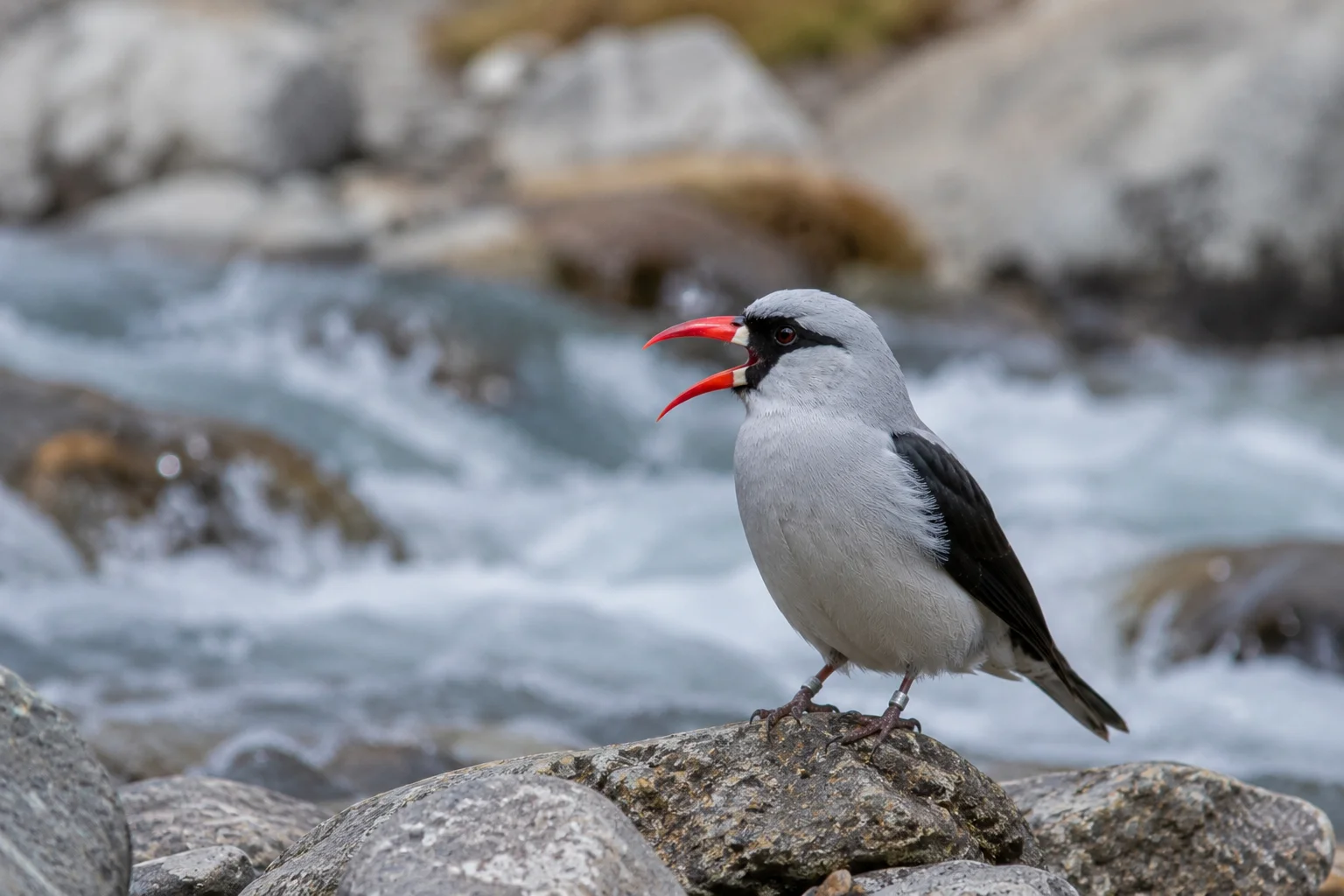
If you look at an ibisbill up close, it has bold coloring: a bright crimson beak, a striking black mask across its face, a black band on its chest, and pale grey feathers. However, against the backdrop of a Central Asian riverbed, these contrasting colors break up the bird’s outline perfectly. When it stands completely still among smooth grey river stones and dark shadows, the bird becomes nearly invisible to predators.
4. They Live at Extreme Altitudes
The ibisbill thrives in an environment where many other shorebirds would struggle to survive. They prefer to breed along the rocky, shingle riverbanks of the Tibetan Plateau, the Himalayas, and parts of the Tien Shan mountains. During the warmer breeding months, they can regularly be found at staggering elevations ranging from 5,600 to over 14,000 feet above sea level, where the air is thin and the water is frigid.

5. They Are Missing a Back Toe
Most birds have four toes on each foot—three pointing forward and one pointing backward—to help them perch on branches. Because the ibisbill spends its entire life walking on flat, smooth river stones and wading through shallow water, it completely lost the need for a hind toe through evolution. They rely entirely on three forward-facing toes, which feature a tiny web of skin to help them walk on wet pebbles.
6. Their Beak is a Specialized Probe
The ibisbill’s signature curved beak is not designed for catching fish in open water or cracking seeds. Instead, it is a highly specialized tool used for probing underneath heavy, submerged rocks. The bird wades into the shallow edges of slow-moving rivers and uses its beak to feel around in the dark crevices beneath the gravel, pulling out hidden caddisfly larvae, mayflies, and other aquatic insects.
7. They Are Unexpectedly Good Swimmers
While they are classified as wading birds and spend most of their time walking along the shoreline, ibisbills are actually highly capable swimmers. If they need to cross a deep, fast-flowing channel of melted glacier water to reach a new feeding spot, they will often choose to swim directly across the freezing river rather than wasting energy taking flight.
8. They Practice a “Head-Down” Run
When the breeding season arrives, ibisbills become very protective of their chosen river territory. If they need to move quickly across the stones without drawing too much attention from eagles or neighboring rivals, they use a distinct running posture. They lower their heads down near the rocks and scurry quickly over short distances, only standing fully upright when they need to scan their surroundings.
9. Their Nests Are Extremely Simple
Unlike songbirds that weave complex, hanging nests out of grass and spiderwebs, the ibisbill prefers a much simpler approach. Their nest is little more than a shallow scrape made directly on the ground of a pebbly riverbank or a small mid-river island. Sometimes, the parents will arrange a few small, smooth pebbles around the edges of the scrape before laying their two to four oval-shaped eggs.
10. They Will Occasionally Eat Small Mammals
For decades, scientists believed that the ibisbill’s diet consisted exclusively of aquatic insects, worms, and the occasional small fish. However, recent field observations in the Kashmir region revealed a surprising addition to their menu. Researchers documented ibisbills successfully capturing and eating small voles (a type of field mouse) near the riverbanks, proving they are opportunistic hunters when extra protein is available.
11. Winter Forces Them Down the Mountain
While the ibisbill is well-adapted to cold weather, it cannot survive when its feeding grounds completely freeze over solid. As the harsh Himalayan winter sets in and high-altitude rivers turn to thick ice, the birds are forced to migrate. They travel down the mountain slopes to lower elevations—sometimes dropping all the way down to 330 feet above sea level—to find flowing water where they can still probe for food.
12. They Sound Like a Ringing Bell
Because they live near the constant, rushing noise of mountain rivers, ibisbills need a vocalization that can carry over the sound of the water. They communicate using a sharp, ringing whistle that sounds like “klew-klew.” This clear, penetrating call helps scattered pairs keep track of each other across wide, stony valleys during the breeding season.
13. Males and Females Look Nearly Identical
In many bird species, the males display brightly colored feathers to attract mates, while the females remain dull and camouflaged to hide on the nest. The ibisbill does not follow this pattern. Both sexes wear the exact same grey, black, and white plumage and feature the same bright red beak. The only slight difference is that the female’s beak is occasionally a fraction of an inch longer than the male’s.
14. They Are a Major Prize for Birdwatchers
Because they live in remote, politically complex, and physically demanding environments, seeing an ibisbill in the wild is a rare achievement. Birdwatchers from all over the world often plan extensive, high-altitude trekking trips to regions like Bhutan, Nepal, or Kazakhstan just for the chance to spot one. They are frequently considered the “bird of the trip” by those lucky enough to find them.
15. Their Legs Change Color Mysteriously
One of the more unusual physical traits of the ibisbill involves the color of its legs. In healthy, living adults, the legs are typically a muted, greyish-purple color. However, early naturalists and museum collectors noted a strange phenomenon: shortly after an ibisbill dies, a chemical and physical change causes its legs to turn a bright, vivid crimson color that matches its beak.