The Bloody Revenge: 15 Fascinating Facts About Kill Bill
Quentin Tarantino's martial arts revenge saga Kill Bill stands as one of the most stylized and celebrated action duologies in cinematic history. From practical arterial blood spray engineered with Chinese condoms to intense behind-the-scenes injuries and hidden Easter eggs, the two-part epic is packed with surprising trivia. Discover how grueling stunt work, classic cinema homages, and famous Hollywood friendships shaped Uma Thurman's iconic role as The Bride.
1. The Infamous Convertible Crash That Strained Tarantino and Thurman's Bond
Uma Thurman suffered severe real-life injuries while filming a high-speed driving scene in a blue 1973 Volkswagen Carmen Ghia convertible. The car's seat was improperly modified and unsecured, causing Thurman to lose control and crash directly into a tree. The impact resulted in permanent damage to her neck and knees, alongside a concussion that left her deeply traumatized. For years, the incident caused a major rift between Thurman and director Quentin Tarantino over safety standards and footage retention. Tarantino later publicly expressed deep remorse for pushing her to perform the stunt herself instead of using a trained professional stunt driver.
2. Hundreds of Gallons of Fake Blood and No CGI Gore
Quentin Tarantino famously shunned modern digital visual effects in favor of traditional, practical blood splatters reminiscent of 1970s martial arts cinema. The special effects team reportedly used over 450 gallons of fake blood across both volumes to capture the over-the-top violence. To achieve the dramatic high-pressure arterial spray common in classic samurai films, the crew utilized Chinese condoms filled with red liquid. When sliced or popped on set, these pressurized props yielded the exact stylized, exploding spray Tarantino desired. This dedication to authentic practical effects gave the fight sequences their distinct graphic novel atmosphere.
3. The Vulgar Hidden Message Under The Bride's Sneakers
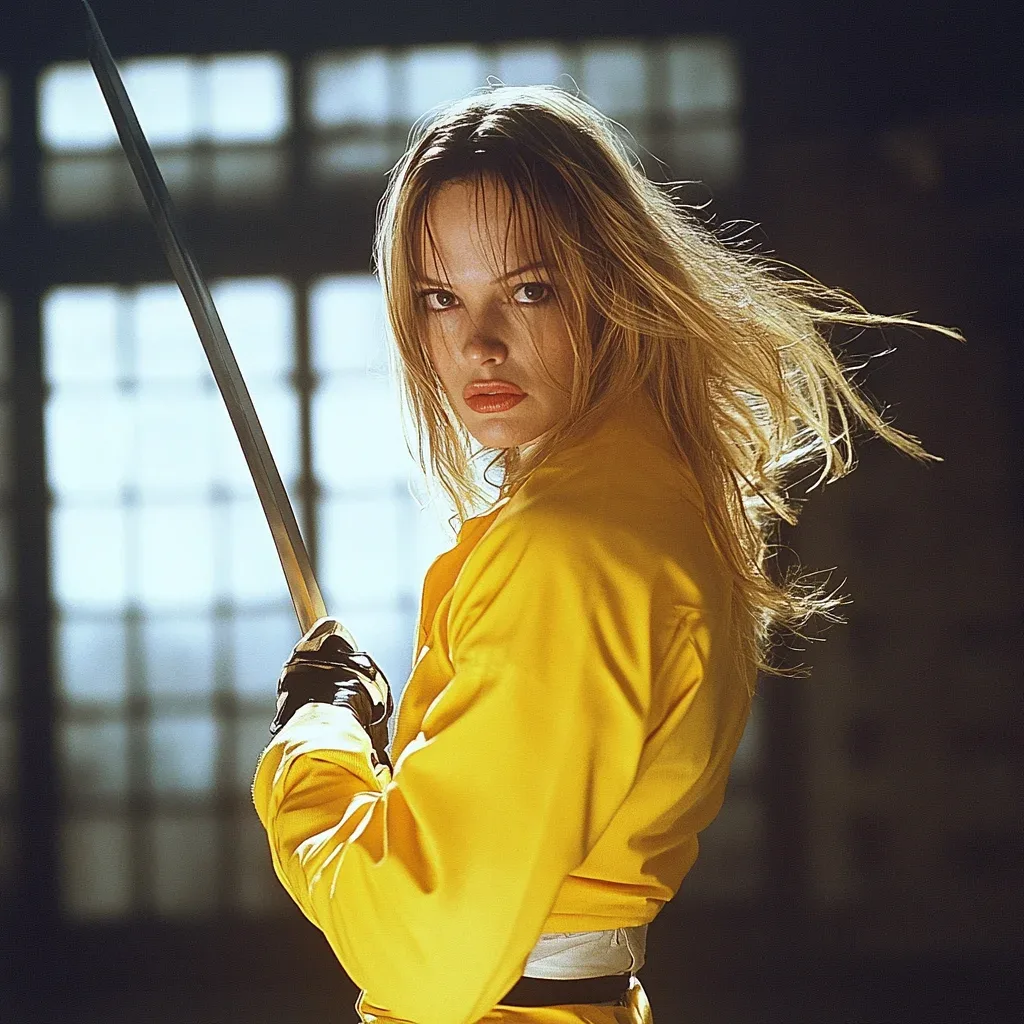
The iconic yellow-and-black tracksuit worn by Uma Thurman was a direct homage to Bruce Lee’s famous outfit in Game of Death. However, costume designers added a subtle, cheeky detail to the bottom of her custom Onitsuka Tiger Tai-Chi sneakers. The tread pattern on the soles was customized to spell out the words "Fuck U" in bold lettering. This hidden easter egg is clearly visible in select shots as Beatrix kicks her opponents directly in the face. It served as a hilarious, covert insult aimed at her cinematic enemies right before their defeat.
4. Martial Arts Icon Gordon Liu Played Two Distinct Roles
Legendary Shaw Brothers martial artist Gordon Liu was cast in two prominent, completely contrasting roles across the two volumes. In Kill Bill: Volume 1, Liu portrays Johnny Mo, the suited leader of O-Ren Ishii’s deadly personal guard, the Crazy 88. He returned in Kill Bill: Volume 2 under heavy prosthetic makeup to play Pai Mei, the ruthless, white-bearded tutelary kung fu master. Tarantino was such a massive fan of Liu's 1978 classic The 36th Chamber of Shaolin that he created both roles specifically to showcase the actor's versatile physical skills. Liu's dual performance remains one of the most celebrated Easter eggs for hardcore kung fu cinema fans.
5. Tarantino Kept the "Pussy Wagon" and Lent It to Pop Superstars
The bright yellow Chevrolet Silverado driven by Beatrix Kiddo, featuring prominent "Pussy Wagon" tailgate lettering, became an instant pop culture symbol. After filming wrapped, Quentin Tarantino bought the truck from the production team and kept it as part of his personal vehicle collection. He frequently drove the customized truck around Los Angeles to generate buzz leading up to the film’s theatrical premiere. Years later, Tarantino famously lent the vehicle to pop icons Lady Gaga and Beyoncé to feature in their viral 2010 music video for the hit song "Telephone." The truck remains one of the most recognizable screen-used vehicles in modern Hollywood history.
6. The Bride's True Name Was Hidden in Plain Sight
Throughout Kill Bill: Volume 1, the main character's real name is censor-bleeped every time another character attempts to speak it aloud. This stylistic choice built mysterious anticipation around her identity until the official reveal in the second volume. However, sharp-eyed viewers could easily figure out her identity in the very first movie without waiting for the sequel. During the scene where Beatrix purchases an airline ticket to Tokyo, her full name—Beatrix Kiddo—is clearly printed on the boarding pass held in her hand. Tarantino intentionally hid the major twist right under the audience's noses from the start.
7. The Concept Was Born on the Set of Pulp Fiction
The idea for the entire revenge saga originated during late-night brainstorming sessions between Uma Thurman and Quentin Tarantino on the set of Pulp Fiction. While filming the classic diner and dance scenes in 1993, the pair began discussing a hypothetical revenge movie centered on a betrayed female assassin code-named "The Bride." Over the next decade, Tarantino fleshed out the premise into a sprawling epic script tailored specifically for Thurman. As a milestone gift, Tarantino presented her with the completed screenplay on her 30th birthday. Their collaborative genesis earned Thurman a rare co-creator credit for "The Bride" in the opening titles.
8. The Crazy 88 Was Actually Much Smaller
The climactic battle at the House of Blue Leaves pits Beatrix Kiddo against O-Ren Ishii’s feared syndicate known as the Crazy 88. Despite their intimidating moniker, Bill explicitly notes in the script that there were never actually eighty-eight bodyguards present. The gang simply selected the name because they thought it sounded cool and imposing to rival syndicates. During the bloody melee sequence, Beatrix defeats approximately fifty-seven opponents rather than eighty-eight. The remaining members fled in terror after seeing their leader and top lieutenants brutally dismantled.
9. Chiaki Kuriyama Accidentally Hit Tarantino with Her Weapon
Japanese actress Chiaki Kuriyama delivered a terrifying performance as Gogo Yubari, O-Ren Ishii’s lethal teenage bodyguard armed with a spiked meteor hammer. Operating the deadly chained ball prop required immense physical coordination and precision on a tightly packed set. During a close-up camera setup, Kuriyama accidentally misjudged her distance and struck Tarantino directly in the head while swinging the heavy weapon. Fortunately, the director emerged unharmed and laughed off the chaotic mishap, praising the authentic intensity it brought to the sequence. The accident only reinforced Tarantino's fondness for real, unscripted dangerous energy on set.
10. Warren Beatty Was Originally Cast as Bill
Quentin Tarantino originally wrote the titular role of Bill specifically for Hollywood legend Warren Beatty. Beatty spent months in discussions regarding the character's backstory and suave persona, but ultimately backed out due to concerns over the lengthy overseas shooting schedule. Following Beatty's departure, Tarantino completely reworked the character to fit cult icon David Carradine, famous for his role in the 1970s television series Kung Fu. Carradine brought a gritty, philosophical stillness to the villainous leader that drastically altered the tone of the movie for the better. Beatty later commended Carradine’s magnetic performance, acknowledging that the recasting was a masterstroke.
11. The Single-Take Sequence Required Six Hours of Rehearsal
The iconic House of Blue Leaves scene includes a dazzling, continuous Steadicam tracking shot following Beatrix Kiddo through the crowded Japanese restaurant. The camera seamlessly glides down hallways, tracks up staircases, follows characters into restrooms, and drops through ceilings without a single cut. Because the complex shot required perfect choreography between dozens of actors, lighting technicians, and camera operators, the crew spent six continuous hours rehearsing it. Cinematographer Robert Richardson executed the flawless single take on the first official attempt after rehearsals concluded. It stands as one of the most technically ambitious camera movements in modern action filmmaking.
12. Production I.G Animated O-Ren Ishii's Tragic Backstory
To detail the brutal backstory of Tokyo underworld boss O-Ren Ishii, Tarantino pivoted away from live-action to anime. He hired the acclaimed Japanese animation studio Production I.G, famous worldwide for crafting the groundbreaking sci-fi anime film Ghost in the Shell. Tarantino requested a visually shocking style reminiscent of violent 1970s Japanese anime classics like Golgo 13. The seven-minute animated sequence took months to produce, delivering an emotionally charged, hyper-violent interlude that contextualized O-Ren’s ruthless rise to power. Critics widely cited the sequence as one of the artistic high points of the entire two-part epic.
13. Robert Rodriguez Composed the Soundtrack for Only One Dollar
Director Robert Rodriguez provided the musical score for Kill Bill: Volume 2, contributing several original atmospheric tracks to the film. As close friends and frequent collaborators, Rodriguez charged Tarantino a token fee of just one dollar for his extensive scoring work. Tarantino happily paid the symbolic fee, promising to return the favor whenever Rodriguez needed technical assistance on a future project. Tarantino kept his promise shortly thereafter by directing a full scene in Rodriguez’s 2005 neo-noir hit Sin City for the exact same one-dollar fee. Their famous "one-dollar rule" became a legendary testament to their unique creative partnership.
14. Miramax Forced the Epic to Be Split Into Two Volumes
Tarantino originally shot Kill Bill as a single, massive four-hour cinematic narrative intended for a single theatrical release. However, producer Harvey Weinstein and Miramax executives realized that general audiences might resist a four-hour martial arts movie with a long runtime. Rather than butchering the story by cutting major subplots or action sequences, Tarantino proposed splitting the film into two distinct volumes released months apart. This decision allowed Volume 1 to focus heavily on fast-paced action, while Volume 2 took a more slow-burn, dialogue-driven approach. The structural division proved to be a major financial and critical victory for everyone involved.
15. Beatrix Only Kills One Person Directly in Volume 2
While Kill Bill: Volume 1 features a staggering body count of over forty onscreen deaths, Volume 2 takes a remarkably understated narrative approach. Throughout the entire second film, Beatrix Kiddo directly takes the life of only one person: Bill himself during their final showdown. Other villains meet gruesome fates in the sequel, but Beatrix isn't directly responsible for their deaths; Budd is killed by Elle Driver's hidden black mamba snake, and Beatrix merely blinds Elle before leaving her alive in a trailer. This sharp contrast underscores Beatrix's emotional growth and restraint as she nears the end of her quest for justice.
Sources & References
This AI-assisted post was rigorously curated and fact-checked for accuracy by:
 Martin Roháček
How fun was this article? 🤔
Tap a star to rate it
🧠 Quiz: How closely were you paying attention?
10 questions — all answers are in the article above!
Enjoyed these facts? There's more! 💌
Fresh fun facts in your inbox. No spam, ever.