The Uncanny Avian Mammal: 15 Fascinating Facts About Kiwis
New Zealand's iconic kiwi is one of the most eccentric creatures on Earth, defying almost every standard rule of avian biology. With hair-like plumage, heavy marrow-filled leg bones, and nostrils located at the very tip of its long beak, this flightless bird behaves much more like a small nocturnal mammal. Female kiwis produce massive eggs that can weigh up to 20 percent of their body weight, while devoted males spend months incubating them inside underground burrows. From clawed wings to mammalian body temperatures, discover the extraordinary truths behind this remarkable flightless oddity.
1. Females Lay Massive Eggs Relative to Body Size
Female kiwis lay eggs that are truly staggering in proportion to their overall body mass. A single kiwi egg can weigh up to 20 percent of the mother's entire weight, making it relatively larger than the egg of any other living bird species. To put this into perspective, an ostrich egg accounts for only about two percent of an adult female ostrich's body mass. In the final weeks before laying, the massive egg occupies so much space in the body cavity that the female physically cannot fit food in her stomach, forcing her to fast. This extreme evolutionary commitment produces extraordinarily developed chicks, but it places immense physical demands on the mother.
2. Their Bones Are Heavy and Marrow-Filled
Most birds evolved light, hollow bones filled with air sacs to make flying as effortless as possible, but the flightless kiwi went in the opposite direction. Its skeleton consists of heavy, sturdy leg bones packed with dense marrow, much like the skeletal structure of land mammals. This extra weight provides a low center of gravity and excellent stability as the bird moves through uneven forest terrain. The heavy bones also supply the structural strength needed to anchor powerful leg muscles for sprinting and digging. This unique skeletal adaptation shows how thoroughly the kiwi abandoned flight to adapt to a life on the ground.
3. Nostrils Sit at the Very Tip of the Beak
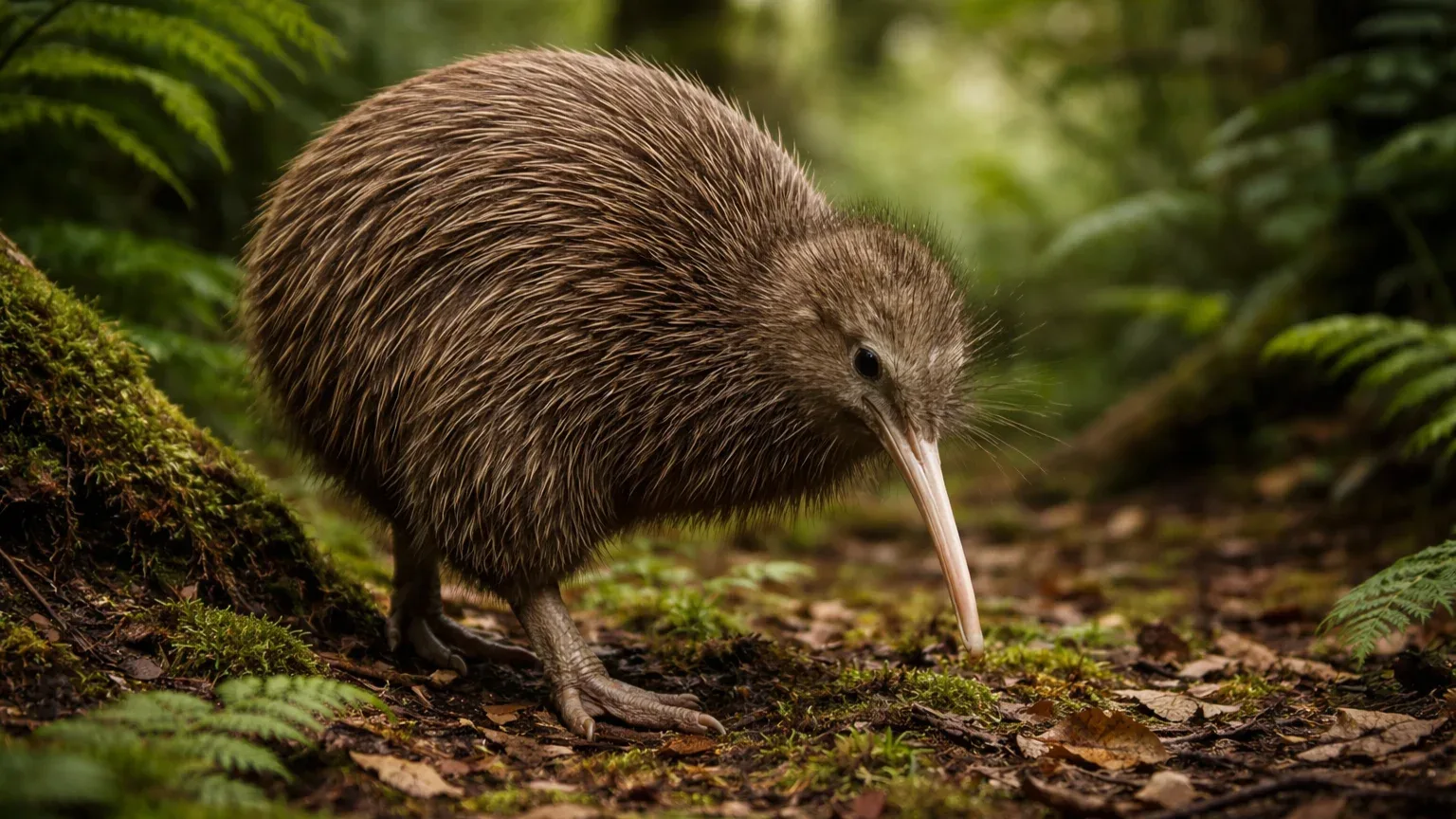
The kiwi holds the unique distinction of being the only bird species on Earth with nostrils located at the very tip of its long bill. While all other birds feature nostrils near the base of the beak close to the head, the kiwi's nostrils allow it to hunt almost entirely by scent. As it probes deep into damp forest soil, the kiwi inhales sharp bursts of air to sniff out earthworms, grubs, and underground invertebrates. This acute sense of smell is so refined that a kiwi can locate prey moving several centimeters below the surface. To keep its nasal passages clear while digging in mud, the bird regularly blows air through its bill with a sharp snorting sound.
4. Facial Whiskers Help Them Navigate the Dark
Surrounding the base of a kiwi's beak are long, slender bristles that function almost identically to mammalian whiskers. Known scientifically as rictal bristles, these flexible hair-like structures are packed with sensitive nerve endings that detect subtle movements and obstacles. Because kiwis roam pitch-black rainforest floors at night, these whiskers prevent them from bumping into low-hanging branches and exposed tree roots. They also help the kiwi detect crawling insects that brush against its face in the dark. This tactile sensory system compensates for the kiwi's tiny eyes and limited visual acuity in nocturnal environments.
5. Their Feathers Resemble Shaggy Fur
At first glance, a kiwi appears to be covered in coarse animal fur rather than typical avian plumage. This unique look occurs because kiwi feathers completely lack the tiny interlocking hooks, known as barbules, that lock flight feathers together into smooth vanes. Instead, kiwi feathers hang loose, soft, and shaggy, providing maximum insulation against chilly nighttime temperatures. The dull brown and grey tones of these hair-like feathers also offer exceptional camouflage among fallen leaves and forest debris. Because flying is off the table, the kiwi's plumage evolved purely for warmth, protection, and camouflage.
6. Muscular Legs Deliver Devastating Defensive Kicks
Despite having stubby, vestigial wing remnants hidden beneath its thick plumage, the kiwi possesses exceptionally strong, heavy-boned legs. These powerful limbs account for a substantial portion of the bird's total weight and serve as its main line of defense. When cornered by rivals or predators, a kiwi can deliver rapid, powerful kicks capable of inflicting severe cuts with its sharp claws. The bird also uses its strong legs to excavate extensive underground burrows and defend its territory boundaries. Field researchers often report that handling a wild kiwi requires caution due to the impressive kicking strength in its legs.
 Birds of the World
From record-breaking aerial plunge-divers to massive flightless icons, the avian world is a marvel of evolutionary engineering. Discover the extraordinary intellects, specialized survival skills, and hidden superpowers of the planet's most fascinating birds.
See All Facts
Birds of the World
From record-breaking aerial plunge-divers to massive flightless icons, the avian world is a marvel of evolutionary engineering. Discover the extraordinary intellects, specialized survival skills, and hidden superpowers of the planet's most fascinating birds.
See All Facts
7. They Can Outrun Human Sprinters in the Forest
Given its round body shape and short legs, one might expect the kiwi to be a slow and clumsy traveler. In reality, this ground-dwelling bird is a remarkably agile runner capable of navigating dense jungle undergrowth with incredible speed. In short bursts, a frightened kiwi can easily outrun an adult human sprinting through native bush terrain. Their low center of gravity and strong leg muscles allow them to change direction instantly and weave through tangled roots. This surprising agility served as the kiwi's primary survival strategy against ancient aerial predators before land mammals arrived in New Zealand.
8. Pairs Often Stay Together for Life
Kiwis usually form monogamous partnerships, and many couples remain together for the rest of their lives. Once a male and female pair up, they establish a shared home territory, and some kiwi partnerships have been known to last longer than 20 years. The bond is not unbreakable, though, as some birds do split up and move on to new partners. Every evening, paired kiwis call out to one another across the forest to reinforce their territory boundaries and locate each other in the dark. These vocalizations feature distinct pitches, with males producing a high-pitched whistle while females respond with a lower, raspy cry.
9. Dedicated Males Perform Most Egg Incubation
Incubating a massive kiwi egg demands immense physical effort and patience, a responsibility that falls largely on the male in most kiwi species. In the case of the North Island brown kiwi, the male warms the egg in an underground burrow for an extraordinary 75 to 85 days. During this lengthy incubation period, the male leaves the nest for only a short time each night to feed, losing a significant portion of his body weight. His body heat maintains the precise temperature needed for the slow-developing embryo inside the thick shell. This division of labor gives the female time to recover from the massive energy loss of producing the egg.
10. Chicks Hatch Fully Feathered and Independent
When a kiwi chick finally breaks out of its thick shell after nearly three months of incubation, it emerges in a state unlike almost any other bird species. The hatchling is fully covered in soft, mature feathers, with its eyes open and its sensory systems ready to function immediately. Kiwi parents do not feed their chicks; instead, the newborn survives for its first week or two by absorbing a large internal yolk sac. Within days of hatching, the young chick wanders out of the burrow unaccompanied to hunt for its own food. This level of self-sufficiency is extremely rare in the bird world, where most hatchlings require weeks of parental feeding.
11. Their Body Temperature Matches Mammals
While most modern birds maintain high internal body temperatures between 40 and 42 degrees Celsius, the kiwi operates at a much lower metabolic rate. Its average internal body temperature stays between 37 and 38 degrees Celsius, matching the normal body temperature of typical placental mammals. This lower core temperature reflects the kiwi's slow baseline metabolism and ground-dwelling lifestyle, which requires less intense cellular energy expenditure than powered flight. This mammalian thermal profile is another evolutionary trait pointing to the kiwi's early separation from other bird lineages millions of years ago.
12. Their Tiny Wings End in a Claw
Kiwis do have wings, but they are so small that they stay completely hidden beneath the bird's shaggy plumage. These vestigial wings play no role in getting around, yet each one still ends in a small, cat-like claw at its tip. The wings are a leftover from the kiwi's distant ancestors, which could fly before their descendants settled into a life on the ground. With no need to take to the air, the kiwi's wings shrank to mere stubs over millions of years. Like the bird's heavy bones and fur-like feathers, the hidden wing claw is a striking reminder of how far the kiwi has drifted from the typical avian blueprint.
13. They Live in Complex Underground Burrows
Unlike standard birds that construct twig nests high in tree branches, the kiwi is a committed subterranean architect. Using its sharp claws and sturdy beak, the kiwi digs complex burrows directly into damp soil, under root mats, or beneath fallen logs. A single kiwi may use dozens of different burrows and shelters scattered throughout its territory, often sleeping in a different one from one day to the next. They routinely camouflage the entrance with fresh leaves and twigs to conceal the opening from view. These underground dens provide a stable climate, keeping the birds cool during hot summers and warm during cold winter nights.
14. They Are Strictly Nocturnal Hunters
The kiwi lives a secretive, night-bound life that keeps it safely hidden from view during daylight hours. By sleeping in underground burrows throughout the day and emerging only after complete dusk, the kiwi historically avoided giant daytime aerial predators like raptors. Darkness also offers ideal foraging conditions, as nighttime moisture brings earthworms and soil invertebrates closer to the ground surface. Their large ear openings and acute sense of smell are perfectly tuned for pitch-black hunting where eyesight is ineffective. This strictly nocturnal lifestyle makes wild kiwi sightings extremely rare for human visitors to New Zealand's forests.
15. Females Are Significantly Larger Than Males
In the majority of bird species, males are larger and more brightly colored than females to attract mates, but kiwis display reverse sexual dimorphism. Female kiwis are consistently larger and heavier than their male counterparts. They also feature noticeably longer beaks, which allow them to probe deeper into soil for nutrient-rich prey. Evolutionary biologists believe this size advantage evolved primarily to accommodate the massive egg that females must carry and develop inside their body cavity. The larger body frame provides the essential physical capacity and energy reserves required for egg production.
Sources & References
This AI-assisted post was rigorously curated and fact-checked for accuracy by:
 Martin Roháček
How fun was this article? 🤔
Tap a star to rate it
🧠 Quiz: How closely were you paying attention?
10 questions — all answers are in the article above!
Enjoyed these facts? There's more! 💌
Fresh fun facts in your inbox. No spam, ever.