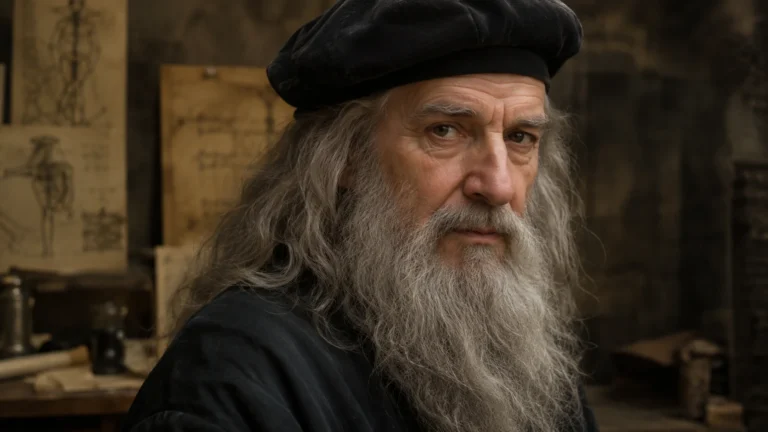
His morning routine involved an incredibly obsessive, mathematical approach to brewing coffee. Before he could begin composing for the day, Beethoven insisted on manually counting out exactly sixty individual coffee beans for every single cup he drank, believing this highly specific, rigid measurement was the only way to achieve the perfect, stimulating brew.
A severe lack of formal education meant he was incredibly poor at basic mathematics. Because he was pulled out of school at age eleven to focus entirely on his musical career, he never actually learned how to multiply or divide numbers. If his financial ledgers required multiplying a number like fifty by sixty, he would literally write the number fifty down sixty individual times on a piece of paper and add them all together.
His father deliberately lied about his age to aggressively market him as a child prodigy. Seeking to capitalize on the massive fame of Wolfgang Amadeus Mozart, Johann van Beethoven routinely lied to the public and concert promoters about his son’s birth year, a deception so deeply ingrained that Beethoven himself genuinely believed he was two years younger than his actual age for most of his adult life.
His living conditions were famously chaotic, unsanitary, and deeply squalid. The composer was an absolute nightmare for landlords, moving his residence within the city of Vienna over seventy different times throughout his life. Visitors frequently noted with sheer horror that his apartments were littered with rotting food, scattered manuscripts, and unemptied chamber pots sitting casually underneath his grand piano.
He was once officially arrested by the local police for vagrancy. Because he frequently wandered the streets of Vienna muttering musical phrases to himself while wearing filthy, tattered, and completely unkempt clothing, a local constable mistook the legendary composer for a homeless beggar and threw him in jail until a musical colleague arrived to positively identify him.
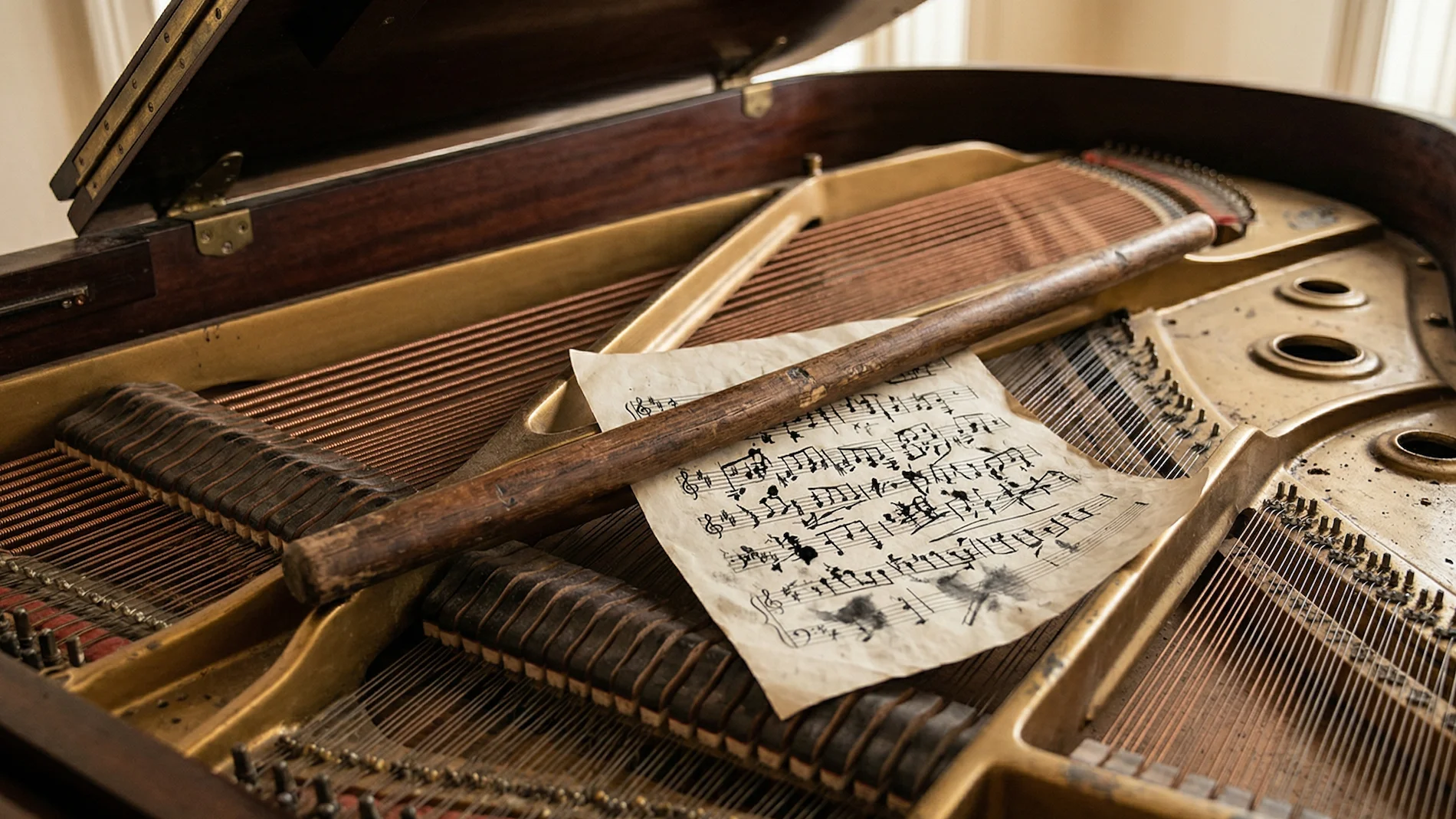
He utilized a primitive form of bone conduction to compose music after losing his hearing. As his deafness grew severe, he developed a bizarre method of clenching a wooden stick tightly between his teeth and pressing the other end directly against the soundboard of his piano, allowing the physical vibrations of the struck chords to travel directly through his jawbone and into his inner ear.
He routinely shocked his brain by dunking his head into freezing cold water. Whenever he experienced a severe creative block or felt exhausted during late-night composition sessions, he would lean over a washbasin and pour pitchers of ice-cold water directly over his head, a habit he performed with such aggressive frequency that the water would routinely soak through the floorboards and leak onto the neighbors below him.
Modern genetic testing recently revealed that he was suffering from massive lead poisoning. In 2023, scientists conducted an advanced DNA analysis on preserved locks of the composer’s hair, discovering lethal, astronomically high levels of lead in his system. Historians and medical professionals now believe he accidentally poisoned himself by drinking massive quantities of cheap wine that contemporary merchants had illegally sweetened with lead sugar.

His entire life was plagued by agonizing gastrointestinal illnesses. Long before his liver completely failed, he suffered from chronic, daily stomach cramps and severe bouts of diarrhea, a debilitating physical reality that made him incredibly irritable and heavily influenced the sudden, violent dynamic shifts and angry outbursts present in his middle-period compositions.
His political rage physically destroyed the title page of his own masterpiece. Originally, he had proudly dedicated his groundbreaking Symphony No. 3, the Eroica, to Napoleon Bonaparte, viewing him as a champion of democracy. However, when he learned that Napoleon had crowned himself Emperor, the composer flew into a violent rage and scratched the dedication off the manuscript with a knife so aggressively that he tore a massive hole straight through the paper.
He wrote a deeply tragic suicide note at the age of thirty-one. Known as the Heiligenstadt Testament, he hid a deeply personal, agonizing letter in his desk addressed to his brothers, confessing his absolute despair over his deteriorating hearing and admitting that he had heavily considered ending his own life, choosing to survive only because he felt a moral obligation to release the music trapped inside his head.
The identity of his greatest love remains one of the most intense mysteries in music history. He never married, but following his death, executors discovered a passionate, highly secretive ten-page love letter hidden in his personal effects, addressed only to an unnamed woman he passionately referred to as his Immortal Beloved.
He initiated a vicious, incredibly destructive custody battle that ruined his nephew’s life. Following the death of his brother, the composer spent years in court ruthlessly fighting his sister-in-law for sole custody of his nephew Karl, ultimately subjecting the boy to such overbearing, toxic, and suffocating control that the young man tragically attempted suicide to escape his uncle’s obsessive grasp.
He premiered his greatest symphony while completely and utterly deaf. When he conducted the massive, historic premiere of his Symphony No. 9, he was so profoundly deaf that he could not hear the orchestra playing slightly behind his chaotic gestures, and when the piece concluded, a soloist had to physically turn him around so he could visually see the audience weeping and throwing their hats in the air.
His skull was physically mutilated and robbed during his autopsy. Immediately following his death, an ambitious medical assistant secretly sawed open his skull and stole his temporal bones and inner ear structures in an attempt to study the physical cause of his deafness, anatomical artifacts that were eventually completely lost to history.
Sources and References:
Current Biology Cell Press: https://www.cell.com/current-biology/fulltext/S0960-9822(23)00181-1
Notre Dame Biomechanics in the Wild: https://sites.nd.edu/biomechanics-in-the-wild/2019/03/05/the-future-of-hearing-might-be-in-your-bones/
The Napoleon Series Historical Archive: https://www.napoleon-series.org/ins/scholarship98/c_eroica.html
Broomfield Symphony Orchestra History: https://broomfieldsymphony.org/musical-trivia/musicians-with-arrest-records/
CEENTA Medical Ear Nose and Throat Archives: https://www.ceenta.com/news-blog/the-hearing-loss-of-ludwig-van-beethoven