The Boundless Steppe: 15 Fascinating Facts About Mongolia
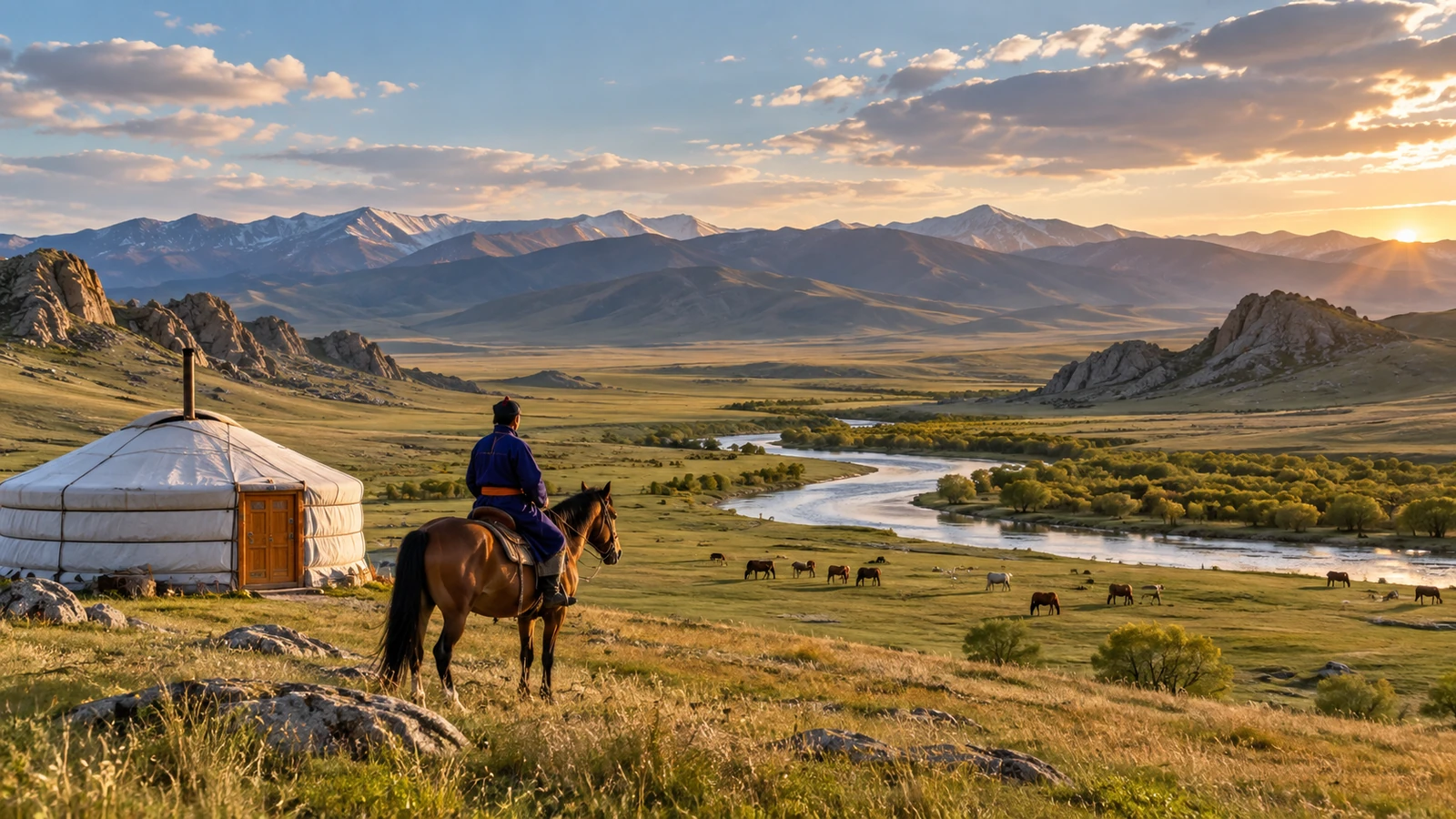
Stretching across vast swaths of Central Asia, Mongolia is a land of dramatic contrast, ancient nomadic traditions, and untamed natural wilderness. From the freezing capital city where street vendors sell outdoor ice cream in winter to desert cliffs that yielded the world's first dinosaur eggs, Mongolia's story is utterly unique. Its deep relationship with horses, ancient postal networks, and vibrant festivals continue to shape national identity today. Discover the fascinating history, wildlife, and customs that define this rugged land of eternal blue skies.
1. The Most Sparsely Populated Nation on Earth
Mongolia holds the title of the world's most sparsely populated sovereign nation, spanning a landmass larger than France, Germany, and Spain combined. Across its vast territory of over 1.5 million square kilometers, the population density averages just two people per square kilometer. Outside the sprawling capital city of Ulaanbaatar, endless stretches of rolling steppes, rugged mountain ranges, and desert expanses remain completely uninhabited. This extraordinary abundance of open land offers nomadic pastoralists immense personal space and tranquility. The country's solitude is so profound that traveling for hours across the steppe without encountering a single building or paved road is entirely normal.
2. Horses Officially Outnumber Human Residents
Horses are deeply woven into Mongolian culture, so much so that animals officially outnumber human citizens. The nation is home to roughly four million horses, compared to a human population of around 3.5 million people. Semi-nomadic families rely heavily on these hardy animals for transportation, herding livestock, and providing milk. Traditional Mongolian proverbs famously declare that a Mongolian without a horse is like a bird without wings. These short-statured, resilient equines are direct descendants of the ancient steeds that carried the Mongol armies across Eurasia centuries ago.
3. Home to the World's Oldest Official Nature Reserve
Long before Yellowstone National Park was established in 1872, Mongolia created the world's first officially protected nature reserve. In 1778, local authorities declared Bogd Khan Uul, a sacred mountain located just south of modern-day Ulaanbaatar, a protected sanctuary. The decree strictly banned logging, hunting, and agricultural cultivation on the mountain to preserve its natural state and sacred fauna. Mongolian spiritual traditions had long held the mountain in high regard, associating its forested peaks with local spirits and ancient deities. Today, Bogd Khan Uul remains a sanctuary for coniferous forests, red deer, and rare alpine plants.
4. The Birthplace of Dinosaur Egg Discoveries
In 1923, an expedition led by American paleontologist Roy Chapman Andrews made an extraordinary scientific breakthrough in the Gobi Desert. At the dramatic orange sandstone cliffs known as Bayanzag, or the Flaming Cliffs, Andrews and his team discovered the first confirmed fossilized dinosaur eggs. Prior to this groundbreaking find, scientists debated whether dinosaurs laid eggs or gave birth to live young. The Gobi Desert turned out to be one of the richest dinosaur fossil beds on Earth, preserving prehistoric skeletons in exceptional detail. Paleontologists continue to unearth preserved skeletons of species like Protoceratops and Velociraptor from these desert sands.
5. Known as the Land of the Eternal Blue Sky
Mongolians affectionately refer to their homeland as Munkh Khukh Tengri, which translates to the Land of the Eternal Blue Sky. The country enjoys over 250 sunny days each year, experiencing clear, cloudless skies across all four seasons. This high frequency of sunshine is caused by strong high-pressure weather systems that dominate the high-altitude Mongolian Plateau. However, abundant sunshine does not guarantee warm weather, as winter days are frequently brilliant blue yet intensely cold. Sky worship held a central place in traditional Mongolian Shamanism, where the blue sky was revered as a supreme cosmic deity.
6. Ulaanbaatar is the Coldest Capital City on Earth
Ulaanbaatar holds the undisputed title of the coldest national capital city on Earth, beating out frigid capitals like Ottawa and Moscow. Due to its high altitude, landlocked geographical position, and intense Siberian winds, winter temperatures regularly plunge below minus 40 degrees Celsius. Despite the punishing frost, daily life in the capital continues briskly, with outdoor winter markets remaining active. In a famous local twist, street vendors sell ice cream directly out of paper boxes on the sidewalk without needing freezer units. The severe cold persists for months, keeping the nearby Tuul River completely frozen straight through early spring.
7. The Ger is a Masterpiece of Nomadic Engineering
Many Mongolians continue to live in traditional portable felt dwellings called gers, known internationally as yurts. These circular structures consist of expandable wooden lattice walls, roof poles, and a central crown covered by thick layers of sheep wool felt. Designed for maximum thermal efficiency, a ger keeps families warm during harsh winters while allowing cool air to circulate in the summer. An experienced nomadic family can completely dismantle or reassemble a full ger in under an hour without using nails or complex machinery. This remarkable mobility enables pastoral families to easily migrate several times a year to follow seasonal livestock pastures.
8. World-Famous Vocal Traditions Preserved by UNESCO
Mongolia is renowned for Khöömii, a specialized technique of throat singing that enables a single vocalist to produce multiple distinct pitches simultaneously. By controlling air pressure and manipulating the oral cavity, singers generate a deep, resonant low drone while simultaneously chanting a whistling high melody. Another iconic musical art form is Urtiin Duu, or Long Song, characterized by complex drawn-out vocalizations and dramatic ornamental vibrato. These traditional songs frequently mimic natural sounds such as mountain winds, rushing rivers, and galloping horses. Both vocal art forms are inscribed on UNESCO's Intangible Cultural Heritage list in recognition of their cultural significance.
9. Mothers of Large Families Receive State Medals
The Mongolian government maintains a unique national award system designed to honor women who raise large families. Mothers who give birth to and raise four or more children receive official state medals known as the Order of the Glorious Mother. The award is divided into two classes: the Second Degree medal for mothers of four or five children, and the First Degree medal for mothers of six or more children. Honorees receive annual financial stipends, social prestige, and formal invitations to state holiday celebrations. Families take tremendous pride in these awards, often displaying the mother's state medals prominently inside their homes.
10. Sanctuary for the Wild Two-Humped Bactrian Camel
The Gobi Desert is home to the endangered wild Bactrian camel, one of the few wild camel species remaining on Earth today. Unlike their single-humped Arabian cousins, Bactrian camels possess two thick humps that store fat, allowing them to endure long periods without food or water. These resilient creatures can comfortably survive extreme temperature swings ranging from 40 degrees Celsius in summer to minus 40 degrees in winter. Domesticated Bactrian camels serve as vital transport animals for desert herders and yield fine, warm camel wool. Every winter, the Thousand Camel Festival in Ömnögovi Province celebrates these magnificent animals with traditional camel races and polo matches.
11. Airag is the National Fermented Beverage
The national beverage of Mongolia is airag, a fizzy, slightly sour drink made from fermented mare's milk. Herders milk mares during the summer months and churn the fresh milk thousands of times in a traditional leather vessel to initiate fermentation. The resulting drink contains a mild alcohol content alongside high concentrations of vitamins and minerals essential for nomadic diets. Offering airag is a fundamental gesture of Mongolian hospitality, and guests are traditionally presented with a brimming bowl upon entering a home. Custom dictates that visitors should accept the bowl with their right hand and take at least a small sip to show respect.
12. Genghis Khan Adopted the Official Uyghur Script
Although Genghis Khan was illiterate throughout his life, he recognized the crucial need for a unified written script to govern his expanding empire. Around 1204, after defeating the Naiman tribe, he captured an Uyghur scribe named Tatar-Tonga and commissioned him to adapt the Uyghur alphabet for the Mongolian language. This elegant vertical script is written from top to bottom and left to right, creating a distinct visual tradition. The script allowed the Mongol Empire to codify its grand legal code, known as the Yassa, and manage extensive trade networks. While Cyrillic became standard in the 20th century, Mongolia is currently restoring the traditional script to official co-government status.
13. The Naadam Festival Features the Three Manly Games
Every July, Mongolia hosts Naadam, a major national festival showcasing the ancient sports of wrestling, horse racing, and archery. The origins of Naadam date back centuries to military training exercises and seasonal nomad gatherings on the open steppe. Mongolian wrestling features no weight classes or time limits, ending only when a competitor touches the ground with a knee, elbow, or back. The horse races cover grueling distances of up to 30 kilometers across open terrain, navigated by highly skilled child jockeys aged five to twelve. Archery competitions showcase historical bow-making techniques, with competitors aiming at small woven leather targets placed on the ground.
14. Stepping on a Foot Requires an Immediate Handshake
In Mongolian social custom, accidentally touching or stepping on someone else's foot is considered a minor sign of disrespect. Nomadic tradition holds that stepping on another person's foot or shoe symbolizes stepping on their personal fortune or spiritual dignity. To instantly clear any potential offense, the person who made contact must immediately extend a friendly handshake to the individual. This prompt gesture signals that the foot touch was completely unintentional and restores social harmony between the two parties. Foreign travelers quickly pick up on this practice, as even minor bumps in crowded markets are met with instant handshakes.
15. The Medieval Örtöö was an Ancient Express Postal Network
In the 13th century, Genghis Khan and his successors established the Örtöö, an exceptionally fast postal relay system spanning much of Eurasia. Specialized messenger riders traveled across thousands of miles, stopping at regular relay stations located roughly 25 to 30 miles apart. At each station, couriers could instantly swap tired horses for fresh steeds or hand off urgent dispatches to waiting riders. This horse express network allowed imperial messages to travel up to 200 miles in a single day, far outpacing communication speeds anywhere else in the world. The Örtöö maintained administrative control across the empire and inspired express delivery systems for generations to come.
Sources & References
This AI-assisted post was rigorously curated and fact-checked for accuracy by:
 Martin Roháček
How fun was this article? 🤔
Tap a star to rate it
🧠 Quiz: How closely were you paying attention?
10 questions — all answers are in the article above!
Enjoyed these facts? There's more! 💌
Fresh fun facts in your inbox. No spam, ever.