The Imperial Nomad: 15 Fascinating Facts About the Mongol Empire
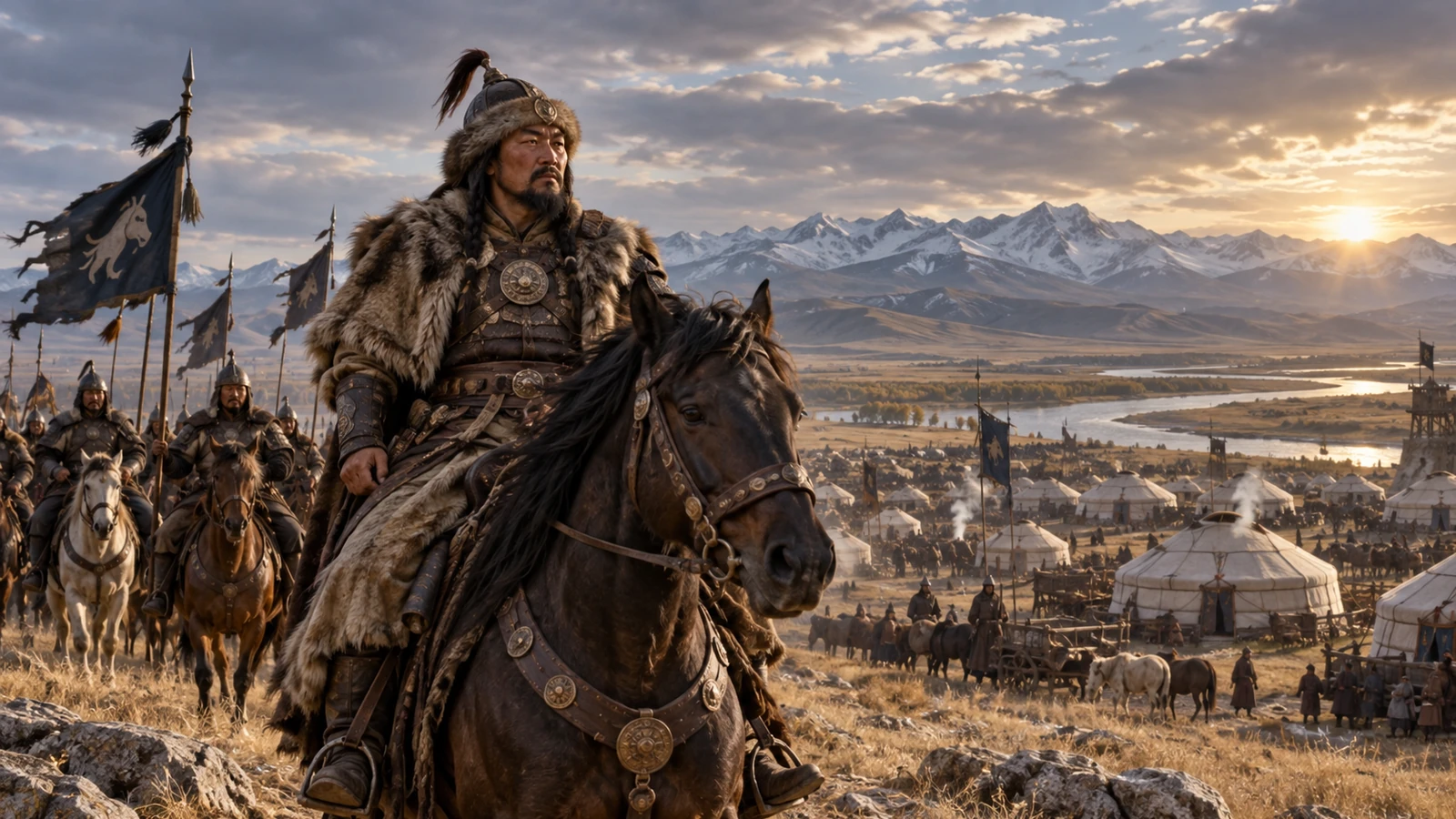
Spanning from the Sea of Japan to the gates of Central Europe, the Mongol Empire was the largest contiguous land empire in human history. Under the leadership of Genghis Khan and his successors, nomadic horsemen reshaped global trade, military strategy, and cultural exchange. From sophisticated communication networks and unprecedented religious tolerance to terrifying siege tactics and mysterious royal burials, their legacy extends far beyond brute conquest. Here are 15 fascinating facts about the empire that forever connected the medieval world.
1. The Yam Created the World's First Transcontinental Postal Network
Long before modern courier services, Genghis Khan established an extraordinary communication grid known as the Yam. This system utilized a vast network of relay stations positioned roughly 25 to 30 miles apart, matching a single day's ride on horseback. Dispatch riders carrying official passports could swap exhausted horses for fresh mounts at every post, allowing urgent messages to travel up to 200 miles in a single day. The efficiency of the Yam allowed the Great Khan to receive intelligence from distant frontiers weeks faster than any rival nation could manage. This rapid flow of information proved essential for coordinating massive military campaigns across thousands of miles.
2. Soldiers Drank Horse Blood to Survive Long Campaigns
Mongol warriors traveled with impressive light logistics, enabling their armies to move at speeds that bewildered their enemies. When supplies ran out during grueling long-distance marches, soldiers relied on an extreme survival technique by tapping the veins of their own mounts. A rider would make a small incision in his horse's neck, drink a small amount of blood, and then bandage the wound without harming the animal permanently. This nutrient-rich nourishment sustained the cavalry on campaigns where stopping to hunt or forage would invite ambush or delay critical tactical maneuvers. Coupled with dried meat curds, this technique allowed Mongol horsemen to march for days without carrying heavy supply wagons.
3. They Weaponized the Bubonic Plague at the Siege of Kaffa
The Mongol siege of the Genoese-controlled port city of Kaffa in 1346 is widely considered one of the earliest documented instances of biological warfare. When the Black Death decimated the besieging Mongol army commanded by Janibeg, the general turned a devastating outbreak into a tactical weapon. He ordered the catapulting of plague-infected corpses over Kaffa's high stone walls to infect the besieged population inside. As the horror spread within the fortress, panicked Genoese merchants fled aboard ships bound for Italy, unwittingly carrying the deadly pathogen across the Mediterranean. Many historians believe this desperate siege tactic directly accelerated the arrival of the devastating Black Death in Europe.
4. Royal Executions Were Carried Out Without Spilling Blood
In Mongol spiritual belief, shedding the blood of royalty onto the earth was a grave taboo that offended Tengri, the supreme sky god. When noble enemies or fallen princes were condemned to death, executioners devised elaborate non-bloody methods to carry out the sentence. High-ranking captives were frequently wrapped tightly inside felt carpets and then trampled to death by galloping warhorses. Other royal prisoners were smothered beneath heavy wooden floorboards while Mongol commanders celebrated victory at banquets above them. Through these brutal yet ritualistic methods, the conquerors strictly adhered to their spiritual laws while eliminating political rivals.
5. A Warrior Princess Won 10,000 Horses Through Wrestling
Khutulun, the great-great-granddaughter of Genghis Khan and cousin to Kublai Khan, was legendary across Asia for her unmatched athletic prowess. She publicly declared that she would marry any man who could defeat her in a traditional Mongolian wrestling match, provided the suitor wagered horses on the outcome. Suitor after suitor tried and failed against the formidable princess, losing their livestock in the process. Through her undefeated streak, Khutulun amassed a staggering personal herd of over 10,000 horses, making her as wealthy as a regional prince. She eventually chose her own husband without losing a single bout, cementing her status as a legendary figure in steppe history.
6. The Empire Practiced Widespread Religious Freedom
While medieval Europe and the Middle East were frequently engulfed in religious conflicts, the Mongol Khans instituted remarkably tolerant policies across their territories. The imperial court granted tax exemptions to clergy and permitted Christians, Muslims, Buddhists, and Taoists to practice their faith without state interference. In the imperial capital of Karakorum, houses of worship representing various world religions stood side by side, sharing the same city streets. Khans routinely hosted theological debates at court, seeking spiritual insight and practical wisdom from scholars of different traditions. This pragmatism helped unify diverse populations across the vast expanse of conquered lands.
7. Mongol Composite Bows Outranged European Longbows
The core weapon of the Mongol war machine was a masterwork of engineering made from layered horn, wood, and sinew glued together under pressure. Because these materials bent under tension, the recurve design stored an enormous amount of kinetic energy in a compact frame suitable for mounted archers. A skilled horseman using a composite bow could strike targets at distances exceeding 350 meters, outranging traditional European longbows. The bow required immense draw weight and years of training to master, giving horse archers an overwhelming tactical advantage. Combined with fluid cavalry maneuvers, this superior firepower devastated infantry formations before close combat even began.
8. Whistling Arrows Transmitted Battlefield Commands Across Miles
Mongol military commanders resolved the chaotic challenge of battlefield communication by deploying specialized signaling ammunition. Officers carried composite arrows fitted with hollow, perforated bone tips that produced a high-pitched, piercing whistle when shot through the air. By firing these whistling arrows in specific directions or sequences, commanders signaled tactical orders instantly across noisy combat zones. Soldiers were trained from youth to immediately follow the trajectory and sound of these whistling projectiles without waiting for verbal commands. This silent acoustic system allowed Mongol armies to execute complex, coordinated ambushes and feigned retreats with clockwork precision.
9. The Burial Place of Genghis Khan Remains an Unsolved Mystery
When Genghis Khan died in 1227 during a campaign against the Western Xia, his followers went to extreme lengths to hide his final resting place. According to legend, the funeral escort slaughtered anyone who crossed their path during the journey back to the Mongolian homeland to maintain absolute secrecy. Once the Great Khan was buried, soldiers allegedly rode hundreds of horses over the site to erase any footprints or disturbed soil. Some historical accounts even claim a river was diverted over the grave to permanently obscure its location from grave robbers. To this day, despite modern satellite imagery and archaeological expeditions, his tomb has never been found.
10. General Subutai Conquered More Territory Than Any Other Commander
While Genghis Khan built the empire, his primary general, Subutai, was the mastermind responsible for its astounding physical expansion. Subutai directed military operations that conquered or subjugated 32 distinct nations and won over 65 pitched battles throughout his career. He coordinated massive armies operating thousands of miles apart simultaneously, orchestrating synchronized invasions in China and Eastern Europe. Utilizing an advanced intelligence network of spies and scout riders, Subutai mapped unknown European topographies long before launching his assaults. His tactical genius made him arguably the most successful military strategist in world history.
11. The Destruction of Baghdad Turned the Tigris Black with Ink
In 1258, the Mongol commander Hulagu Khan laid siege to Baghdad, the radiant capital of the Abbasid Caliphate and center of the Islamic Golden Age. When the city fell after a brief siege, Mongol troops systematically sacked its grand architectural treasures and burned priceless cultural institutions. The famous Grand Library of Baghdad, known as the House of Wisdom, was thoroughly destroyed alongside centuries of scientific and literary manuscripts. Eyewitness accounts recorded that so many historical texts were thrown into the Tigris River that its waters ran black from ink. The catastrophic loss marked a tragic turning point in Islamic intellectual history and regional urban development.
12. The Pax Mongolica Rendered the Silk Road Unprecedentedly Safe
At the height of Mongol rule, a period of unprecedented political stability known as the Pax Mongolica swept across Eurasia. By imposing strict legal codes known as the Yassa and heavily policing trade routes, the Khans eliminated banditry along the transcontinental Silk Road. Historical accounts frequently cited a famous contemporary saying that a young woman bearing a golden pot could walk unharmed from Persia to China. This extraordinary level of public safety allowed merchants like Marco Polo to travel thousands of miles without fear of violent attack. The resulting economic boon catalyzed an unparalleled exchange of trade goods, technology, and ideas between East and West.
13. Fermented Mare's Milk Was the Empire's National Drink
The staple beverage of both common nomads and high-ranking nobility in the Mongol Empire was an alcoholic drink called airag (or kumis). Because raw horse milk contains high sugar levels, it ferments rapidly when churned inside leather sacks over several days. The resulting drink is a mildly alcoholic, tangy, and carbonated beverage rich in essential vitamins and minerals. Airag played a vital central role in social ceremonies, military victories, and state banquets throughout the empire's history. Even today, pastoralists living across the Mongolian steppe continue to prepare airag during the summer months using traditional fermentation techniques.
14. Kublai Khan Designed the Foundation of Modern Beijing
In 1271, Genghis Khan's grandson Kublai Khan established the Yuan Dynasty and decided to move his imperial capital away from the Mongolian steppe into northern China. He commissioned the construction of a grand new capital city named Dadu, which translates to "Great Capital." Kublai Khan envisioned a sprawling, meticulously planned metropolis laid out on a precise geometric grid system according to traditional Chinese architectural principles. Dadu became the financial and political center of China and directly evolved into modern-day Beijing. The wide avenues and historical city quarters established under Kublai's direction still shape the urban grid of the metropolis today.
15. They Spared and Recruited Enemy Engineers
Unlike many conquering armies of the era that slaughtered captured populations indiscriminately, the Mongols practiced a highly pragmatic policy toward skilled labor. When taking enemy cities, commanders conducted careful censuses to identify and isolate artisans, physicians, metalworkers, and engineers. Chinese siege specialists were spared and immediately integrated into the imperial military apparatus to design catapults, battering rams, and early gunpowder weapons. Muslim engineers from Persia were similarly repurposed to construct sophisticated counterweight trebuchets for campaigns in Southern China. This systematic recruitment of foreign technical talent transformed nomadic horse archers into masters of advanced siege warfare.
Sources & References
This AI-assisted post was rigorously curated and fact-checked for accuracy by:
 Martin Roháček
How fun was this article? 🤔
Tap a star to rate it
🧠 Quiz: How closely were you paying attention?
10 questions — all answers are in the article above!
Enjoyed these facts? There's more! 💌
Fresh fun facts in your inbox. No spam, ever.