The Revolutionary Master: 15 Fascinating Facts About Pablo Picasso
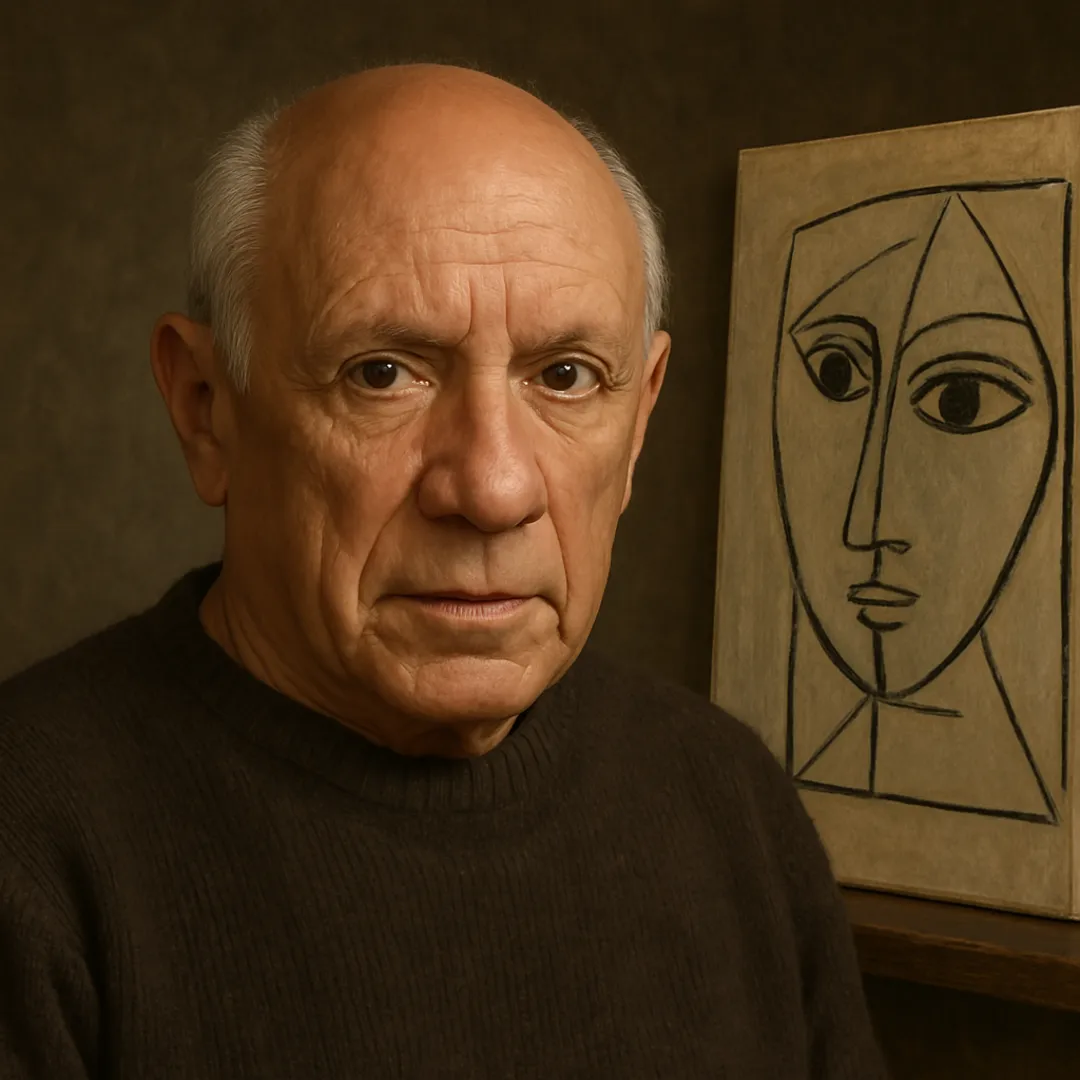
Pablo Picasso revolutionized modern art with unmatched creative energy and an iconoclastic spirit that defined the twentieth century. From his child-prodigy origins in Malaga to co-founding Cubism and creating over 50,000 artworks, Picasso spent a lifetime shattering classical rules. Uncover the eccentric realities behind the legend, including hidden paintings beneath his canvases, a brief stint as a suspect in the Mona Lisa heist, and his razor-sharp defiance of wartime occupiers.
1. His Full Name Consisted of 23 Words
When Pablo Picasso was born in Málaga, Spain, in 1881, his parents baptized him with an extraordinarily long name to honor a succession of saints and revered relatives. His official birth certificate lists him as Pablo Diego José Francisco de Paula Juan Nepomuceno María de los Remedios Cipriano de la Santísima Trinidad Ruiz y Picasso. The tradition of bestowing multiple baptismal names was common in Andalusia, blending maternal and paternal lineage alongside holy figures. However, as he established his reputation as a young artist, he gradually trimmed down his moniker to maintain maximum impact. Ultimately, the world came to know him simply by his mother's distinct Italian-derived surname, Picasso.
2. His First Word Was Reportedly "Pencil"
According to family lore, Picasso possessed an artistic instinct that predated his ability to form full sentences. Before he could speak fluently, he would make marks on paper, exhibiting a natural fascination with lines and shading. His mother recalled that his very first articulated word was "piz," short for lápiz, the Spanish word for pencil. Rather than playing with conventional toys, the young child spent hours drawing shapes in the dirt outside his home. Recognizing his extraordinary early gift, his father, Don José Ruiz y Blasco, an art professor, began formal training with him when Pablo was just seven years old.
3. He Completed an Advanced Art Exam in a Single Day
Picasso’s technical skill developed at an astonishing pace during his early adolescence, quickly surpassing his father’s own abilities. At age 14, he applied for admission to the prestigious Llotja Academy of Fine Arts in Barcelona, where his father taught. Candidates were typically given an entire month to complete the rigorous classical entrance examination. Young Picasso astounded the admission board by finishing his detailed figurative portfolio in less than a single day. The faculty was so impressed by his precocious mastery of anatomy and perspective that they waived the age restriction and admitted him immediately.
4. He Dropped His Father's Surname to Build His Own Brand
Early in his career, the artist signed his paintings as "P. Ruiz Picasso" or "Pablo Ruiz Picasso," incorporating his father’s surname Ruiz. However, Ruiz was an extremely common family name in Spain, whereas his mother’s surname, Picasso, was far rarer and carried Italian roots. Around 1901, he made the deliberate decision to drop "Ruiz" altogether and sign his works solely as "Picasso." He noted that the double 's' sound in Picasso felt stronger and far more memorable than Ruiz. This savvy rebranding choice helped establish a bold, unique visual identity that became one of the most recognized signatures in art history.
5. He Was Once Questioned as a Suspect in the Mona Lisa Theft
In August 1911, Leonardo da Vinci's Mona Lisa was stolen from the Louvre Museum in Paris, sparking a massive international investigation. The scandal unexpectedly pulled Picasso into court when police discovered he had previously purchased stolen Iberian stone sculptures. The sculptures had been looted from the Louvre by an acquaintance, the secretary of poet Guillaume Apollinaire, who sold them to Picasso. Both Picasso and Apollinaire were detained and interrogated by French authorities as potential conspirators in the museum heist. Picasso was eventually released without charge after convincing the magistrate he had no connection to the missing painting.
6. He Co-Founded Cubism and Dismantled Traditional Perspective
Alongside French painter Georges Braque, Picasso developed Cubism in the early 20th century, fundamentally altering how space and form were depicted. Rather than rendering objects from a single, fixed viewpoint as classical artists had done for centuries, Cubists fragmented subjects into geometric planes. This revolutionary approach allowed multiple angles of an object or figure to be displayed simultaneously on a two-dimensional canvas. The movement shattered Renaissance rules of perspective and paved the way for modern abstract art across the globe. Critics were initially bewildered by Cubist compositions, but the style ultimately became one of the most influential artistic movements in history.
7. He Kept a Blanks-Loaded Revolver to Fire at Inquisitive Admirers
Picasso was famously protective of his artistic process and grew easily irritated by pretentious questions about his work. To deter overzealous admirers and critics who demanded deep explanations of his paintings, he acquired a revolver. The weapon was loaded entirely with blank cartridges, which he would point and fire at people who asked annoying questions. He also used the blank pistol to scare off viewers who inquired about the meaning of his art or accused him of non-conformity. While the stunt was intended as dramatic performance art, it underscored his refusal to explain what his creations were meant to symbolize.
8. He Handed Out Guernica Postcards to Nazi Officers in Paris
During the German occupation of Paris in World War II, Picasso chose to remain in his studio despite the grave personal risks. Because his work was classified as "degenerate art" by the Nazi regime, he was forbidden from exhibiting his paintings publicly. Gestapo officers frequently raided his apartment to inspect his work and search for hidden materials. During one such raid, an officer pointed to a photograph of his anti-war masterpiece Guernica and asked, "Did you do that?" Picasso famously replied with razor sharpness, "No, you did."
9. Guernica Was Created as a Furious Political Protest
In April 1937, Nazi and Fascist Italian bombers decimated the Basque town of Guernica at the request of Spanish Nationalist forces during the Spanish Civil War. Horrified by the brutal civilian slaughter, Picasso abandoned his initial plans for the 1937 Paris World's Fair and painted Guernica in just thirty-five days. The massive monochromatic canvas measures over 25 feet wide and features agonized figures, a dying horse, and a grieving mother holding her child. It quickly became an international symbol of anti-war resistance and human suffering. Picasso decreed that the painting should not return to Spain until democracy was fully restored, which finally occurred in 1981.
10. He Created Over 50,000 Artworks in His Lifetime
According to the Guinness World Records, Picasso remains the most prolific professional painter in human history. Over a career spanning more than seven decades, he produced an astounding total of roughly 50,000 individual artworks. His incredible output includes approximately 1,350 paintings, 100,000 prints and engravings, 34,000 book illustrations, and 300 sculptures and ceramics. He worked relentlessly, often late into the night, experimenting with almost every artistic medium available. This obsessive creative energy meant that he generated more original works than almost any other master artist in recorded history.
11. Modern X-Rays Have Revealed Hidden Paintings Beneath His Canvases
Throughout his career, Picasso frequently reused old canvases due to financial constraints in his youth or sudden shifts in creative inspiration. Advanced infrared imaging and X-ray technology have recently revealed entire forgotten compositions beneath some of his most famous masterpieces. For instance, beneath his Blue Period masterpiece The Old Guitarist, scientists discovered a ghost image of a seated woman nursing a child. Similarly, under The Blue Room, researchers uncovered a hidden portrait of a bearded man wearing a bow tie. These painted-over works provide priceless insights into his evolving creative techniques and working habits.
12. His Beloved Dachshund Ate from His Dinner Plate
Picasso was an avid animal lover throughout his life, keeping a menagerie that included a goat named Esmeralda, several monkeys, and numerous dogs. His most cherished pet was Lump, a dachshund brought to his villa by photographer David Douglas Duncan in 1957. Picasso and Lump bonded instantly, and the dog remained at Picasso’s estate for the rest of his life. Lump was allowed unprecedented freedom in the household, sleeping in Picasso’s bed and eating off a plate painted specifically for him. The little dachshund featured prominently in dozens of Picasso’s works, including a famous series of reinterpreted studio studies after Velázquez.
13. He Designed Radical Stage Sets for the Ballets Russes
Beyond painting and sculpture, Picasso made significant contributions to the world of performing arts through his theatrical collaborations. In 1917, impresario Sergei Diaghilev invited Picasso to design the sets, curtain, and costumes for the avant-garde ballet Parade. Picasso designed towering cubist costumes made of cardboard and painted canvas that constrained the dancers' movements, transforming them into living kinetic sculptures. His radical set designs shocked conservative opera audiences but earned praise from contemporary critics. Through this commission, he also met his first wife, the Russian ballerina Olga Khokhlova.
14. He Was Married Twice and Fathered Four Children
Contrary to common myths claiming Picasso never married, he was legally wed to two different women during his lifetime. He married his first wife, Russian ballerina Olga Khokhlova, in 1918, with whom he had a son named Paulo. Decades later, in 1961, he married Jacqueline Roque, who remained with him until his death in 1973. Throughout his life, Picasso had romantic relationships with several muses—including Marie-Thérèse Walter and Françoise Gilot—resulting in three more children: Maya, Claude, and Paloma. His complex personal relationships deeply influenced his art, as his female partners frequently served as the primary subjects for major style shifts.
15. He Spent Decades Unlearning Classical Technique to Paint Like a Child
Having mastered traditional draughtsmanship as a teenager, Picasso spent the remainder of his long career stripping away formal rules. He realized that technical perfection could stifle spontaneous expression, leading him to study primitive art, children's drawings, and prehistoric artifacts. One of his most famous quotes reflects this lifelong aesthetic quest: "It took me four years to paint like Raphael, but a lifetime to paint like a child." By dismantling classical conventions of line, form, and perspective, he reshaped modern art aesthetics. He continued painting daily until his death at age 91 in 1973, leaving an indelible mark on global culture.
Sources & References
This AI-assisted post was rigorously curated and fact-checked for accuracy by:
 Martin Roháček
How fun was this article? 🤔
Tap a star to rate it
🧠 Quiz: How closely were you paying attention?
10 questions — all answers are in the article above!
Enjoyed these facts? There's more! 💌
Fresh fun facts in your inbox. No spam, ever.