The Triumphant Arena: 15 Fascinating Facts About the Paralympics
From its origins as a hospital rehabilitation program for World War II veterans to its standing today as the world's third-largest sporting event, the Paralympic Games showcase extraordinary athletic achievement. Adaptive elite sports feature revolutionary engineering, extreme physical courage, and unique regulations designed to establish absolute fairness. Discover the fascinating origins, incredible records, and mind-boggling techniques behind the global Paralympic movement.
1. The Movement Started as Spinal Injury Therapy for WWII Veterans
In 1948, a German-born neurologist named Sir Ludwig Guttmann organized a small athletic contest at Stoke Mandeville Hospital in England. Working with British World War II veterans who had suffered spinal cord injuries, Guttmann firmly believed that competitive sport was the most effective form of physical and psychological rehabilitation. On July 29, 1948—the exact same day as the opening of the London Olympic Games—sixteen injured servicemen and women gathered to compete in archery and netball. This modest hospital gathering was dubbed the Stoke Mandeville Games and laid the foundational stone for the modern global phenomenon. Over the following decade, international competitors joined the roster, culminating in the first official Paralympic Games held in Rome in 1960.
2. The Word "Paralympic" Underwent an Official Linguistic Shift
Many people assume that the prefix of the word "Paralympic" has always held its current meaning, but its linguistic origins actually evolved over time. When the term was first coined in the mid-20th century, it was a simple blend of the words "paraplegic" and "Olympic." However, as the movement rapidly expanded to welcome athletes with a diverse array of physical, visual, and intellectual impairments, that original compound word became outdated. The International Paralympic Committee officially redefined the name using the Greek preposition para, which translates to "alongside" or "beside." Today, the name officially signifies that the Paralympic Games exist in parallel with the Olympic Games, highlighting their equal status on the world stage.
3. Wheelchair Rugby Was Originally Named "Murderball"
Wheelchair rugby is widely recognized as one of the most intense and full-contact team events in the entire Paralympic movement. Invented in Canada in 1977 by quadriplegic athletes seeking an alternative to wheelchair basketball, the sport was originally named "murderball" due to its ferocious, high-impact nature. Athletes maneuver specialized, heavy-duty wheelchairs reinforced with front bumpers and aluminum frames designed specifically to withstand repeated high-speed collisions. Opponents slam into one another with massive force to block lanes and strip possession, frequently sending chairs tipping onto two wheels. The sport was later renamed wheelchair rugby for international competition, making its official Paralympic debut at the Sydney 2000 Games.
4. Visually Impaired Swimmers Depend on "Tappers"
For visually impaired athletes in swimming events, navigating a 50-meter lane at top speed poses the constant danger of colliding with concrete pool walls during turns and finishes. To prevent injuries and ensure precise timing, athletes rely on trusted assistants known officially as "tappers." These assistants stand at the edge of the pool holding long poles equipped with soft foam or tennis balls on the end. As the swimmer approaches the wall, the tapper gently strikes them on the head or upper back, signaling the exact moment to execute a flip-turn or reach for the touchpads. This vital communication requires absolute trust, synchronicity, and flawless execution between the swimmer and their assistant.
5. The Most Decorated Paralympian Holds More Medals Than Michael Phelps
While Olympic swimmer Michael Phelps is famous for holding the Olympic medal record with 28 total podium finishes, his tally is surpassed by American swimmer Trischa Zorn. Born blind, Zorn competed across eight consecutive Paralympic Games between 1980 and 2004, dominating backstroke, butterfly, freestyle, and individual medley events. Over her sensational career, she amassed an astounding total of 55 Paralympic medals, including 41 gold, 9 silver, and 5 bronze. Remarkably, she went completely undefeated across 12 individual events at the 1980, 1984, and 1988 Games combined. Zorn was inducted into the International Paralympic Hall of Fame in 2012 and remains the undisputed sovereign of aquatic sports.
6. Sighted Guides and Pilots Stand on the Podium to Win Official Medals
In Paralympic events designed for athletes with vision loss, sighted guides play an indispensable role in steering competitors safely toward victory. In Para athletics, blind runners are tied to sighted guide runners at the wrist using a flexible tether, requiring identical stride rhythms throughout the sprint or distance race. Similarly, in Para cycling, visually impaired athletes compete on tandem bicycles behind a sighted rider known as a "pilot" who handles the steering and gear shifting. Recognizing that these performances are true athletic partnerships, the International Paralympic Committee awards official medals and podium placement to guides and pilots alongside the primary athletes.
7. The Logo Features "Agitos" Symbolizing Global Dynamic Movement
Unlike the five interlocking rings of the Olympic Games, the Paralympic symbol consists of three distinct, crescent-shaped figures called "Agitos." The term Agito is derived from the Latin verb meaning "I move," representing the dynamic athletic spirit and continuous movement of the games. Rendered in red, blue, and green—the three colors most widely represented on national flags across the globe—the shapes encircle a central focal point. This configuration symbolizes athletes from every corner of the earth coming together to inspire and excel. The symbol has undergone subtle design refinements since its introduction, maintaining its powerful message of motion, unity, and resilience.
8. Blind Football Requires Absolute Silence from the Crowd
Football 5-a-side, also known as blind football, is a fast-paced game that places extraordinary demands on auditory perception and spatial awareness. All four outfield players wear complete blackout eye masks to ensure a level playing field regardless of differing degrees of visual impairment. The ball is custom-made with internal steel rattles or ball bearings that produce a distinct metallic sound as it rolls across the pitch. Because players must track the ball, communicate with sighted goal guides, and hear approaching opponents purely by ear, spectators must remain completely silent during play. Crowds are only permitted to cheer and erupt when a goal is scored or play stops.
9. Ibrahim Hamato Plays World-Class Table Tennis Using His Teeth
Egyptian table tennis player Ibrahim Hamato delivered one of the most miraculous athletic displays in modern sports history after losing both arms in a train accident at age ten. Determined not to abandon his passion for table tennis, Hamato spent years trying different techniques before perfecting an extraordinary playing style. He grips the handle of his paddle firmly between his teeth, using his powerful neck muscles to execute forehands, backhands, and heavy topspin drives. To serve, he tosses the ball into the air using his bare toes and strikes it mid-flight with incredible precision. Hamato represented Egypt at the Rio 2016 and Tokyo 2020 Paralympics, proving that human ingenuity knows no physical boundaries.
10. The "Armless Archer" Set a World Record Beating Able-Bodied Professionals
American archer Matt Stutzman was born without arms, forcing him to learn how to perform everyday tasks—and eventually master compound archery—using his feet. Stutzman sits in a chair, holds the bow grip with his right toes, pulls the bowstring back using a custom shoulder harness, and releases the arrow with a jaw-operated mechanism. In 2015, Stutzman set a Guinness World Record for the longest accurate shot in archery history by striking a target at a distance of 283.47 meters (310 yards). His record beat the previous mark held by able-bodied archers, demonstrating that adaptive mechanics can equal or surpass conventional techniques. Stutzman went on to capture a silver medal at the 2012 London Paralympics and a gold medal at Paris 2024.
11. Equipment Evolved from Heavy Standard Wheelchairs to High-Tech Carbon Fiber
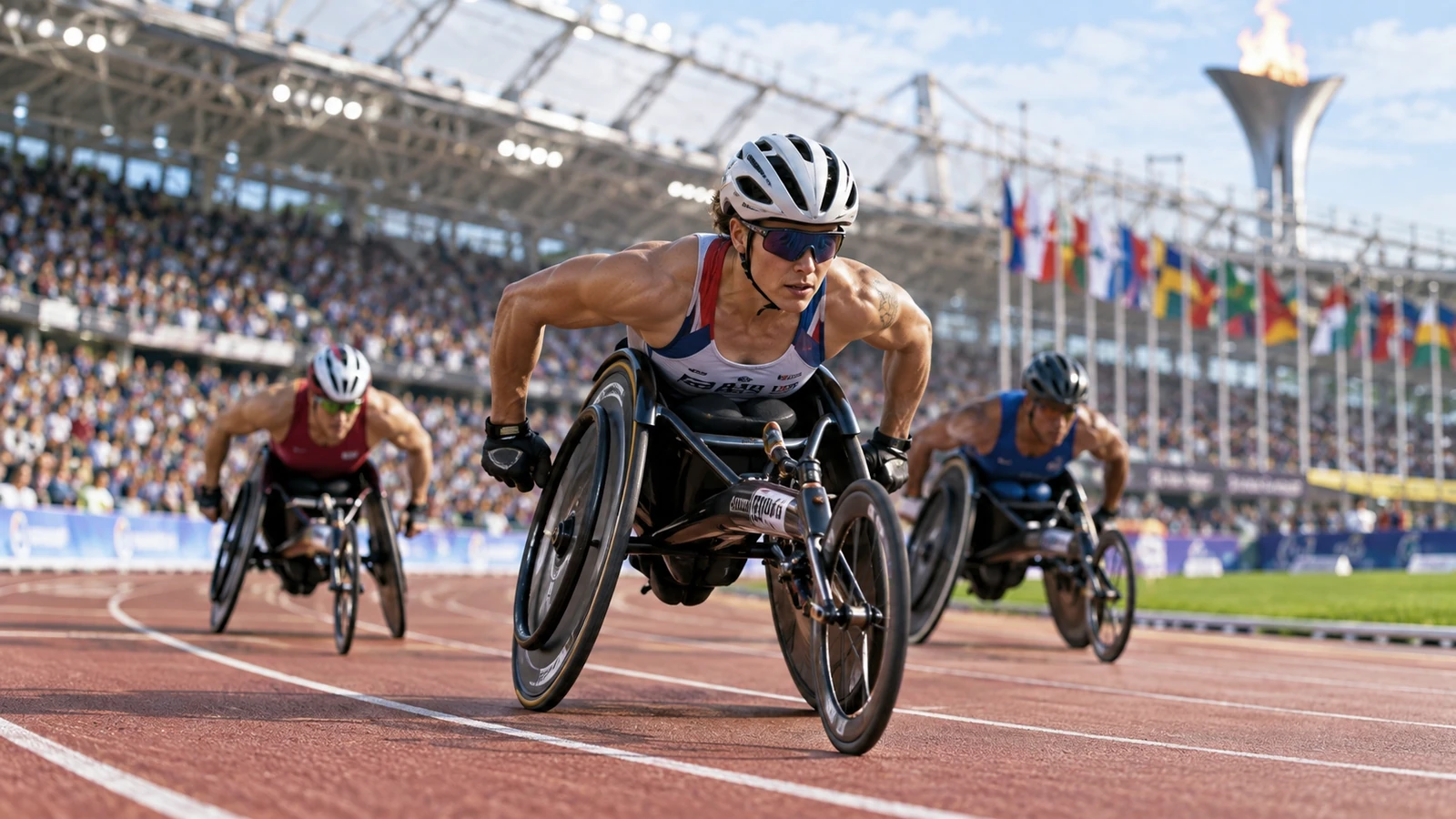
During the early decades of the Paralympic Games, athletes competed using their standard everyday wheelchairs, which were heavy, rigid, and unoptimized for athletic performance. By the 1980s, bioengineers and sports designers began engineering specialized sports wheelchairs crafted from aerospace-grade aluminum, titanium, and carbon fiber composites. Modern racing wheelchairs feature three wheels, custom-molded seats, and long cambered rear wheels that maximize stability and propulsion efficiency at high speeds. Equipment design is so advanced that a custom racing chair or basketball frame can cost tens of thousands of dollars. These technological breakthroughs have dramatically shattered world records across every track and field discipline.
12. Host Cities Are Bound to Host Both Games in the Same Venues
Prior to 1988, the Paralympic Games were frequently held in different cities or even different countries than the Summer Olympic Games. That changed dramatically at the Seoul 1988 Summer Games, where both events shared the same host city and modern athletic venues back-to-back. The success of this integrated approach led to a formal agreement signed in 2001 between the International Olympic Committee and the International Paralympic Committee. Under the "One City, One Games" principle, any candidate city bidding to host the Olympics must automatically bid to host the Paralympics as well. This mandate guarantees world-class venues, housing, and infrastructure for Paralympic athletes worldwide.
13. Tandem Para Cyclists Can Exceed Speeds of 60 Kilometers Per Hour
Para cycling track and road events showcase remarkable velocity, particularly in the tandem discipline designed for athletes with visual impairments. In tandem cycling, a sighted cyclist known as the "pilot" sits in the front seat to steer and manage the gears, while the visually impaired athlete, known as the "stoker," sits in the rear seat to generate explosive leg power. Because two athletes are transferring power to a single streamlined bicycle frame, tandem teams generate immense momentum on the velodrome banked track. On flat straightaways and downhill sections, these synchronized dynamic duos can routinely reach speeds exceeding 60 kilometers per hour (37 mph). The sport requires flawless physical coordination and intense mutual confidence between both riders.
14. Sherif Osman Can Lift Over Four Times His Own Body Weight
Powerlifting at the Paralympic Games is a supreme test of upper-body strength, featuring a specialized bench press movement performed by athletes with lower-limb disabilities. Egyptian powerlifter Sherif Osman established himself as one of the most dominant strength athletes in history by competing in the 59-kilogram weight class. Despite weighing under 130 pounds, Osman successfully bench-pressed over 211 kilograms (465 pounds) in official competition. This feat means he hoisted more than four times his own body weight off his chest while keeping his legs strictly motionless. Osman won three consecutive Paralympic gold medals between 2008 and 2016, setting multiple world records along the way.
15. The Winter Paralympics Were Introduced in Sweden in 1976
While the Summer Paralympics grew rapidly throughout the 1960s, winter adaptive sports required more time to establish a unified international showcase. The inaugural Winter Paralympic Games were finally held in 1976 in Örnsköldsvik, Sweden, featuring events in alpine skiing and cross-country skiing. Athletes with spinal injuries, amputations, and visual impairments competed using adapted equipment, such as sit-skis and specialized outriggers. The 1976 Games welcomed 198 athletes from 16 nations, laying the foundation for modern winter events like Para ice hockey and Para snowboard. Today, the Winter Paralympics stand as a premier global sporting spectacle held every four years in tandem with the Winter Olympics.
Sources & References
This AI-assisted post was rigorously curated and fact-checked for accuracy by:
 Martin Roháček
How fun was this article? 🤔
Tap a star to rate it
🧠 Quiz: How closely were you paying attention?
10 questions — all answers are in the article above!
Enjoyed these facts? There's more! 💌
Fresh fun facts in your inbox. No spam, ever.