The Deadly Balloon: 15 Fascinating Facts About Pufferfish
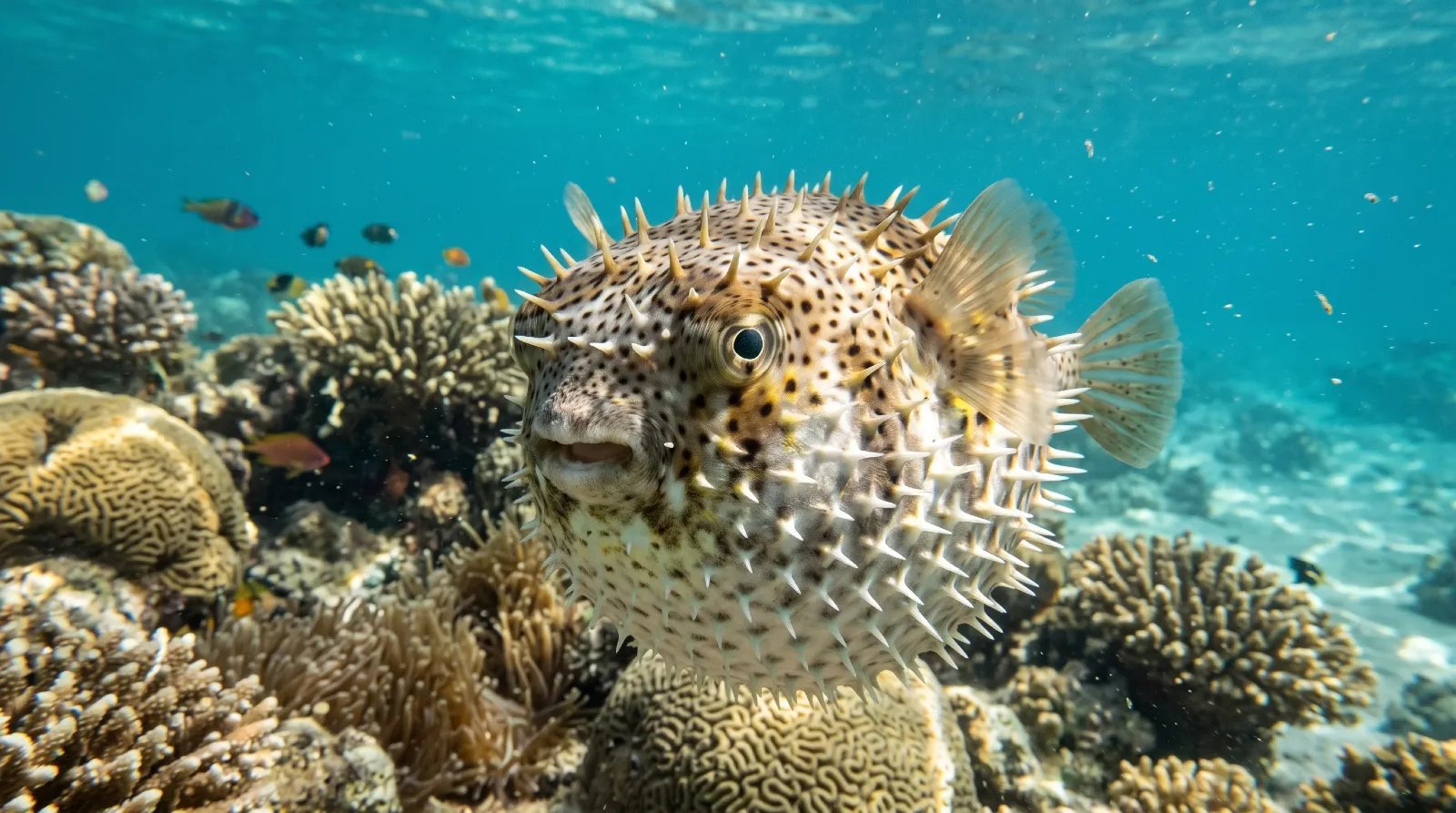
Pufferfish can turn themselves into spiky balls, carry enough poison to kill a person and yet are served as a luxury delicacy in Japan. Some males are underwater artists, and dolphins have been filmed passing them around in what looks suspiciously like a party. Here are the surprising facts about one of the ocean's most dangerous little fish.
1. They inflate by gulping water.
When a pufferfish is threatened, it rapidly swallows large amounts of water into its highly elastic stomach, swelling to several times its normal size. Out of the water, it can do the same with air. The sudden transformation turns a slow, easy-looking target into a large, round ball that is very difficult for a predator to swallow.
2. Many are covered in hidden spines.
Instead of normal fish scales, many pufferfish have small spines embedded in their skin. When the fish is deflated, the spines lie flat and are hard to notice. When it inflates, the spines stick out in all directions, turning the fish into a prickly ball that few predators want to bite.
3. They are among the most poisonous vertebrates on Earth.
Most pufferfish species contain tetrodotoxin, a nerve poison that is far more potent than cyanide. It is concentrated mainly in the liver, ovaries and sometimes the skin. A single fish can contain enough toxin to kill several adult humans, and there is no known antidote.
4. The poison comes from bacteria.
Pufferfish do not make tetrodotoxin themselves. Scientists increasingly believe that it is produced by bacteria and builds up in the fish through its diet. Pufferfish raised on farms with carefully controlled food are often non-toxic, which shows how important their natural diet is.
5. In Japan, they are an expensive delicacy.
Despite the danger, pufferfish meat, known as fugu, is considered a luxury in Japan, Korea and China. In Japan, chefs must train for years and pass strict examinations before they are licensed to prepare it. They carefully remove the poisonous organs and serve the meat, often as paper-thin slices of sashimi arranged in beautiful patterns.
6. Traditionally, the Japanese emperor was not allowed to eat it.
Because of the risk of poisoning, fugu was traditionally forbidden to the Emperor of Japan. The dish is still banned or restricted in some places today. Fugu liver, which is considered the tastiest and most dangerous part, has been banned from sale in restaurants in Japan since 1984.
 Marine and Freshwater Animals
Twenty-five animals of the sea and rivers, from the largest creature ever to exist to a seahorse dad, each linked to its full 15-fact article.
See All Facts
7. Captain James Cook nearly died after eating one.
In 1774, during his second voyage around the world, the British explorer James Cook and two of his naturalists tasted the liver and roe of a pufferfish in New Caledonia. They soon felt numb and weak and were lucky to survive. A pig that ate the leftovers died the next morning.
8. Their teeth are fused into a beak.
The name of the pufferfish family, Tetraodontidae, means "four teeth" in Greek. Pufferfish have four large teeth fused into a powerful beak, two on top and two on the bottom. They use it to crush the shells of clams, mussels, crabs and sea urchins, and the teeth keep growing throughout their lives.
9. Male pufferfish create underwater sand art.
In the 1990s, divers off the Japanese island of Amami Ōshima began finding mysterious circular patterns about two metres wide on the sea floor. In 2012, scientists discovered that they were made by small male pufferfish, which spend days carving the elaborate designs by swimming and flapping their fins in the sand. The circles attract females and provide a safe place to lay eggs.
10. Dolphins may use them to get "high".
In a BBC documentary, young dolphins were filmed carefully passing a pufferfish between them, gently chewing it and then floating near the surface in an apparent trance. Some scientists suggested that small doses of the fish's toxin might have a narcotic effect on the dolphins. Others are more sceptical, but the footage became famous around the world.
11. Puffing up can be dangerous for the pufferfish.
Inflating is a last line of defence, not something pufferfish enjoy. It puts a strain on their bodies and makes them slow and clumsy swimmers. If a pufferfish is repeatedly stressed into puffing up, for example by people handling it for photos, it can be harmed or even killed.
12. Their eyes move independently, like a chameleon's.
Pufferfish are slow swimmers, so good eyesight is essential for spotting danger. Like chameleons, they can move each eye independently. Many species can also change the colour or brightness of their patterns to match their surroundings or their mood.
13. Bright colours are a warning.
While many pufferfish are drab and blend in, others are brightly coloured and make no attempt to hide. Scientists believe these vivid patterns act as a warning to predators that the fish is poisonous. Even the larvae of some species carry the toxin on their skin, which causes predators to spit them out.
14. Some live in rivers and lakes.
Not all pufferfish live in the sea. Around 30 species are found in fresh or brackish water in Africa, South America and Asia. The largest freshwater species, the Mbu pufferfish of the Congo River, can grow to more than 50 centimetres long.
15. They have one of the smallest genomes of any vertebrate.
The genome of the Japanese pufferfish, or fugu, is remarkably compact, about one-eighth the size of the human genome, yet it contains a similar number of genes. Because of this, it was one of the first vertebrate genomes to be sequenced, in 2002, and it has helped scientists to identify genes in other animals, including humans.
Sources & References
This AI-assisted post was rigorously curated and fact-checked for accuracy by:
 Martin Roháček
How fun was this article? 🤔
Tap a star to rate it
🧠 Quiz: How closely were you paying attention?
10 questions — all answers are in the article above!
Enjoyed these facts? There's more! 💌
Fresh fun facts in your inbox. No spam, ever.