The Island at the Edge of the World: 15 Fascinating Facts About Skellig Michael
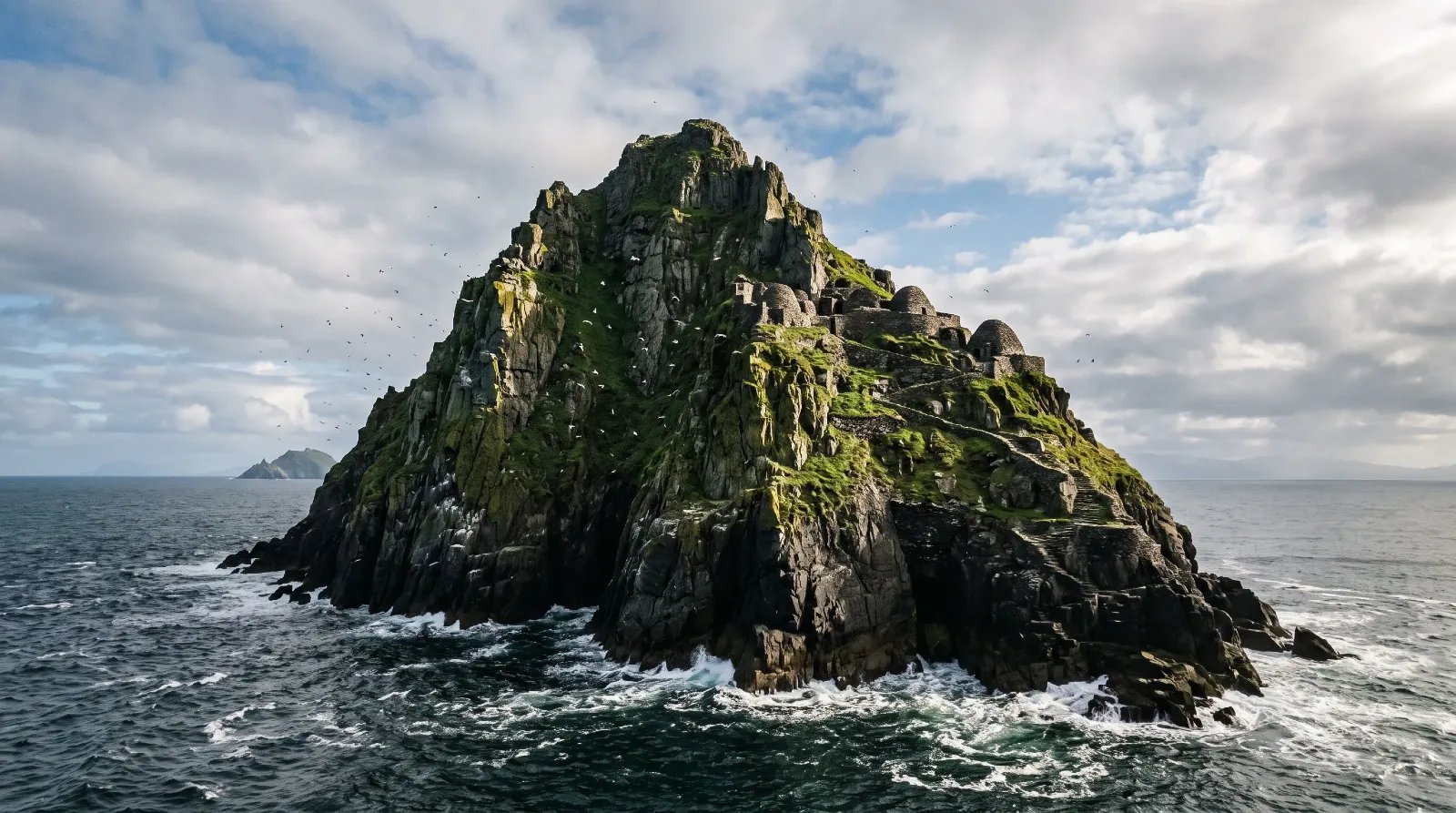
Rising out of the Atlantic off the coast of Ireland, Skellig Michael looks like a place no human could survive. Yet a handful of medieval monks lived on this jagged rock for centuries, built stone huts that are still watertight today and survived Viking raids. More recently, it became a home for Luke Skywalker. Here are the stories behind one of Europe's most extraordinary islands.
1. Monks lived on this remote rock for around 600 years.
Skellig Michael lies about 12 kilometres (7.5 miles) off the coast of County Kerry in the Atlantic Ocean. Sometime between the 6th and 8th centuries, Christian monks founded a monastery on the island, seeking extreme isolation for prayer. They remained there until around the 12th or 13th century, when the community moved to the mainland at Ballinskelligs. Tradition credits Saint Fionán with founding the monastery, although historians doubt this.
2. The whole community was tiny.
Despite its fame, the monastery was never large. Historians estimate that no more than about twelve monks and an abbot lived on the island at any one time. They grew vegetables in small terraced gardens, collected rainwater in cisterns and relied on seabirds, eggs and fish for food.
3. Their stone huts are still watertight after more than 1,000 years.
The monastery sits on a terraced shelf about 180 metres (600 feet) above the sea. Its six beehive-shaped cells, known as clocháns, were built from stone without any mortar, using a technique called corbelling, in which each layer of stones projects slightly inward until the roof closes. The buildings are so well constructed that their interiors have stayed dry for more than a millennium, despite the fierce Atlantic weather.
4. Visitors must climb around 600 ancient stone steps.
The monks carved steep flights of stone steps into the rock, leading up from three different landing points. Today, visitors climb roughly 600 uneven steps, with no handrails and sheer drops to the sea, to reach the monastery. The steps are so exposed that landings are cancelled whenever the weather turns bad.
5. Vikings raided the island in 823.
Even this remote outpost was not safe from the Vikings. Irish annals record that in 823 "Skellig was plundered by the heathens" and its abbot, Eitgal, was carried off and died of hunger. The Vikings attacked again in 838. Remarkably, the monastery survived and continued for several more centuries.
6. A hermit lived on an even more dangerous peak.
Away from the main monastery, near the top of the island's South Peak, lie the remains of a hermitage built on tiny ledges above a sheer drop. It can only be reached by a narrow and hazardous route, and access today is permitted only by special arrangement. The hermitage is considered one of the most inaccessible early medieval monuments in Europe.
7. Its name means "splinter of stone".
The word "Skellig" comes from the Irish word "sceilig", meaning a splinter of stone, which perfectly describes the island's jagged shape. It is named after the Archangel Michael, to whom the monastery had been dedicated by the 11th century at the latest. Its sister island, Little Skellig, is smaller and cannot be visited.
8. Little Skellig is home to one of the largest gannet colonies in the world.
Neighbouring Little Skellig is covered with tens of thousands of nesting northern gannets during the breeding season. From a distance, the birds and their droppings make the rock look as if it is covered in snow. Landing there is forbidden, so the gannets are left in peace.
9. Thousands of puffins nest in burrows on the island.
Each spring, Atlantic puffins arrive on Skellig Michael to breed in burrows dug into the island's soil. Visitors often encounter them sitting just metres from the stone steps. The puffins leave again by around August, spending the rest of the year far out at sea.
10. Star Wars turned the island into a planet.
Skellig Michael appeared as the planet Ahch-To, where Luke Skywalker lives in hiding, in "Star Wars: The Force Awakens" (2015) and "Star Wars: The Last Jedi" (2017). The final scene of "The Force Awakens", in which Rey climbs the stone steps to find Luke, was filmed there. Aerial footage of the island also appeared in "The Rise of Skywalker" (2019).
11. The island's puffins inspired the porgs.
When filming "The Last Jedi" on Skellig Michael, the crew found protected puffins everywhere and could not simply chase them out of shots. Rather than digitally erasing every bird, the filmmakers created the porgs, small bird-like creatures that could be placed over the real puffins. The porgs went on to become one of the most popular characters in the film.
12. Only 180 visitors are allowed to land each day.
To protect the fragile monastery and wildlife, the Irish Office of Public Works limits visitors to 180 per day. The island can only be visited during the summer season, roughly from May to early October, and only on licensed boats. Even then, rough seas often prevent boats from landing.
13. Waves can break high over the landing pier.
Skellig Michael takes the full force of Atlantic swells arriving from distant storms. Even when the mainland is calm, the sea around the island can be extremely rough. Waves have been recorded breaking up to 10 metres over the pier, which is why trips are so often cancelled at the last minute.
14. Lighthouse keepers and their families once lived there.
In the 1820s, two lighthouses were built on Skellig Michael, along with a road cut into the rock to serve them. Keepers and sometimes their families lived on the island for long periods, and the remains of a medieval church on the island contain a gravestone dated 1871 for members of a lighthouse keeper's family. The upper lighthouse is no longer used, but the lower one still operates automatically.
15. UNESCO named it a World Heritage Site in 1996.
Skellig Michael was added to the UNESCO World Heritage List in 1996 as an exceptional example of an early Christian monastic settlement. UNESCO praised the monastery's remarkable state of preservation, which allows visitors to see how the monks lived more than 1,000 years ago. Few places in Europe show so clearly how extreme early medieval monastic life could be.
Sources & References
This AI-assisted post was rigorously curated and fact-checked for accuracy by:
 Martin Roháček
How fun was this article? 🤔
Tap a star to rate it
🧠 Quiz: How closely were you paying attention?
10 questions — all answers are in the article above!
Enjoyed these facts? There's more! 💌
Fresh fun facts in your inbox. No spam, ever.