
The Sluggish Marvel: 15 Fascinating Facts About Snails
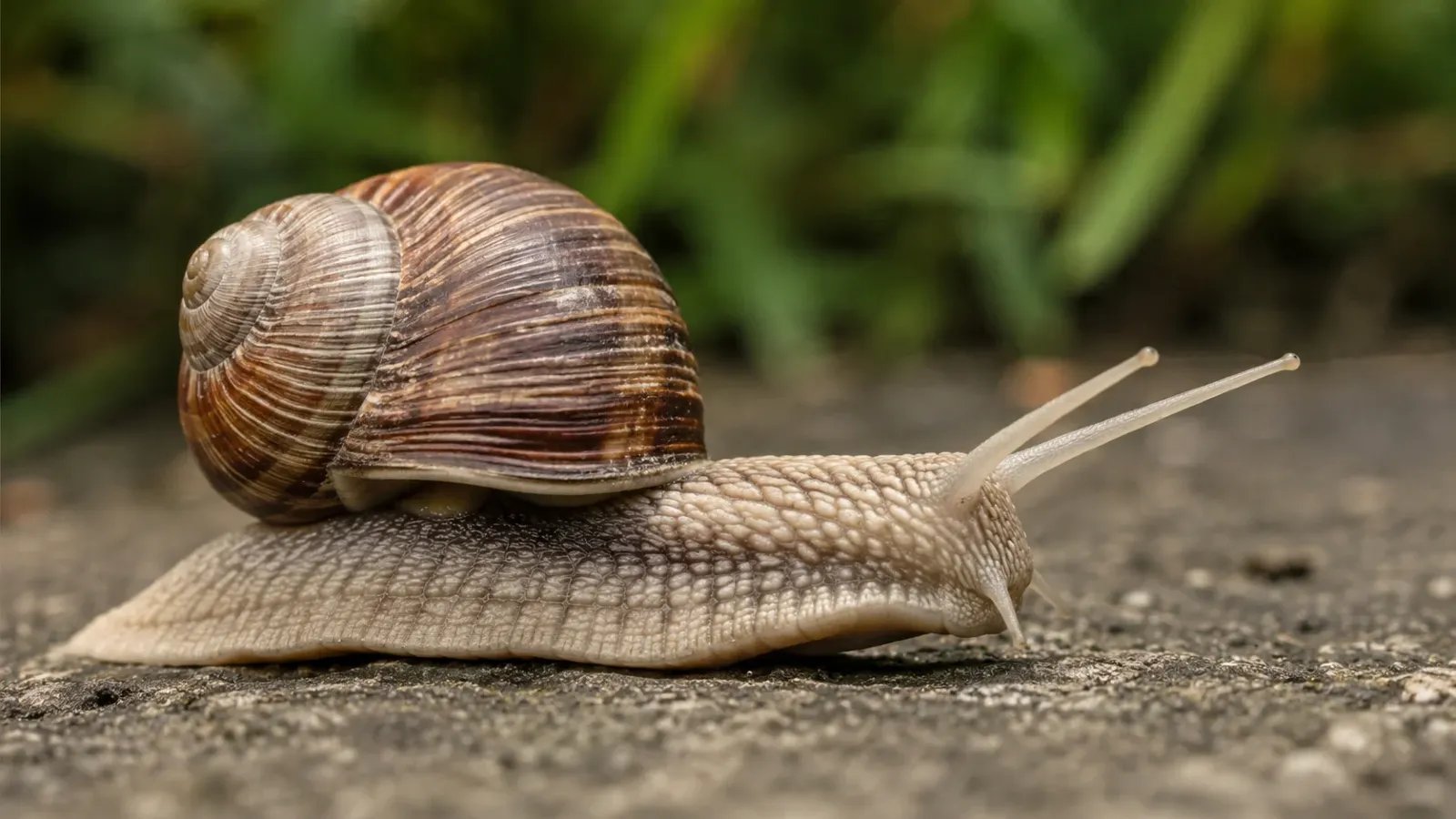
Snails are often dismissed as simple garden pests, but this is a gross misconception. Far from being primitive blobs, these ancient mollusks boast thousands of microscopic teeth, complex reproductive anatomies, and even lethal venoms. Prepare to discover the highly sophisticated biology and bizarre evolutionary adaptations hidden entirely within their unassuming coiled shells.
1. Snails possess up to twenty thousand microscopic teeth arranged in rows on a ribbon-like structure called a radula.
Rather than chewing their food like mammals, snails use this conveyor belt of chitinous teeth to scrape across surfaces. As the front teeth wear down from grinding against leaves, bark, or even limestone, new ones constantly grow in the back and move forward to replace them, functioning similarly to the continuous dental mechanics of a great white shark.
2. Many land snails fire calcified projectiles known as love darts into their mates during courtship to increase reproductive success.
These sharp, mucus-coated darts do not transfer sperm; instead, they deliver a specialized hormone that prevents the receiving snail's body from digesting the sperm. Because most terrestrial snails are hermaphrodites competing to fertilize each other, the one whose dart successfully pierces the other ensures its genetic material has a significantly higher chance of survival.
3. Marine cone snails produce a neurotoxic venom so potent that a single drop can kill several human adults.
The geographic cone snail hunts fish by extending a modified radula tooth like a harpoon, injecting a complex cocktail of hundreds of different toxins called conotoxins. Because there is no antivenom, a sting from one of these deceptively beautiful creatures results in rapid muscle paralysis and respiratory failure, earning them the nickname cigarette snails since victims supposedly only have time for one last smoke.
4. Desert snails can enter a state of deep sleep known as estivation and survive without food or water for up to three years.
When faced with extreme drought and heat, these mollusks retreat deep into their shells and seal the entrance with a barrier of dried mucus called an epiphragm. This impenetrable seal prevents moisture loss while the snail dramatically drops its metabolic rate to near zero, patiently waiting for the next rainfall to reawaken and resume its life.
5. Almost all snail shells coil to the right, and the rare left-coiling mutants often struggle to find mates due to mismatched anatomy.
This spiral direction, known as chirality, is determined by a single gene at the very beginning of embryonic development. Because a snail's reproductive organs are positioned according to the direction of its shell, a left-coiling snail physically cannot align its anatomy with a standard right-coiling partner, making reproduction nearly impossible for these rare mirrored variants.
6. Snail mucus is a non-Newtonian fluid that simultaneously acts as a powerful adhesive and an ultra-slick lubricant.
When a snail is resting, its slime is sticky enough to glue it vertically to a pane of glass. However, when the snail exerts pressure by moving its muscular foot, the mucus instantly liquefies, allowing the creature to glide over jagged rocks or the edge of a razor blade without sustaining any structural damage to its delicate body.
 Insects and Invertebrates
Discover the bizarre biology and complex societies of the world's most misunderstood invertebrates. From subterranean fungus farmers to insects with microscopic solar panels, explore the hidden marvels of the creeping, crawling, and flying creatures that sustain global ecosystems.
See All Facts
Insects and Invertebrates
Discover the bizarre biology and complex societies of the world's most misunderstood invertebrates. From subterranean fungus farmers to insects with microscopic solar panels, explore the hidden marvels of the creeping, crawling, and flying creatures that sustain global ecosystems.
See All Facts
7. The scaly-foot gastropod incorporates solid iron into its shell and foot to survive the extreme environments of deep-sea hydrothermal vents.
Found miles beneath the ocean surface where temperatures fluctuate wildly and predators abound, this incredible marine snail extracts toxic iron sulfides from the superheated vent water. It synthesizes these minerals to grow armor plates and an iron-infused shell, making it the only known living organism on Earth that utilizes iron sulfide in its structural skeleton.
8. A snail achieves forward motion by sending waves of muscular contractions from the back of its foot to the front.
Rather than walking or slithering, snails propel themselves using pedal waves. As these ripples of muscle contraction travel along their underside, small segments of the foot lift, move forward, and plant themselves back down in the mucus layer. This incredibly energy-intensive mode of transport is precisely why their top speed is restricted to a mere three feet per hour.
9. The Giant African Land Snail can grow up to eight inches in length and consume over five hundred different species of plants.
Weighing nearly two pounds with shells the size of a human fist, these massive terrestrial mollusks are voracious eaters. In calcium-poor environments, they have even been known to eat sand, small stones, animal bones, and the stucco off houses to gather enough minerals to maintain their enormous, rapidly growing shells.
10. Terrestrial snails are completely deaf and rely entirely on chemical sensors and rudimentary eyesight to navigate the world.
Without ears or any auditory nerve centers in their primitive brains, snails experience an entirely silent existence. Instead, they interpret their environment through olfactory organs located on their lower tentacles, effectively tasting and smelling the air to locate food and mates, while their upper tentacles possess eye spots that can only distinguish basic light from shadow.
11. Most land snails are simultaneous hermaphrodites, meaning they possess fully functional male and female reproductive organs at the same time.
Despite having the biological equipment to self-fertilize, snails generally seek out a partner to ensure genetic diversity. During an encounter, both individuals will usually exchange sperm bundles, meaning a single mating session can result in both participants crawling away pregnant and subsequently laying clutches of dozens of tiny, translucent eggs.
12. The deadly venom of the cone snail is actively used to create painkillers that are one thousand times more powerful than morphine.
Scientists have isolated specific peptide toxins from the venom that target pain receptors in the human nervous system without crossing into the brain regions that cause addiction. This has led to the development of synthetic drugs that block severe, chronic pain signals without the dangerous respiratory depression and physical dependency associated with standard opioids.
13. The rosy wolfsnail is a highly aggressive cannibalistic predator that tracks down other snails by following their slime trails.
Native to the southeastern United States, this remarkably swift gastropod features sensory extensions resembling a mustache, which it uses to chemically detect the mucus paths of its prey. Once it catches up, the rosy wolfsnail either swallows smaller snails whole or inserts its elongated head into larger shells to consume the victim alive.
14. A snail is born with a proto-shell that expands in a continuous spiral throughout its life by secreting calcium carbonate from a specialized organ.
The mantle, a fleshy layer lining the inside of the shell, constantly pulls calcium and proteins from the snail's diet to build new shell material at the opening. Because the shell is permanently attached to the snail's body via a network of strong muscles, a snail can never leave its shell; if the shell is severely crushed, the animal will ultimately perish.
15. Despite having only two nerve cords rather than a true centralized brain, snails possess long-term memory capabilities.
Research on pond snails has demonstrated that they can be classically conditioned to associate specific tastes with distinct outcomes, remembering these lessons for weeks. Their large, easily accessible neurons have made them vital scientific models for neurobiologists studying the fundamental cellular mechanisms behind how memories are formed, stored, and retrieved in all animals.
Sources & References
This AI-assisted post was rigorously curated and fact-checked for accuracy by:
 Martin Roháček
How fun was this article? 🤔
Tap a star to rate it
🧠 Quiz: How closely were you paying attention?
10 questions — all answers are in the article above!
Enjoyed these facts? There's more! 💌
Fresh fun facts in your inbox. No spam, ever.