
The Gothic Victorian Marvel: 15 Fascinating Facts About Tower Bridge
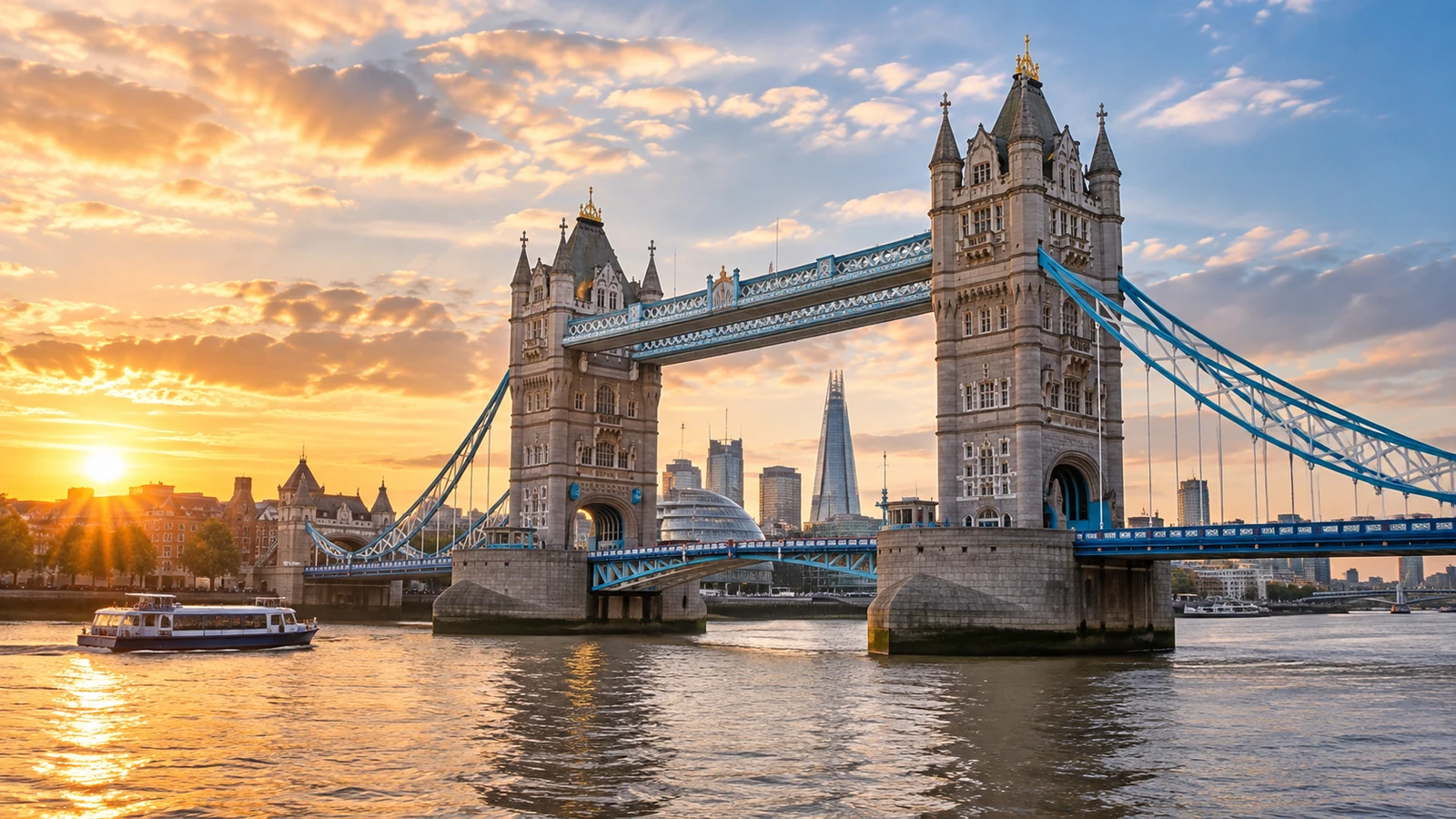
Spanning the River Thames with its twin Neo-Gothic towers and elevated walkways, Tower Bridge is one of the world's most recognizable architectural landmarks. Completed in 1894, this engineering masterpiece uniquely combines suspension cables with steam-powered bascule drawbridges. Beyond its postcard-perfect exterior lies a dramatic history of bus jumps, unauthorized jet fly-throughs, secret underwater concert halls, and mistaken identity. Discover the fascinating engineering secrets and colorful legends behind London's iconic river crossing.
1. A Double-Decker Bus Once Jumped the Opening Bridge
In December 1952, driver Albert Gunter was driving the number 78 bus across Tower Bridge when he noticed the road ahead was suddenly sinking. The gate watchman had forgotten to ring the warning bell or close the gates before starting the lift mechanism. Realizing he could not stop in time on the wet asphalt, Gunter made a split-second decision to slam on the accelerator. The bus leaped across a three-foot opening gap, soaring over the Thames to land safely on the northern bascule, which had not yet begun to rise. None of the twenty passengers were seriously injured, and Gunter was rewarded with a day off and a ten-pound bonus for his bravery.
2. Its Iconic Blue Color Is Actually Quite Recent
While visitors today recognize Tower Bridge by its striking blue and white color scheme, it was originally painted a drab chocolate brown. When the bridge opened in 1894, Victorian civic leaders selected dark brown paint to tone down its massive industrial appearance and blend in with surrounding docks. It retained various muted tones for decades until 1977, when the city completely repainted the structure. The vivid royal blue, white, and red color scheme was chosen specifically to celebrate the Silver Jubilee of Queen Elizabeth II. The royal blue hue remained so popular that it was kept during subsequent restorations, becoming a permanent defining feature.
3. It Is a Bascule Bridge, Not a Classic Drawbridge
Tower Bridge is frequently mislabeled as a traditional drawbridge, but it is actually a highly sophisticated bascule bridge. The term comes from the French word for "see-saw," describing the precise balancing act that allows the bridge to operate. Each of the massive road leaves, known as bascules, weighs over one thousand tons and pivots on a central axle. They are heavily counterweighted inside the piers so that very little energy is required to swing them upward. As a result of this Victorian engineering triumph, the giant steel leaves can raise to an angle of 86 degrees in just sixty seconds.
4. River Traffic Always Holds Ultimate Right of Way
By ancient parliamentary legislation, river traffic on the Thames takes precedence over all road vehicles and pedestrians. Any boat or ship taller than thirty feet has the right to demand a bridge lift, and the city cannot charge the vessel any fee for opening. This rule is enforced strictly, regardless of who happens to be attempting to cross the bridge on land. In 1997, United States President Bill Clinton was traveling in a motorcade with Prime Minister Tony Blair when the bridge began to open. The presidential convoy was forced to stop and wait patiently as the small wooden barge Gladys passed underneath.
5. The High-Level Walkways Were Once Notorious Crime Dens
When Tower Bridge was constructed, the upper walkways were designed so pedestrians could cross the river even when the bascules were raised. However, crossing required climbing hundreds of stairs with heavy bags, which proved far too inconvenient for ordinary commuters. Because very few law-abiding citizens used the high walkways, the secluded space rapidly became a magnet for criminals. Pickpockets, footpads, and unsavory street traders took control of the elevated passages, turning them into a notorious red-light haunt. The City of London finally shut down the walkways in 1910, keeping them closed to the public for more than seven decades.
6. Secret Underwater Chambers Host Classical Music Concerts
Deep beneath the river level, inside the concrete piers that support the bridge, lie gigantic hollow spaces known as bascule chambers. These cavernous brick-lined rooms provide the necessary clearance for the massive iron counterweights to drop down as the road leaves rise up into the air. When the bridge is stationary, these sunken chambers remain completely empty and possess extraordinary natural acoustics. In recent years, engineers and arts organizations have transformed the southern bascule chamber into an exclusive subterranean performance hall. Today, adventurous concertgoers can descend beneath the Thames to enjoy contemporary classical music performances surrounded by Victorian brickwork.
7. Rebellious Pilots Have Flown Planes Right Through the Gap
The dramatic silhouette of Tower Bridge has repeatedly tempted daring aviators to test their skills between its towers and walkways. In 1912, aviation pioneer Frank McClean inadvertently found himself flying too low over the Thames and successfully steered his biplane right between the high walkways and the bascules. A much more dramatic stunt occurred in April 1968, when Royal Air Force pilot Alan Pollock was angered by government defense cuts. Flying a Hawker Hunter jet without authorization, Pollock buzzed the Houses of Parliament before sweeping down the Thames and blasting through Tower Bridge at high speed. He was promptly arrested upon landing and medically discharged from the air force.
8. Steam Power Driven by Coal Kept the Bridge Moving for Decades
For its first eighty years of service, Tower Bridge relied entirely on steam power to operate its massive hydraulics. Massive coal-fired boilers heated water to generate steam, which drove powerful engines that pumped water into enormous hydraulic accumulators. This pressurized water was then released on demand to drive the mechanical gears that lifted the bascules. The system was so reliable that it operated without major failure through two world wars and thousands of river crossings. In 1974, the bridge was converted to modern electro-hydraulic power, but the original Victorian steam engines were carefully preserved and remain open to visitors.
9. The Stone Architecture Is a Disguise Over a Steel Frame
Tower Bridge appears to be a medieval stone masterpiece built to rival grand castles, but its appearance is entirely decorative. The underlying structure consists of an advanced steel skeleton weighing over eleven thousand tons. Victorian architects encased the massive metal frame in thick masonry made of Cornish granite and Portland stone to give it a classical appearance. This design choice was mandatory to satisfy aesthetic demands and harmonize with the adjacent historic Tower of London. Without this stone cladding, Tower Bridge would resemble a purely industrial steel truss bridge similar to those built across industrial shipping routes.
10. Bridge Openings Have Dropped From 18,000 to Under 1,000 per Year
When Tower Bridge opened in the late nineteenth century, the Pool of London was the busiest port facility in the world. Ships packed with commercial cargo arrived constantly, requiring the bridge to open between twenty and fifty times every single day. In its first full year of operation alone, the bascules were raised over seventeen thousand times to let maritime traffic pass. As commercial shipping moved downriver to modern deep-water container ports like Tilbury, river traffic dramatically diminished. Today, Tower Bridge opens approximately eight hundred times a year, mostly for luxury yachts, historic tall ships, and sightseeing cruises.
2>11. Victorian Gear Mechanics Left Behind Haunting Urban LegendsMaintaining the original steam engines and heavy machinery was dangerous work for Victorian laborers operating in dark, oily spaces. Tragically, a few workers were killed or injured when caught in the moving gears and massive counterweights during bridge lifts. These industrial accidents gave rise to long-standing ghost stories among the maintenance crew stationed beneath the roadway. Staff working in the Victorian engine rooms have reported unexplainable cold spots, shadowy figures, and the sound of heavy metallic clanking when the machinery is completely dormant. The stories persist to this day, making the subterranean engine rooms a popular stop for supernatural enthusiasts.
12. A Morbid Alcove Earned the Name "Dead Man's Hole"
Directly beneath the northern approach of Tower Bridge sits a small riverbank alcove that carries a somber maritime history. Due to the natural currents and eddies of the River Thames, floating debris and drowning victims frequently washed ashore at this specific location. Local authorities constructed a specialized sheltered spot known as "Dead Man's Hole" to collect deceased individuals pulled from the water. A nearby mortuary, equipped with a retractable table powered by river water, was used by city coroners to process bodies. Today, visitors can still see the brick archway and iron steps where bodies were once brought ashore.
13. Glass Walkways Offer Views Through Fifty-Millimeter Panels
In 2014, city authorities transformed the high-level walkways by installing state-of-the-art glass floors situated 42 meters above the river. Each glass section measures eleven meters long and consists of six individual layers of high-strength glass totaling 53 millimeters in thickness. The glass panels are capable of holding the weight of two full-sized double-decker buses or six elephants simultaneously. Visitors can walk directly across these transparent floor panels to observe pedestrians, red London buses, and river vessels passing beneath their feet. The installation quickly became one of London's most popular photographic spots for tourists.
14. It Survived Heavy Bombing During the WWII Blitz
During World War II, the German Luftwaffe targeted London's docks relentlessly in an effort to cripple British trade and infrastructure. Positioned at the heart of the East End docklands, Tower Bridge was a high-value target and a key navigation landmark for enemy bombers. Despite thousands of bombs falling across the surrounding riverbanks, Tower Bridge suffered surprisingly minimal structural damage throughout the war. The most serious incident occurred in December 1940, when a bomb exploded on the roadway, damaging the bascule mechanism. Royal Engineers repaired the damage in record time, ensuring that military convoys could continue crossing the river.
15. It Is Frequently Confused With the Nearby London Bridge
Despite being one of the world's most recognizable landmarks, Tower Bridge suffers from chronic identity theft by tourists and media outlets. Many visitors mistakenly believe that this grand Victorian bascule structure is actually "London Bridge." In reality, London Bridge is located a half-mile further upstream and is a far simpler, utilitarian concrete structure built in the 1970s. The confusion is so widespread that legend insists American businessman Robert P. McCulloch accidentally bought the old 1831 London Bridge thinking he was purchasing Tower Bridge. Although McCulloch denied the rumor, the story reflects how deeply embedded the name confusion remains worldwide.
Sources & References
This AI-assisted post was rigorously curated and fact-checked for accuracy by:
 Martin Roháček
How fun was this article? 🤔
Tap a star to rate it
🧠 Quiz: How closely were you paying attention?
10 questions — all answers are in the article above!
Enjoyed these facts? There's more! 💌
Fresh fun facts in your inbox. No spam, ever.