The Unforgettable Fire: 15 Fascinating Facts About U2
From four Dublin teenagers rehearsing in a cramped kitchen to one of the biggest stadium rock acts in history, U2 has defined modern rock music for over four decades. Behind their soaring anthems and record-breaking world tours lies a rich history of surprising artistic gambles, near-disasters, and deeply personal moments. Discover the remarkable true stories behind Bono's iconic eyewear, Brian Eno's near-erasure of a classic hit, and how a local hearing aid store inspired one of music's most famous names.
1. Before Becoming U2, the Band Called Themselves Feedback
When the group formed at Dublin's Mount Temple Comprehensive School in 1976, the teenage musicians lacked both experience and formal musical vocabulary. The band initially named themselves Feedback simply because it was one of the few technical audio terms they actually knew. They later rebranded as The Hype before local musician Steve Averill suggested the name U2 just prior to a talent contest in 1978. Averill picked U2 because it was ambiguous, memorable, and left room for interpretation, referencing the Cold War spy plane, a naval submarine class, and the phrase "you too." Although the band members initially disliked the name, they agreed to use it for the competition and ultimately adopted it permanently.
2. Bono’s Stage Name Came from a Dublin Hearing Aid Shop
Born Paul David Hewson, the U2 frontman did not choose his famous moniker out of vanity or theatrical grandiosity. During his adolescence in Dublin, he was part of a surrealist street gang called Lypton Village, where members regularly bestowed surreal nicknames on one another. He was initially dubbed "Bonavox of O'Connell Street" after a local store selling hearing aids, derived from the Latin phrase bona vox, meaning "good voice." Over time, the name was shortened to Bona Vox and eventually just Bono. Although he resisted the nickname at first, he embraced it after learning its literal translation, which proved prophetically fitting for his future vocal career.
3. The Edge Revolutionized Rock Guitar with Delay Effects
Guitarist David Evans, globally known as The Edge, forged one of the most recognizable guitar sounds in rock history without relying on traditional heavy distortion. Instead, he pioneered an atmospheric style heavily reliant on digital and analog delay units, most notably the Electro-Harmonix Memory Man and the TC Electronic 2290. By playing precise dotted-eighth-note delay patterns, a single guitar note creates a shimmering cascade of echo that sounds like multiple instruments playing simultaneously. This rhythmic innovation became the sonic foundation for classic tracks like "Where the Streets Have No Name" and "Pride (In the Name of Love)." His minimalistic, textured approach challenged the era's prevailing trend of fast guitar shredding and reshaped modern alternative music.
4. An Unannounced Rooftop Gig in Los Angeles Nearly Stopped Traffic
In March 1987, U2 paid homage to The Beatles' famous 1969 rooftop performance by playing an unannounced set on top of a liquor store in downtown Los Angeles. The impromptu concert was staged specifically to film the music video for "Where the Streets Have No Name." As thousands of fans and curious onlookers poured into the streets, traffic quickly ground to a halt across several surrounding city blocks. LAPD officers eventually shut down the performance due to growing safety concerns and public disruption, all of which was captured on film and included in the final video edit. The music video went on to win a Grammy Award for Best Performance Music Video in 1989.
5. Brian Eno Almost Wiped the Master Tape for "Where the Streets Have No Name"
During the recording of The Joshua Tree, the band spent weeks frustratingly attempting to arrange the complex backing track for "Where the Streets Have No Name." Producer Brian Eno grew so exasperated by the tedious, incremental progress that he decided the only solution was to erase the tape entirely and force the band to start fresh. Eno believed the group had fallen into a rut by over-analyzing every single bar of the song. However, sound engineer Pat McCarthy caught Eno preparing to record over the master multi-track tape and physically intervened to protect the recording. The tape survived, allowing co-producer Daniel Lanois to finish mixing what became one of U2's most enduring anthems.
6. Freezing Swedish Cold Forced the Use of Double Riders in a Music Video
The music video for "New Year's Day," released in 1983, features striking imagery of four horseback riders clad in dark cloaks navigating a snowy landscape. Filmed in Sälen, Sweden, during the height of winter, the conditions were far too harsh for the Irish musicians to ride horses safely. Temperatures dropped so dramatically that the band members refused to mount the horses in the deep snow after brief initial attempts. As a result, four local Swedish teenage girls were hired as body doubles to don the cloaks and ride through the frozen wilderness on camera. Bassist Adam Clayton also famously lost his luggage before the shoot, forcing him to wear borrowed clothes that gave him a distinctively rugged appearance in the clip.
7. "Sunday Bloody Sunday" Opens with a Distinctive Stairwell Snare Beat
Unlike traditional rock tracks that open with a melodic guitar riff, "Sunday Bloody Sunday" starts with an iconic, military-style snare drum roll played by Larry Mullen Jr. Recorded at Windmill Lane Studios in Dublin, the track's distinctive drum sound was achieved by placing Mullen's drum kit at the base of a concrete stairwell to capture natural reverberation. Mullen's aggressive march pattern immediately establishes a serious tone for a song addressing the tragic 1972 shooting of civil rights protesters in Northern Ireland. Bono famously introduced the song during live performances by assuring audiences that it was not a rebel song, but rather a universal plea for peace. The martial opening drum pattern remains one of the most influential drum intros in rock history.
8. Part of *The Joshua Tree* Was Recorded in a Rumored Haunted Mansion
To capture a spacious and organic atmosphere for The Joshua Tree, U2 leased Danesmoate House, a Georgian mansion situated at the foot of the Wicklow Mountains near Dublin. Built in the 18th century, the historic estate carried a long-standing reputation among locals for being haunted by spirits associated with the Hellfire Club. The band converted the mansion's grand drawing room into a makeshift recording studio, utilizing its high ceilings to create expansive natural acoustics. Rather than being distracted by the eerie surrounding legends, the band thrived in the isolated environment, recording core backing tracks for "With or Without You" and "One Tree Hill." Bassist Adam Clayton fell so completely in love with the estate that he later purchased the property as his personal residence.
9. Their American Television Debut Took Place on a Late-Night Show in 1981
Long before becoming international stadium headliners, U2 made their very first American television appearance on NBC's The Tomorrow Show with Tom Snyder in April 1981. At the time, the young Irish quartet was touring North America to promote their debut studio album, Boy. During the broadcast, the band delivered energetic live renditions of "I Will Follow" and "Twilight," introducing their post-punk sound to millions of late-night viewers. Host Tom Snyder conducted a memorable post-performance interview with a 20-year-old Bono and The Edge, discussing their Dublin roots and musical aspirations. This televised appearance proved to be a critical stepping stone in establishing their early North American fanbase.
10. The Edge Contemplated Leaving Music Due to Religious Struggles
In 1981, following the release of their debut album, U2 experienced a profound internal crisis that nearly led to the group's dissolution. Bono, The Edge, and Larry Mullen Jr. were deeply involved with a Dublin Christian fellowship group called Shalom. Members of the religious group began pressuring the musicians to abandon popular music, arguing that the rock lifestyle was fundamentally incompatible with a devout spiritual life. The Edge felt particularly torn between his artistic passion and his personal faith, prompting him to seriously consider quitting the band to pursue engineering or religious ministry. After weeks of tense discussions, band manager Paul McGuinness persuaded them that they could reconcile their spiritual integrity with a career in rock music.
11. Bono’s Trademark Sunglasses Are Worn for a Medical Condition
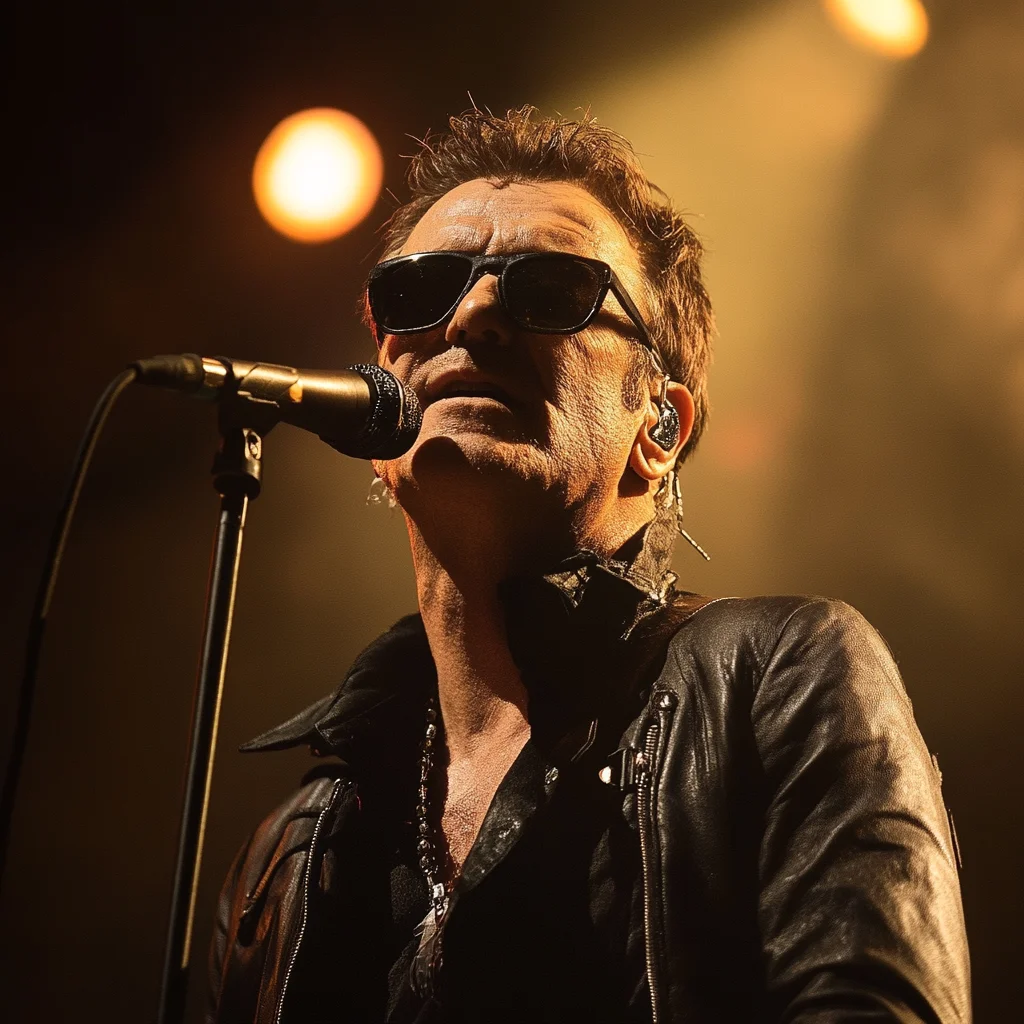
For decades, Bono's ubiquitous tinted eyewear was assumed by many to be purely a rock star fashion statement, but its origin is strictly medical. In 2014, the singer revealed during an interview on BBC's The Graham Norton Show that he had been living with glaucoma for over twenty years. Glaucoma is a chronic eye condition that damages the optic nerve and renders the eyes extraordinarily sensitive to light and high contrast. Harsh concert stage lighting, camera flashes, and bright sunlight can cause significant physical discomfort and optical strain without proper protection. His custom tinted lenses shield his eyes from intense glare while allowing him to perform under heavy lighting rigs.
12. Their Landmark 1997 Sarajevo Concert Promoted Healing After War
On September 23, 1997, U2 performed a emotional concert at the Koševo Stadium in Sarajevo as part of their massive PopMart Tour. The event marked the first major international concert held in the city following the devastating Bosnian War and the protracted Siege of Sarajevo. The band had maintained close connections with the city throughout the conflict, broadcasting live satellite hookups from war-torn Sarajevo during their 1993 Zooropa Tour. Over 45,000 concertgoers from formerly warring ethnic factions gathered together for the show, which was widely hailed as a powerful symbol of post-war reconciliation. Despite Bono suffering severe vocal hoarseness during the set, the audience carried the performance by singing the lyrics in unison.
13. They Were the First Band to Guest Star in *The Simpsons* 200th Episode
In 1998, U2 marked a major pop culture milestone by appearing as animated caricatures of themselves in the milestone 200th episode of The Simpsons, titled "Trash of the Titans." In the story, Homer Simpson interrupts U2's PopMart stadium concert in Springfield to promote his campaign for Sanitation Commissioner. All four band members voiced their own characters, engaging in self-deprecating banter before Homer gets dragged away by stage security guards. U2 was the first musical group ever featured in a 200th episode celebration for a prime-time animated series. The episode went on to win a Primetime Emmy Award for Outstanding Animated Program.
14. The U2 360° Tour Built the Largest Concert Stage Structure in History
Between 2009 and 2011, U2 embarked on the U2 360° Tour, a production that redefined the physical scale of stadium rock shows. The centerpiece of the tour was a massive, four-legged steel structure nicknamed "The Claw," which stood 165 feet tall and allowed unobstructed 360-degree audience viewing. Designed by Willie Williams and Mark Fisher, the colossal structure required 120 trucks to transport each of the three identical steel rigs across world continents. The tour grossed over $736 million and drew more than 7.2 million attendees, holding the world record for highest-grossing concert tour for eight years. The immense scale of the production set a new standard for live architectural design in popular entertainment.
15. Vocal Emergencies Forced Bono to Change His Live Singing Technique
Across U2's long touring career, Bono has encountered critical vocal health challenges that threatened his ability to perform. During the 1989 Lovetown Tour, doctors warned him that his uninhibited, aggressive singing style was causing serious vocal cord strain and advised prolonged rest. He was forced to re-evaluate his vocal mechanics, incorporating formal vocal training to sustain his high notes without damaging his vocal cords. Decades later, during a 2018 concert in Berlin, Bono experienced a complete loss of voice just a few songs into the performance due to onstage smoke effects, forcing an immediate cancellation. His commitment to vocal retraining has enabled the band to maintain their demanding live schedule for over forty years.
Sources & References
This AI-assisted post was rigorously curated and fact-checked for accuracy by:
 Martin Roháček
How fun was this article? 🤔
Tap a star to rate it
🧠 Quiz: How closely were you paying attention?
10 questions — all answers are in the article above!
Enjoyed these facts? There's more! 💌
Fresh fun facts in your inbox. No spam, ever.