The Forest Drummers: 15 Fascinating Facts About Woodpeckers
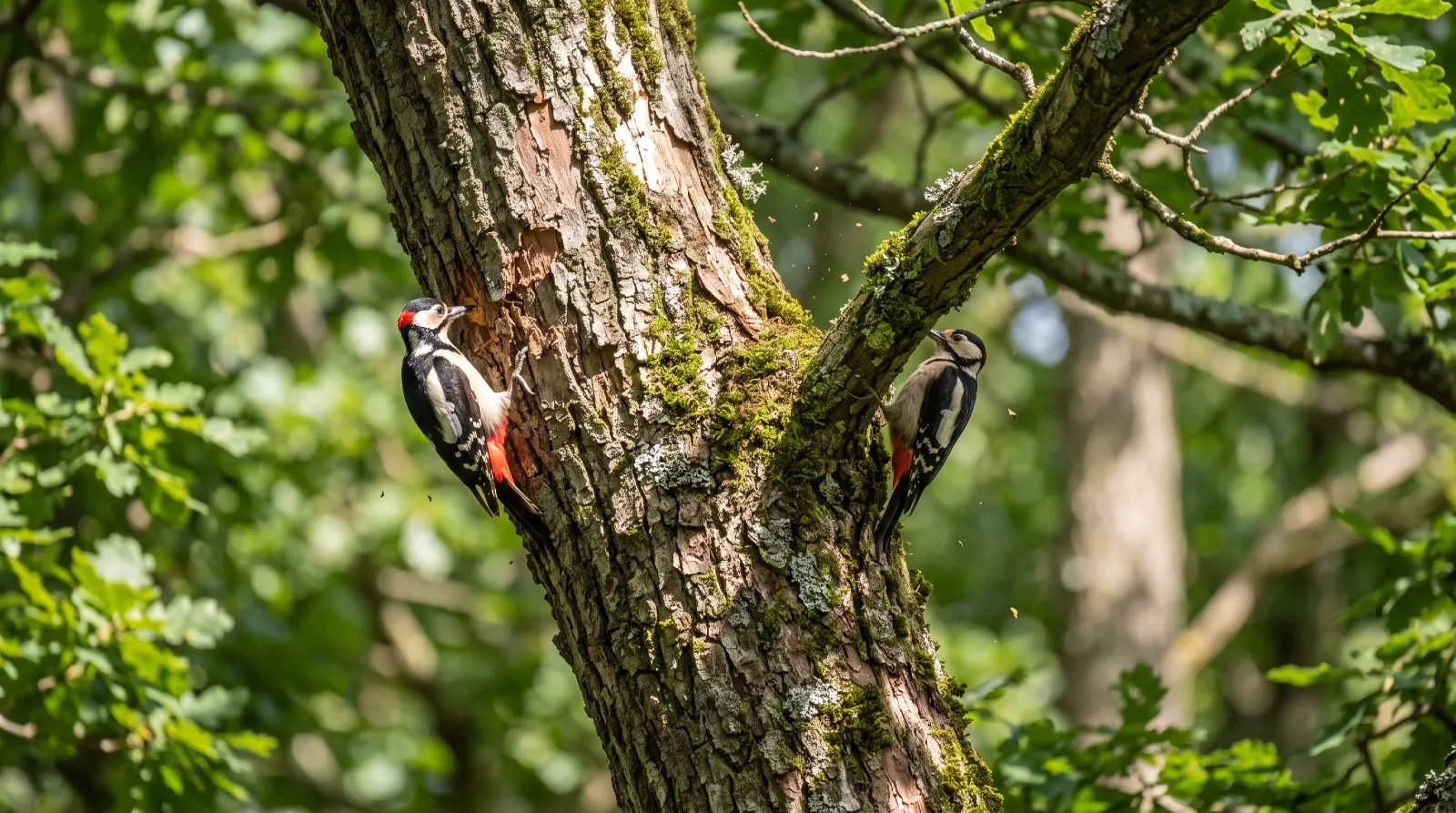
Woodpeckers slam their heads into trees thousands of times a day, yet they do not seem to get headaches. Their tongues wrap around their skulls, their eyes have built-in safety goggles, and one species stores tens of thousands of acorns in its own pantry tree. Here is how these remarkable birds turned headbanging into an art form.
1. Their tongue wraps around their skull.
A woodpecker's tongue is supported by an extremely long hyoid bone. Instead of staying in the throat, it splits in two, runs around both sides of the skull, over the top of the head and ends near the nostril. This allows many woodpeckers to stick their tongues out far beyond the tip of their beak to reach insects hidden deep inside wood.
2. Their tongues are sticky and barbed.
The tip of a woodpecker's tongue is often covered in tiny backward-pointing barbs and coated with sticky saliva. Once the tongue reaches a beetle larva inside a tunnel, the barbs hook into it so the bird can pull it out. Some species, such as the green woodpecker, use their long tongues to lick ants out of anthills.
3. Each peck hits with a force of up to about 1,000 g.
When a woodpecker hammers a tree, its head decelerates at around 10,000 metres per second squared, roughly 1,000 times the force of gravity. A human would suffer serious brain injury from even a fraction of that impact. Woodpeckers can repeat these blows many times a second, thousands of times a day.
4. Their head works like a hammer, not a shock absorber.
For years, it was widely believed that a woodpecker's skull worked like a cushioned helmet. A 2022 study using high-speed video found the opposite: the head and beak act as a stiff hammer, transferring the full force of the blow into the wood. Instead of absorbing shock, woodpeckers seem to be protected mainly by their small brains, which are less vulnerable to impacts than larger ones.
5. Their brains may not escape completely unharmed.
A 2018 study of preserved woodpecker brains found accumulations of tau protein, which in humans is associated with brain damage from repeated blows to the head. Scientists do not yet know whether this harms the birds. It is possible that in woodpeckers the protein even plays a protective role.
6. They have built-in safety goggles.
Just a millisecond before the beak strikes the wood, a thick, transparent third eyelid called the nictitating membrane closes over each eye. It protects the eye from flying splinters and may also help to keep the retina from being damaged by the jolt. Their nostrils are protected too, often by slit-like openings and special feathers that keep out wood dust.
 Birds of the World
From record-breaking aerial plunge-divers to massive flightless icons, the avian world is a marvel of evolutionary engineering. Discover the extraordinary intellects, specialized survival skills, and hidden superpowers of the planet's most fascinating birds.
See All Facts
7. Drumming is how they talk.
Woodpeckers do not only peck to find food. They also drum rapidly on trees, hollow branches and sometimes metal gutters or chimneys to communicate. Drumming announces a territory and attracts a mate, and each species has its own rhythm and speed. Some woodpeckers deliberately choose the most resonant surfaces they can find to make their drumming carry further.
8. Their feet and tail work like a tripod.
Most woodpeckers have two toes pointing forward and two pointing backward, an arrangement called zygodactyl feet that gives a strong grip on vertical tree trunks. Their stiff tail feathers press against the bark and act as a prop. Together, the feet and tail form a stable tripod while the bird hammers away.
9. One woodpecker stores tens of thousands of acorns.
The acorn woodpecker of western North America lives in family groups that drill thousands of small holes into a single tree, called a granary. Each hole is filled with an acorn, and one granary tree can hold tens of thousands of them. The group guards its stockpile fiercely and moves acorns to smaller holes as they dry out and shrink.
10. Sapsuckers run their own sap bars.
Sapsuckers are woodpeckers that drill neat rows of small holes in tree bark and return later to drink the sweet sap that oozes out. They also eat the insects attracted to the sap. Other animals, including hummingbirds, bats and squirrels, often visit these sap wells too.
11. There are no woodpeckers in Australia.
The woodpecker family includes around 240 species found across most of the world. However, there are no woodpeckers in Australia, New Guinea, New Zealand or Madagascar, or in the polar regions. In some of these places, other birds and animals have evolved to fill the role of the woodpecker.
12. The smallest woodpecker is smaller than a sparrow.
Woodpeckers range from tiny piculets to large, crow-sized birds. The bar-breasted piculet of South America is only about 7.5 centimetres long and weighs around 9 grams. At the other end of the scale, the great slaty woodpecker of Southeast Asia can be up to 55 centimetres long.
13. The "Lord God Bird" may be extinct.
The ivory-billed woodpecker, once found in the southern United States and Cuba, was one of the largest woodpeckers in the world. It was nicknamed the "Lord God Bird" because people who saw it supposedly exclaimed "Lord God, what a bird!". There have been no confirmed sightings for decades, and it is generally considered extinct, although some birdwatchers still hope it survives.
14. Their holes become homes for other animals.
Many woodpeckers carve out a new nest hole every year. Their old holes are then used by a wide range of animals that cannot dig their own, such as owls, bluebirds, flying squirrels, bats and even bees. This makes woodpeckers important "ecosystem engineers" in many forests.
15. Woody Woodpecker was inspired by a noisy real bird.
The cartoon character Woody Woodpecker first appeared in 1940 and starred in theatrical short films until 1972. According to his creator, the animator Walter Lantz, the idea came from a real woodpecker that kept noisily pecking at the roof of the cabin where he was spending his honeymoon. Woody's famous laugh became one of the best-known sounds in animation.
Sources & References
This AI-assisted post was rigorously curated and fact-checked for accuracy by:
 Martin Roháček
How fun was this article? 🤔
Tap a star to rate it
🧠 Quiz: How closely were you paying attention?
10 questions — all answers are in the article above!
Enjoyed these facts? There's more! 💌
Fresh fun facts in your inbox. No spam, ever.