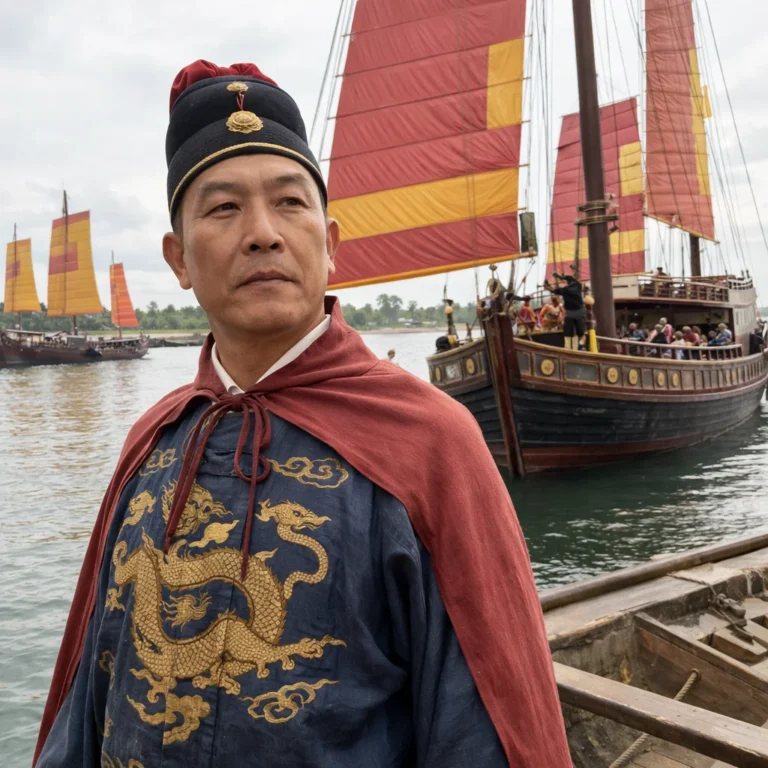
Zheng He commanded the largest wooden fleet the world has ever seen. While Christopher Columbus sailed with three small boats, this Chinese admiral led floating cities that housed thousands of men. For instance, his flagship was longer than a modern football field. Furthermore, he was a eunuch who rose from slavery to become the right hand of the emperor. Prepare to set sail with the Three-Jewel Eunuch.
Zheng He
He was born with the name Ma He. He grew up in a Muslim family in the Yunnan province. However, the Ming army captured him as a young boy and changed his life forever.
His ships were arguably the largest wooden vessels ever built. Historical records state his “Treasure Ships” measured over 400 feet long. Consequently, you could fit all of Columbus’s ships onto the deck of a single one of Zheng He’s vessels.
He brought a giraffe back to China as a “unicorn.” When he visited Africa, he acquired a giraffe to present to the emperor. The Chinese court insisted this gentle animal was actually a “Qilin,” a mythical beast that appears only during the reign of a perfect sage.
He was a eunuch who served in the imperial household. At the age of ten, soldiers castrated him and placed him in the service of a prince. Despite this brutal beginning, his status allowed him to gain the trust of the emperor more than the regular officials.
He defeated a powerful pirate king named Chen Zuyi. In the Strait of Malacca, the pirate fleet tried to ambush the treasure ships. Zheng He crushed them, killed 5,000 pirates, and took the pirate king back to Beijing for execution.
The government destroyed his logs to prevent future voyages. Confucian officials hated the massive cost of the expeditions. Therefore, they burned his maps and journals after his death to ensure no emperor would ever sail to the West again.
He left a stone tablet that honored three religions equally. The Galle Trilingual Inscription in Sri Lanka praises Buddha, Shiva, and Allah. This demonstrates a level of religious tolerance that was incredibly rare for the time period.
His nickname “Sanbao” might be the origin of Sinbad. He was often called “Sanbao,” which means “Three Jewels.” Some historians believe that stories of his massive fleet influenced the later legends of Sinbad the Sailor in the Middle East.
He likely died at sea during his final voyage. Although he has a tomb in Nanjing, it is actually empty. The grave contains only his shoes and a braid of his hair, while his body rests somewhere in the ocean.
He grew fresh food on his ships to prevent disease. The vessels carried large tubs of soil to grow soybeans and vegetables. As a result, his crew avoided the scurvy that plagued European sailors for centuries afterward.
He captured a king and brought him to China. When the King of Ceylon refused to pay tribute and attacked the fleet, Zheng He launched a ground assault. He seized the king and his family and transported them all the way to the Ming court.
He was a devout Muslim who also worshipped a sea goddess. Although he followed Islam, he actively promoted the worship of Mazu, the Chinese goddess of the sea. He believed she protected his fleet during the dangerous typhoons of the Indian Ocean.
Historical records claim he stood seven feet tall. While this might be an exaggeration, descriptions portray him as a terrifying physical presence. His deep voice and massive frame intimidated foreign rulers before he even spoke.
His fleet carried over 28,000 men. This number included soldiers, diplomats, doctors, and astronomers. In comparison, most European fleets of the era carried only a few hundred men.
Finally, his voyages indirectly led to the Great Wall. The massive cost of his trips drained the treasury. Consequently, later emperors decided to spend money on defensive walls instead of expensive ships.
How useful was this post?
Click on a star to rate it!
This AI-assisted post was rigorously curated and fact-checked for accuracy by: