The Greatest Spectacle in Racing: 15 Fascinating Facts About the Indianapolis 500
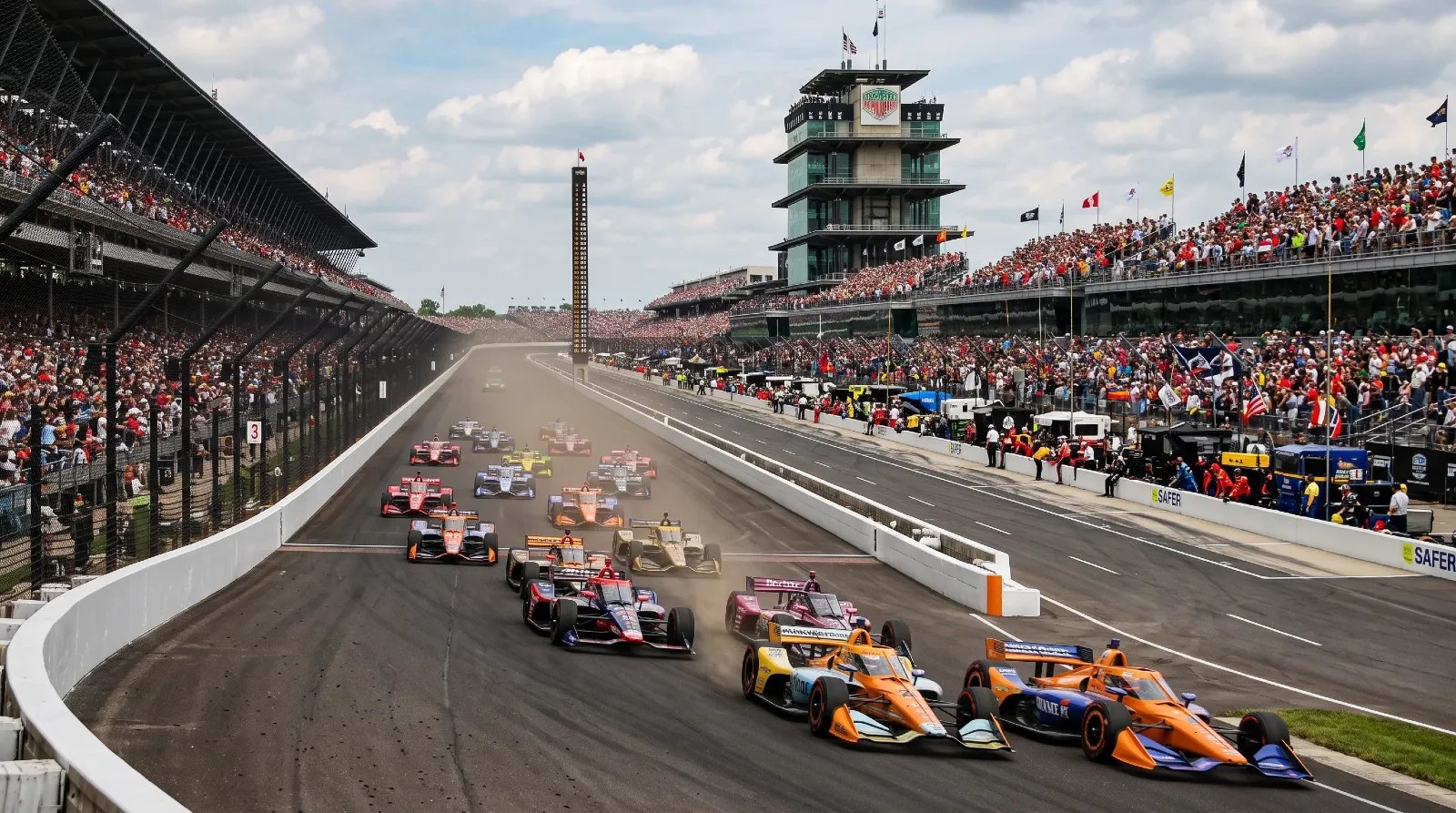
The Indianapolis 500 is more than 200 laps of flat-out speed. It is a race whose winners drink milk instead of champagne, whose track sits in its own town and has a golf course in the middle, and whose very first event had nothing to do with cars. Here is what makes "The Greatest Spectacle in Racing" so strange and special.
1. The winner drinks milk because of one thirsty driver.
After winning in 1933, Louis Meyer asked for a glass of buttermilk. When he won his third title in 1936, he was handed a bottle and photographed swigging from it in Victory Lane. A dairy executive spotted the marketing opportunity, and milk has been offered to the winner almost every year since. Modern drivers can even choose between whole, 2% and skim milk.
2. A winner who chose orange juice was booed.
In 1993, Emerson Fittipaldi, who owned orange groves in Brazil, broke tradition by drinking orange juice instead of milk during the televised winner's interview. Fans and dairy farmers were outraged, and he was booed at later events. Fittipaldi did drink some milk after the broadcast ended, but the public relations damage had already been done.
3. The track is still called the Brickyard.
The original dirt and gravel surface proved disastrous at the first races in 1909. Within weeks, workers hand-laid 3.2 million paving bricks, each weighing about 4.5 kilograms (10 pounds), on a cushion of sand. The bricks were gradually covered with asphalt, but a strip exactly one yard wide was left exposed at the start-finish line. Winners now kneel and kiss these bricks, a tradition started by NASCAR driver Dale Jarrett in 1996.
4. The very first event at the speedway was a balloon race.
On 5 June 1909, more than two months before the oval was completed, the Indianapolis Motor Speedway hosted a race for gas-filled balloons. Around 40,000 people watched nine balloons lift off. The winner, named Universal City, landed about 615 kilometres (382 miles) away in Alabama after more than a day in the air.
5. It is the largest sports venue on Earth.
The Indianapolis Motor Speedway has a permanent seating capacity of more than 257,000, making it the highest-capacity sports venue in the world. Add the crowds in the infield, and race-day attendance has been estimated at well over 300,000. The 2.5-mile oval is so large that Yankee Stadium, the Rose Bowl, Churchill Downs and Vatican City could all fit inside it at the same time.
6. There is a golf course inside the racetrack.
The Brickyard Crossing golf course first opened as the Speedway Golf Course in 1929. Fourteen of its holes lie outside the track along the backstretch, while four holes sit in the infield, surrounded by the racing circuit. Golfers can play while cars practise on the oval around them.
7. The speedway has its own town.
Although it is known as the Indianapolis Motor Speedway, the track is not technically in Indianapolis. In 1926, the neighbourhood around it voted to incorporate, together with the track, as the independent town of Speedway, Indiana. The town is completely surrounded by the city of Indianapolis.
8. The first winner raced with a rear-view mirror instead of a passenger.
In the first Indianapolis 500 in 1911, most cars carried a riding mechanic who watched for traffic behind. Ray Harroun drove alone in his Marmon Wasp and fitted a mirror to see approaching cars instead. He won the race at an average speed of about 120 km/h (75 mph), and his car is often credited with one of the first uses of a rear-view mirror on an automobile.
9. A World War I flying ace once owned the track.
Eddie Rickenbacker, America's top fighter ace of World War I, drove in the Indianapolis 500 four times and bought the speedway in 1927. The race was suspended during World War II, and the neglected track was in poor condition by the end of the war. In 1945, businessman Tony Hulman bought it and restored it, and his family owned the speedway for three generations until 2019.
10. The winner's trophy is far too valuable to take home.
The Borg-Warner Trophy, made of sterling silver, has been awarded since 1936. It features a sculpted face of every winner of the race, and new bases have been added over the decades as space ran out. Winners do not keep the original. Instead, they receive a smaller replica nicknamed the "Baby Borg".
11. The closest finish was decided by 0.043 seconds.
In 1992, Al Unser Jr. crossed the line just 0.043 seconds ahead of Scott Goodyear after a tense final lap. It remains the closest finish in the race's history. Unser Jr. was so emotional in Victory Lane that his words, "You just don't know what Indy means," became one of the event's most famous quotes.
12. A woman changed the race's most famous command.
For decades, the race began with the words "Gentlemen, start your engines!" In 1977, Janet Guthrie became the first woman to qualify for the Indianapolis 500. That year, track owner Tony Hulman adapted the command to acknowledge her. Today, the traditional call is usually "Drivers, start your engines."
13. One singer performed "Back Home Again in Indiana" for more than 40 years.
Before every race, the crowd hears the song "Back Home Again in Indiana". The actor and singer Jim Nabors, best known as Gomer Pyle on American television, performed it almost every year from 1972 until 2014. When he retired from the role, many fans said the race would never feel quite the same again.
14. Some drivers race the Indy 500 and a NASCAR race on the same day.
The Indianapolis 500 is held on the same Sunday of the Memorial Day weekend as NASCAR's Coca-Cola 600 in Charlotte, North Carolina. A handful of drivers have tried "The Double", racing 1,100 miles in one day and flying between the tracks in between. Tony Stewart completed all 1,100 miles in 2001, while Kyle Larson's 2024 attempt was disrupted by rain.
15. No driver has ever won it five times.
Four drivers share the record of four Indianapolis 500 wins: A. J. Foyt, Al Unser, Rick Mears and Hélio Castroneves. Castroneves became the newest member of the club in 2021. Rick Mears also holds the record for the most pole positions, with six.
Sources & References
This AI-assisted post was rigorously curated and fact-checked for accuracy by:
 Martin Roháček
How fun was this article? 🤔
Tap a star to rate it
🧠 Quiz: How closely were you paying attention?
10 questions — all answers are in the article above!
Enjoyed these facts? There's more! 💌
Fresh fun facts in your inbox. No spam, ever.