The Doomed Leviathan: 15 Fascinating Facts About the RMS Lusitania
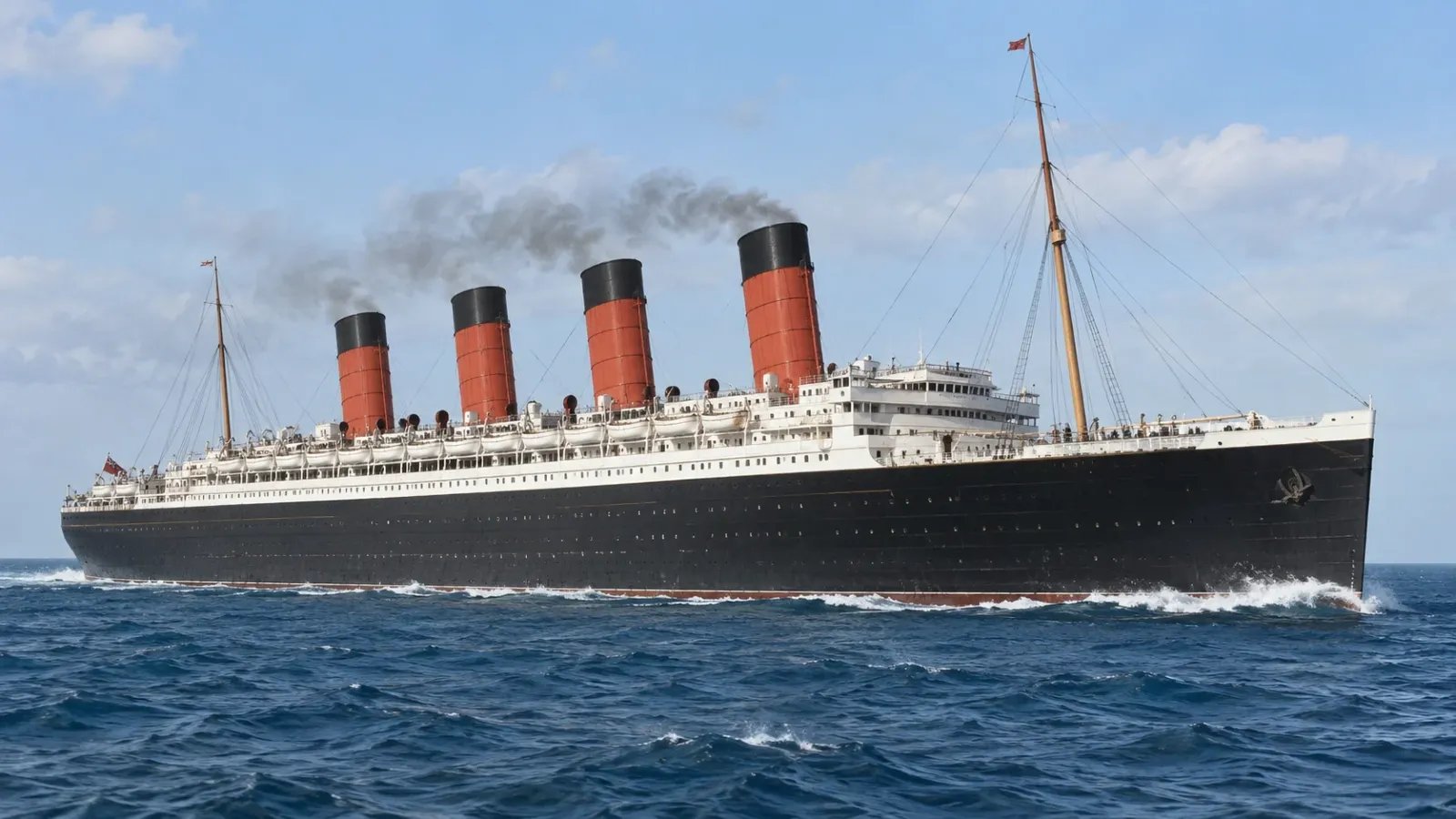
The sinking of the Lusitania in 1915 is often remembered as the moment America entered World War I, yet the United States did not declare war for almost two more years. Behind the tragedy lies a story of newspaper warnings, a mysterious second explosion, a forged propaganda medal and a wreck that once sold for just £1,000.
1. For a few months, it was the largest ship in the world.
When the Cunard liner Lusitania entered service in September 1907, it was the largest passenger ship afloat, measuring about 240 metres (787 feet) long. It held that title for only a few months, until its slightly larger sister ship, the Mauretania, entered service later the same year. The Lusitania was also extremely fast and won the Blue Riband for the quickest Atlantic crossing in 1907.
2. The British government paid for it with a war in mind.
Under an agreement signed in 1903, the British government lent Cunard £2.6 million at a low interest rate to build the Lusitania and the Mauretania, and paid each ship an annual subsidy. In return, the ships had to be designed so that they could be converted into armed auxiliary cruisers in wartime. Their coal bunkers were even placed along the sides of the hull to provide extra protection.
3. Germany's warning appeared right next to the ship's own advertisement.
On 22 April 1915, the German Embassy in Washington submitted a notice to around 50 American newspapers warning travellers that ships flying the British flag could be destroyed in the waters around the British Isles. The warning was published just as the Lusitania prepared to leave New York on 1 May, and in some papers it appeared directly beside Cunard's advertisement for the voyage. Most passengers ignored it, believing the ship was too fast to be caught by a submarine.
4. It sank in just 18 minutes.
On the afternoon of 7 May 1915, the German submarine U-20 torpedoed the Lusitania about 11 nautical miles off the Old Head of Kinsale in southern Ireland. The ship listed so sharply that only six of its lifeboats were launched successfully. It sank in about 18 minutes. By comparison, the Titanic took more than two and a half hours to go down.
5. Nearly 1,200 people died.
Of the 1,960 people on board, 1,197 died and 763 survived. Among the dead were 128 Americans, including the millionaire Alfred Gwynne Vanderbilt, the theatre producer Charles Frohman and the writer Elbert Hubbard. Hundreds of bodies washed ashore on the Irish coast, but most of the victims were never found.
6. A mysterious second explosion still puzzles historians.
The submarine's captain, Walther Schwieger, recorded firing only one torpedo, yet many survivors reported a second, more powerful explosion moments after the first. Its cause has never been proven. Suggested explanations include exploding boilers or steam lines, a coal dust explosion and the ignition of cargo. The second blast probably explains why the ship sank so quickly.
7. The ship was carrying ammunition, and it was not a secret.
The Lusitania's cargo included about 4.2 million rounds of rifle ammunition, 1,250 empty shell cases and cases of non-explosive fuses. These items were openly listed in the ship's cargo manifest, which The New York Times published the day after the sinking. Germany used the cargo to justify the attack, while most experts believe the small-arms ammunition was not powerful enough to cause the second explosion.
8. Three stowaways were locked in the ship's cells.
Shortly after leaving New York, crew members discovered three German-speaking stowaways on board. They were locked up below deck so that they could be handed over to the authorities in Liverpool, possibly on suspicion of spying. When the ship sank so suddenly, all three went down with it, and their identities have never been confirmed.
9. Alfred Vanderbilt reportedly gave away his life jacket.
Alfred Gwynne Vanderbilt was one of the richest men in America. Survivors later said that during the sinking he helped women and children into lifeboats and gave his own life jacket to a woman, even though he reportedly could not swim. His body was never recovered.
10. The captain survived by clinging to wreckage.
Captain William Thomas Turner stayed on the bridge until the ship went down and was swept into the sea. He survived for around three hours in the cold water before being rescued. Afterwards, the Admiralty tried to blame him for not following its advice, but the official British inquiry led by Lord Mersey placed the blame on the German submarine.
11. The United States did not enter the war for almost two years.
The sinking caused outrage in America, but President Woodrow Wilson chose diplomacy over war. Just three days later, he gave a famous speech in which he said that a nation could be "too proud to fight". The United States only declared war on Germany in April 1917, after Germany resumed unrestricted submarine warfare and more American ships were sunk.
12. A German medal became British propaganda.
In 1915, the German artist Karl Goetz made a satirical medal mocking Cunard for continuing to sail despite the warnings. Mistakenly, he dated the sinking 5 May instead of 7 May, which made it look as if the attack had been planned in advance. The British seized on this and produced hundreds of thousands of copies of the medal, selling them in boxes as proof of German brutality.
13. The sinking inspired one of the first animated documentaries.
Because there was no film footage of the disaster, the American cartoonist Winsor McCay decided to recreate it by hand. He and his assistants spent almost two years drawing around 25,000 images for "The Sinking of the Lusitania", released in 1918. The 12-minute film is often described as the oldest surviving animated documentary.
14. The submarine that sank it ended up stranded on a beach.
In November 1916, U-20 ran aground in fog on the coast of Denmark. Unable to free the submarine, its crew blew it up to stop it from falling into enemy hands. Walther Schwieger survived, but he was killed in 1917 when his new submarine struck a mine.
15. The wreck was once sold for just £1,000.
The Lusitania lies about 93 metres (305 feet) below the surface off the Irish coast. In 1967, the insurers sold the wreck to former US Navy diver John Light for just £1,000. The American businessman Gregg Bemis later became its sole owner and fought long legal battles for the right to explore it, especially after Ireland declared it a protected heritage site in 1995.
Sources & References
This AI-assisted post was rigorously curated and fact-checked for accuracy by:
 Martin Roháček
How fun was this article? 🤔
Tap a star to rate it
🧠 Quiz: How closely were you paying attention?
10 questions — all answers are in the article above!
Enjoyed these facts? There's more! 💌
Fresh fun facts in your inbox. No spam, ever.