1. The Core Conflict Revolved Around Transmission Distances
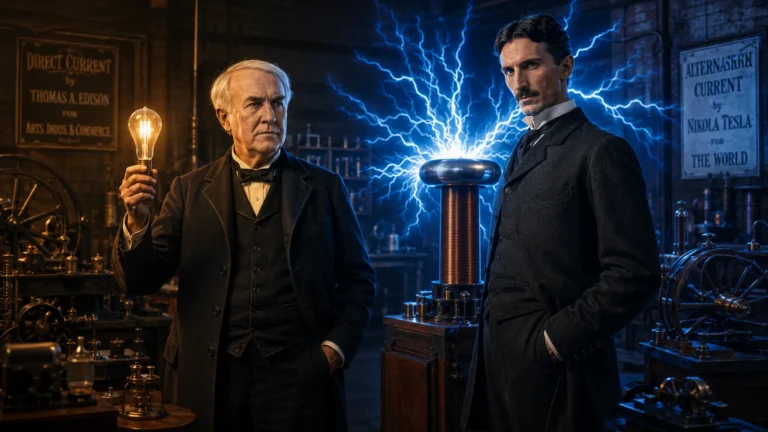
The fundamental technical divide between the two systems centered entirely on how far electricity could travel economically from a power station. Thomas Edison developed direct current, which flows continuously in a single direction but could not easily be converted to different voltages. This severely limited Edison’s power stations to a service radius of roughly one mile before line losses became insurmountable, meaning large cities would require a polluting, coal-fired generating plant on almost every street corner. Nikola Tesla and George Westinghouse countered with alternating current, which could easily be stepped up to massive voltages via transformers for long-distance transmission and safely stepped back down for domestic use.
2. Edison Launched a Massive Public Misinformation Campaign
Fearing the absolute loss of lucrative patent royalties from his established direct current networks, Thomas Edison initiated a ruthless propaganda war to discredit the competition. He aggressively spread misinformation claiming that alternating current was an uncontrollable, highly dangerous technology that posed an immediate threat to public safety. Edison distributed sensational pamphlets to lawmakers and the press, attempting to convince citizens that having alternating current lines running near their homes was an instant death sentence. This aggressive corporate smear campaign was specifically designed to maintain General Electric’s monopoly on the burgeoning American utility market.
3. Stray Animals Were Electrocuted to Prove AC Lethality
To provide gruesome visual proof for his safety warnings, Thomas Edison and his associates resorted to highly controversial public demonstrations. Operating out of Edison’s West Orange laboratory, technician Harold P. Brown gathered stray dogs, cats, and unwanted livestock to publicly subject them to high-voltage alternating current. Technicians invited local newspaper reporters to witness the brutal spectacles, deliberately demonstrating that alternating current killed the animals instantly while direct current allegedly spared them. The ruthless experiments aimed to permanently link Westinghouse’s alternating current with sheer terror in the minds of the American public.
4. The First Electric Chair Was Built Using AC Generators
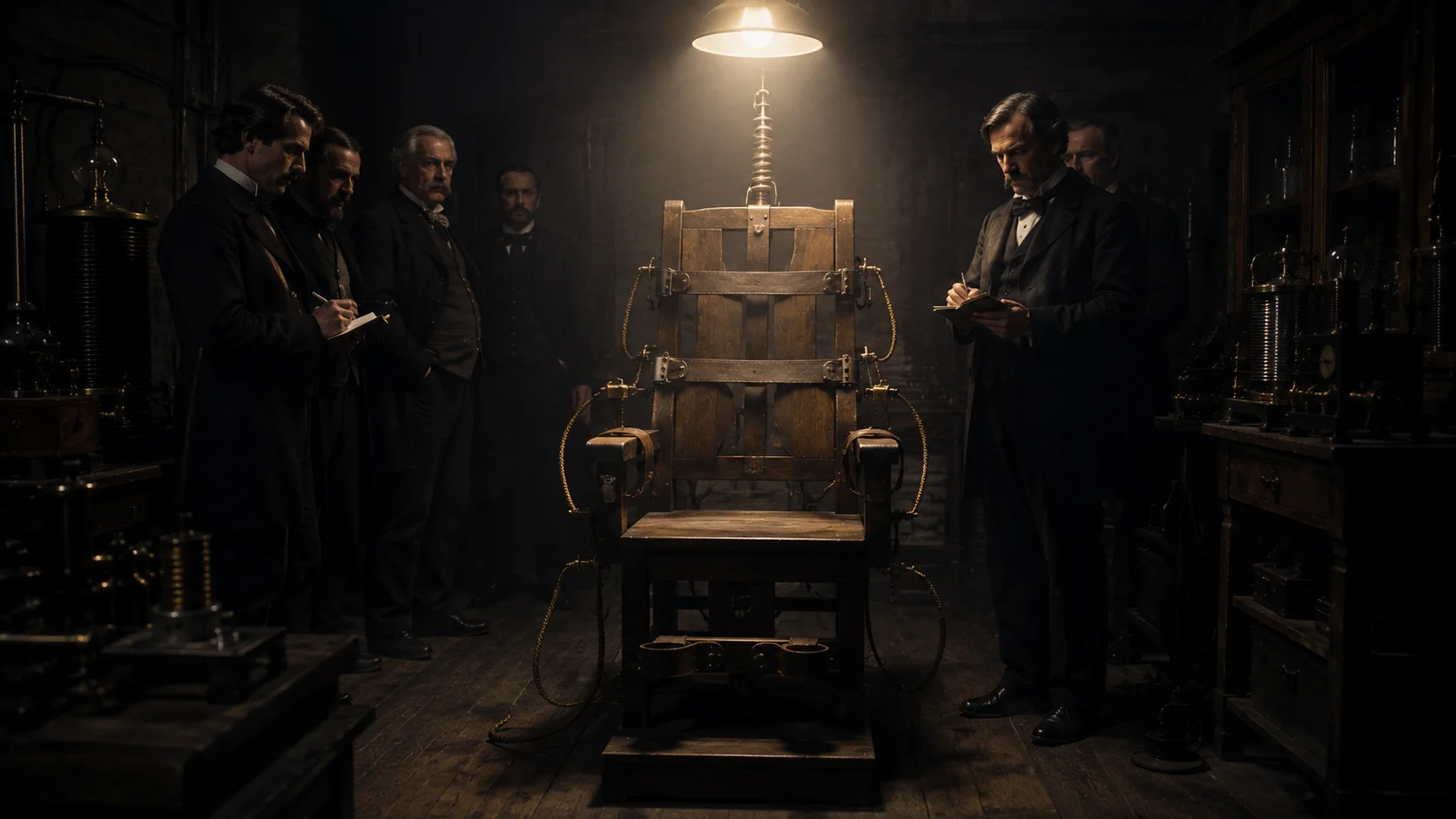
Taking the smear campaign to an entirely new extreme, anti-alternating current advocates secretly maneuvered to turn the competitor’s technology into a state execution tool. Harold P. Brown secretly purchased surplus Westinghouse alternating current generators and shipped them to New York prison authorities to construct the world’s first electric chair. The overarching goal was to ensure the public associated alternating current with capital punishment, with Edison even suggesting the gruesome phrase to be Westinghoused as a synonym for execution. The subsequent botched execution of William Kemmler in 1890 horrified onlookers, but it ultimately failed to halt the nationwide adoption of alternating current.
5. Tesla Publicly Shocked Himself to Demonstrate Safety
Determined to counter the terrifying narrative pushed by Edison’s camp, Nikola Tesla embarked on a series of spectacular stage lectures across the country. Dressed in elegant formal wear, the brilliant inventor publicly subjected his own body to harmless high-frequency alternating current shocks exceeding 250,000 volts. Sparks safely cascaded across his skin without causing injury, allowing him to illuminate gas-filled lamps held entirely in his bare hands. These dazzling theatrical demonstrations captivated international scientists and decisively proved to the public that alternating current could be safely mastered and controlled.
6. Westinghouse Underbid General Electric at the Chicago World’s Fair
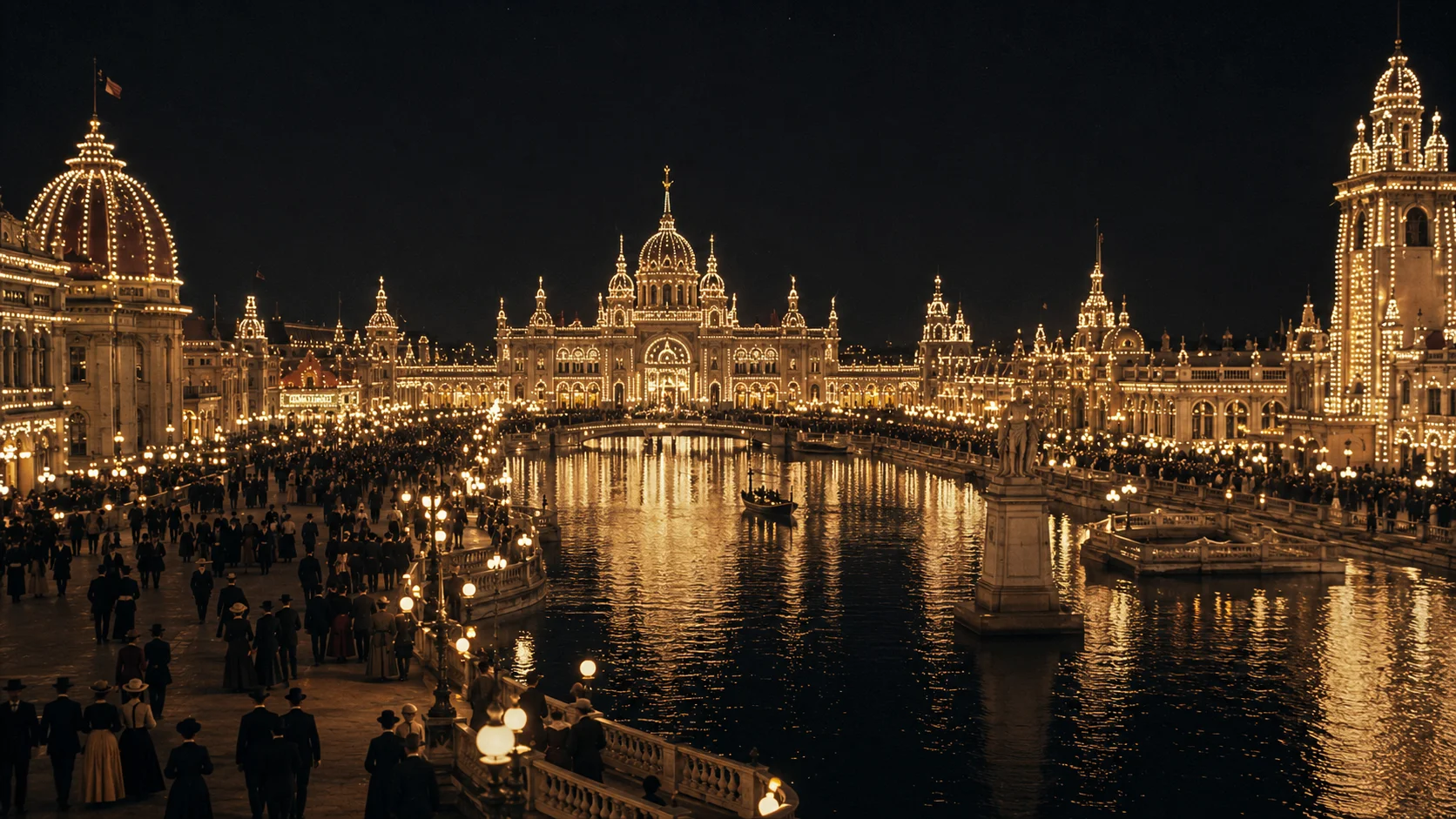
The current war reached a pivotal turning point in 1893 during the intense bidding war to illuminate the massive World’s Columbian Exposition in Chicago. General Electric initially bid over half a million dollars to electrify the fairgrounds using Edison’s direct current infrastructure. George Westinghouse aggressively swooped in and won the historic contract by proposing to power the entire exposition for a fraction of the cost using Tesla’s polyphase alternating current system. The resulting spectacle illuminated the neoclassical buildings with a brilliant white glow, successfully proving the safety and efficiency of alternating current to 27 million international visitors.
7. Edison Blocked Westinghouse From Using His Lightbulbs
Furious after losing the prestigious Chicago World’s Fair contract, Thomas Edison retaliated by using patent law to sabotage the exhibition. He strictly barred Westinghouse from using his patented incandescent lightbulb design, which featured a proprietary screw-in base and a vacuum-sealed glass envelope. Facing a severe logistical disaster just weeks before the opening day, Westinghouse’s engineering team worked frantically to invent and manufacture an entirely new double-stopper lightbulb. They successfully produced hundreds of thousands of these workaround bulbs in record time, entirely bypassing Edison’s legal blockade and keeping the fairgrounds brilliantly illuminated.
8. Telluride Hosted the First Commercial High-Voltage AC Line
Long before massive utility grids existed, the tiny mining town of Telluride, Colorado, served as an incredibly successful proving ground for high-voltage power. In 1891, the Ames Hydroelectric Generating Plant installed a pioneering Westinghouse alternating current system to supply electricity to the remote Gold King Mine. Operating under an unprecedented pressure of 3,000 volts, the facility transmitted single-phase alternating current over three miles of rugged, mountainous terrain where delivering coal was virtually impossible. This highly successful industrial installation decisively proved that alternating current could economically power heavy machinery over long distances.
9. Niagara Falls Became the Ultimate Battleground
The ultimate validation for alternating current arrived in 1893 when the Niagara Falls Power Company sought a system capable of harnessing the immense kinetic energy of the waterfall. Although some skeptics doubted that hydroelectric generators could reliably transport electricity all the way to nearby Buffalo, Nikola Tesla remained entirely convinced that his system could power the entire eastern United States. The commission ultimately awarded the massive generation contract to George Westinghouse, who heavily utilized Tesla’s polyphase induction motor patents. On November 16, 1896, Buffalo was successfully lit up by alternating current generated over twenty miles away, signaling a decisive victory for long-distance transmission.
10. General Electric Secretly Pushed Edison Aside
While Thomas Edison stubbornly refused to acknowledge the obvious technical superiority of alternating current, the financial backers of General Electric realized they were losing the war. Led by the ruthless financier J.P. Morgan, the company’s board quietly sidelined Edison from the decision-making process and began aggressively acquiring alternating current patents. General Electric completely shifted its corporate strategy, jumping onto the alternating current bandwagon to bid on massive infrastructure projects alongside Westinghouse. By abandoning direct current as their primary standard, the corporate giant ensured its permanent survival while leaving Edison’s original vision entirely behind.
11. Tesla Tore Up His Royalties to Save Westinghouse
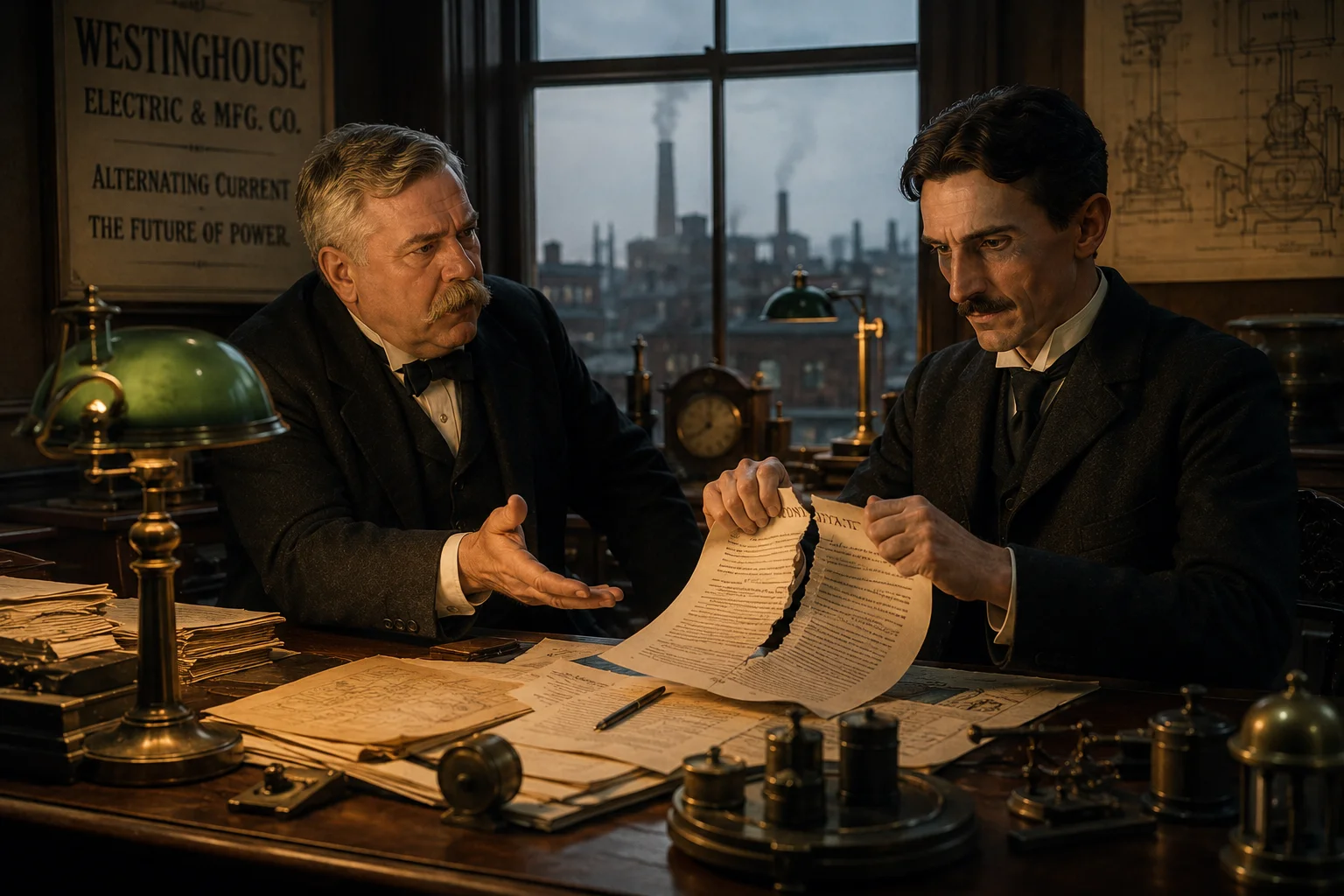
The intense legal battles and expensive infrastructure investments of the current war pushed George Westinghouse’s company to the brink of financial ruin during the economic panic of 1893. Westinghouse’s financial advisors insisted that the company could only survive by escaping the highly lucrative royalty contract agreed upon with Nikola Tesla, which paid him for every horsepower of alternating current generated. Recognizing that his grand vision for global electrification would completely collapse if Westinghouse went bankrupt, Tesla famously tore up his original contract. This incredibly generous act sacrificed billions in future personal wealth but permanently secured the nationwide triumph of alternating current.
12. Direct Current Remained Active in Cities for a Century
Although alternating current decisively won the battle for long-distance transmission and nationwide grid standards, Edison’s direct current infrastructure did not disappear overnight. Because massive investments had already been made in underground cables and industrial DC motors, many major urban centers maintained localized direct current networks for decades. New York City utility companies continued to supply direct current to older buildings, elevators, and transit systems throughout the entire 20th century. Consolidated Edison only officially shut down its very last direct current distribution service in November 2007, marking the true, delayed end of Edison’s original grid.
13. Edison Eventually Admitted Sticking to DC Was a Mistake
Despite spending years fiercely attacking alternating current in public, Thomas Edison eventually came to realize the immense error of his stubborn technological loyalty. Late in his life, the legendary inventor expressed profound regret during a quiet conversation with his son, Theodore Edison. He admitted that sticking so rigidly to direct current rather than embracing and developing alternating current was the absolute biggest developmental mistake of his entire career. This quiet concession perfectly illustrates how corporate pride temporarily blinded one of history’s greatest minds to the inevitable evolution of electrical physics.
14. Modern Engineering Sparked a High-Voltage DC Renaissance
In a fascinating twist of modern engineering, direct current has experienced a massive resurgence that challenges the absolute dominance of alternating current. Because direct current is highly stable and does not suffer from the same capacitive losses as alternating current over extreme distances, utility companies now utilize High-Voltage Direct Current lines. These specialized superhighways efficiently transport immense electricity across massive underwater cables and connect remote offshore wind farms directly to national grids. Advanced solid-state converters easily step the voltage up and down, proving that Edison’s preferred current still possesses incredible value for specialized modern infrastructure.
15. Everyday Electronics Rely on a Seamless Hybrid Armistice
Rather than ending in total destruction, the bitter rivalry ultimately concluded in a beautiful, highly functional armistice right inside our modern homes. The massive electrical grid continues to transport high-voltage alternating current across continents, perfectly honoring the visionary engineering of Nikola Tesla and George Westinghouse. However, the moment that power reaches our wall outlets, laptop adapters and phone chargers instantly convert the alternating current back into smooth, stable direct current. Because delicate digital microchips, LED lights, and electric vehicle batteries strictly require direct current to operate, the brilliant legacies of both inventors remain inextricably linked every single day.
Sources and References