The Oceanic Nomad: 15 Fascinating Facts About Albatrosses
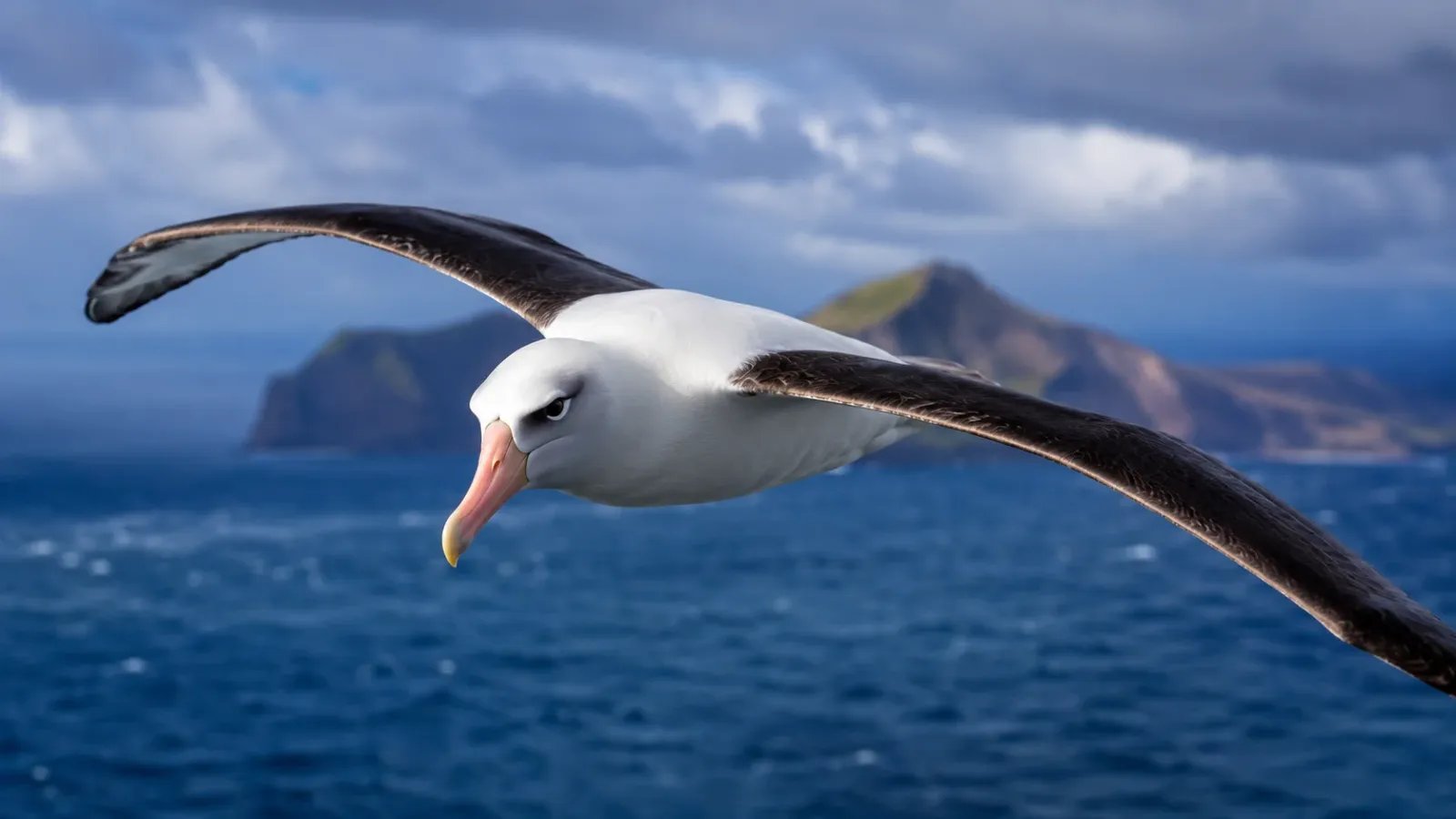
Often dismissed as a mere metaphor for a psychological burden, the albatross is actually an aerodynamic marvel. Far from a curse, these majestic seabirds can spend years aloft without touching land, drink ocean water, and form lifelong bonds. Discover the hidden science and surprising truths behind the ocean's greatest wanderer.
1. Albatrosses can fly thousands of miles without flapping their wings a single time.
Instead of relying on powered flight, these birds utilize a technique called dynamic soaring. By angling their massive wings, they extract energy from the wind gradients just above the ocean's surface, repeatedly climbing into the wind and gliding downward. This allows them to cover immense distances while expending barely more energy than they do when resting in a nest.
2. An albatross's heart rate while flying is incredibly close to its resting heart rate.
Because dynamic soaring is so highly efficient, an albatross in flight does not experience the cardiovascular strain typical of other flying birds. Researchers wearing heart monitors on the birds discovered that soaring requires nearly zero active muscular exertion. Their shoulder joints feature a specialized tendon that locks their wings in the fully extended position, meaning they do not even have to use muscle power to keep their wings outstretched.
3. These seabirds possess specialized internal desalination plants that allow them to survive solely on seawater.
Spending years over the open ocean means freshwater is completely inaccessible. To adapt, albatrosses have a specialized pair of salt glands situated above their eye sockets. These glands extract excess salt from the bird's bloodstream and excrete it as a highly concentrated saline fluid, which the bird simply sneezes out through its tube-like nostrils.
4. Unlike most birds, albatrosses have a highly developed sense of smell that helps them locate prey in the featureless ocean.
Historically, scientists believed birds had a poor sense of smell, but the albatross shatters this myth. They possess unusually large olfactory bulbs in their brains, allowing them to detect dimethyl sulfide from miles away. This chemical is released when phytoplankton is eaten by krill, creating an odor plume that guides the albatross directly to an abundant food source in an otherwise empty expanse of water.
5. A juvenile albatross will spend five to seven uninterrupted years at sea before touching land again.
After a young albatross fledges and takes its first flight from the breeding colony, it begins an epic maritime journey. It will not return to solid ground until it reaches sexual maturity, living entirely on the ocean waves, sleeping on the water's surface, and hunting squid and fish. This uninterrupted oceanic phase is one of the longest continuous periods away from land of any terrestrial animal.
6. The Wandering Albatross possesses the largest wingspan of any living bird, capable of reaching up to twelve feet across.
This astonishing physical adaptation is what makes their mastery of dynamic soaring possible. Their wings are exceptionally narrow but incredibly long, maximizing lift and minimizing drag. A single twelve-foot wingspan is roughly the length of a small car, making the Wandering Albatross a true giant of the skies that dwarfs nearly every other avian species on Earth.
 Birds of the World
From record-breaking aerial plunge-divers to massive flightless icons, the avian world is a marvel of evolutionary engineering. Discover the extraordinary intellects, specialized survival skills, and hidden superpowers of the planet's most fascinating birds.
See All Facts
Birds of the World
From record-breaking aerial plunge-divers to massive flightless icons, the avian world is a marvel of evolutionary engineering. Discover the extraordinary intellects, specialized survival skills, and hidden superpowers of the planet's most fascinating birds.
See All Facts
7. Scientists believe albatrosses are capable of sleeping while actively flying across the ocean.
While they certainly rest on the surface of the water, evidence suggests albatrosses also practice unihemispheric slow-wave sleep in the air. This phenomenon allows half of the bird's brain to rest while the other half remains alert, maintaining the locking mechanism in their wings and keeping them aloft on the wind currents. This split-brain resting state ensures they never have to stop their migrations to catch up on sleep.
8. The oldest known wild bird in the world is a Laysan albatross named Wisdom who is over seventy years old.
Albatrosses are incredibly long-lived, far exceeding the lifespans of most other bird species. Wisdom, banded by researchers in 1956 at the Midway Atoll, has outlived many of the scientists who originally studied her. Even more remarkably, she has continued to successfully lay eggs and raise chicks well into her seventies, defying previously held biological assumptions about avian fertility and aging.
9. Albatrosses have some of the lowest divorce rates in the animal kingdom, but environmental stress is causing breakups to increase.
These birds are famous for forming lifelong pair bonds, cemented through elaborate, years-long courtship dances. Traditionally, if a breeding season fails, the pair simply tries again the next year. However, recent scientific studies show that warming ocean temperatures and subsequent food shortages are causing female albatrosses to abandon their underperforming partners at unprecedented rates in search of better providers.
10. The word albatross derives from a linguistic misunderstanding involving Arabic and Portuguese terms for completely different birds.
The English word morphed from the Portuguese word alcatraz, which actually meant pelican. That term itself evolved from the Arabic word al-qadus, meaning the diver. When English sailors encountered these massive ocean wanderers, they slightly altered the Portuguese term, blending it with the Latin word albus, meaning white. Thus, the giant soaring bird was accidentally named after a diving pelican.
11. The superstition that killing an albatross brings bad luck was largely invented by a single 18th-century poem.
Samuel Taylor Coleridge's famous poem The Rime of the Ancient Mariner cemented the idea of the albatross as an omen of bad luck if harmed. In reality, prior to this poem's publication in 1798, sailors did not widely revere the bird or fear killing it. Mariners routinely captured and ate albatrosses, and even used their hollow wing bones to craft tobacco pipes without fear of oceanic curses.
12. Albatrosses belong to a unique order of birds defined entirely by the strange, tube-like structures on their beaks.
They are members of the order Procellariiformes, commonly referred to as tubenoses. These prominent external nostrils run along the top or sides of the upper beak and serve dual purposes. Not only do they house the bird's extraordinary olfactory system, but they also act as an exhaust pipe for the salty brine processed by their desalination glands, protecting their eyes from the expelled salt.
13. Young albatrosses must learn a highly complex, species-specific dance over several years before they can find a mate.
Courtship for an albatross is not an instinctual given; it is a learned behavior. Young birds gather in designated areas of the colony to practice a synchronized series of bill clattering, sky pointing, bowing, and calling. They initially practice with many partners, slowly refining their moves over several seasons until they perfect a unique sequence with a single compatible bird, which becomes their lifelong mate.
14. An albatross can weaponize a foul-smelling stomach oil to defend itself against predators.
When threatened, both adults and chicks can project a stream of specialized stomach oil from their mouths with surprising accuracy. This oil is not just incredibly pungent; it is extremely dangerous to predatory birds. The waxy substance mats down the feathers of the attacker, destroying their waterproofing and often causing the predator to die from hypothermia or drowning if it lands in the ocean.
15. A single albatross can circumnavigate the entire globe in less than two months.
Thanks to their mastery of dynamic soaring and the powerful polar wind currents of the Southern Ocean, albatrosses are unparalleled marathoners. Tracking data has revealed that a Grey-headed Albatross can fly around the world in just forty-six days, maintaining steady speeds of over fifty miles per hour without resting. Over the course of a seventy-year lifespan, an albatross may fly millions of miles, the equivalent of traveling to the moon and back several times.
Sources & References
This AI-assisted post was rigorously curated and fact-checked for accuracy by:
 Martin Roháček
How fun was this article? 🤔
Tap a star to rate it
🧠 Quiz: How closely were you paying attention?
10 questions — all answers are in the article above!
Enjoyed these facts? There's more! 💌
Fresh fun facts in your inbox. No spam, ever.