The Elusive Outlaw: 15 Fascinating Facts About Billy the Kid
Billy the Kid remains one of the most romanticized and misunderstood figures of the American Wild West. Born Henry McCarty in the crowded tenements of New York City, he transformed from an orphaned teenager into a notorious frontier gunman during New Mexico's bloody Lincoln County War. Behind the dime-novel legends of high-stakes bank heists and ruthless massacres lies a complex young man who spoke fluent Spanish, rarely stole from banks, and died in pitch darkness at just twenty-one years old. Explore fifteen fascinating facts that separate the real frontier outlaw from the western myth.
1. Born in New York City as Henry McCarty
Despite his iconic association with the American Southwest, Billy the Kid was actually born Henry McCarty in the crowded tenements of New York City around 1859. His family moved westward to Indiana and Kansas before eventually settling in the New Mexico Territory. To conceal his identity during his years as a fugitive, he later adopted the alias William H. Bonney, using his mother's maiden name. While dime novels painted him as a native son of the frontier, his early childhood was spent far from dusty western trails. This urban background makes his rapid transformation into the Wild West's most infamous gunman all the more surprising.
2. Fluent in Spanish and Beloved by the Hispano Community
Unlike many Anglo-American settlers who arrived in New Mexico in the 1870s, Billy made a deliberate effort to immerse himself in local culture. He became completely fluent in Spanish and was well known for his polite manners and dancing skills at regional gatherings. This cultural fluency earned him deep affection and loyalty from the native Hispano population. When lawmen hunted him across the territory, local Hispanic families routinely offered him shelter, food, and advanced warning of approaching posses. To many in New Mexico's native communities, he was viewed not as a ruthless killer, but as a friendly defender fighting corrupt political factions.
3. Never Robbed a Bank or a Train
Hollywood westerns frequently depict Billy the Kid stopping locomotives at gunpoint or blowing open heavy bank safes in dramatic heists. In historical reality, there is no record of him ever robbing a single train, bank, or stagecoach. His criminal record primarily involved stealing horses and cattle, often driving stolen livestock across territorial borders for sale. Cattle rustling was a lucrative and common enterprise in the open-range Southwest, making Billy a stock thief rather than a master bandit. The popular image of him as a grand thief was largely constructed by sensational newspaper reporting after his death.
4. The Multi-Million-Dollar Tintype Photograph
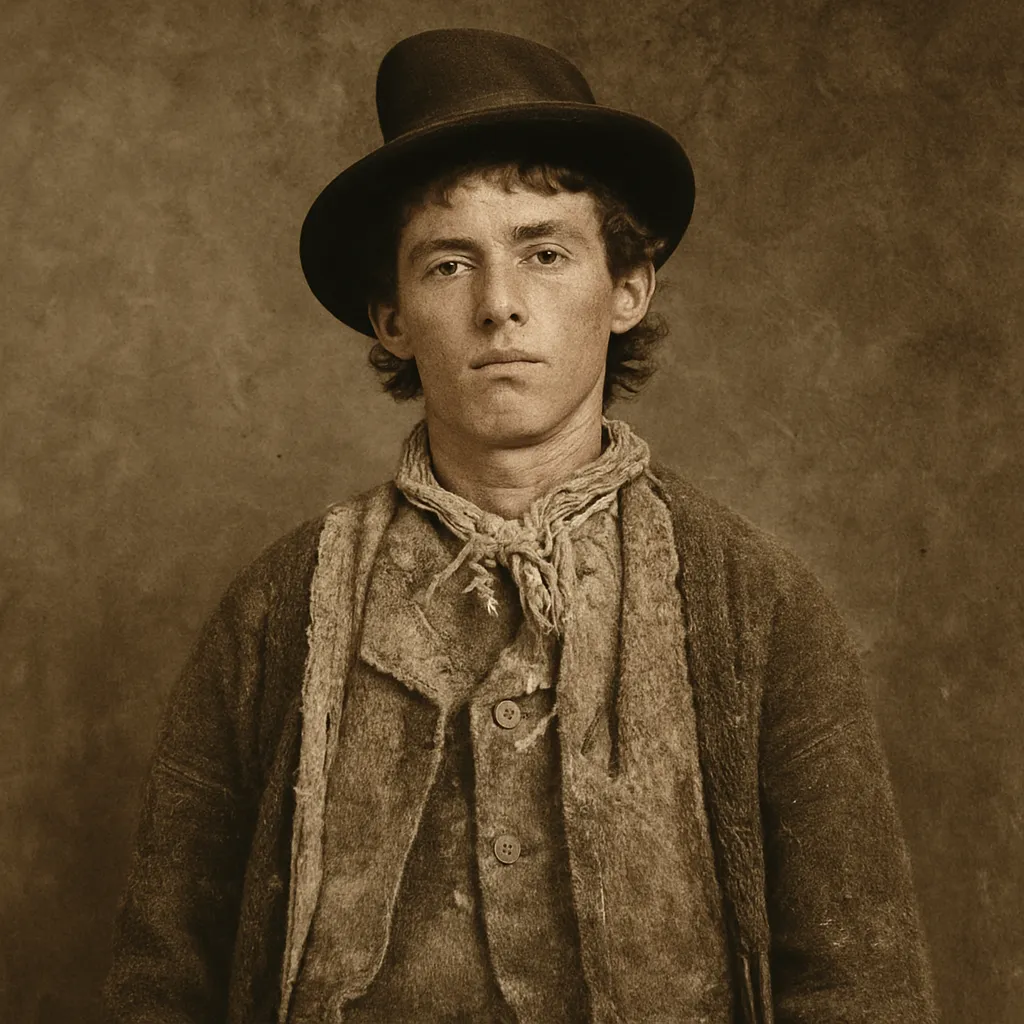
Only one indisputably authenticated photograph of Billy the Kid exists today, taken outside a saloon in Fort Sumner around 1879. The tiny tintype image measures just two by three inches and shows an unkempt youth standing with a Winchester rifle and Colt revolver. For over a century, the original photograph remained in private hands before being auctioned in 2011. Billionaire William Koch purchased the historic artifact for $2.3 million, making it one of the most expensive photographs ever sold. The image remains the single definitive visual glimpse into the actual appearance of the legendary outlaw.
5. The Left-Handed Myth Born from a Mirrored Image
For decades after his death, historians and popular media asserted that Billy the Kid was left-handed based on his famous single photograph. In the image, his firearm holster appears on his left hip, inspiring the 1958 Paul Newman movie The Left Handed Gun. However, tintypes are reversed mirror images by nature of their chemical photographic process. Detailed examination of the Winchester rifle in his hands revealed that its loading gate was on the wrong side, proving the image was mirrored. When flipped correctly, the holster sits on his right hip, confirming that Billy was actually right-handed.
6. Killed Eight Men, Not Twenty-One
Wild West folklore claimed that Billy the Kid killed twenty-one men in his short life, one for every year he lived. Contemporary court records and historical investigations reveal this number to be a massive exaggeration driven by tabloid journalists. Historians have confirmed that Billy was responsible for killing four men single-handedly and assisted in killing four others during group shootouts. While eight homicides made him a lethal gunman by any standard, it falls far short of the bloodthirsty body count touted by frontier legends. Most of these killings occurred within the brutal violence of the Lincoln County War rather than random murders.
7. Orphaned at Age Fifteen Before Turning to Crime
Billy's slide into outlawry was triggered by severe personal tragedy early in his teenage years. His mother, Catherine McCarty, died of tuberculosis in Silver City, New Mexico, in September 1874, leaving fifteen-year-old Henry effectively orphaned. His stepfather abandoned the young boy shortly after her death, leaving him to fend for himself in a lawless frontier town. Struggling to survive the approaching winter, Henry began committing minor thefts of food and clothing. What started as petty survival crimes rapidly escalated after his arrest, setting off a chain reaction that defined his brief life.
8. A Heavy Iron Cage Protects His Gravestone
Billy the Kid was buried in the old military cemetery at Fort Sumner, New Mexico, but his final resting place has not remained undisturbed. Over the decades, devoted fans and souvenir hunters repeatedly stole his tombstone, causing it to disappear for years at a time. The stolen gravestone was recovered in locations as far away as Texas before being returned to New Mexico. To prevent further theft and vandalism, local authorities eventually placed a heavy iron and steel cage over the entire burial plot. Today, visitors can view his grave securely enclosed behind thick iron bars designed to keep souvenir hunters at bay.
9. First Jailbreak via a Laundry Chimney
Billy's very first escape from custody set the stage for his reputation as an elusive, slippery criminal. In September 1875, he was arrested in Silver City for receiving stolen clothes taken from a Chinese laundry by an associate. Facing jail time, the skinny sixteen-year-old took advantage of his slender frame while guards were unmindful. He squeezed his way up the narrow brick chimney of the jailhouse and scrambled onto the roof before fleeing into the night. This daring, unorthodox jailbreak marked the official start of his life as a fugitive on the run from the law.
10. The Curious Claim of Brushy Bill Roberts
In 1950, an elderly Texas resident named Ollie "Brushy Bill" Roberts claimed that he was actually Billy the Kid and had survived the 1881 shooting. Roberts sought a formal pardon from New Mexico Governor Thomas Mabry, claiming Pat Garrett had shot another man by mistake in the dark. He possessed numerous scars matching Billy's documented battle wounds and demonstrated an intricate knowledge of the Lincoln County War. However, historians pointed out glaring chronological inconsistencies in his family record, and the governor ultimately denied the petition. Most serious scholars view the Brushy Bill claim as a fascinating frontier hoax rather than historical fact.
11. Betrayed by Governor Lew Wallace
In 1879, New Mexico Territorial Governor Lew Wallace—who later wrote the classic novel Ben-Hur—attempted to end the Lincoln County violence. Wallace secretly met with Billy and offered him a full pardon if he would surrender and testify against murder suspects. Billy complied with the agreement, voluntarily surrendering and giving detailed grand jury testimony at great personal risk. However, the local district attorney refused to honor the bargain and kept Billy locked up to face murder charges himself. Feeling thoroughly betrayed by the government, Billy orchestrated another bold prison escape and returned to a life of outlawry.
12. Pat Garrett Was a Former Drinking Companion
Popular depictions often portray Pat Garrett and Billy the Kid as bitter mortal enemies locked in a lifelong feud. Historical accounts suggest that prior to Garrett's election as Lincoln County Sheriff, the two men were actually casual acquaintances. They frequently frequented the same saloons in Fort Sumner, drinking and playing cards together during quieter times. When Garrett took the badge, he accepted the job with a duty to track down his former drinking partner. This personal acquaintance added a tragic layer of intimacy to Garrett's relentless hunt for the young outlaw.
13. Slender Wrists Enabled Daring Handcuff Escapes
Billy possessed exceptionally small hands and wrists relative to the size of his forearms, an anatomical trait that proved invaluable during his escapes. His most sensational escape occurred on April 28, 1881, at the Lincoln County Courthouse while awaiting execution. As Deputy James Bell escorted him back from the outhouse, Billy managed to slip one of his small hands entirely out of his iron handcuffs. He struck the guard with the loose metal shackle, seized the deputy's revolver, and shot him dead. He then ambushed a second deputy from a balcony before riding out of town on a stolen horse.
14. The Regulators Began as a Legally Deputized Posse
The violent group Billy fought with during the Lincoln County War, known as the Regulators, did not begin as an illegal gang of outlaws. Following the murder of English merchant John Tunstall by a rival business faction's corrupt deputies, a local justice of the peace formed the group. The judge officially deputized Billy and his companions as a legal posse to serve arrest warrants on Tunstall's killers. Only after the territorial governor declared their warrants invalid were the Regulators branded as outlaws by the political machine. Thus, Billy began the bloodiest conflict of his life acting under the explicit authority of the law.
15. Slain in the Dark Armed Only with a Kitchen Knife
The myth of Billy the Kid often concludes with a dramatic, high-noon quick-draw showdown against Sheriff Pat Garrett in the middle of a dusty street. The historical reality of his death on July 14, 1881, was far less romantic and far more opportunistic. Garrett ambushed Billy around midnight inside the pitch-black bedroom of mutual friend Pete Maxwell in Fort Sumner. Billy entered the room barefoot, carrying a butcher knife to cut off a piece of beef for a late-night meal. Sensing someone in the shadows, Billy asked in Spanish, "¿Quién es?" (Who is it?), before Garrett fired two shots from the darkness, killing him instantly.
Sources & References
This AI-assisted post was rigorously curated and fact-checked for accuracy by:
 Martin Roháček
How fun was this article? 🤔
Tap a star to rate it
🧠 Quiz: How closely were you paying attention?
10 questions — all answers are in the article above!
Enjoyed these facts? There's more! 💌
Fresh fun facts in your inbox. No spam, ever.