The Windswept Archipelago: 15 Fascinating Facts About the Falkland Islands
Often dismissed as just a remote battlefield from a 1982 war, the Falkland Islands are actually a thriving, biologically rich archipelago with a complex history. Far from a barren wasteland, this South Atlantic territory boasts unique wildlife, deep geological mysteries, and quirky cultural traditions. Let's explore the surprising realities hidden within these isolated, windswept shores.
1. The Falkland Islands were once physically attached to the eastern coast of South Africa before continental drift tore them away.
Millions of years ago during the breakup of the supercontinent Gondwana, the microplate containing the Falklands rotated and drifted westward. Geologists have matched the specific rock types and ancient glacial deposits found on the islands directly to formations in South Africa's Karoo Basin, proving this remote archipelago was once a neighbor to the African continent rather than South America.
2. The archipelago is home to more than a million penguins, drastically outnumbering the human population.
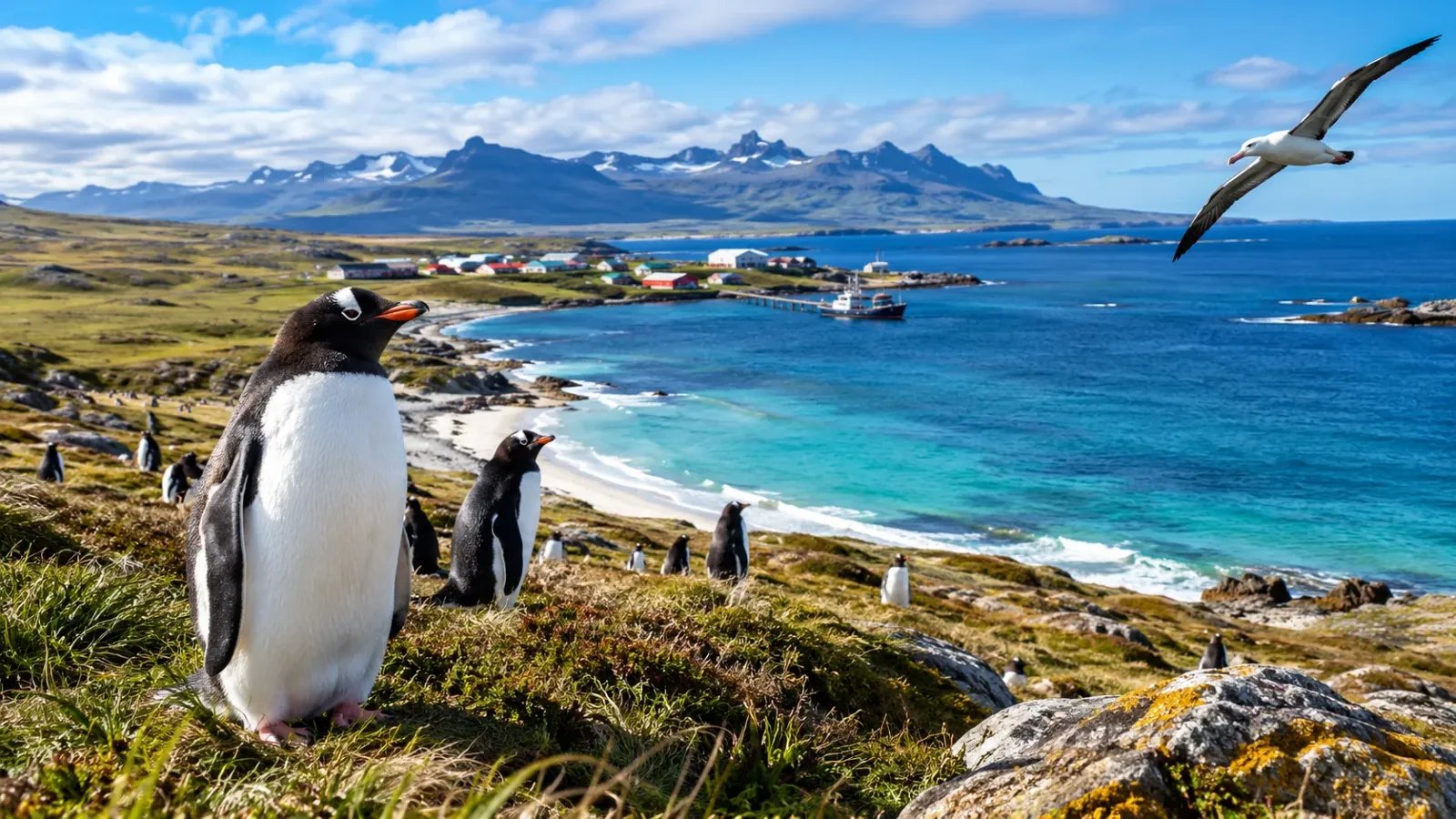
While only about 3,500 people live on the islands, they share their home with five breeding species of penguins: King, Gentoo, Rockhopper, Magellanic, and Macaroni. This incredible density of marine birds is supported by the nutrient-rich waters of the Patagonian Shelf, making the territory one of the world's most critical sanctuaries for global seabird conservation.
3. Leftover landmines from the 1982 conflict inadvertently created thriving nature reserves that protected local penguin colonies.
Following the Falklands War, thousands of landmines were left buried in the beaches. Because penguins are too light to trigger the explosives, they were able to use these restricted, fenced-off beaches as safe havens free from human interference or habitat destruction. By the time the islands were finally declared entirely mine-free in 2020, the penguin populations had boomed in these accidental sanctuaries.
4. There are no native trees growing anywhere on the Falkland Islands due to the relentless oceanic winds.
The islands' native flora consists almost entirely of hardy grasses, low shrubs, and flowering plants adapted to an environment blasted by constant, salt-heavy winds from the Roaring Forties. Any trees present on the islands today were introduced by humans and require special protective barriers to survive the fierce gales that otherwise stunt their growth.
5. The only native land mammal to ever inhabit the islands was a mysterious, dog-like predator known as the warrah.
The Falkland Islands wolf, or warrah, baffled early explorers like Charles Darwin because it was the sole terrestrial mammal on an archipelago hundreds of miles from any continent. Modern genetic sequencing revealed that its closest living relative is the maned wolf of South America, and it likely crossed over a frozen ice bridge during the last Ice Age before being hunted to extinction by settlers in 1876.
6. The landscape is scarred by massive rivers of jagged rocks called stone runs, which Charles Darwin thought were caused by earthquakes.
These bizarre geological formations look like frozen rivers made of quartzite boulders, some stretching for miles. Darwin was fascinated by them during his visit on the HMS Beagle, but modern science has revealed they are actually the result of repeated freezing and thawing cycles during the last Ice Age, which shattered bedrock and pushed the boulders down valleys through a process called solifluction.
7. The inhabitants of the Falkland Islands voted to remain a UK overseas territory with a 99.8 percent majority in 2013.
Despite Argentina's long-standing claims to the territory, which it calls the Islas Malvinas, the local population is fiercely British. In a 2013 sovereignty referendum, out of 1,517 valid votes cast by islanders, only three individuals voted against remaining a British Overseas Territory, underscoring the deep cultural and historical ties the residents feel toward the United Kingdom.
8. Stanley is the only official town on the islands, and everywhere else is simply referred to as the Camp.
The capital city, Stanley, houses the vast majority of the island's human population. The rest of the territory, comprising over 700 smaller islands and vast stretches of rural land on East and West Falkland, is known as Camp. The term derives from the Spanish word campo, meaning countryside, a linguistic remnant from 19th-century South American gauchos who worked there.
9. The Falkland Islands host over seventy percent of the global population of black-browed albatrosses.
These massive seabirds, possessing wingspans of up to eight feet, flock to the islands' steep coastal cliffs to breed. Steeple Jason Island alone holds the largest single colony in the world, with hundreds of thousands of breeding pairs. The isolation of the islands and the rich feeding grounds of the surrounding ocean make it an unparalleled hub for this magnificent, near-threatened species.
10. Sheep farming was the backbone of the local economy for over a century, resulting in a sheep-to-human ratio of nearly one hundred and fifty to one.
Before the establishment of commercial fishing and tourism, wool was the primary export of the islands. Vast tracts of the Camp are still dedicated to grazing roughly half a million sheep, mostly Corriedale and Polwarth breeds. This agricultural heritage deeply shaped the culture, leading to sprawling, isolated farm settlements connected by dirt tracks and a reliance on small aircraft for transport.
11. The territory prints its own currency, the Falkland Islands pound, which is legally pegged directly to the British pound sterling.
While it holds the exact same value as the UK pound, the local currency features unique local imagery, such as penguins, sheep, and native plants, alongside the portrait of the British monarch. These coins and banknotes are virtually impossible to exchange outside of the islands and the UK, making them prized items for visiting numismatists.
12. Broadband internet access on the islands is delivered entirely by satellite and was once heavily rationed by the megabyte.
Because no undersea fiber-optic cables connect the Falkland Islands to the rest of the world, all internet and telecommunications rely on a geostationary satellite link. For years, residents had to deal with extremely strict data caps and slow speeds, a stark reminder of their geographical isolation, though recent technological upgrades have significantly improved bandwidth and connectivity.
13. The export of Illex and Loligo squid revolutionized the islands' economy and currently provides the majority of the government's revenue.
Following the declaration of a 200-mile exclusive economic zone in 1986, the Falkland Islands began selling lucrative fishing licenses to international fleets. The cold, clear waters are highly productive for these two types of squid, and the careful management of this fishery transformed the territory from a struggling, sheep-based economy into a highly self-sufficient and prosperous society.
14. The island's only regular newspaper, the Penguin News, is traditionally published every Friday and has been running since 1979.
Operating as a vital community hub, the Penguin News covers everything from local government disputes and agricultural updates to dart tournament results and ferry schedules. Despite the small population it serves, the publication remains fiercely independent and provides a fascinating, unfiltered window into the daily realities and hyper-local concerns of island life.
15. One of the most decisive naval battles of the First World War was fought just off the coast of the Falkland Islands.
In December 1914, a powerful British Royal Navy squadron ambushed and destroyed the German East Asia Squadron in the Battle of the Falkland Islands. The German fleet, commanded by Admiral Maximilian von Spee, had planned to raid the British supply base at Stanley but was surprised by superior British battlecruisers, resulting in a crushing defeat that ended Germany's commerce raiding in the high seas.
Sources & References
This AI-assisted post was rigorously curated and fact-checked for accuracy by:
 Martin Roháček
How fun was this article? 🤔
Tap a star to rate it
🧠 Quiz: How closely were you paying attention?
10 questions — all answers are in the article above!
Enjoyed these facts? There's more! 💌
Fresh fun facts in your inbox. No spam, ever.