The Global Symphony: 15 Fascinating Facts About Hip-hop
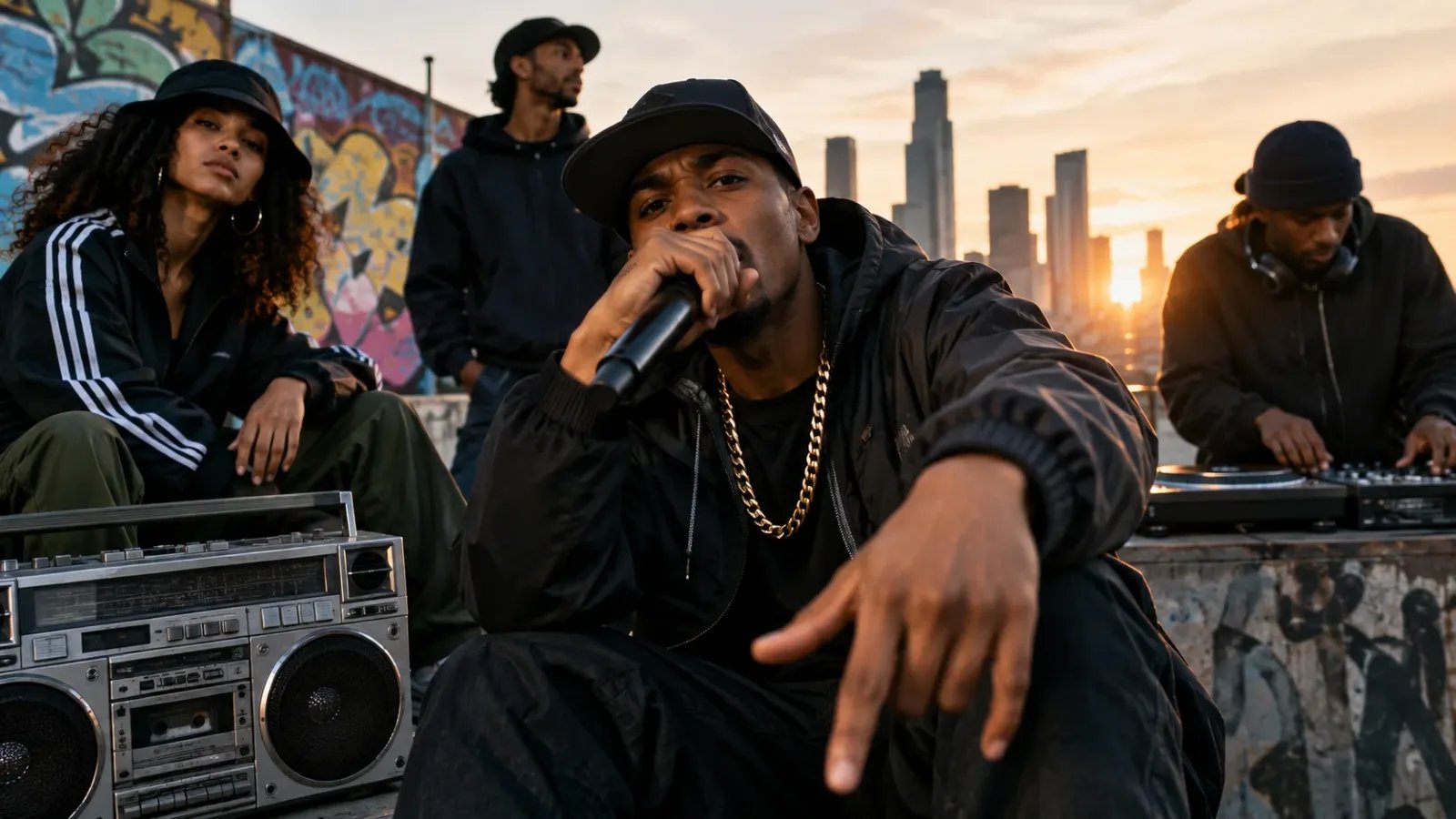
Dismissed by early critics as a passing fad, hip-hop is actually a complex linguistic and cultural science. Born in the 1970s Bronx, it fuses socio-political poetry with audio innovation. Far from simple party music, this global force revolutionized linguistics and sound engineering. Here are fifteen surprising truths about its history.
1. The term hip-hop was originally coined by Lovebug Starski and Keef Cowboy as a mocking cadence of marching soldiers.
Cowboy, of Grandmaster Flash and the Furious Five, created the term while teasing a friend who had just joined the US Army. He scat-sang the words hip, hop, hip, hop to mimic the rhythmic cadence of marching boots. This rhythmic vocalization was later integrated into his stage performance and adopted by other pioneers, eventually becoming the official moniker for the entire culture.
2. The iconic breakbeat DJ technique was born from an acute sociological observation of dance floor psychology, not random experimentation.
DJ Kool Herc noticed that crowds at his Bronx parties waited for the instrumental breaks in funk records to dance their hardest. Acting on this psychological insight, he developed the merry-go-round technique, using two copies of the same record to loop the break indefinitely. This scientific approach to sustaining crowd energy laid the foundational architecture for all hip-hop music.
3. Rapping derives heavily from the West African griot tradition of oral history, contradicting the myth that it was merely an evolution of disco hosting.
While early MCs certainly hyped up crowds like disco hosts, the rhythmic, rhyming storytelling of rap is a direct descendant of griots. These nomadic musicians and poets preserved tribal histories through rhythmic speech over instrumentation. Enslaved populations brought these oral traditions to the Americas, where they mutated into blues, jazz poetry, and eventually modern rapping.
4. The Roland TR-808 drum machine became the heartbeat of hip-hop because it was considered a commercial failure by mainstream studios.
Professional rock and pop producers abandoned the TR-808 in the early 1980s because its synthesized sounds, like its booming sub-bass kick, sounded nothing like real drums. Because it was a flop, it ended up in pawn shops where early, cash-strapped hip-hop producers bought it on the cheap. Its futuristic, mechanical boom ended up defining the acoustic footprint of an entire generation.
5. The first hip-hop song to win a Grammy was ironically boycotted by its own creators to protest the award ceremony's lack of respect for the genre.
In 1989, DJ Jazzy Jeff and The Fresh Prince won the inaugural Grammy for Best Rap Performance for Parents Just Don't Understand. However, the Recording Academy decided not to televise the presentation of this new category. Recognizing the slight against their culture, the duo, alongside other prominent nominees like LL Cool J, led a boycott of the ceremony to demand equal broadcast visibility.
6. Beatboxing was invented as a purely economic adaptation to the high cost of electronic drum machines.
In the impoverished neighborhoods of 1980s New York, aspiring artists simply could not afford expensive synthesizers and samplers. To compensate, musicians like Doug E. Fresh and the Fat Boys learned to manipulate their vocal cords, lips, and nasal cavities to mimic complex percussive frequencies. This biological emulation of digital hardware became a respected art form of its own.
7. The FBI maintained extensive, classified intelligence files on multiple hip-hop groups, treating them as organized political threats rather than musical acts.
Groups like N.W.A and the Wu-Tang Clan were subjects of serious federal surveillance. The FBI famously sent a warning letter to N.W.A's distributor over their anti-police brutality lyrics, misunderstanding the artistic expression of systemic frustration as a literal terrorist conspiracy. This surveillance highlights how deeply hip-hop functioned as a socio-political megaphone for marginalized communities.
8. The linguistic complexity of a standard rap verse utilizes more advanced internal rhyme schemes than most classical English poetry.
Academic studies of artists like MF DOOM and Eminem reveal structural frameworks that dwarf the basic rhyming schemes of traditional poetry. Rappers employ multi-syllabic rhymes, assonance, and syncopated rhythmic placements that cross over musical bar lines. This sophisticated phonetic math requires immense neurological processing, proving that rapping is a highly elevated literary form.
9. Scratching a record was discovered entirely by accident when a teenager tried to stop a spinning record to hear his mother calling him.
In 1975, a young Grand Wizzard Theodore was practicing his DJ skills in his bedroom when his mother told him to turn the music down. He placed his hand on the spinning vinyl to pause it, accidentally dragging it back and forth. Intrigued by the rhythmic, abrasive sound it produced, he refined the mistake into scratching, a technique that transformed the turntable from a playback device into a musical instrument.
10. Hip-hop culture is officially recognized by the United Nations as an international instrument for peace and human rights.
In 2001, the Hip-Hop Declaration of Peace was presented to the UN. Signed by pioneers like KRS-One and Afrika Bambaataa, the document outlines guiding principles for the culture, explicitly defining it as a global movement dedicated to peace, love, unity, and safely enjoying oneself. It formally shifted the definition of hip-hop from a regional music genre to an international philosophy.
11. The commercial explosion of hip-hop directly correlates with the invention of the cassette tape, not vinyl records or radio play.
While vinyl was the medium of the DJ, the cassette tape was the medium of the masses. In the late 1970s, hip-hop received zero radio play, making it impossible to consume outside of live parties. Enterprising individuals began recording these live park jams onto boombox cassette decks and selling them hand-to-hand, creating a decentralized distribution network that proved the genre's massive market viability.
12. Graffiti, often dismissed as mere vandalism, is categorized by historians as the critical visual pillar of hip-hop that predates the music itself.
Long before DJs started looping breakbeats, marginalized youths in Philadelphia and New York were using spray paint to reclaim urban spaces. Graffiti writers developed highly complex, coded typographies to communicate identity and territory. When hip-hop music emerged, it naturally absorbed this pre-existing visual rebellion, ensuring the culture had an aesthetic language to match its sonic one.
13. The iconic gold chains worn by early hip-hop artists were inspired by a psychological need to project sovereign wealth in deeply impoverished environments.
The trend of massive gold jewelry, pioneered by artists like Kurtis Blow, was not just about vanity. It was a conscious rejection of the extreme poverty surrounding these artists. By wearing oversized, visible wealth, rappers were visually manifesting success and power, adopting the aesthetics of royalty to counter the systemic socio-economic disenfranchisement of their neighborhoods.
14. The popularization of the term bling-bling actually prompted linguistic scholars to officially add it to the Oxford English Dictionary.
First popularized in 1999 by the Cash Money Millionaires track Bling Bling, the term described the aesthetic of flashy jewelry. It infiltrated global lexicon so rapidly and thoroughly that by 2003, Oxford lexicographers codified it into the dictionary. This demonstrates hip-hop's undeniable, documented power to invent and permanently alter the English language.
15. Sampling in hip-hop has led to the discovery and preservation of hundreds of obscure jazz and soul musicians who would have otherwise been forgotten by history.
Critics often wrongly accuse sampling of being intellectual theft, but it functions as a highly effective auditory archive. By digging through dollar-bins for forgotten vinyl, hip-hop producers resurrect obscure rhythms from 1960s and 1970s session musicians. This practice has generated renewed interest, and often delayed royalties, for older artists whose original labels had completely abandoned them.
Sources & References
This AI-assisted post was rigorously curated and fact-checked for accuracy by:
 Martin Roháček
How fun was this article? 🤔
Tap a star to rate it
🧠 Quiz: How closely were you paying attention?
10 questions — all answers are in the article above!
Enjoyed these facts? There's more! 💌
Fresh fun facts in your inbox. No spam, ever.