The Unexpected Journey: 15 Fascinating Facts About The Hobbit
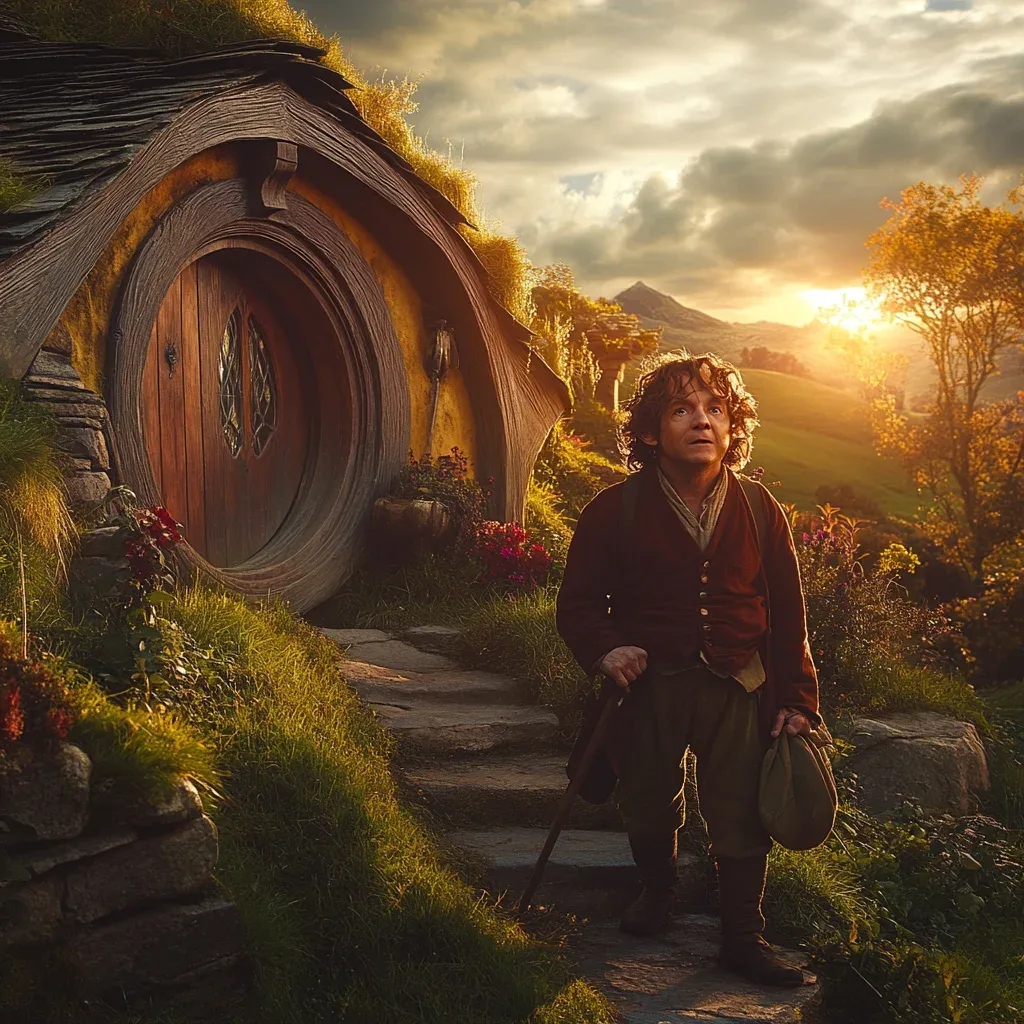
Published in 1937, J.R.R. Tolkien's The Hobbit began as a bedtime story for his children and grew into one of the most influential works of modern fantasy. Bilbo Baggins's quest across Middle-earth introduced readers to iconic characters like Gandalf and Gollum while laying the groundwork for The Lord of the Rings. Decades later, director Peter Jackson adapted the beloved classic into a record-breaking film trilogy that revolutionized cinematic technology. From hand-crafted prosthetic feet to ancient linguistic roots, these surprising facts illuminate the enduring legacy of Middle-earth's favorite homebody.
1. It Started on a Blank Grading Sheet
J.R.R. Tolkien was an Oxford professor grading essay papers in the summer of 1930 when he stumbled upon a blank page left by an examinee. On a sudden whim, he picked up his pen and wrote the legendary opening line: "In a hole in the ground there lived a hobbit." He originally had no clear idea what a hobbit was, but he began developing a bedtime mythology for his four young children around this quiet hole-dweller. Over the next few years, Tolkien wrote down the tale and shared manuscript drafts with friends, including fellow author C.S. Lewis. The story eventually reached London publisher Allen & Unwin after a former student recommended the manuscript. Rayner Unwin, the publisher's ten-year-old son, was paid a shilling to review the book and enthusiastically declared it worthy of publication.
2. The Book Has Never Gone Out of Print
Since its initial publication on September 21, 1937, The Hobbit has remained continuously in print for nearly nine decades. The original print run of 1,500 copies sold out in the United Kingdom within three months due to ecstatic critical reception. Today, the classic children's fantasy novel has been translated into more than 50 languages and has sold over 100 million copies worldwide. Its enduring popularity transformed Tolkien from a respected academic philologist into a globally renowned literary icon. Readers interested in legendary adaptations can check out our list of iconic book-to-movie adaptations to see how other literary classics made their way to the big screen.
3. Tolkien Rewrote a Key Chapter Years Later
The original 1937 edition of The Hobbit portrayed Gollum in a remarkably different light during the famous riddle contest. In the initial version, Gollum was willing to surrender the magic ring as a fair prize if Bilbo won the game. However, as Tolkien developed The Lord of the Rings, he realized the Ring possessed a dark, corrupting influence that made such generosity impossible. In 1951, Tolkien revised Chapter 5, titled "Riddles in the Dark," to show Gollum as manic, deceptive, and deeply obsessed with his "precious." He cleverly explained this textual discrepancy within Middle-earth lore by claiming Bilbo had lied in his original memoir to justify holding onto the stolen ring.
4. One Short Book Was Expanded Into Three Films
Director Peter Jackson initially planned to adapt The Hobbit into a two-part movie series following his massive success with The Lord of the Rings trilogy. However, during production, Jackson and his co-writers decided to expand the project into three feature films spanning nearly eight total hours. To justify this expansion, the screenwriters drew heavily from the extensive appendices Tolkien wrote at the end of The Return of the King. These supplemental notes allowed the filmmakers to depict events occurring off-screen in the original novel, such as Gandalf's investigation of the Necromancer at Dol Guldur. Moviegoers interested in massive cinematic productions can explore our facts about behind the scenes movie magic for more set secrets.
5. The Films Pioneered 48 Frames Per Second Technology
When The Hobbit: An Unexpected Journey hit theaters in 2012, it made history as the first commercial feature film released in High Frame Rate (HFR) 3D at 48 frames per second. Traditional cinema had operated at 24 frames per second since the late 1920s to standardise sound recording and film stock costs. Doubling the frame rate produced hyper-realistic clarity, sharp detail, and drastically reduced motion blur during fast action sequences. While some critics found the ultra-clear motion jarring, Jackson argued that HFR offered a more immersive experience akin to looking through a window into Middle-earth. The technical push required theaters worldwide to upgrade their digital projection systems to handle the higher bandwidth.
6. Hundreds of Prosthetic Hobbit Feet Were Destroyed During Filming
Achieving Bilbo's iconic bare, hairy feet required an incredible effort from the movie's makeup and prosthetic artists. Over the course of the trilogy, Weta Workshop produced more than 800 custom pairs of soft latex feet for the lead hobbit actors and their stunt doubles. Each morning, actors like Martin Freeman had to stand for up to an hour while makeup artists glued the delicate prosthetics over their real feet. Because the thin latex material tore during removal at the end of every shooting day, each pair could only be worn once before being discarded. Special heating elements were even built into floors on colder set days to prevent the actors' feet from freezing in the New Zealand winter.
 Famous Film Series and Franchises
Explore the fascinating behind-the-scenes secrets, groundbreaking visual effects, and unexpected cultural impacts of cinema's biggest blockbusters. From nuclear allegories to million-dollar improvisations, discover the untold stories behind your favorite film franchises.
See All Facts
Famous Film Series and Franchises
Explore the fascinating behind-the-scenes secrets, groundbreaking visual effects, and unexpected cultural impacts of cinema's biggest blockbusters. From nuclear allegories to million-dollar improvisations, discover the untold stories behind your favorite film franchises.
See All Facts
7. Andy Serkis Directed Second-Unit Sequences
Andy Serkis did not merely reprise his iconic role as the motion-capture character Gollum for the trilogy. Peter Jackson trusted Serkis so implicitly that he hired the actor to serve as the second-unit director across 266 days of principal photography. Serkis was responsible for filming intricate action sequences, aerial landscapes, and dynamic character moments involving massive battle crews. Directing second-unit required Serkis to fly all over New Zealand via helicopter while maintaining Jackson's visual vision and tone. The experience launched Serkis's career behind the camera, eventually leading him to direct major Hollywood blockbusters like Venom: Let There Be Carnage.
8. The Real Hobbiton Set Still Exists in New Zealand
The breathtaking Shire scenes were filmed on a family-owned sheep farm located near Matamata on the North Island of New Zealand. During the filming of The Lord of the Rings in 1999, the original set was built using temporary materials like plywood and polystyrene that were mostly dismantled after filming. When Jackson returned to shoot The Hobbit in 2009, the production team rebuilt 44 hobbit holes using permanent construction materials like timber and stone. Today, the Hobbiton Movie Set is a permanent tourist destination that hosts hundreds of thousands of visitors every year. Fans of epic film sets can discover more travel destinations in our feature on famous filming locations to visit across the globe.
9. Howard Shore Used Music to Link the Two Trilogies
Academy Award-winning composer Howard Shore returned to craft the musical scores for all three Hobbit films, composing over nine hours of original music. Shore intentionally embedded subtle thematic motifs from his famous Lord of the Rings score to create musical continuity across both sagas. He integrated new dwarf anthems like "Misty Mountains" into the orchestral soundscapes to reflect the darker, ancient heritage of Thorin Oakenshield. Shore worked with musicians playing traditional instruments from around the world to give distinct cultural sounds to elves, goblins, and dwarves. His masterwork culminated in a musical transition that seamlessly blends the final notes of The Battle of the Five Armies into the opening theme of The Fellowship of the Ring.
10. Tolkien Invented Middle-earth Languages First
Unlike most authors who invent stories first and world-building later, Tolkien created his complex fantasy universe to give his constructed languages a place to exist. As a brilliant professor of Germanic philology, Tolkien began inventing Elvish languages like Quenya and Sindarin as early as 1910. He designed The Hobbit around Middle-earth's linguistic history, creating distinct dialects for dwarves, orcs, and men. In the book, the common language spoken by Bilbo and the dwarves is technically "Westron," which Tolkien translated into modern English for the reader's convenience. Fans across the globe still study, write, and converse in Tolkien's Elvish tongues using his detailed grammatical rules.
11. Production Was Delayed to Secure Martin Freeman
Peter Jackson always had British actor Martin Freeman in mind as his absolute first choice to play Bilbo Baggins. However, casting Freeman seemed impossible when scheduling conflicts arose with the actor's starring role in the hit BBC series Sherlock. Unwilling to settle for any other actor, Jackson persuaded movie studio executives to adjust the entire filming schedule around Freeman's availability. Production halted for two months mid-shoot, allowing Freeman to fly back to London to film the second season of Sherlock before returning to New Zealand. Jackson later stated that Freeman was the only person alive who could naturally capture Bilbo's reluctant, home-loving, yet courageous spirit.
12. Weta Workshop Crafted Thousands of Real Weapons
The prop and armor department at Weta Workshop in Wellington took physical craftsmanship to extraordinary lengths for the cinematic trilogy. Armorers designed and hand-crafted thousands of real weapons, shields, and suits of armor tailored to the distinct culture of each Middle-earth race. Dwarf weapons featured heavy, geometric patterns, while Elvish blades displayed graceful, flowing curves inspired by organic plant life. Artisans forged steel blades for close-up shots while lightweight aluminum and urethane rubber duplicates were crafted for dangerous stunt sequences. The sheer volume of weapons required multiple dedicated armories on set, staffed by specialists who maintained and repaired equipment daily.
13. Ancient Myths Inspired Gollum and the Riddles
The thrilling riddle battle between Bilbo and Gollum was directly inspired by Tolkien's passion for ancient Norse sagas and Old English literature. In Old English culture, wisdom contests featuring poetic riddles were considered a vital test of mental intellect and survival. Tolkien drew inspiration from Anglo-Saxon manuscripts like the 10th-century Exeter Book, which contained dozens of poetic riddles about nature and daily objects. Gollum's tragic descent into a creeping, amphibious creature also echoes river monsters and subterranean ghouls found in Germanic folklore. By blending these medieval motifs into his narrative, Tolkien gave Bilbo's survival match a timeless mythic resonant tone.
14. Smaug Was Based on the Dragon in Beowulf
The terrifying dragon Smaug, who guards the hoard of Erebor, was heavily influenced by Tolkien's academic expertise in the Anglo-Saxon epic poem Beowulf. Tolkien was a world-renowned authority on Beowulf and produced an acclaimed prose translation of the poem during his academic career. Like the dragon in Beowulf, Smaug is obsessed with gold, acutely aware of every single coin in his pile, and flies into a vengeful rage when a single cup is stolen. Tolkien even adapted Smaug's sly, conversational speech style from ancient heroic poetry where dragons possessed sinister intelligence. Benedict Cumberbatch's voice and motion-capture performance in the films brought this classic literary archetype into the modern era.
15. Tolkien Created the Original Artwork Himself
In addition to writing the text, J.R.R. Tolkien was a skilled artist who created many original illustrations for the first UK edition of The Hobbit. He designed the original dust jacket cover art depicting the mountains, trees, and flying dragons, which remains iconic to this day. Tolkien also drew detailed maps of Wilderland and Thorin's Map featuring secret moon-runes that can be read when held up to light. His black-and-white ink drawings of Rivendell, Hobbiton, and the Hill provided readers with an authentic visual blueprint directly from the author's imagination. Color plates painted by Tolkien were later added to subsequent editions, making the book a complete personal artistic masterpiece.
Sources & References
This AI-assisted post was rigorously curated and fact-checked for accuracy by:
 Martin Roháček
How fun was this article? 🤔
Tap a star to rate it
🧠 Quiz: How closely were you paying attention?
10 questions — all answers are in the article above!
Enjoyed these facts? There's more! 💌
Fresh fun facts in your inbox. No spam, ever.