The Enigmatic Bard: 15 Fascinating Facts About Homer
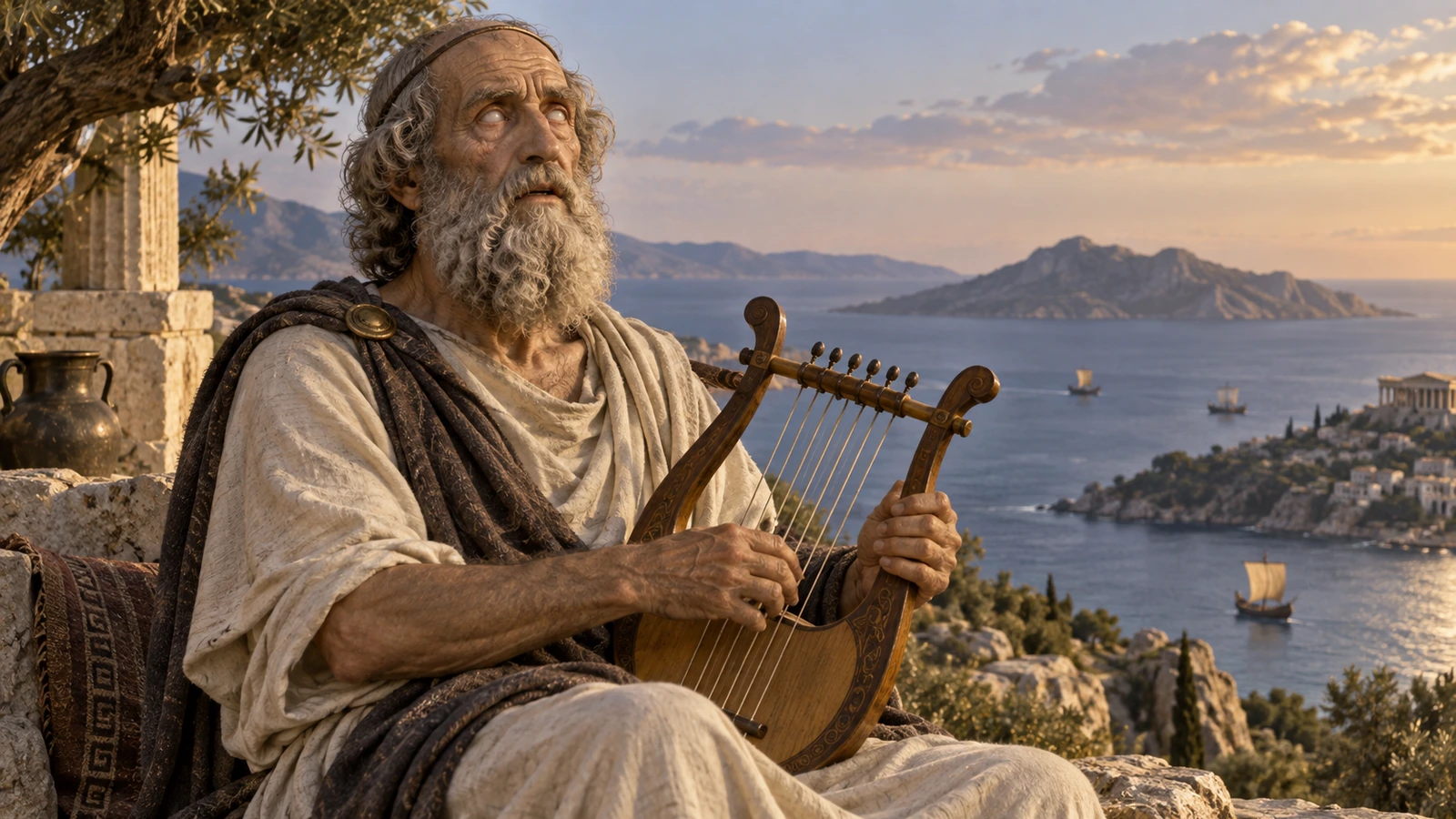
As the central figure of classical literature, Homer gave Western civilization its foundational epics in the Iliad and the Odyssey. Yet behind these timeless tales of gods, heroes, and tragic warfare lies a profound mystery: historians still debate whether Homer was a single blind poet or a collective tradition of oral bards. From ancient cities competing for his birthplace to his surprising omission of the color blue, the story behind Homer is as dramatic as his ancient poems. Here are 15 fascinating facts about the legendary figure who shaped the Western imagination.
1. The "Homeric Question" Still Divides Historians Today
For centuries, literary scholars have debated whether Homer was a single genius or a convenient shorthand for generations of anonymous oral bards. Known as the "Homeric Question," this academic debate explores whether the Iliad and the Odyssey were created by one individual or assembled from centuries of spoken folklore. Multiple stylistic inconsistencies across both works suggest that different poets contributed distinct sections over time. However, the remarkable thematic unity of the texts leads other experts to argue that a single master poet curated the final masterworks. Today, many classicists view Homer as a monumental artistic tradition rather than a singular biographical figure.
2. Seven Ancient Cities Fought Over His Birthplace
Because no historical birth certificate or record survived from the ancient world, multiple cities fiercely contested the honor of being Homer's birthplace. An ancient Greek epigram famously noted that seven cities claimed the poet as their native son, including Smyrna, Chios, Colophon, and Rhodes. These rival settlements recognized that claiming Homer provided immense prestige and economic benefits through early literary tourism. Chios even possessed a guild of professional reciters called the Homeridae, who claimed direct physical descent from the poet. This intense civic rivalry demonstrates how central Homer's identity was to ancient Greece and its shared identity.
3. His Legendary Blindness Might Be a Historical Mistake
Popular tradition has long depicted Homer as a blind, white-bearded wanderer, but modern linguistics suggests this image may rest on a misunderstanding. In ancient Greek, the name Homeros can be translated as "he who does not see," but it can also mean "hostage" or "pledge." Sculptors in antiquity seized upon the visual interpretation, carving busts of a sightless sage that established the iconic image for thousands of years. Additionally, ancient cultures often associated blindness with prophetic vision and divine musical inspiration. Whether he was actually blind or not, the visual trope of the blind bard became synonymous with epic poetry itself.
4. Over 27,000 Lines of Verse Were Preserved Entirely by Memory
The Iliad and the Odyssey comprise over 27,000 lines of complex poetry that were originally performed entirely from memory without written scripts. To accomplish this staggering feat, ancient reciters utilized a strict meter known as dactylic hexameter, which established a rhythmic pattern resembling a musical beat. Bards also relied on standardized stock phrases, such as "rosy-fingered Dawn" or "swift-footed Achilles," which acted as formulaic memory aids during live recitations. These performances could stretch over several days during religious festivals and civic gatherings. Writing was only introduced to transcribe the epics centuries after their initial oral creation.
5. The Infamous Trojan Horse Never Actually Appears in the Iliad
Most people assume the iconic story of the wooden Trojan Horse is the climax of Homer's Iliad, but the poem actually ends long before the city falls. The Iliad concludes with the solemn funeral of the Trojan prince Hector, leaving the ultimate fate of Troy unresolved in that specific epic. The famous tale of the deceptive wooden horse appears only briefly in the Odyssey as a nostalgic story recounted by a character during a banquet. Detailed accounts of the wooden horse trick were actually written down much later by Roman writers, most notably Virgil in the Aeneid.
6. Alexander the Great Kept an Annotated Iliad Under His Pillow
Alexander the Great was so obsessed with Homer's epic tale of war that he carried a personal copy of the Iliad throughout his conquest of Asia. His childhood tutor, the philosopher Aristotle, had personally edited and annotated this custom copy, known as the "casket copy." Alexander reportedly slept with the book under his pillow alongside his daggers, viewing the Greek warrior Achilles as his ultimate personal role model. Whenever Alexander visited ancient sites like Troy, he sacrificed at the supposed tomb of Achilles to draw inspiration for his own conquests. Homer's writing directly shaped the ambitions of history's most famous military commander.
 Writers and Literary Greats
Discover the astonishing true stories, eccentric habits, and thrilling adventures of history's greatest writers. From firing squads and pirate captivity to military hoaxes, their real lives rivaled their greatest fictions.
See All Facts
Writers and Literary Greats
Discover the astonishing true stories, eccentric habits, and thrilling adventures of history's greatest writers. From firing squads and pirate captivity to military hoaxes, their real lives rivaled their greatest fictions.
See All Facts
7. An Amateur Archaeologist Used the Iliad as a Map to Find Real Troy
For centuries, mainstream historians dismissed the Trojan War as pure mythology created for entertainment. That perspective changed radically in the 1870s when German businessman and self-taught archaeologist Heinrich Schliemann took Homer's geographical clues literally. By studying the topographic descriptions in the Iliad, Schliemann excavated the mound of Hisarlik in modern-day Turkey and unearthed the physical ruins of ancient Troy. While his unscientific excavation techniques damaged several historical layers, he proved that Homer's narrative was anchored in genuine Bronze Age reality.
8. Myth Says He Was Killed by a Riddle About Lice
An absurd ancient legend recorded in pseudo-biographical texts claims that Homer's death was caused by a frustrating riddle he could not solve. According to the story, the poet visited the island of Ios and encountered a group of young fishermen. When Homer asked what they had caught, the boys replied with a riddle: "What we caught, we left behind; what we didn't catch, we brought with us." The answer was head lice, but Homer was so baffled by the puzzle that he fell into despair and died of stress shortly after. While undoubtedly a comical folk fable, the tale highlights how ancient Greeks loved surrounding their cultural icons with bizarre lore.
9. Homeric Greek Was an Artificial Language That Nobody Spoke
The language used in Homer's epics was not the spoken vernacular of any real city-state, but a specialized dialect crafted exclusively for poetry. Known as Homeric Greek, this literary dialect blended features of Ionic and Aeolic Greek while retaining archaic Bronze Age vocabulary. Oral bards constructed this artificial tongue because its flexible word forms allowed them to easily fit words into the strict meter of dactylic hexameter. As a result, even to ancient Greek listeners in the 5th century BCE, Homer's poetry sounded uniquely ancient and grandly otherworldly.
10. Plato Called Him the Educator of Greece—Then Tried to Ban Him
The philosopher Plato recognized Homer as the fundamental bedrock of Greek education, referring to him as the poet who "educated Hellas." However, in his famous philosophical dialogue The Republic, Plato made the controversial argument that Homer's works should be banned from his ideal city-state. Plato argued that Homer's gods were terrible moral role models because they lied, cheated, committed adultery, and threw temper tantrums. He worried that young citizens would copy the unethical behavior of deities like Zeus and Ares. Despite Plato's fierce philosophical critique, Homer remained the undisputed center of classical education.
11. The Odyssey Is History's First Epic Narrative Sequel
While the Iliad is a gritty, tragic war drama set outside the walls of Troy, the Odyssey serves as its narrative follow-up, creating the template for modern sequels. It continues the story by following the clever king Odysseus on his harrowing ten-year journey home after the war. The stylistic shift between the two works is dramatic, moving from realistic battlefield combat to a fantasy-filled travelogue featuring monsters, witches, and sea sirens. This stark difference in tone led some ancient critics to speculate that the two epics were composed by entirely different authors operating decades apart.
12. He Claimed Not to Write the Epics, But to Channel a Goddess
In the tradition of ancient oral poetry, Homer did not present himself as an original author in the modern sense, but as a humble microphone for the divine. Both the Iliad and the Odyssey open with famous invocations asking the Muse, the divine goddess of artistic inspiration, to sing through the poet. The opening line of the Iliad literally begins with the word "Sing, O goddess, the anger of Achilles." This ritual opening signaled to the audience that the story was sacred truth passed directly down from Mount Olympus rather than human fiction.
13. The Epics Offer Surprisingly Sympathetic Portrayals of the Enemy
Unlike many ancient military propaganda tales, Homer's works exhibit a remarkably balanced and empathetic view of wartime enemies. In the Iliad, the Trojan prince Hector is portrayed as a courageous, devoted family man defending his homeland against invaders. Conversely, the primary Greek hero Achilles is depicted as vengeful, emotionally unstable, and ruthless on the battlefield. The poem culminates not in a victorious slaughter, but in a heartbreaking scene where Achilles and the Trojan King Priam weep together over their shared grief. This deep humanism set Homeric literature apart from typical military chronicles of the ancient Near East.
14. His Descriptions of Color Led to Bizarre Scientific Theories
Homer's descriptions of colors are notoriously strange to modern readers, famously describing the sea as "wine-dark" and the sky as "bronze." British Prime Minister and classical scholar William Gladstone published a study in 1858 noting that Homer never used the word "blue" anywhere in his works. Gladstone theorized that ancient Greeks were literally colorblind to blue light because the word for blue was absent from early vocabulary. Modern linguists and scientists now understand that color terms evolve based on cultural necessity rather than optical differences, but Homer's peculiar color palette remains a famous linguistic puzzle.
15. His Epics Are the Oldest Surviving Works of European Literature
Dating back to roughly the 8th century BCE, Homer's epics represent the foundational starting point of European literature. Composed near the end of the Greek Dark Ages, these texts preserved vital cultural memories of the Mycenaean Bronze Age that had collapsed centuries earlier. Without the preservation of the Iliad and the Odyssey, vast amounts of early Western mythology, linguistics, and historical memory would have been lost across the ancient Mediterranean. They laid the structural framework for drama, philosophy, and historical writing that still resonates today.
Sources & References
This AI-assisted post was rigorously curated and fact-checked for accuracy by:
 Martin Roháček
How fun was this article? 🤔
Tap a star to rate it
🧠 Quiz: How closely were you paying attention?
10 questions — all answers are in the article above!
Enjoyed these facts? There's more! 💌
Fresh fun facts in your inbox. No spam, ever.