The Aerial Acrobat: 15 Fascinating Facts About Hummingbirds
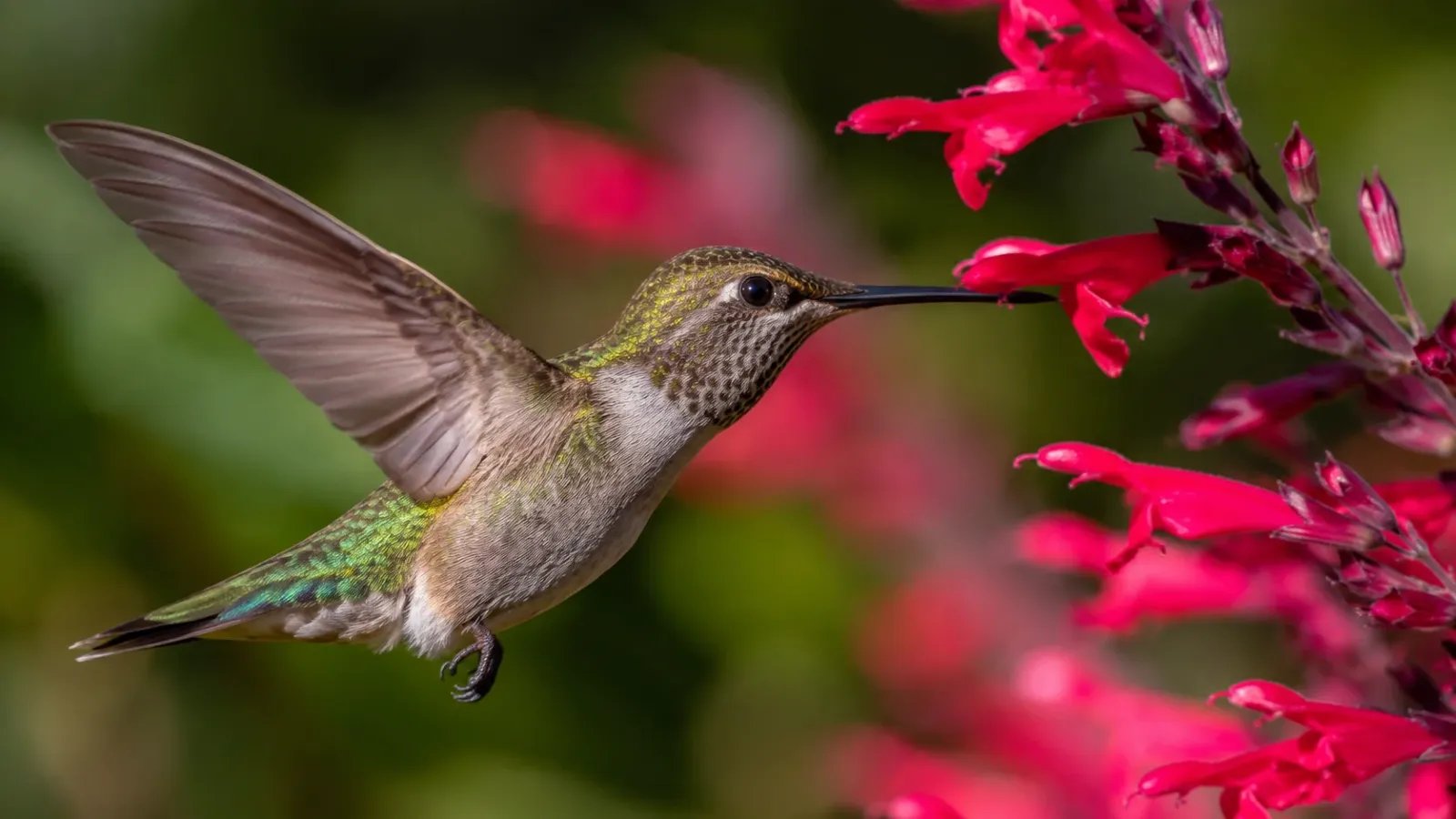
Forget the myth that hummingbirds survive solely on a diet of sweet nectar; these tiny gladiators are actually ruthless predators driven by a hyperactive metabolism. Beneath their iridescent feathers lies a marvel of evolutionary engineering capable of manipulating fluid dynamics and defying gravity. Prepare to discover the bizarre, high-stakes scientific reality of this avian marvel.
1. Hummingbirds do not suck up nectar through their beaks like a straw, but rather pump it up using microscopic, spring-loaded grooves on their tongues.
The long-held belief was that capillary action or a vacuum effect drew nectar into the bird's mouth. However, high-speed photography reveals that their split tongues are bordered by thin, fringed structures. When the tongue dips into nectar, fluid pressure forces these structures open. As the bird pulls its tongue back, the fringes spring shut, physically trapping the nectar in a microscopic fluid pump mechanism that operates at astonishing speeds, up to twenty times a second.
2. Nectar only fuels their immense energy needs, while their actual nutritional survival relies on hunting and eating hundreds of insects and spiders every day.
Sugar water provides the high-octane fuel required to keep a hummingbird airborne, but it lacks the protein, vitamins, and amino acids necessary to rebuild cellular tissue. To get these essential nutrients, hummingbirds are ferocious aerial hunters. They aggressively snatch fruit flies, gnats, and aphids out of the air, and frequently raid spider webs to steal trapped insects, sometimes even eating the spiders themselves to fulfill their dietary requirements.
3. To avoid starving to death while they sleep, hummingbirds induce a nightly state of mini-hibernation called torpor that plummets their body temperature and heart rate.
A hummingbird's metabolism is so fast that it is always hours away from starvation. When they cannot feed at night, they shut down their physiological systems to conserve energy. During torpor, their heart rate can drop from over a thousand beats per minute to roughly fifty, and their body temperature drastically falls to match the ambient air. It can take a hummingbird up to an hour of violent shivering to generate enough body heat to awaken from this deep, death-like state each morning.
4. Hummingbirds possess a fourth type of color cone in their retinas that allows them to perceive ultraviolet light and non-spectral colors invisible to the human eye.
While humans are trichromatic, relying on three color cones to see red, blue, and green, hummingbirds are tetrachromatic. This extra cone expands their visible spectrum into the ultraviolet range. More impressively, it allows them to see combination colors like ultraviolet-green or ultraviolet-red. This hyper-vision helps them spot highly reflective nectar-bearing flowers against dense, leafy green backgrounds, turning a seemingly uniform forest into a brightly illuminated treasure map.
5. Unlike other birds that generate lift solely on the downstroke of their wings, hummingbirds generate lift on both the upstroke and the downstroke, similar to insects.
The ball-and-socket joint of a hummingbird's shoulder is highly flexible, allowing the wing to rotate a full 180 degrees. When they fly, they do not flap their wings up and down, but rather sweep them in a rapid figure-eight motion. This aerodynamic inversion forces air downward on both the forward and backward strokes, granting them 25 percent of their lift on the upstroke. This exact mechanism is what enables their famous, perfectly stable hovering capabilities.
6. The hummingbird has the largest brain-to-body mass ratio of any bird in the world, with its brain accounting for over four percent of its total weight.
Despite their minuscule size, these birds require massive processing power to navigate their high-speed environments. A significant portion of this brainpower is dedicated to the hippocampus, the region responsible for spatial memory. A hummingbird can remember the precise location of thousands of individual flowers within its territory, and it keeps a mental timer of exactly how long it takes for each specific blossom to refill with nectar after it has been drained.
 Birds of the World
From record-breaking aerial plunge-divers to massive flightless icons, the avian world is a marvel of evolutionary engineering. Discover the extraordinary intellects, specialized survival skills, and hidden superpowers of the planet's most fascinating birds.
See All Facts
Birds of the World
From record-breaking aerial plunge-divers to massive flightless icons, the avian world is a marvel of evolutionary engineering. Discover the extraordinary intellects, specialized survival skills, and hidden superpowers of the planet's most fascinating birds.
See All Facts
7. Hummingbirds are entirely incapable of walking or hopping because their leg architecture evolved to prioritize reduced weight and drag over terrestrial mobility.
Belonging to the taxonomic order Apodiformes, which literally translates to footless, hummingbirds have highly specialized, tiny legs. Their feet are strictly adapted for perching and scratching rather than locomotion. If they need to move even a fraction of an inch sideways on a branch, they must use their wings to hover and reposition themselves. This evolutionary trade-off sacrificed leg muscles to make way for massive pectoral muscles, which can make up a third of their body weight.
8. Despite their delicate appearance, hummingbirds are intensely territorial and frequently engage in violent, mid-air dogfights using their bills as weapons.
Pound for pound, hummingbirds are some of the most aggressive vertebrates on the planet. When defending a premium patch of flowers or a feeder, a dominant male will dive-bomb intruders, including birds of prey like hawks and crows. During intra-species combat, they lock talons, rip feathers, and try to stab one another with their needle-like bills. Some species even have serrated edges or hook-like tips on their bills specifically evolved for ripping feathers from their rivals.
9. At rest, a hummingbird takes about two hundred and fifty breaths a minute, but that rate skyrockets to over a thousand breaths per minute during active flight.
Their extreme metabolic furnace requires a massive, constant influx of oxygen to burn the sugars they consume. To accommodate this, hummingbirds possess incredibly efficient lungs paired with nine air sacs that extend into their hollow bones. This respiratory anatomy allows for a continuous, unidirectional flow of oxygenated air through their lungs on both the inhalation and exhalation, preventing them from suffocating during their high-speed, acrobatic maneuvers.
10. The brilliant, metallic colors of a hummingbird's throat feathers are not created by pigment, but by microscopic structures that refract light like tiny prisms.
If you were to grind up a hummingbird's glowing ruby-red throat feather, you would end up with gray or black dust. The dazzling iridescence is a phenomenon called structural coloration. The keratin layers in their feathers contain microscopic air bubbles arrayed in highly specific, lattice-like structures. As light hits these layers, it bends and splits. The colors you see depend entirely on the angle of the light and the position of the observer, which is why a hummingbird can look brilliantly colored one second and dull brown the next.
11. Relative to their body length, male hummingbirds execute courtship dives faster than the atmospheric reentry of the Space Shuttle or a fighter jet at full afterburner.
During mating displays, males fly high into the air and plummet toward the ground to impress females. During this dive, they can reach speeds of roughly ninety feet per second. When measured in body lengths per second, they cover 385 body lengths in a single second. For comparison, a diving peregrine falcon reaches about 200 body lengths per second, and a space shuttle reentering the atmosphere covers just over 200, making the hummingbird an undisputed champion of relative speed.
12. Hummingbirds lack the specific gene receptor that allows animals to taste sweetness, but they genetically mutated their savory receptors to taste sugar instead.
Through the course of evolution, the ancestors of all modern birds lost the T1R2 gene, which mammals use to detect sweet flavors. Since birds were primarily carnivorous, this loss did not matter. However, as hummingbirds evolved to exploit flower nectar, they repurposed their umami receptor, typically used to taste amino acids and savory meats. This genetic workaround physically morphed their taste buds, effectively allowing them to taste sugar using a biological pathway meant for meat.
13. A hummingbird can withstand gravitational forces during its courtship dives that would easily cause a highly trained human fighter pilot to black out.
When a male hummingbird pulls out of its extreme courtship dive, the sudden change in trajectory subjects its tiny body to over nine Gs of force. In a human, blood would pool in the lower extremities, draining from the brain and causing a loss of consciousness. The hummingbird's ability to survive this extreme centrifugal force without passing out or suffering vascular damage is attributed to its highly adapted circulatory system, immensely strong heart, and compact biological design that prevents blood from pooling.
14. Despite living life on the absolute edge of metabolic exhaustion, hummingbirds have relatively long lifespans, with some individuals living over a decade in the wild.
Generally, animals with extremely fast heart rates and hyperactive metabolisms, like shrews and mice, burn out quickly and have very short lifespans of one to two years. Hummingbirds defy this biological rule of thumb. While many die in their first year due to predators or migration hazards, those that survive to adulthood often live to be three to five years old. The oldest known wild hummingbird, a Broad-tailed Hummingbird, was documented living for over twelve years, an astonishing feat for such a fragile creature.
15. The Ruby-throated Hummingbird completes a non-stop, five-hundred-mile migration across the Gulf of Mexico, burning up almost its entire body weight in fat to make the journey.
Before undertaking this perilous over-water flight, the bird engages in hyperphagia, intensely gorging on nectar and insects to double its body weight in stored fat. Once it sets out over the ocean, there is nowhere to land and no food to eat for roughly eighteen to twenty-two hours. By the time it reaches the opposing shoreline, the hummingbird has metabolized almost every gram of the fat it stored, arriving exhausted and dangerously close to starvation, yet triumphant in one of the animal kingdom's most grueling endurance tests.
Sources & References
This AI-assisted post was rigorously curated and fact-checked for accuracy by:
 Martin Roháček
How fun was this article? 🤔
Tap a star to rate it
🧠 Quiz: How closely were you paying attention?
10 questions — all answers are in the article above!
Enjoyed these facts? There's more! 💌
Fresh fun facts in your inbox. No spam, ever.