
15 Fascinating Facts About Moles
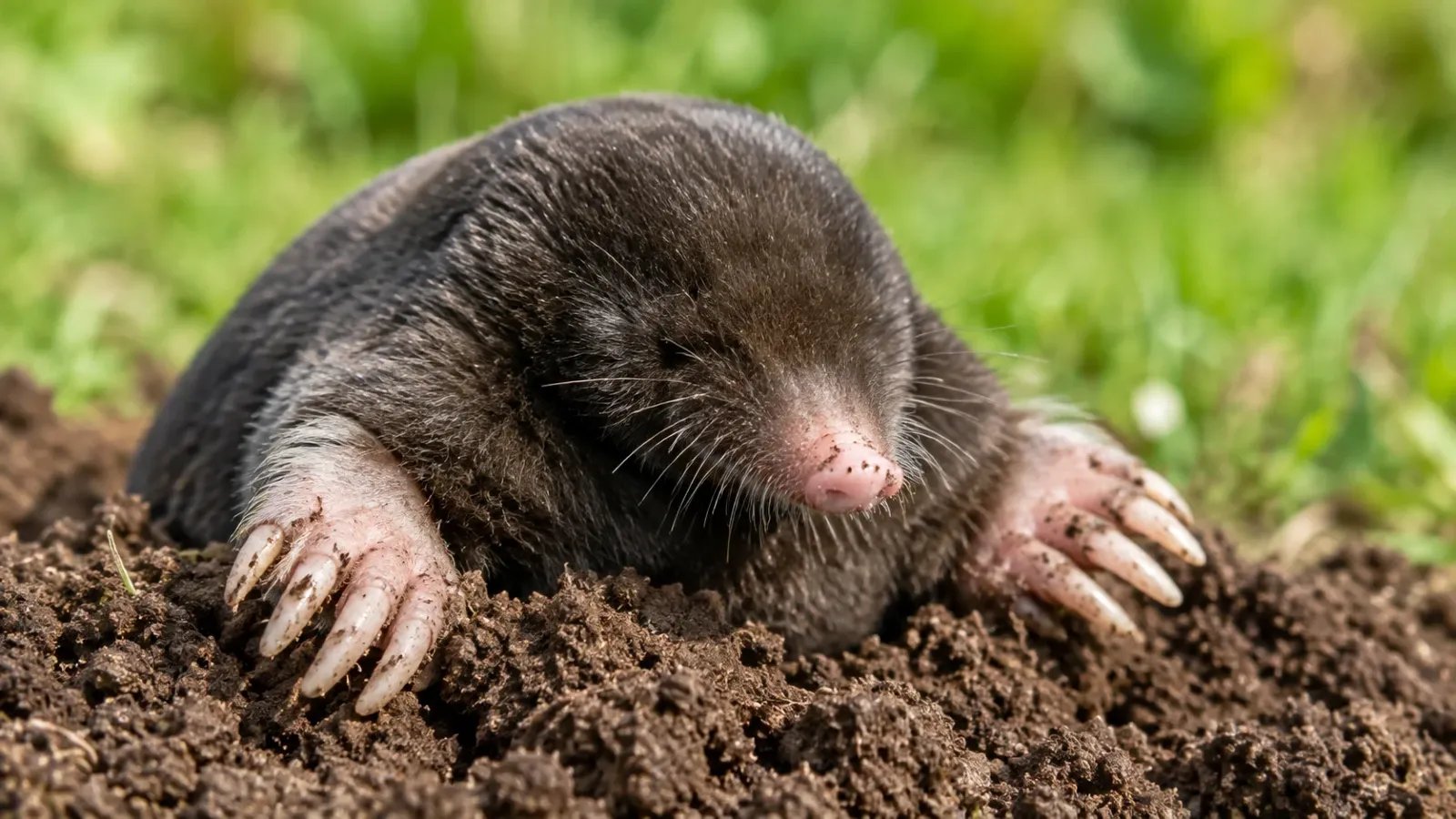
Moles are not blind rodents aimlessly ruining lawns. These subterranean mammals are actually sophisticated predators with specialized biology built to dominate the dark. From bizarre sensory organs to incredible feats of strength, their evolutionary secrets will completely change how you view these elusive dirt-dwelling architects.
1. Moles are not rodents but belong to an entirely separate mammalian order called Eulipotyphla.
Many people mistakenly group moles with mice and rats, but they are actually closely related to hedgehogs and shrews. This specific taxonomic order translates to "truly fat and blind," though as we will soon see, this name is only partially accurate. Their evolutionary lineage diverged from rodents millions of years ago to pursue an exclusively insectivorous diet rather than a plant-based one.
2. Moles produce a specialized toxic saliva that paralyzes earthworms so they can be hoarded alive.
Instead of eating their prey immediately, moles act as subterranean preppers. Their saliva contains a unique toxin that immobilizes earthworms without killing them. This allows the mole to store thousands of living, paralyzed worms in specially constructed underground larders to consume later, particularly during cold winter months when prey is scarce.
3. The star-nosed mole can identify and consume its prey faster than the human eye can track.
Holding the title for the world's fastest eating mammal, the star-nosed mole takes only 120 milliseconds to identify and consume a piece of food. Its brain processes information at astonishing speeds, taking a mere 8 milliseconds to decide whether an object is edible. This hyper-efficient foraging system is crucial for surviving in nutrient-poor wetland environments.
4. Moles possess a unique hemoglobin structure that allows them to survive on remarkably low oxygen levels.
Deep underground, oxygen is scarce and carbon dioxide levels are lethally high. To survive in these suffocating conditions, moles have evolved a special type of hemoglobin protein in their red blood cells. This adaptation allows their blood to bind oxygen far more effectively than other mammals, enabling them to thrive in stale, subterranean tunnel systems without suffocating.
5. Moles are not completely blind but use their limited vision to detect changes in light.
Despite the popular misconception that they lack sight, moles do possess tiny eyes hidden beneath their dense fur. While they cannot resolve sharp images or colors, their eyes are highly sensitive to sudden changes in illumination. This acts as a vital predator detection system, alerting the mole if a predator breaches its tunnel or if it accidentally burrows too close to the surface.
6. A mole's fur lacks a specific directional grain, allowing it to move backward through tunnels without getting stuck.
If you pet most mammals, their fur lays flat in one direction and bristles if rubbed the wrong way. A mole's velvety fur, however, points straight up and articulates freely in any direction. This incredible biological adaptation ensures that dirt does not become trapped in their coats and allows them to reverse through incredibly tight tunnels without physical resistance.
7. The star-nosed mole's fleshy snout is the most sensitive touch organ of any known mammal.
The strange, alien-looking star on the end of this specific mole's nose is not for smelling, but for feeling. It contains over 25,000 microscopic sensory receptors known as Eimer's organs spread across 22 fleshy tentacles. This organ is so hypersensitive that it allows the mole to essentially see its environment in total darkness through incredibly detailed tactile feedback.
8. A mole can dig surface tunnels at an astonishing rate of eighteen feet per hour.
While that might sound slow compared to a running animal, moving solid earth is incredibly labor-intensive. Powered by massive, paddle-like forepaws and specialized shoulder muscles, a mole essentially swims through the soil. They consume enormous amounts of energy during this process, requiring them to eat roughly their own body weight in insects every single day to fuel their excavation.
9. Female moles possess a unique genetic trait where they develop both ovarian and testicular tissue.
In a fascinating biological twist, female moles are technically intersex. They possess specialized gonads called ovotestes. While the ovarian section produces eggs for reproduction, the testicular tissue produces immense amounts of testosterone. This hormonal boost grants female moles the extraordinary muscle mass and aggressive territorial behavior required to survive a solitary, demanding life underground.
10. Moles actually possess two distinct thumbs on each front paw to maximize their digging efficiency.
To move massive amounts of dirt, moles need broad shovels. Evolution solved this by giving them an extra digit on their forepaws. This second thumb is not a true finger with joints, but rather an elongated wrist bone called a prepollex that has grown outward. This adaptation widens the surface area of their paws, allowing them to displace far more soil with every single stroke.
11. A single mole's solitary tunnel network can stretch for over a mile beneath the surface.
Moles are fiercely territorial and solitary creatures, and the intricate tunnel systems they build serve as both their homes and massive hunting traps. A resident mole continuously patrols these extensive networks, relying on earthworms and grubs to unknowingly fall into the open burrows. If another mole enters this sprawling labyrinth, a vicious fight for territory will instantly ensue.
12. Moles have the rare biological ability to smell in stereo to precisely locate their prey.
Just as humans use two ears to determine the direction of a sound, the common mole uses its two nostrils to pinpoint exactly where a scent is originating. Each nostril receives olfactory inputs independently, allowing the mole's brain to compute the precise trajectory of a nearby earthworm. This stereoscopic smelling is incredibly rare in the animal kingdom and crucial for hunting in absolute darkness.
13. The star-nosed mole has the bizarre ability to smell underwater by blowing and re-inhaling air bubbles.
Most mammals lose their sense of smell completely when submerged, but the semi-aquatic star-nosed mole developed an ingenious workaround. As it swims, it exhales tiny air bubbles directly onto objects or scent trails underwater, and then instantly sniffs the bubbles back into its nose. This allows the mole to capture odor molecules trapped in the water, making it a highly lethal aquatic hunter.
14. Moles have an unusually high tolerance for carbon dioxide that would quickly suffocate other mammals.
The air trapped in deep subterranean burrows is heavily polluted with the exhaled breath of the mole and the natural decomposition of the soil. While humans would quickly experience hypercapnia and suffocate, moles have adapted a unique respiratory exchange system. Their lungs can expel carbon dioxide at massive rates, allowing them to repeatedly recycle the poor-quality air of their tiny tunnels.
15. The lifespan of a mole is surprisingly short, rarely exceeding three years in the wild due to extreme metabolic stress.
Despite their lack of traditional predators due to their subterranean lifestyle, the physical demands of being a mole are brutally high. The constant, exhausting labor of digging, combined with the fierce territorial battles they fight and the stress of hunting enough food to fuel their massive metabolism, causes them to age rapidly. Most succumb to exhaustion or starvation long before old age.
Sources & References
This AI-assisted post was rigorously curated and fact-checked for accuracy by:
 Martin Roháček
How fun was this article? 🤔
Tap a star to rate it
🧠 Quiz: How closely were you paying attention?
10 questions — all answers are in the article above!
Enjoyed these facts? There's more! 💌
Fresh fun facts in your inbox. No spam, ever.