
The Underground Superheroes: 15 Fascinating Facts About Naked Mole-Rats
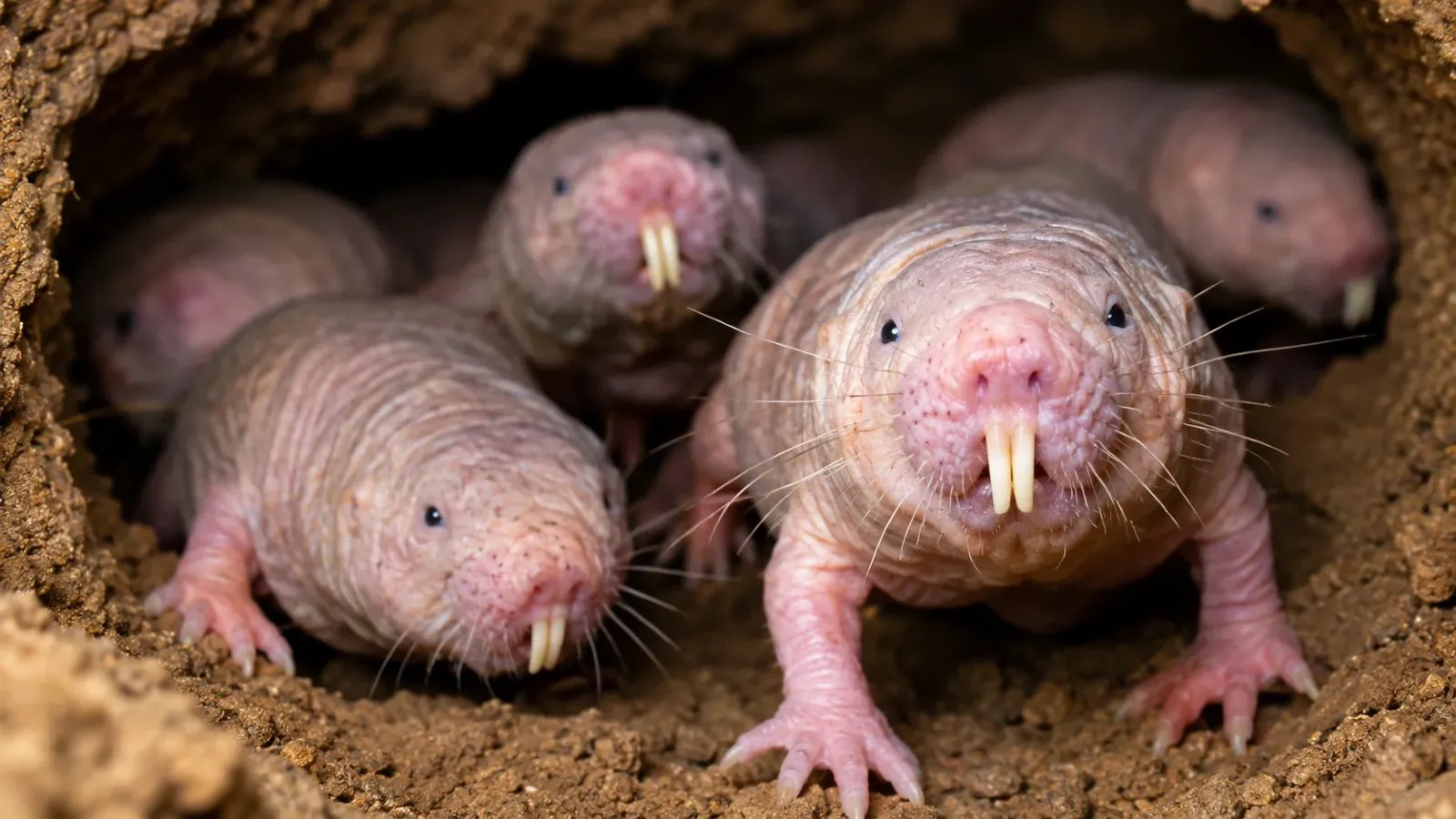
Naked mole-rats are nearly hairless rodents with a highly social underground life. Studies have revealed unusual longevity, cancer resistance, oxygen-deprivation tolerance and colony-specific calls. Their abilities are extraordinary, but depend on the trait and conditions being studied.
1. They live like ants, with a queen in charge.
Naked mole-rats are one of only two known eusocial mammals, meaning they live in colonies organised like those of ants, bees and termites. In each colony, a single female, the queen, and one to three males do all the breeding. Everyone else works as a non-breeding labourer, digging tunnels, gathering food, caring for pups or defending the colony.
2. They can live for more than 37 years.
Most rodents of their size live for only a few years, but naked mole-rats can live for more than 37 years in captivity. That makes them the longest-lived rodents known. A house mouse of similar size, by comparison, rarely lives beyond three years.
3. They hardly seem to age at all.
Long-term studies of captive naked mole-rats found that adult mortality risk did not show the usual steep increase with age over the ages well represented in the data. That is remarkable, but it does not mean the animals are immortal or that every organ remains unchanged forever. Breeding status and study conditions also matter when comparing survival.
4. They almost never get cancer.
Naked mole-rats are remarkably resistant to cancer, which is very rare in the species. Scientists have identified several possible reasons, including an unusually thick form of a substance called hyaluronan that may stop cells from crowding together and forming tumours. Researchers hope that understanding these defences could one day help to fight cancer in humans.
5. They can survive for minutes without oxygen.
In a 2017 experiment, naked mole-rats recovered after eighteen minutes in an atmosphere with no oxygen. They became unresponsive and greatly reduced their activity, then recovered when air was restored. Fructose-fuelled anaerobic metabolism helped support vital tissues. This laboratory result is not a claim that they remain normally active without oxygen.
6. They rely heavily on their surroundings and one another for warmth.
Naked mole-rats have an unusually limited ability to maintain a constant body temperature on their own. They conserve heat by huddling and can move into warmer parts of their tunnel system. Their temperature therefore varies more with the environment than in many familiar mammals.
 You might also like
The Vibrant Heavyweights: 15 Fascinating Facts About Mandrills
7. Their skin does not feel certain kinds of pain.
Experiments have found unusual insensitivity to acid and capsaicin in naked mole-rat skin. This does not make them unable to feel all pain: other damaging stimuli still produce responses. Researchers have investigated links with their underground environment and altered sensory signalling, rather than a universal resistance to injury.
8. Their lips close behind their teeth.
Naked mole-rats dig with their large front teeth, which stick out of their mouths. Their lips seal behind the teeth, so they can gnaw through soil without getting a mouthful of dirt. About a quarter of all their muscle mass is used to close their powerful jaws.
9. They can run backwards as fast as forwards.
Living in narrow tunnels has made naked mole-rats experts at reversing. They can move backwards just as quickly as they move forwards. Sensitive hairs on their bodies and tails help them feel their way through the dark, since their tiny eyes are of little use underground.
 Rodents and Small Mammals
Eleven small mammals with big surprises, from squirrels, flying squirrels, beavers, capybaras and porcupines to naked mole-rats, moles, hedgehogs, stoats, raccoons and bats.
See All Facts
10. Their colonies can number in the hundreds.
A typical colony contains around 75 to 80 animals, but some have been found with nearly 300 members. They live in vast underground tunnel systems that can stretch for several kilometres in the dry regions of East Africa, including Kenya, Ethiopia and Somalia.
11. Each colony has its own accent.
Naked mole-rats communicate with a range of chirps and squeaks. A 2021 study found that each colony has its own distinctive "dialect" of soft chirps, which helps members recognise one another and spot intruders. The dialect appears to be set by the queen, and pups adopted into a new colony learn the local version.
12. Big workers act as soldiers.
Colony members share work such as digging, moving soil, gathering food and tending pups. Larger animals can be especially important in defence, but tasks are not divided into fixed insect-like castes with an unchanging job for every individual. Behaviour varies with body size, age and the needs of the colony.
🤔 Quick guess
How do naked mole-rats eat underground tubers without killing the plant?
13. They eat underground tubers without killing the plant.
Naked mole-rats feed mainly on large tubers and roots. Instead of eating an entire tuber, they often eat only the inside and leave the outer part intact, allowing the plant to regrow. This means a single tuber can feed a colony for months or even years.
14. The queen grows longer when she takes power.
When a female becomes queen, she does more than start breeding. Her spine actually lengthens, giving her a longer body to carry large litters of pups. Queens can give birth to litters of up to around 20 pups or more at a time.
15. They are not actually completely naked.
Despite their name, naked mole-rats are not entirely hairless. They have around 100 fine hairs scattered over their bodies, which work like whiskers to help them sense their surroundings. Their pink, wrinkly skin lacks the insulating fat layer found in most mammals.
How did these facts land?
Know someone who'd love these facts? Share them 👇
🧠 Quiz: How closely were you paying attention?
Think you remember the facts? 10 questions, tap an answer.