15 Surprising Facts About Illinois
A city with a wooden solar calendar, a neighborhood ordered from a catalog, and a nuclear laboratory with bison: Illinois rewards a closer look.
1. Cahokia kept track of the sun with wooden posts
Long before Chicago existed, Cahokia was a major Indigenous center in what is now southwestern Illinois. At its peak around 1050–1150, it may have held 10,000 to 20,000 people. Among its features was a circle of wooden posts known today as Woodhenge. Alignments between the central viewing position, outer posts, and sunrise marked the seasons. The reconstructed circle stands within a much larger urban landscape of mounds, plazas, homes, and public works built by Mississippian people.
2. The first controlled nuclear chain reaction happened in a squash court
On December 2, 1942, Enrico Fermi's team achieved a self-sustaining nuclear chain reaction beneath the west stands of the University of Chicago's Stagg Field. Chicago Pile-1 was assembled from layers of graphite containing uranium, supported by a wooden framework. The reactor operated for 28 minutes before a control rod stopped the reaction. Its unlikely sports-facility setting housed a crucial Manhattan Project experiment: the team was demonstrating control of nuclear fission, not generating electricity for the neighborhood.
3. Carlinville built an entire neighborhood from catalog houses
In 1918, Standard Oil ordered Sears kit houses for its Carlinville workforce. The resulting Standard Addition contained 156 homes assembled from shipped materials, including precut, numbered lumber keyed to building plans. Sears even named its Carlin model for the town. After the local mines closed in 1925, many houses stood empty for years; in 1935, some sold for just $350. A mass purchase intended to house miners left a neighborhood that also records the abrupt disappearance of their jobs.

4. Chicago sent its river away from its drinking water
Chicago's sewers originally discharged into a river that flowed toward Lake Michigan, the city's drinking-water source. Opening the Chicago Sanitary and Ship Canal in 1900 reversed the flow and sent wastewater toward the Des Plaines, Illinois, and Mississippi rivers. Earlier pumping had already attempted a reversal, but could not reliably maintain it during heavy rain. The major engineering achievement protected Chicago's lake supply while also directing the city's pollution downstream, where other communities had their own water concerns.
5. Illinois chose a state fossil scientists still argue about
The Tully monster had eyes on a sideways bar and a long snout ending in a toothed feeding structure. Its soft body survived inside ironstone concretions in the roughly 300-million-year-old Mazon Creek deposits. A 2016 study placed it among vertebrates related to lampreys. A 2023 study using three-dimensional scans challenged that interpretation, arguing that several supposed vertebrate structures had been misidentified. Illinois's official fossil therefore offers an unusually vivid example of evidence being reexamined rather than a mystery neatly settled.
6. A coffee mill helped make better barbed wire
Joseph Glidden's experiments near DeKalb produced a commercially influential barbed-wire design patented on November 24, 1874. According to the Glidden Homestead's account, he and blacksmith Phineas Vaughan modified an old coffee mill to make small, uniform wire coils. Glidden's design trapped the pointed barbs between twisted strands so they stayed in position. Other barbed-wire patents already existed; his important contribution was an effective arrangement that could be manufactured and used widely, rather than the first thought of putting spikes on a fence.
 You might also like
The Unstoppable Thrill of March Madness: 15 Fascinating Facts About College Basketball's Biggest Tournament
7. A famous early 'steel plow' was not made entirely of steel
John Deere began making plows in Grand Detour in 1837 to tackle sticky prairie soil. The familiar story emphasizes steel, but Smithsonian testing of an early 1838 example found a wrought-iron moldboard and a steel cutting share. The investigators concluded that grinding and polishing mattered greatly to its ability to shed soil. That surviving implement makes the invention more interesting than a simple material swap: the surface finish and the different jobs of its components were central to its performance.
8. Violence in Lincoln's hometown helped spur the NAACP
In August 1908, a white mob attacked Black residents of Springfield, burning homes and businesses and lynching two Black men. The violence attracted particular national attention because it occurred in Abraham Lincoln's hometown, exposing the persistence of racial terror outside the South. It became one catalyst for the NAACP's founding in 1909. Archaeology later uncovered foundations of burned homes that were never reoccupied, preserving direct physical evidence of the neighborhood and the lives disrupted by the attacks.
9. A Chicago club gave house music a home—and a name
The Warehouse opened in Chicago in 1977 with Frankie Knuckles as its resident DJ. Initially serving a largely Black gay membership, it became a space where disco, soul, gospel, and electronic sounds could be stretched and reshaped for dancers. The developing sound became associated with the club's name: house music. Its history involves both musical experimentation and a community creating space for itself. Tape edits and extended mixes helped move familiar records beyond the limits of their original arrangements.
10. Fermilab keeps bison alongside particle physics
Fermilab's first director, Robert Wilson, established a bison herd at the laboratory in 1969. He intended the animals to connect the research campus with the history of the Midwestern prairie. The laboratory also undertook native-prairie restoration, making its grounds a setting for both scientific experiments and ecological work. The herd requires active management: the lab's account describes periodically replacing bulls to maintain genetic diversity. Calves born on the site each spring add another seasonal rhythm to life around the accelerators.
11. A Mississippi River shortcut left part of Illinois on the other bank
On April 20, 1881, the Mississippi broke through the narrow neck of land near Kaskaskia and entered part of the smaller Kaskaskia River's channel. Erosion gradually consumed much of the old village, once Illinois's state capital. The relocated community remained in Illinois even though the main Mississippi channel now lay to its east. Today, road access to the Kaskaskia Bell State Memorial comes through Missouri. A change in the river's route did not automatically redraw the state around it.
12. Collinsville's giant catsup bottle was working infrastructure
The enormous Brooks catsup bottle in Collinsville was completed in 1949 as a 100,000-gallon water tower for a bottling plant. Its job included supplying the factory's fire-protection sprinklers. The bottle itself is about 70 feet tall, standing on legs roughly 100 feet high. A local preservation campaign restored the structure in 1995 after its future came into doubt. The roadside landmark began as a practical industrial tank whose shape also advertised what the plant sold.
13. A ten-cent trial sale preceded Dairy Queen's first shop
Dairy Queen traces its beginnings to an August 4, 1938, trial at Sherb Noble's ice-cream shop in Kankakee. Customers paid ten cents for an all-you-can-eat introduction to a soft frozen dairy dessert, and Noble served more than 1,600 portions in two hours. The first shop bearing the Dairy Queen name opened in Joliet on June 22, 1940. Keeping the two places and dates separate reveals how a product test grew into a branded retail business.
14. Southern Illinois has a swamp of ancient cypress trees
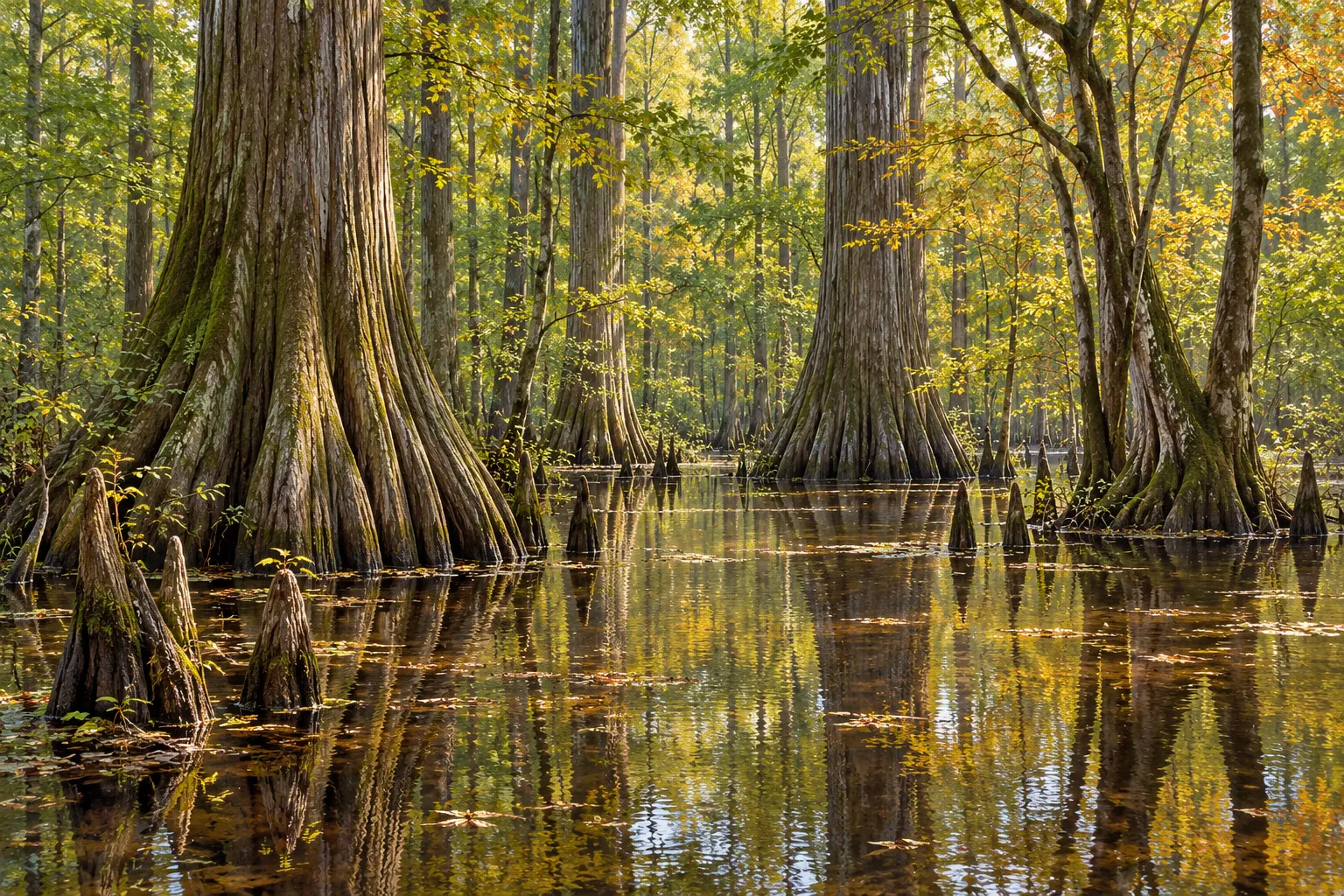
Cache River State Natural Area preserves a cypress-and-tupelo landscape in far southern Illinois. State natural-resource descriptions identify trees more than 1,000 years old, with enormous flared bases rising from the wetland. The setting occupies a floodplain carved by ancient Ohio River floodwater; the Ohio later adopted a different course, leaving the Cache to wind through the wetlands. For a place nicknamed the Prairie State, Illinois also shelters a strikingly different world of dark water, old trees, and projecting cypress knees.
15. Pullman porters won a contract that reached beyond the railway
The Brotherhood of Sleeping Car Porters organized in 1925 under A. Philip Randolph and spent more than a decade fighting for recognition from the Pullman Company. Its 1937 contract brought improvements in pay, job security, and grievance procedures. The National Park Service identifies it as the first major labor agreement between an African American union and a corporation. Chicago's Pullman history therefore connects company-town architecture and railway luxury with a major campaign for Black workers' rights and wider civil rights.
How did these facts land?
Know someone who'd love these facts? Share them 👇