
The Secret Leviathan: 15 Fascinating Facts About the Manhattan Project
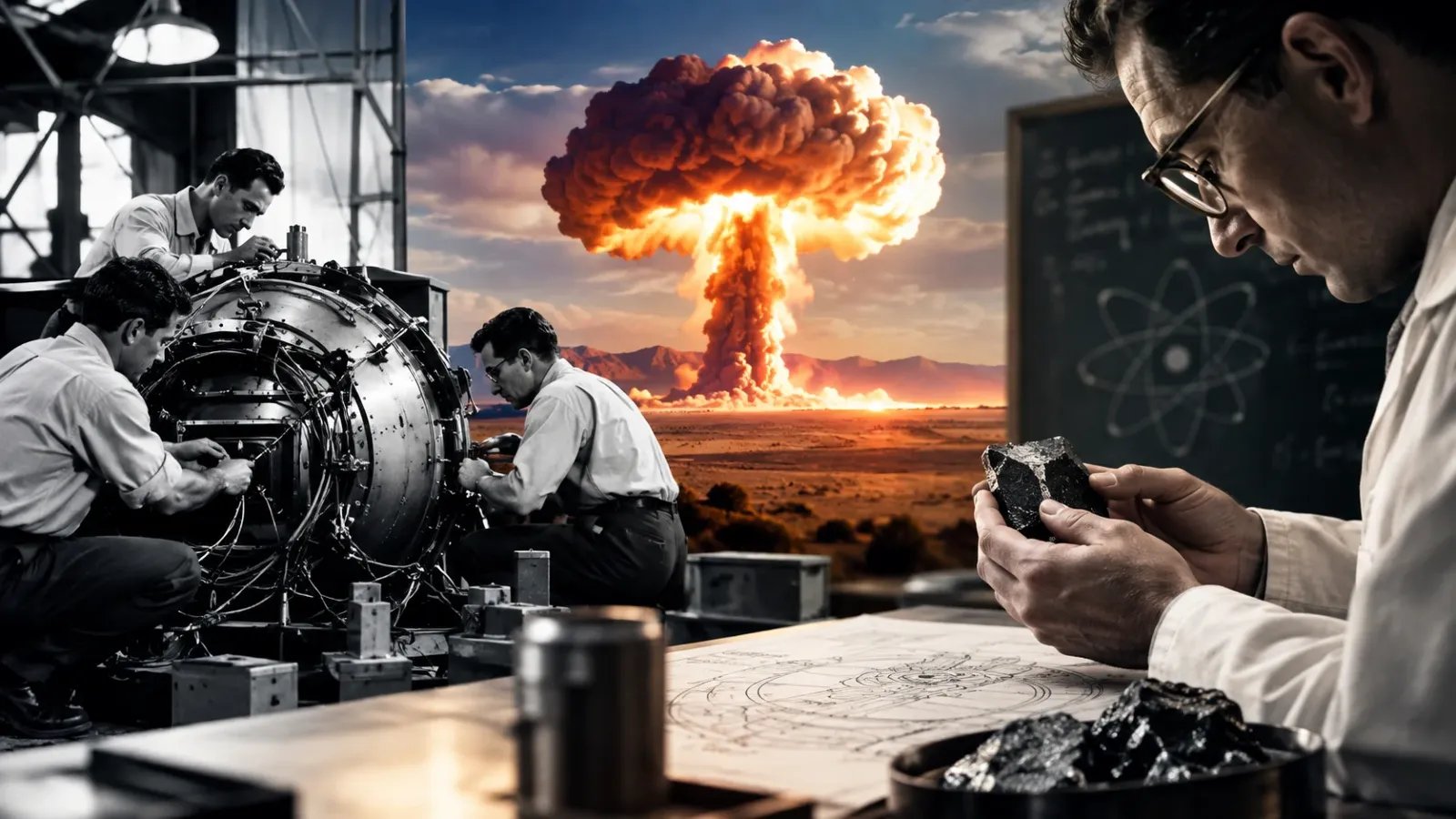
Contrary to the myth of a few isolated geniuses in a desert lab, the Manhattan Project was a sprawling industrial leviathan employing over 130,000 people who rarely knew what they were building. Explore the shadow cities, radioactive espionage, and staggering logistics behind the dawn of the atomic age.
1. The United States Treasury secretly lent the Manhattan Project 14,700 tons of solid silver to build electromagnets because copper was desperately needed for the war effort.
At the Y-12 plant in Oak Ridge, scientists needed massive electromagnets to separate uranium isotopes. With copper heavily restricted for bullet casings and communication wires, engineers approached the Treasury Department for a substitute. They borrowed billions of dollars worth of silver bullion, which was melted, extruded into wire, and coiled into giant magnets. After the war, the project returned the silver, accounting for almost every ounce despite years of heavy industrial use.
2. The overwhelming majority of the 130,000 people who worked on the Manhattan Project had absolutely no idea they were building a weapon of mass destruction until the bombing of Hiroshima.
General Leslie Groves obsessed over security, implementing a strict policy of compartmentalization. Workers were only given the exact fragments of information required to perform their specific tasks. A laundry worker might monitor a dial, or a pipefitter might weld a specific joint, without ever knowing how their work connected to the larger facility. This massive system of blind labor prevented espionage but created an incredibly surreal environment where tens of thousands of Americans built the atomic age in total ignorance.
3. A stray Japanese paper balloon bomb almost caused a catastrophic nuclear meltdown at the secret Hanford plutonium plant in Washington state.
In early 1945, Japan launched thousands of explosive-laden paper balloons into the jet stream, hoping they would strike the American mainland. One of these balloons drifted over the highly classified Hanford site and struck a power line, short-circuiting the electrical grid that supplied the nuclear reactor's cooling pumps. A complete meltdown was only narrowly averted because safety scram systems rapidly engaged and backup generators kicked in, saving the world's first large-scale nuclear reactor from a tragic disaster.
4. The Eastman Kodak Company discovered the existence of the top-secret atomic bomb before the American public because radioactive fallout ruined their unexposed X-ray film.
Shortly after the Trinity test in New Mexico, Kodak noticed that batches of their highly sensitive X-ray film produced in New York were severely fogged and ruined. A company physicist investigated and realized the cardboard packaging was contaminated with a radioactive isotope. The contamination was traced to river water in Indiana used by the paper mill, which had been polluted by a radioactive fallout cloud blowing east from the Trinity site. Kodak figured out the government was testing nuclear weapons, but agreed to keep it quiet in exchange for advanced warnings of future tests.
5. The project necessitated the creation of entire bustling cities in Tennessee, Washington, and New Mexico that were completely erased from official maps and hidden from the public.
To achieve the industrial scale required for atomic research, the government seized massive tracts of land to build Oak Ridge, Hanford, and Los Alamos. These became instant metropolises with their own bowling alleys, theaters, and symphony orchestras, yet they possessed no official existence. Babies born in Los Alamos had their birthplace listed simply as a post office box in Santa Fe, and workers in Oak Ridge were subjected to lie detector tests just for asking questions about the town's perimeter fences.
6. Young women with a high school education proved highly superior to PhD physicists at operating the complex calutrons used to enrich uranium.
At the Oak Ridge facility, managers hired young local women, often dubbed the Calutron Girls, to monitor the dials and switches of the mass spectrometers separating uranium isotopes. The scientists who designed the machines initially believed that only highly educated physicists could understand the nuances of operating them. However, when a competition was held, the young women easily outperformed the scientists because they attentively followed the delicate protocols instead of overthinking and endlessly tweaking the equipment.
 Wars and Conflicts of the 20th Century
Explore the hidden realities of 20th-century warfare and geopolitical conflicts. From world-altering military campaigns and covert intelligence operations to the eccentricities of ruthless dictators, uncover the surprising truths behind the events that shaped the modern world.
See All Facts
Wars and Conflicts of the 20th Century
Explore the hidden realities of 20th-century warfare and geopolitical conflicts. From world-altering military campaigns and covert intelligence operations to the eccentricities of ruthless dictators, uncover the surprising truths behind the events that shaped the modern world.
See All Facts
7. The Manhattan Project was initiated entirely out of the terrifying, yet ultimately false, assumption that Nazi Germany was on the brink of completing an atomic bomb.
The famous 1939 letter drafted by Leo Szilard and signed by Albert Einstein warned President Franklin D. Roosevelt that German physicists had discovered nuclear fission and could develop a weapon of unprecedented power. This fear drove the massive American investment. However, Allied intelligence later discovered that the German nuclear program was severely underfunded, heavily fragmented, and years away from producing a functional weapon, meaning the United States was effectively racing a ghost.
8. The security apparatus was so thoroughly compromised by Soviet spies that Joseph Stalin knew about the successful Trinity test before President Harry Truman did.
Despite the obsessive compartmentalization enforced by military commanders, the Soviet Union deeply infiltrated the Manhattan Project. Spies like Klaus Fuchs, Theodore Hall, and David Greenglass smuggled highly classified schematics of the implosion bomb design directly to Moscow. When Truman casually mentioned a new weapon of unusual destructive force to Stalin at the Potsdam Conference, Stalin acted unfazed because his intelligence network had already briefed him on the inner workings of the plutonium bomb.
9. Scientists at Los Alamos literally gambled on whether the first nuclear explosion would ignite the Earth's atmosphere and destroy all life on the planet.
Prior to the Trinity test, physicist Edward Teller raised a theoretical concern that the immense heat of a nuclear blast could trigger a self-sustaining fusion reaction in the nitrogen of the Earth's atmosphere. Though calculations by J. Robert Oppenheimer and Hans Bethe proved this scenario was effectively impossible, it remained a dark joke among the staff. On the morning of the test, Nobel laureate Enrico Fermi morbidly walked around taking side bets from his colleagues on whether the blast would incinerate just New Mexico or the entire world.
10. To trigger the plutonium bomb, scientists had to invent specialized explosive lenses that bent shockwaves precisely like glass lenses bend light.
The Fat Man bomb design relied on implosion, which required squeezing a core of plutonium equally from all directions to achieve critical mass. Standard explosives would just blow the core apart unevenly. To solve this, scientists developed complex three-dimensional lenses made of alternating fast- and slow-burning conventional explosives. These lenses shaped the expanding detonation waves into a perfectly spherical, inward-moving shockwave, a masterpiece of mathematical and engineering precision that compressed the plutonium into a critical state.
11. The project dispatched a specialized intelligence unit into combat zones across Europe to hunt down German scientists and steal enemy uranium.
Known as the Alsos Mission, this task force operated on the front lines, often advancing ahead of combat troops to secure scientific targets before the Soviets could reach them. Armed with Geiger counters and military intelligence, Alsos agents interrogated captured physicists, dismantled enemy laboratories, and successfully seized hundreds of tons of German uranium ore hidden in salt mines. This aggressive espionage effort ensured the Allies maintained absolute atomic supremacy at the end of the war.
12. The United States government initially dismissed horrific reports of radiation sickness in Japanese survivors as enemy propaganda.
Military leaders, including General Leslie Groves, were primarily focused on the explosive and thermal power of the atomic bombs. The lingering, deadly effects of ionizing radiation on the human body were poorly understood and largely ignored in military planning. When Japanese doctors began reporting that survivors who seemed uninjured were suddenly dying from rapid hair loss, bleeding, and cellular collapse, the American military high command publicly denied the claims, believing it was an orchestrated attempt to garner global sympathy.
13. The heart of the atomic bomb relied on a fragile golf-ball-sized mechanism that had to mix highly reactive elements in exactly one ten-millionth of a second.
A critical mass of nuclear material is not enough to guarantee an explosion; a massive burst of neutrons is required at the exact millisecond of maximum compression. The Manhattan Project invented an urchin initiator containing beryllium and highly radioactive polonium, separated by thin metallic foil. When the bomb's conventional explosives crushed the core, the foil broke, mixing the elements and releasing the flood of neutrons necessary to kickstart the runaway nuclear chain reaction before the bomb could blow itself apart.
14. Scientists routinely performed a highly dangerous, manual procedure known as tickling the dragon's tail by pushing radioactive materials to the very brink of going critical.
To determine exactly how much plutonium was required to achieve a nuclear chain reaction, researchers at Los Alamos conducted experiments where they manually placed neutron-reflecting bricks around a plutonium core. The slightest slip of a hand could trap enough neutrons to trigger a deadly burst of radiation. This terrifyingly casual protocol eventually claimed the lives of two prominent physicists, Harry Daghlian and Louis Slotin, who both suffered fatal radiation poisoning after their screwdrivers slipped during separate experiments on the exact same core.
15. The Manhattan Project cost nearly two billion dollars, but the actual radioactive fuel for the weapons accounted for a minuscule fraction of that expense.
Over ninety percent of the project's staggering two-billion-dollar budget went toward constructing enormous factories and developing the industrial infrastructure needed to manufacture the fissile material. The K-25 gaseous diffusion plant at Oak Ridge was the largest building in the world under one roof at the time. By the time the bombs were dropped, the actual amount of enriched uranium and refined plutonium used in the weapons could fit inside a few small briefcases, representing the most expensive and labor-intensive manufacturing effort in human history.
Sources & References
This AI-assisted post was rigorously curated and fact-checked for accuracy by:
 Martin Roháček
How fun was this article? 🤔
Tap a star to rate it
🧠 Quiz: How closely were you paying attention?
10 questions — all answers are in the article above!
Enjoyed these facts? There's more! 💌
Fresh fun facts in your inbox. No spam, ever.