The Ancient Crossroads: 15 Fascinating Facts About Jerusalem's Old City
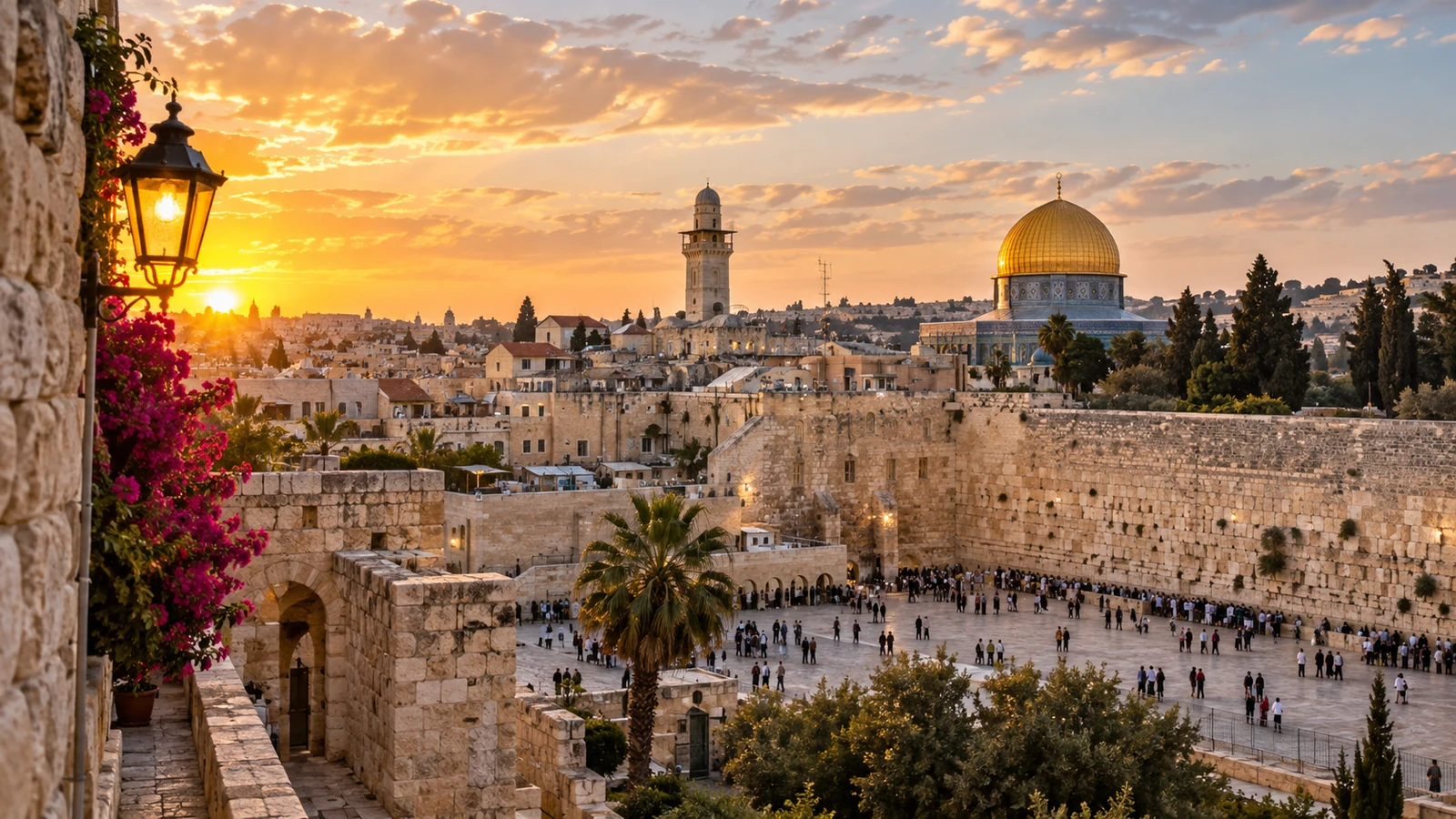
Enclosed within towering walls built during the Ottoman Empire, Jerusalem's Old City packs millennia of concentrated history into an area of less than one square kilometer. Home to sites sacred to Judaism, Christianity, and Islam, this ancient enclave features subterranean tunnels, hidden markets, and architectural layers dating back to antiquity. From ancient megaliths to centuries-old diplomatic stalemates, the stories embedded within these stone streets reveal a complex tapestry of human faith and conflict. Here are 15 fascinating facts about one of the most historically dense urban centers on Earth.
1. The Four Quarters Were Modernized by 19th-Century Mapmakers
Visitors to Jerusalem's Old City often assume the division into Muslim, Christian, Jewish, and Armenian Quarters is an ancient municipal structure. While distinct religious communities resided in separate neighborhoods for centuries, the strict four-quarter grid layout was actually popularized by 19th-century British mapmakers. These cartographers drew rigid boundary lines to make the complex demographic layout understandable to Western audiences. Historically, the borders between these quarters were fluid, with families of various faiths living side by side along shared alleys. Today, the four quarters remain cultural landmarks, each retaining distinct architectural styles, places of worship, and traditions.
2. Ottoman Sultan Suleiman Built the Current Defensive Walls
The impressive stone ramparts that encapsulate the Old City today were constructed between 1535 and 1542 by order of Sultan Suleiman the Magnificent. After the Ottoman Empire conquered the city, Suleiman ordered a complete restoration of its fortification system to protect against potential European crusades. The Ottoman masons cleverly incorporated older building materials into the walls, including heavy stones from Roman, Byzantine, and Crusader structures. The wall stretches for approximately 2.5 miles, rising to an average height of 40 feet with 34 watchtowers. According to popular urban legend, Suleiman executed his chief architects after they accidentally left Mount Zion outside the city's perimeter.
3. The Sealed Golden Gate Has Stood Closed for Centuries
On the eastern wall facing the Mount of Olives sits the Golden Gate, also known as Bab al-Rahma or the Gate of Mercy. It is the oldest of all the gates leading into the Temple Mount enclave, likely constructed during the late Byzantine or early Umayyad periods. Ottoman authorities officially sealed the double-arched gateway with heavy masonry in 1541 to prevent unauthorized entry and fortify the city. Jewish tradition holds that the Messiah will enter Jerusalem through this specific portal, while Christian tradition links it to Jesus's Palm Sunday entrance. To deter messianic claims, an Islamic cemetery was established directly in front of the gate during the Ottoman era.
4. King Herod's Engineering Feats Anchor the Western Wall
The iconic Western Wall was not part of the Second Temple building itself, but rather a retaining wall constructed during King Herod's grand expansion of the Temple Mount around 20 BCE. Herod's master engineers carved massive limestone blocks, known as ashlar masonry, without using mortar to keep them in place. The largest of these stones, situated in the underground continuation of the wall, is known as the Western Stone. Weighing an estimated 570 tons, it stands as one of the heaviest construction blocks ever lifted by humans in antiquity. The precision of Herod's stonemasons allowed these massive monoliths to stay perfectly aligned for over two millennia despite frequent seismic activity.
5. A Subterranean World Exists Beneath the Stone Streets
Far below the busy street bazaars of the Old City lies an expansive network of hidden tunnels, aqueducts, and ancient quarries. Archaeological excavations beneath the Western Wall Plaza have uncovered underground passages dating back to the Second Temple period and earlier. Explorers can walk along original Roman paving stones, view ancient subterranean ritual baths, and see water systems engineered during the reign of King Hezekiah. Among these discoveries is the Warren's Gate shaft, which once served as a primary underground entrance toward the ancient temple complex. These excavations continue to yield artifacts that reframe historical understanding of ancient urban life.
6. Science Dispelled the Myth of the 2,000-Year-Old Olive Trees
Adjacent to the Old City on the slopes of the Mount of Olives lies the famous Garden of Gethsemane, long rumored to hold olive trees present during biblical events. However, modern scientific analysis conducted by the Italian National Research Council provided a more nuanced reality. Radiocarbon dating of tree trunk samples revealed that the oldest standing olive trees date back to the 12th century CE. Genetic testing proved that all eight ancient trees share identical DNA, indicating they were grown from cuttings taken from a single parent tree during the Crusader era. Despite not dating back to antiquity, these trees remain among the oldest known cultivated olive trees in existence.
7. The Byzantine Cardo Was Once a Bustling Roman-Style Highway
During the 6th century CE, Emperor Justinian transformed Jerusalem by expanding the Cardo Maximus, a grand North-South colonnaded thoroughfare. This ancient boulevard cut directly through the center of the city, lined with massive limestone pillars, covered marble walkways, and luxury shops. The street was so central to ancient life that it was featured prominently in the famous 6th-century Madaba Mosaic Map discovered in Jordan. Excavated after 1967, a restored section of the Cardo in the Jewish Quarter allows modern visitors to walk on original Roman-Byzantine flagstones. Today, replica shop vaults along the ancient street host modern art galleries and jewelry boutiques.
8. The Oldest Standing Church Hides Inside the Christian Quarter
While the Church of the Holy Sepulchre draws the vast majority of visitors, the Church of Saint John the Baptist claims the title of the oldest standing church in the Old City. Tucked away behind modern buildings, its subterranean crypt dates back to the 5th century Byzantine era. Crusaders restored and expanded the church in the 11th century, using it as a headquarters for the Knights Hospitaller, an order founded to care for sick pilgrims. The original lower level features ancient Byzantine plaster work and stone masonry preserved beneath the medieval upper sanctuary. It remains an active place of Greek Orthodox worship tucked within the crowded market streets.
9. The Little Western Wall Offers an Intimate Prayer Space
Located deep within the alleys of the Muslim Quarter near the Iron Gate, the Kotel Katan or Little Western Wall is a lesser-known extension of the ancient retaining wall. Because it stands closer to the historical site of the Holy of Holies than the main plaza, many consider it exceptionally sacred. Unlike the primary Western Wall Plaza, this small exposed section of Herodian stone does not feature a divider separating men and women during prayer. It retains the narrow, secluded atmosphere of Jerusalem's historical alleyways before the creation of the large public plaza in 1967. Small prayer notes are frequently placed within the limestone crevices of this tucked-away site.
10. The New Gate Was Created to Accommodate 19th-Century Tourism
Despite its historic appearance, the New Gate was added centuries after the original Ottoman wall project was completed. Constructed in 1889 during the reign of Sultan Abdul Hamid II, it was designed to provide easy access between external pilgrim hospices and the Christian Quarter inside. European powers, particularly the French, pressured the Ottoman administration to breach the wall so visitors would not need to travel around to the distant Jaffa Gate. The gate features Ottoman stone molding meant to blend seamlessly with 16th-century masonry while accommodating modern foot traffic. It remains the newest structural entry point built into Jerusalem's ancient defensive perimeter.
11. The Mount of Olives Houses the World's Oldest Active Jewish Cemetery
Rising directly east of the Old City across the Kidron Valley, the Mount of Olives contains a necropolis that has been in continuous use for over 3,000 years. The hillside is covered with an estimated 150,000 graves, including those of biblical prophets, historic rabbis, and notable political figures. Jewish tradition teaches that when the resurrection of the dead begins, those buried on the Mount of Olives will be the first to return to life. Because of this spiritual significance, burial plots on the mountain have been prized for millennia. The vast field of white limestone tombs creates one of the most recognizable landscapes surrounding the Old City walls.
12. The Dung Gate Was Originally Designed for Waste Removal
Situated at the southern edge of the Old City, the Dung Gate (Bab al-Maghariba) has one of the most unusual names of any city entrance. Mentioned in the biblical Book of Nehemiah, the original site of this gate was where ancient inhabitants carried city refuse out into the Tyropoeon Valley for burning. During the Ottoman period, it was a tiny archway barely wide enough for a single pack animal to transport waste outside the walls. In the 20th century, Jordanian authorities widened the structure to allow vehicular traffic to access the historical quarters. Today, despite its unglamorous historical origin, it serves as the primary access gate for buses visiting the Western Wall Plaza.
13. Subterranean Excavations Uncovered Herodian Mansions
Following the 1967 war, extensive archaeological work conducted beneath destroyed buildings in the Jewish Quarter revealed opulent ancient estates. Located in what is now the Wohl Archaeological Museum, these Herodian-era mansions once belonged to wealthy aristocratic and priestly families living before 70 CE. Excavations exposed remarkably preserved mosaic floors, elaborate fresco walls, and private ritual bath houses known as mikvaot. Archaeologists also discovered charred wooden beams and scorched stones that provide direct physical evidence of the Roman destruction of Jerusalem under Titus. These subterranean ruins allow visitors to step into the exact living spaces of antiquity.
14. The Armenian Quarter Functions as an Autonomous Enclave
Occupying the southwestern corner of the Old City, the Armenian Quarter is the smallest of the four sectors, housing a self-contained community. Armenia became the first nation to adopt Christianity as its state religion in 301 CE, establishing a continuous presence in Jerusalem shortly thereafter. The quarter revolves around the St. James Monastery, an expansive compound that functions almost like a fortified village with its own school, museum, and residential housing. Behind locked gates that were historically closed at sunset, the Armenian Patriarchate maintains autonomous administrative traditions. This tiny enclave has preserved its unique language, distinct ceramic arts, and religious heritage for over 1,700 years.
15. An Immovable Ladder Highlights the Delicate Status Quo
The Church of the Holy Sepulchre is managed under a strict diplomatic arrangement known as the Status Quo, formalized by Ottoman decree in 1852. Six Christian denominations share ownership of the shrine, and no single property or physical object can be altered without unanimous consent. A prominent symbol of this delicate compromise is the Immovable Ladder, a simple wooden ladder resting on a ledge above the main entrance. Placed there by a stonemason prior to 1757, it cannot be moved because no group has the authority to claim ownership of that specific window ledge. The ladder has remained in nearly the exact same spot for over two centuries as a testament to historical diplomacy.
Sources & References
This AI-assisted post was rigorously curated and fact-checked for accuracy by:
 Martin Roháček
How fun was this article? 🤔
Tap a star to rate it
Enjoyed these facts? There's more! 💌
Fresh fun facts in your inbox. No spam, ever.