The Heavy Metal Gods: 15 Fascinating Facts About Judas Priest
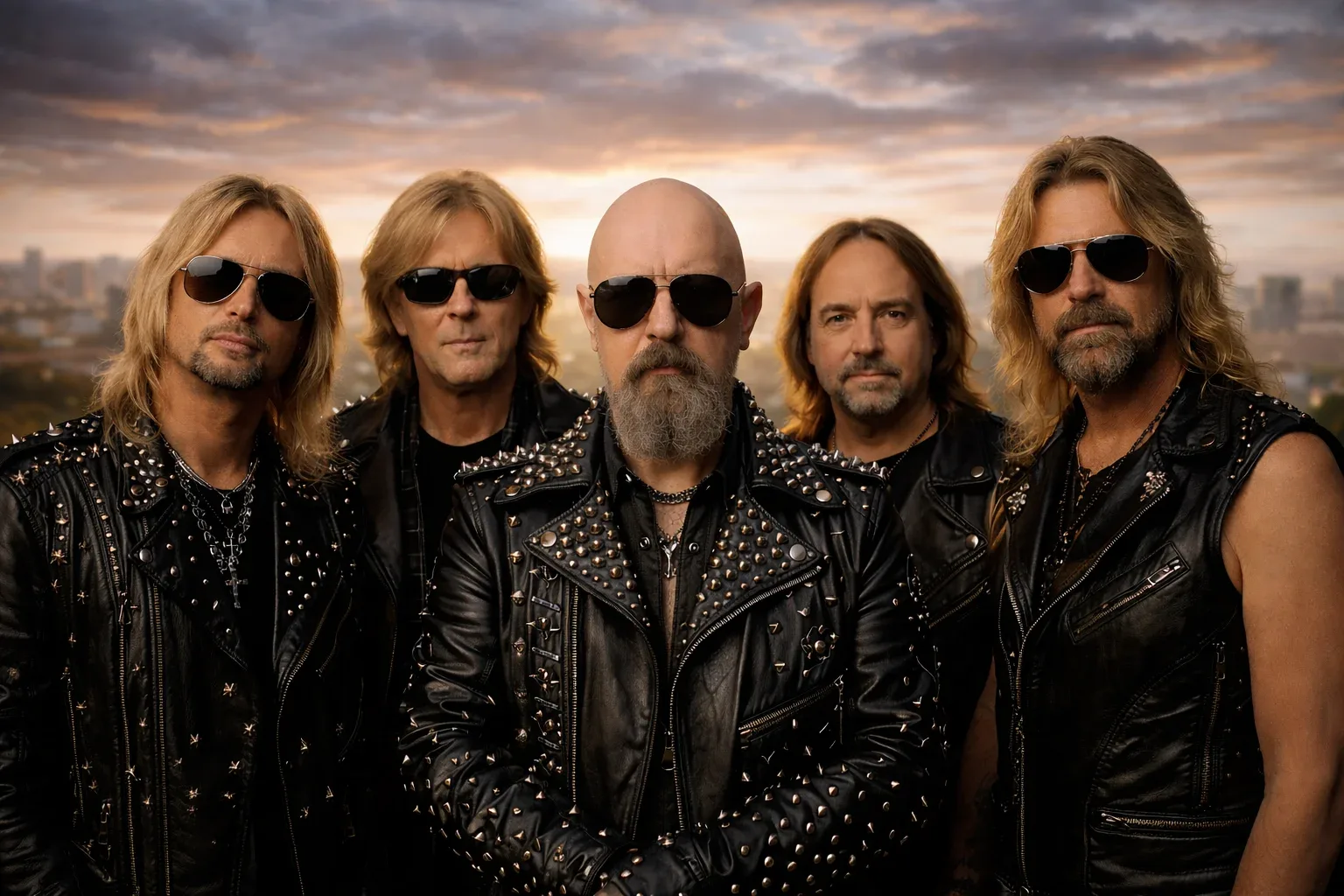
Formed in the industrial heartland of England, Judas Priest redefined heavy metal sound and aesthetic culture for generations. From pioneering the iconic leather-and-studs look to surviving high-profile legal battles and unreleased pop collaborations, the band's history is filled with unbelievable twists. Here are 15 fascinating facts about the legendary Metal Gods that every music fan should know.
1. None of the Original Founding Members Recorded a Single Album
Judas Priest was originally formed in West Bromwich, England, in 1969 by vocalist Al Atkins, bassist Bruno Stapenhill, guitarist John Partridge, and drummer John Ellis. However, this original incarnation disbanded in 1970 without ever recording a proper studio album. When Atkins subsequently joined forces with a new group featuring guitarist K.K. Downing and bassist Ian Hill, he brought the name Judas Priest along with him. Rob Halford eventually replaced Atkins on vocals in 1973, bringing his sister's boyfriend Glenn Tipton along shortly thereafter as a second guitarist. As a result, none of the musical pioneers who initially founded the band ever appeared on any of Judas Priest's classic studio recordings. This unusual turnover makes Ian Hill the sole continuous member involved across the band's entire official discography.
2. The Band’s Name Was Inspired by a Bob Dylan Song
Heavy metal pioneers are rarely associated with folk-rock acoustic troubadours, but Judas Priest owes its moniker directly to Bob Dylan. Original bassist Bruno Stapenhill suggested the name in 1969 after listening to Dylan’s 1967 album John Wesley Harding. Specifically, the name comes from the narrative song 'The Ballad of Frankie Lee and Judas Priest,' which tells an allegorical tale of temptation and downfall. Though the dark and ominous phrase sounded tailor-made for a hard-rock group, Dylan's acoustic storytelling was the actual catalyst. The band members instantly fell in love with the dramatic ring of the words, adopting it long before they developed their signature heavy metal sound. Decades later, Dylan’s subtle literary influence remains firmly embedded in the annals of heavy metal history.
3. Rob Halford Was a Cinema Projectionist Before Becoming the Metal God
Before commanding stadium audiences as heavy metal's iconic 'Metal God,' Rob Halford led a remarkably modest life in the English West Midlands. In his early twenties, Halford worked as a projectionist at a local cinema in Wolverhampton while trying to launch his singing career. Operating heavy reel-to-reel film projectors taught him discipline and gave him a front-row seat to theatrical storytelling and dramatic presentation. He spent long shifts in quiet projection booths dreaming of performing on global stages. When Ian Hill—who was dating Halford’s sister Sue at the time—learned that Halford sang, he invited him to audition for Judas Priest. Halford quit his day job at the cinema shortly after joining, forever trading movie screens for blistering guitar riffs and pyrotechnics.
4. They Transformed a Joan Baez Folk Track into a Heavy Metal Anthem
In 1977, Judas Priest made the surprising choice to record a cover of 'Diamonds & Rust,' a deeply personal folk song written by Joan Baez about her past relationship with Bob Dylan. Their record label originally suggested the idea, hoping a recognizable song would boost the band's commercial prospects. Rather than playing it straight, the group dramatically rearranged the ballad into a thunderous twin-guitar masterpiece featuring blistering tempos and operatic vocals. Joan Baez herself reportedly loved the aggressive transformation and praised the band for breathing new life into her composition. The track became a staple of Judas Priest’s live setlists for decades and proved that heavy metal could reinterpret delicate acoustic music with astonishing power. This bold experiment firmly established the band's willingness to cross genre boundaries early in their career.
5. Rob Halford Defined Metal Fashion via London Fetish Shops
Before Judas Priest popularized dark leather, studs, chains, and whips in the late 1970s, heavy metal musicians primarily wore denim, satin, and bell-bottom jeans. Seeking a striking and dangerous image to match their heavy music around the release of 1978's Hell Bent for Leather, Rob Halford ventured into adult boutiques and S&M shops in London's Soho district. Halford purchased biker jackets, studded collars, leather caps, and metal belts that were originally manufactured for the fetish subculture. When he walked onstage wearing the full leather-and-studs attire, the rest of the band instantly recognized its visceral theatrical impact and adopted the look. What began as Halford's daring personal style quickly became the global uniform for heavy metal fans and artists worldwide.
6. They Recorded an Unreleased Album with 80s Pop Hitmakers Stock Aitken Waterman
In 1988, Judas Priest took an extremely controversial artistic detour by entering the studio with Stock Aitken Waterman, the British production trio responsible for pop mega-hits by Rick Astley and Kylie Minogue. The band spent several days in Paris recording three tracks with the hitmaking team, including an original song titled 'Runaround' and a cover of The Stylistics' 'You Are Everything.' The unexpected collaboration generated massive speculation and anxiety among purist metal fans who feared the group was selling out. Although both parties reported enjoying the recording process, Judas Priest ultimately decided against placing the pop-influenced tracks on their Ram It Down album. To this day, the recorded tracks remain locked deep in the band’s vaults, highly coveted by rare music collectors and die-hard fans alike.
7. Judas Priest Faced an Infamous Subliminal Message Court Trial
In 1990, Judas Priest became embroiled in one of the most publicized legal battles in music history when they were sued in Reno, Nevada. The civil lawsuit alleged that the band hid subliminal messages—specifically the phrase 'do it'—in their 1978 cover of Spooky Tooth's 'Better By You, Better Than Me.' Plaintiffs claimed these hidden commands induced two young fans, James Vance and Ray Belknap, into a tragic 1985 suicide pact. During the six-week trial, Rob Halford took the witness stand and masterfully demonstrated that arbitrary sounds could be misinterpreted when played in reverse. Halford even played backwards recordings of other songs to show that random audio artifacts frequently resemble words. The judge ultimately dismissed the case, ruling that the alleged audio cues were unintentional coincidences rather than sinister subliminal messages.
8. Guitarist Glenn Tipton Began His Musical Journey on the Piano
While Glenn Tipton is revered as one of heavy metal's quintessential lead guitar architects, his musical foundation was built on a far more delicate instrument. Tipton was raised in a musical household and began playing the piano at age five under his mother's strict classical instruction. He spent his childhood mastering complex classical arrangements before ever laying hands on an electric guitar in his late teens. Tipton has repeatedly cited his early classical piano training as the secret weapon behind his sophisticated songwriting and intricate arpeggios. That classical backing directly inspired Judas Priest's trademark harmonized guitar solos alongside fellow guitarist K.K. Downing. Without those early years at the piano keys, heavy metal's iconic dual-guitar assault might have developed quite differently.
9. Scott Travis Was Recruited from the Shred-Metal Outfit Racer X
When Judas Priest needed a powerhouse drummer to reinvigorate their sound in the late 1980s, they turned to American musician Scott Travis. Prior to joining the band in 1989, Travis gained fame in the Los Angeles speed-metal scene alongside virtuoso guitarist Paul Gilbert in the band Racer X. Known for his blistering double-bass technique and relentless precision, Travis immediately transformed Judas Priest's rhythm section. His legendary drum intro on the title track of the 1990 album Painkiller remains one of the most famous drum openings in heavy metal history. Travis was also notably the first American member to join the historically British group. His explosive arrival injected a modern technical intensity that redefined Judas Priest for a new decade.
10. A Stage Fog Motorcycle Mishap Knocked Halford Unconscious
Rob Halford's signature concert entrance involved riding a massive Harley-Davidson motorcycle onto the stage, but the tradition once ended in serious injury. During the final show of the 1991 Operation Rock & Roll tour in Toronto, heavy stage fog completely obscured Halford's line of sight. As he drove onto the stage, the motorcycle hit a hidden drum riser, throwing Halford forward into the equipment. The crash knocked him unconscious and fractured his nose before the band had even played a single note. Despite the severe impact and heavy bleeding, Halford regained consciousness, completed the full concert set, and only then went to the hospital. The traumatic incident contributed to Halford's temporary departure from the band shortly after the tour concluded.
11. K.K. Downing Built an Exclusive Golf Resort on His English Estate
Founding guitarist K.K. Downing turned a personal passion into an ambitious real estate project by transforming his 320-acre estate into a luxury golf destination. Located in Shropshire, England, Astbury Hall featured a championship 18-hole golf course designed to meet international tournament standards. Downing spent millions of pounds developing the pristine property as a serene sanctuary from decades of loud touring and heavy metal music. He frequently hosted corporate events and charity tournaments, taking immense pride in the meticulous upkeep of the lush greens. Unfortunately, due to financial complications and difficult economic conditions, the estate went into administration in 2017 and was subsequently sold. Nevertheless, Downing’s second career as a high-end golf course designer remains one of the most surprising chapters in metal history.
12. They Performed at Live Aid in 1985 Alongside Pop Royalty
On July 13, 1985, Judas Priest brought uncompromising heavy metal to the global stage during the historic Live Aid benefit concert. Performing at JFK Stadium in Philadelphia, Pennsylvania, they played a scorching three-song set that included 'Living After Midnight,' 'The Green Manalishi,' and 'You've Got Another Thing Comin'.' Amidst an eclectic lineup dominated by pop, rock, and soul icons, Judas Priest proudly represented the hard-rock community before an audience of nearly 100,000 live spectators and billions watching on television. Their high-energy performance proved that heavy metal could captivate a massive mainstream global television audience without sacrificing its power. The appearance substantially elevated the band's profile across North America and cemented their status as international cultural ambassadors for the genre.
13. The Hellion Set the Standard for Iconic Heavy Metal Album Mascots
Heavy metal is famous for terrifying visual mascots, and Judas Priest introduced one of the genre's most enduring figures with 'The Hellion.' Created by artist Doug Johnson for the cover of the 1982 album Screaming for Vengeance, the metallic bird of prey symbolized speed, power, and high-tech aggression. The artwork coincided with the album's opening instrumental track, also titled 'The Hellion,' which seamlessly kicked off their breakthrough hit 'Electric Eye.' Johnson followed up two years later by designing 'The Metallian' for the Defenders of the Faith album cover, further solidifying the band's sci-fi aesthetic. These metallic mechanical beasts set a dramatic visual tone that defined 1980s metal album art and became central features of the band's massive stage props.
14. Poverty and Day Jobs Plagued Their Earliest Years
Despite signing record deals in the mid-1970s, the members of Judas Priest spent years living in near-poverty while attempting to build their career. Their original record label, Gull Records, provided such tiny financial advances that band members struggled to pay basic rent and buy food. To survive between tours, the musicians were forced to take mundane odd jobs across the West Midlands. Guitarist K.K. Downing worked as a chef in a local hotel kitchen, while bassist Ian Hill worked as a driver. Rob Halford frequently relied on financial help from family and took part-time retail shifts to keep his finances afloat. It was not until they signed with major label CBS Records in 1977 that they earned enough income to quit their day jobs and focus entirely on music.
15. They Won Their First Grammy Decades After Defining Heavy Metal
Despite pioneering heavy metal sound and style for four decades, Judas Priest had to wait until 2010 to win their very first Grammy Award. The Recording Academy awarded them the Grammy for Best Metal Performance for a live recording of their classic track 'Dissident Aggressor' from the album A Touch of Evil: Live. The song had originally appeared on their 1977 studio album Sin After Sin, making the win an unusual tribute to a track written thirty-three years earlier. Band members expressed immense gratitude during their acceptance speech, viewing the award as a validation of heavy metal's enduring legacy. The honor capped off an extraordinary career arc, proving that their pioneer heavy sound remained potent across generations.
Sources & References
This AI-assisted post was rigorously curated and fact-checked for accuracy by:
 Martin Roháček
How fun was this article? 🤔
Tap a star to rate it
🧠 Quiz: How closely were you paying attention?
10 questions — all answers are in the article above!
Enjoyed these facts? There's more! 💌
Fresh fun facts in your inbox. No spam, ever.