Vanished Without a Trace: 15 Fascinating Facts About the Lost Colony of Roanoke
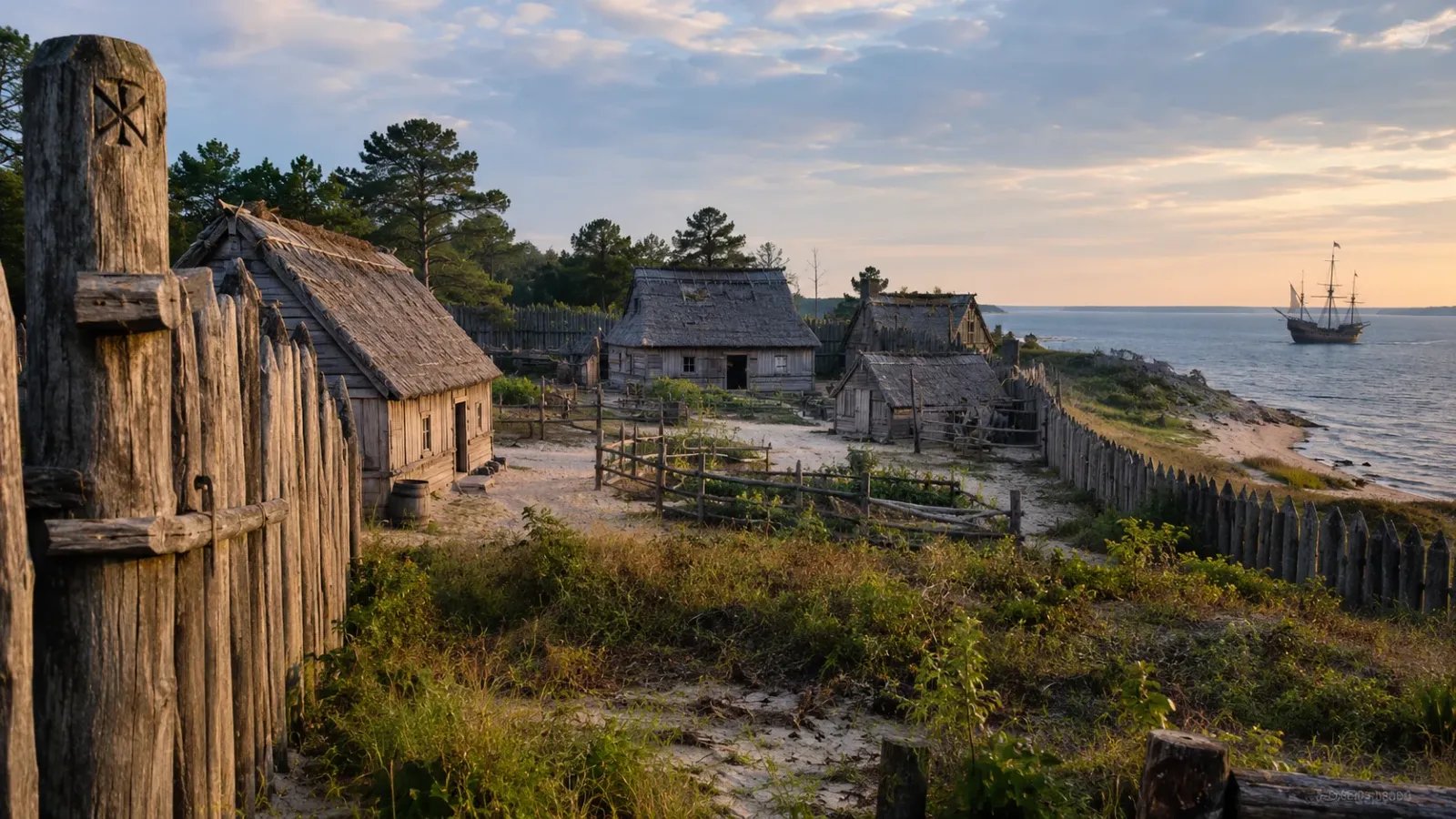
In 1590, Governor John White finally returned to Roanoke Island to find the English colony he had left behind gone, with only a single word carved into a post. Behind America's oldest unsolved mystery lies a story of a war at sea, a fateful storm, a once-in-800-years drought and new archaeological clues that may finally point to the colonists' fate.
1. Roanoke had already lost settlers before the Lost Colony.
The famous 1587 colony was actually England's second attempt to settle Roanoke Island, in what is now North Carolina. A military expedition sponsored by Sir Walter Raleigh arrived in 1585, but after clashes with local Native Americans and food shortages, the men sailed home with Sir Francis Drake in 1586. A small garrison of about 15 men left behind soon afterward also vanished. When the 1587 colonists arrived, they found only the bones of one of them.
2. The colonists were never supposed to stay on Roanoke Island.
The 1587 settlers were meant to found a new colony on the Chesapeake Bay, which offered better land and deeper harbors. They stopped at Roanoke only to check on the earlier garrison. The fleet's pilot, Simon Fernandes, then refused to take them any farther, leaving them on an island with poor soil and a hostile neighborhood.
3. The first English child born in the Americas was one of the lost.
About 115 men, women and children sailed with the 1587 expedition. On August 18, 1587, shortly after their arrival, Eleanor Dare gave birth to a daughter, Virginia, the first English child born in the Americas. Her grandfather was the colony's governor, John White. Virginia Dare later became an American folk heroine, and her name appears on everything from counties to wine labels.
4. The governor was also a gifted artist.
John White first came to Roanoke in 1585 as the expedition's artist and mapmaker. His watercolors of Algonquian villages, people, fish and plants are among the earliest and most detailed images of North America made by an English visitor. The originals are now held at the British Museum in London.
5. The Spanish Armada kept help from arriving for three years.
Within weeks of landing, the colonists persuaded White to sail back to England for supplies. He arrived just as England was bracing for an invasion by the Spanish Armada, and the government kept large ships at home for the country's defense. White's attempt to return in 1588 with two small ships ended when his vessel was attacked by French pirates and forced back to England.
6. White came back on his granddaughter's third birthday.
White finally reached Roanoke Island on August 18, 1590, Virginia Dare's third birthday. The settlement was deserted. The letters "CRO" were carved into a tree, and the word "CROATOAN" was carved into a post at the entrance of the fort. Before leaving, White had told the colonists to carve their destination if they moved, and to add a Maltese cross if they left in distress. There was no cross.
7. The colonists left in an orderly way.
Contrary to the popular image of a village abandoned mid-meal, White found that the houses had been taken down and the area surrounded by a sturdy palisade. Some chests, including three of his own, had been dug up and broken open, and his books, maps and armor lay ruined. The scene suggested a planned departure rather than a sudden attack.
8. A storm stopped White from following them.
Croatoan was the name of an island about 50 miles (80 kilometers) to the south, home to people who had been friendly to the English. White planned to sail there next, but stormy weather broke the ship's anchor cables, and with supplies running low, the captain decided to head back across the Atlantic. White never returned to America, and he never learned what happened to his daughter and granddaughter.
9. A Native American ally was made an English lord.
Manteo, a Croatoan man who had traveled to England in 1584, served the colonists as an interpreter and guide. In August 1587, on Raleigh's orders, he was baptized into the Church of England and named Lord of Roanoke and Dasamongueponke. It is the first recorded Protestant baptism of a Native American in what is now the United States.
10. Sir Walter Raleigh never set foot in North America.
Raleigh organized and financed the Roanoke voyages, and North Carolina's capital is named after him, but he never visited the colony. He later led an expedition to South America in search of the legendary city of El Dorado. He was executed in London in 1618.
11. The colonists arrived during the worst drought in 800 years.
In 1998, scientists studied the growth rings of ancient bald cypress trees in the region. They found that 1587 to 1589 was the driest period in eight centuries. The drought would have ruined crops, made fresh water scarce and left local Native American communities with little food to share, which made the colonists' situation far more desperate.
12. A hidden symbol on an old map pointed to a new clue.
In 2012, researchers at the British Museum examined a map drawn by John White and discovered that a small paper patch concealed a symbol of a fort, about 50 miles inland at the head of Albemarle Sound. Archaeologists have since dug at the site, nicknamed Site X, in Bertie County and found English pottery fragments that may have belonged to some of the colonists.
13. Archaeologists have found 16th-century English objects on Hatteras Island.
Excavations at a former Native American town on Hatteras Island, which was once part of Croatoan, have uncovered items such as a sword hilt, a gun barrel, a slate writing tablet and a gold ring. In 1709, the English explorer John Lawson wrote that some Hatteras Indians had gray eyes and said several of their ancestors were white people who could "talk in a book."
14. The massacre theory rests on a single secondhand account.
One theory says the colonists moved north to the Chesapeake Bay and were killed by the Powhatan chiefdom shortly before Jamestown was founded in 1607. It comes mainly from the writings of William Strachey, a Jamestown colonist who reported what he had been told about the killings. No archaeological evidence has been found to confirm it, and many historians treat it with caution.
15. The mystery has been performed on stage since 1937.
Every summer since 1937, except during World War II and the pandemic, the outdoor drama The Lost Colony has been staged on Roanoke Island, making it one of the longest-running outdoor dramas in America. President Franklin D. Roosevelt attended a performance in its first season, and a young Andy Griffith played Sir Walter Raleigh there in the 1940s.
Sources & References
This AI-assisted post was rigorously curated and fact-checked for accuracy by:
 Martin Roháček
How fun was this article? 🤔
Tap a star to rate it
🧠 Quiz: How closely were you paying attention?
10 questions — all answers are in the article above!
Enjoyed these facts? There's more! 💌
Fresh fun facts in your inbox. No spam, ever.