The Reluctant Genius: 15 Fascinating Facts About Michelangelo
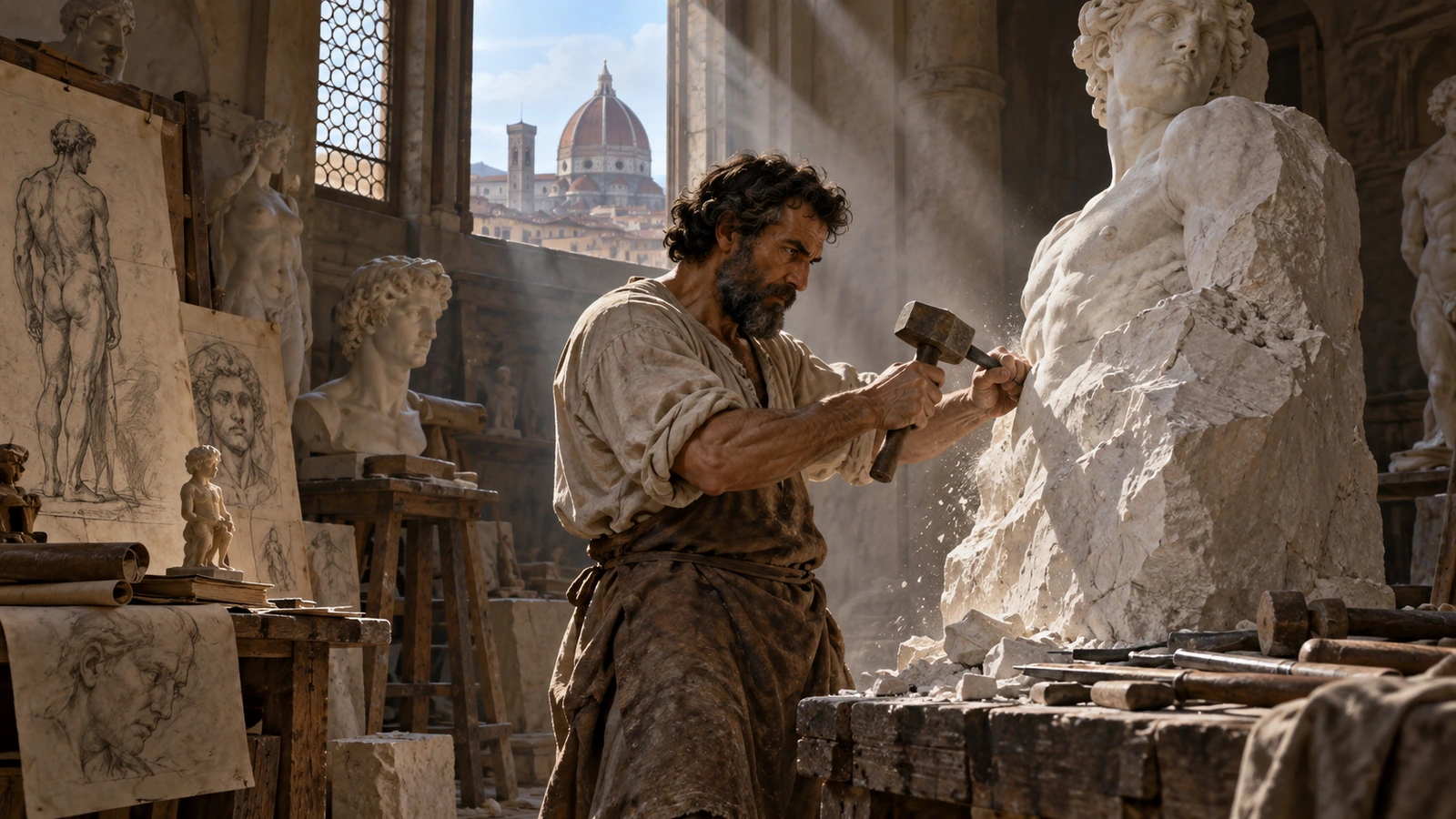
Michelangelo Buonarroti remains one of the most celebrated figures in art history, renowned for timeless masterpieces like the statue of David and the Sistine Chapel ceiling. Yet behind his divine skill lay a fiercely competitive, hygiene-averse, and tormented genius who sculpted snowmen, forged antiquities, and feuded with Leonardo da Vinci. From hidden self-portraits to secret military fortifications, his long life was packed with shocking eccentricities and incredible achievements. Discover 15 fascinating facts about the Renaissance master who reshaped Western art forever.
1. A Rival Artist Permanently Flattened His Nose
During his early artistic studies at the Medici academy in Florence, a young Michelangelo possessed an abrasive temperament that frequently infuriated his peers. While studying frescoes in the Brancacci Chapel, Michelangelo provoked fellow student Pietro Torrigiano with scathing insults about his drawing skills. Enraged by the disrespect, Torrigiano struck him across the bridge of his nose with a crushing blow. Torrigiano later boasted that he felt the bone and cartilage yield beneath his fist like dough. Michelangelo survived the attack, but the brutal blow left his face permanently disfigured with a flattened, crooked nose for the rest of his life.
2. He Began His Career as an Art Forger
Long before he became the undisputed master of the Renaissance, Michelangelo launched his career with a cunning act of deception. In 1496, the twenty-one-year-old sculptor carved a marble statue titled Sleeping Cupid and intentionally treated it with acidic earth to make it look ancient. He sold the fake antiquity to a dealer, who then resold it to Cardinal Raffaele Riario in Rome for a massive sum. When Cardinal Riario discovered the trickery, he demanded a full refund from the merchant. However, the cardinal was so astonished by the sculptor's extraordinary craftsmanship that he invited Michelangelo to Rome, effectively launching his legendary career.
3. He Signed Only One Artwork in His Entire Career
Michelangelo believed that true masterpieces should speak for themselves without the need for an artist's mark. However, he made one famous exception for his majestic Pietà, carved when he was just twenty-four years old. Shortly after the sculpture was unveiled in Saint Peter's Basilica, Michelangelo overheard a group of visitors attributing the breathtaking masterpiece to a rival Milanese sculptor named Cristoforo Solari. Overcome with fury and pride, Michelangelo broke into the church that night with a hammer and chisel. He carved the inscription "Michelangelo Buonarroti, Florentine, made this" across the sash resting on the Virgin Mary's chest.
4. The Marble Block for David Was Abandoned as Damaged Goods
The gigantic piece of Carrara marble used to create David sat neglected in the yard of Florence Cathedral for nearly forty years before Michelangelo touched it. Quarried decades earlier, the stone had been assigned to sculptors Agostino di Duccio and Antonio Rossellino, both of whom abandoned the project due to severe structural flaws and narrow dimensions. Many artists in Florence declared the stone ruined, believing it was impossible to carve a full figure from such a damaged block. Undeterred by its imperfections, Michelangelo took on the challenge in 1501 and labored for over two years to free his masterpiece. Today, the statue stands as an enduring symbol of human perfection carved from a piece of discarded rubble.
5. He Hated Painting the Sistine Chapel Ceiling
Although the Sistine Chapel ceiling is celebrated as one of humanity's greatest artistic achievements, Michelangelo genuinely despised working on it. Pope Julius II essentially forced the master sculptor to accept the painting commission, which Michelangelo felt was beneath his talents as a master of marble. Over four grueling years, he worked in cramped, agonizing positions atop tall wooden scaffolding, constantly enduring dripping paint and blinding dust. To vent his frustration, he penned a bitter poem to a friend describing how the labor gave him a goiter and turned his spine into a bow. He famously lamented that he was in the wrong place and was "not a painter."
6. He Concealed a Gruesome Self-Portrait in the Sistine Chapel
Decades after finishing the Sistine Chapel ceiling, Michelangelo returned to paint The Last Judgment on the altar wall between 1536 and 1541. Tucked within this colossal depiction of divine wrath lies one of the artist's most unsettling personal signatures. Near the center of the fresco, Saint Bartholomew holds an instrument of martyrdom along with his own flayed skin. Upon close inspection, the ghastly, hollow face hanging from the dangling skin is a hideous self-portrait of Michelangelo himself. Scholars speculate that this bizarre detail reflected his intense feelings of spiritual exhaustion, suffering, and personal torment during his later years.
 Painters and Visual Artists
Explore the fascinating lives and enduring legacies of history's greatest visual artists. From Renaissance polymaths to modern revolutionaries, uncover the eccentricities, rivalries, and brilliance behind the world's most famous canvases.
See All Facts
Painters and Visual Artists
Explore the fascinating lives and enduring legacies of history's greatest visual artists. From Renaissance polymaths to modern revolutionaries, uncover the eccentricities, rivalries, and brilliance behind the world's most famous canvases.
See All Facts
7. He Maintained a Bitter Rivalry with Leonardo da Vinci
Renaissance Florence was not big enough for both Michelangelo and Leonardo da Vinci, who harbored an intense mutual dislike for one another. The two titans were total opposites in personal style and artistic philosophy; Leonardo was a suave, well-groomed aristocrat, while Michelangelo was scruffy, ill-tempered, and solitary. Historical accounts recall public arguments between them in the streets of Florence, where they hurled vicious insults regarding each other's unfinished projects. On one famous occasion, Michelangelo publicly mocked Leonardo for his inability to complete a bronze horse sculpture, leaving the older master deeply humiliated. Their rivalry reached a climax when the Florentine government set up a direct competition by commissioning both men to paint opposing battle frescoes in the Palazzo Vecchio.
8. He Once Carved a Magnificent Snowman for a Ruler
During an extraordinarily harsh winter in January 1494, a heavy blizzard blanketed the city of Florence in thick snow. The ruler of Florence, Piero de' Medici—known as "Piero the Unfortunate"—decided to commission something unique to showcase his power and patronize the young artist living in his palace. He commanded nineteen-year-old Michelangelo to sculpt a monument out of the freshly fallen snow in the palace courtyard. While no sketches or descriptions of the temporary artwork survived, contemporary records noted that Michelangelo created a magnificent, larger-than-life figure that captivated all who saw it. The ephemeral masterpiece stood proudly in the courtyard for several days before melting away into history.
9. The Horns on His Moses Statue Were Based on a Translation Error
Visitors admiring Michelangelo's striking marble statue of Moses in Rome's Church of San Pietro in Vincoli often wonder why the prophet features two distinct horns protruding from his head. This bizarre physical feature was not a creative fantasy by Michelangelo, but rather the result of a mistranslation in the Latin Vulgate Bible. When Saint Jerome translated the original Hebrew text of Exodus in the fourth century, he misread the word karan—which means "radiant" or "emitting rays of light"—as keren, which translates to "horned." Consequently, Renaissance artists believed Moses physically sprouted horns after descending from Mount Sinai with the Ten Commandments. Michelangelo faithfully followed this longstanding artistic tradition when chiseling the majestic prophet.
10. He Was Secretly a Master Military Engineer
Michelangelo was not merely an artist confined to studios and churches; he was also an accomplished military defense strategist. In 1529, when the Republic of Florence faced an impending siege by the Imperial Spanish army and Papal forces, the city government appointed Michelangelo as the Governor General of Fortifications. Suspending his sculpting duties, he spent months studying enemy artillery tactics and designing innovative earthwork ramparts to protect the city's vulnerable hillsides. He padded the brick fortress walls with thick sacks of wool to absorb the impact of enemy cannonballs. His ingenious defense systems held off the invading forces for nearly ten months before Florence ultimately surrendered.
11. He Suffered from Terrible Personal Hygiene
Despite his lofty artistic genius, Michelangelo lived in conditions that his contemporaries considered appalling and unhygienic. He was notoriously indifferent to personal cleanliness, rarely bathing or changing his clothes because he believed washing was hazardous to his health. He frequently slept in his clothes, complete with heavy leather dogskin boots that he wore for weeks or months at a time. His biographer Giorgio Vasari wrote that when Michelangelo finally pulled off his boots, his skin often peeled away with the leather like a snake shedding its skin. His household servants frequently complained about his unpleasant body odor and messy living habits, though his foul hygiene did little to diminish his creative output.
12. He Was an Accomplished Poet with Over 300 Written Works
While world-famous for his marble statues and vivid frescoes, Michelangelo was also one of the finest Italian poets of the sixteenth century. Throughout his life, he penned more than 300 sonnets, madrigals, and poetic fragments expressing his deepest inner thoughts. His literary works explored intense themes of romantic devotion, artistic frustration, mortality, and intense spiritual longing. Many of his passionate love poems were addressed to the young nobleman Tommaso dei Cavalieri, while his later works reflected a deeply pious obsession with divine salvation. Today, literary scholars consider his expressive, complex verse to be on par with the poetry of major Renaissance writers.
13. He Burned Thousands of His Own Sketches Before Dying
Michelangelo was an absolute perfectionist who took extreme measures to control his public legacy and artistic reputation. Shortly before his death in Rome at the age of eighty-eight, he ordered large bonfires lit in his studio to burn thousands of his drawings, preliminary sketches, and cartoons. He wished to prevent posterity from seeing the tremendous struggle, repeated drafts, and messy trial-and-error behind his masterpieces. Michelangelo wanted the world to believe that his finished works sprang forth effortlessly from his mind, untouched by human flaw or hesitation. As a result of this purge, only a small fraction of his immense graphic output survives in art collections today.
14. He Died as One of the Wealthiest Men of His Era
Contrary to the classic trope of the starving artist living in poverty, Michelangelo was remarkably shrewd with money and became extraordinarily wealthy. He commanded astronomical fees from popes, cardinals, and monarchs who competed fiercely for his services throughout his long career. Rather than spending lavishly on luxury goods, he invested his massive earnings heavily in prime real estate, purchasing several farms, estates, and houses across Tuscany. When he passed away in 1564, an inventory of his home revealed a wooden chest containing a staggering fortune in gold coins. Adjusted for modern inflation, his net worth at death was estimated to be tens of millions of dollars.
15. He Worked Continuously Until Days Before His Death at Age 88
Michelangelo enjoyed extraordinary longevity for the sixteenth century, living to the remarkable age of eighty-eight. Even as severe osteoarthritis crippled his hands and advanced age wore down his body, he refused to abandon his passion for creation. Just six days before his death in February 1564, he was standing in his cold Roman workshop, hammer and chisel in hand, working tirelessly on the Rondanini Pietà. This hauntingly minimalist sculpture depicted the Virgin Mary supporting the body of Christ and reflected his profound spiritual transition in his final years. His unbroken dedication to art until his dying breath solidified his reputation as a tireless force of artistic creation.
Sources & References
This AI-assisted post was rigorously curated and fact-checked for accuracy by:
 Martin Roháček
How fun was this article? 🤔
Tap a star to rate it
🧠 Quiz: How closely were you paying attention?
10 questions — all answers are in the article above!
Enjoyed these facts? There's more! 💌
Fresh fun facts in your inbox. No spam, ever.