Sparks of Genius: 15 Obscure Facts About Nikola Tesla
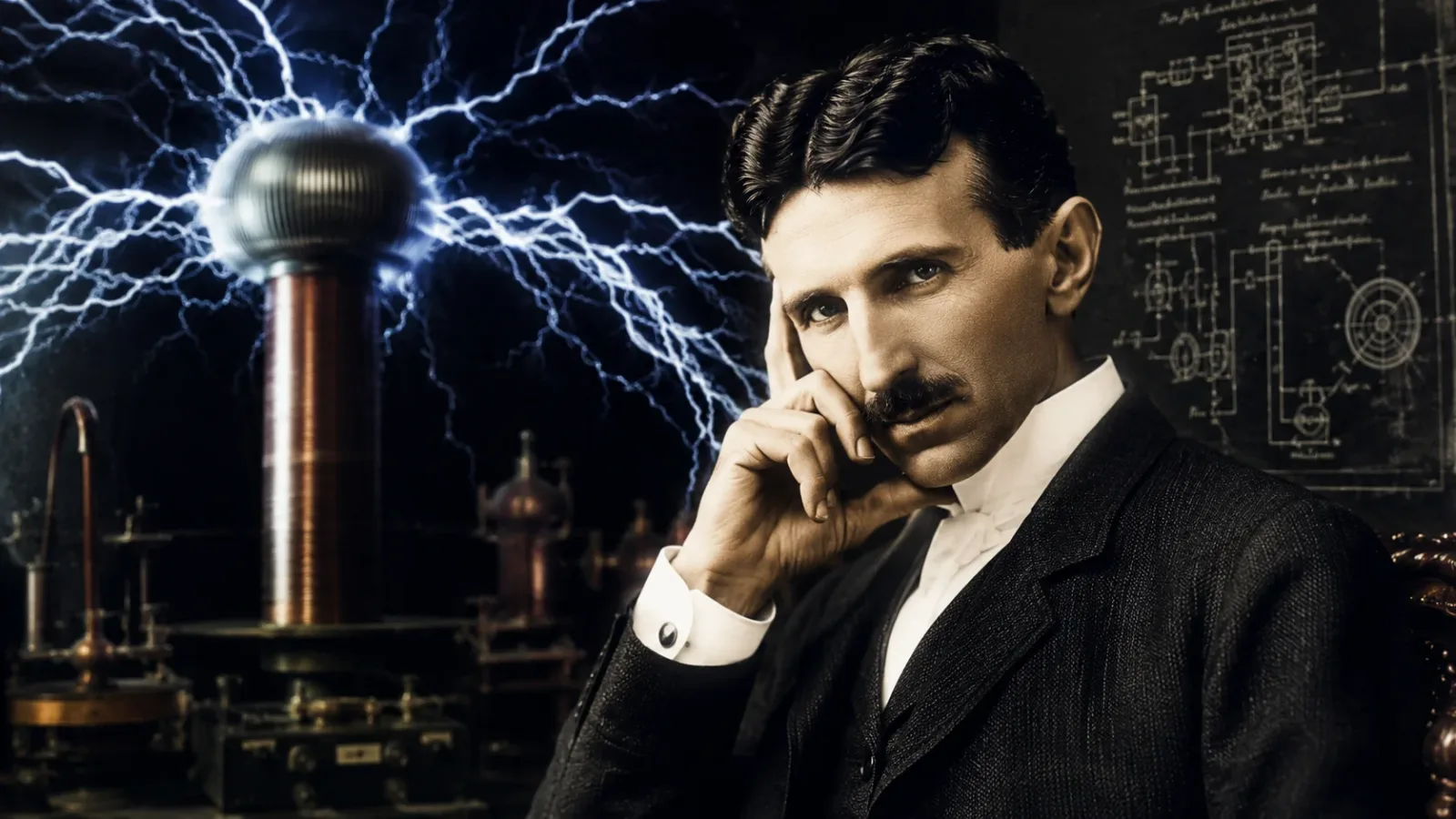
Nikola Tesla is the quintessential mad scientist of the modern era. As the undisputed master of alternating current (AC) electricity, his brilliant mind essentially laid the foundation for the 20th century, bringing power and light to the entire globe. Yet, despite his monumental contributions to science and engineering, Tesla was a deeply eccentric, misunderstood, and frequently exploited figure. From his bizarre daily compulsions to his prophetic visions of the distant future, here are 15 fascinating and lesser-known facts about the true wizard of electricity.
1. A Severe Obsession with the Number Three
Tesla suffered from severe obsessive-compulsive tendencies, and his most famous compulsion revolved around the number three. Before entering any building, he felt a powerful urge to walk entirely around the block three times. He also obsessively washed his hands using exactly three towels and required his hotel room numbers to always be perfectly divisible by three.
2. An Extreme Phobia of Pearls
For reasons he never fully explained, Tesla harbored an intense, visceral hatred of pearls. The sight of them physically disgusted him to the point where he absolutely refused to speak to any woman wearing pearl jewelry. If his own secretary arrived at the laboratory wearing a pearl necklace, he would immediately order her to go home for the day.
3. A True Photographic Memory
Tesla possessed an eidetic, or photographic, memory of the highest caliber. He rarely drew traditional blueprints or wrote down extensive notes for his inventions. Instead, he would memorize entire books and visualize complex, intricate machinery in his mind in complete 3D, mentally testing the parts for wear and tear before ever building a physical prototype.
4. He Fell in Love with a Pigeon
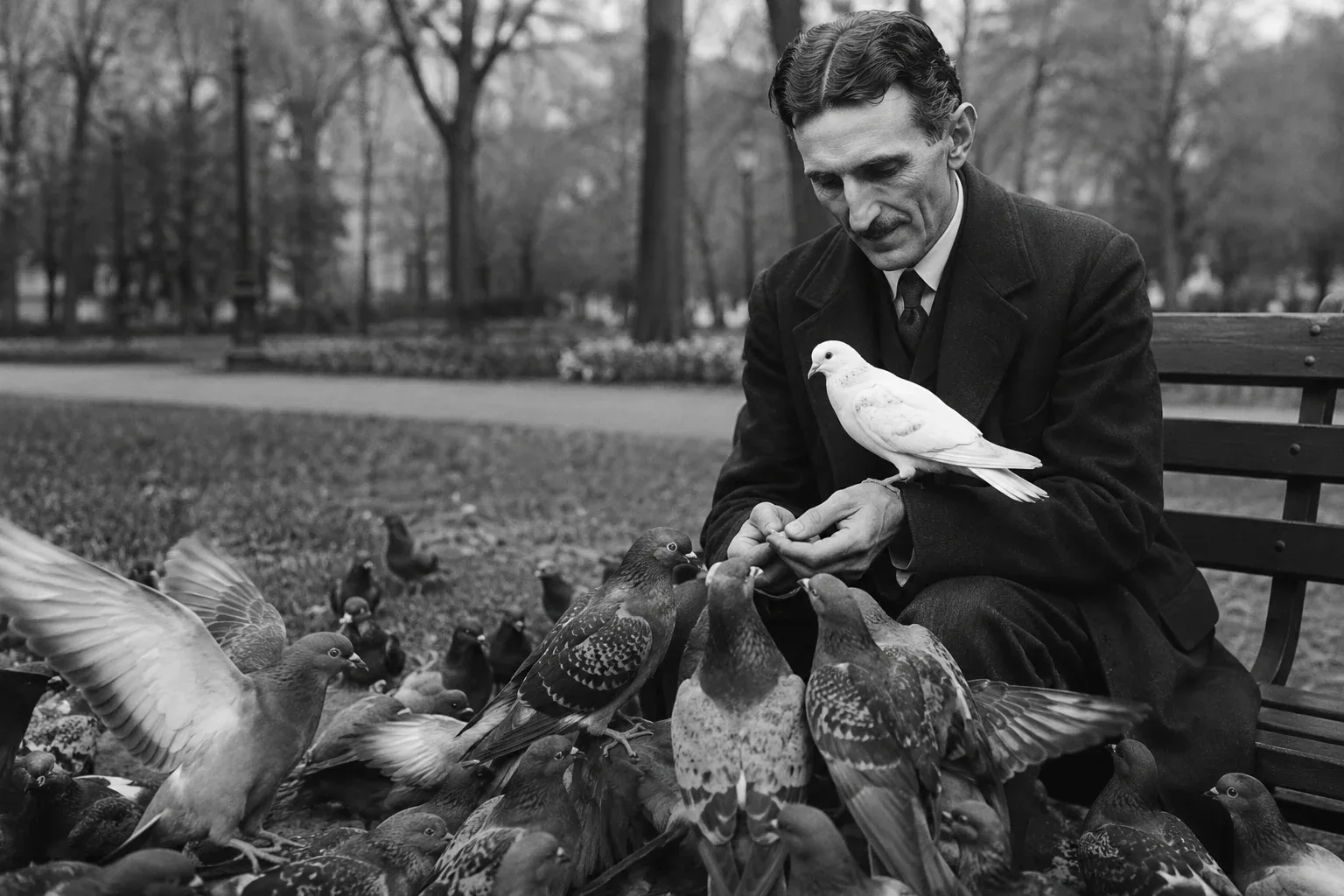
In his later, increasingly lonely years in New York City, Tesla spent hours every day in local parks feeding the pigeons. He developed a deep, highly unusual emotional attachment to one specific white female pigeon. He famously claimed that he loved the bird exactly as a man loves a woman, and that as long as he had her, his life had profound purpose.
5. The True Father of the Radio
While Guglielmo Marconi is historically credited with inventing the radio and even won a Nobel Prize for it, he actually used 17 of Tesla’s previously established patents to achieve his transatlantic transmission. Following a lengthy legal battle that outlasted Tesla’s life, the United States Supreme Court finally ruled in 1943 to posthumously restore Tesla’s status as the true, original inventor of the radio.
6. He Accidentally Caused an Earthquake
While experimenting with mechanical resonance in his Manhattan laboratory, Tesla created a small, pocket-sized oscillator. When he attached it to the steel support beams of his building and turned it on, the machine found the resonant frequency of the structure. It violently shook the building and the surrounding neighborhood, shattering windows and prompting a massive police response before Tesla smashed the device with a hammer to stop it.
 Scientists and Inventors Who Changed the World
See All Facts
Scientists and Inventors Who Changed the World
See All Facts
7. He “Cured” Mark Twain’s Digestion
Tesla and the legendary American author Mark Twain were incredibly close friends. Knowing that Twain suffered from severe, chronic constipation, Tesla invited the writer to his laboratory to stand on his experimental mechanical oscillator platform. The intense, high-frequency vibrations of the machine completely solved Twain’s digestive issues in a matter of minutes, sending the author sprinting to the laboratory restroom.
8. He Predicted the Modern Smartphone
In a remarkable interview with the New York Times in 1909, Tesla accurately predicted the advent of wireless internet and the modern smartphone. He described a future where people would use a small, inexpensive instrument, no bigger than a pocket watch, to instantly transmit wireless messages, listen to music, and hear speeches from across the globe without the need for any wires.
9. A Pioneer of Early X-Rays
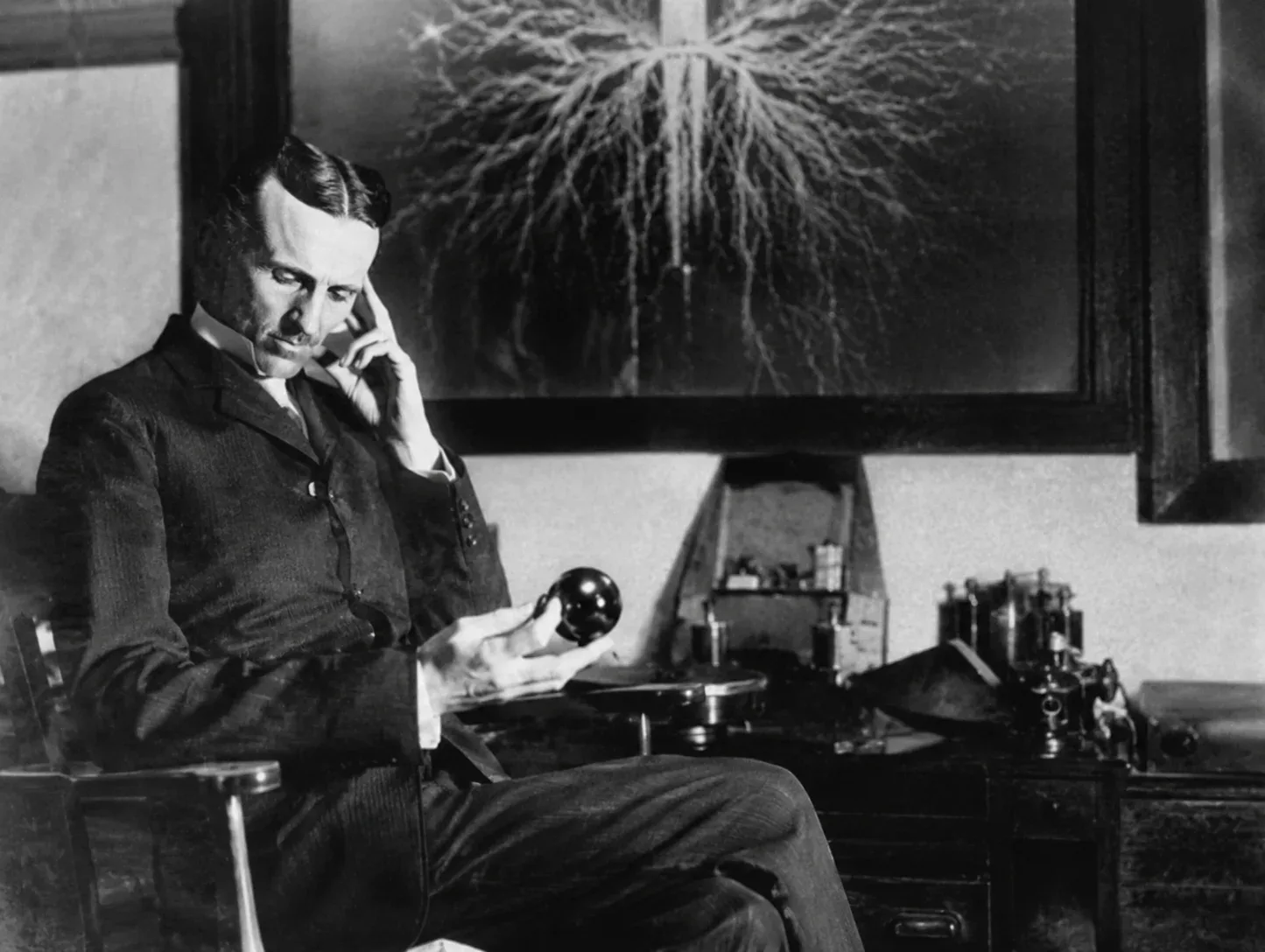
While Wilhelm Röntgen is credited with the discovery of X-rays, Tesla was actually experimenting with the exact same radiation simultaneously. Using his own vacuum tubes, Tesla captured some of the first X-ray images in history—which he called “shadowgraphs”—including a haunting, highly detailed image of the bones inside his own foot.
10. The Mysterious Death Ray
In his twilight years, Tesla claimed to have invented a terrifying superweapon that he called “Teleforce,” which the press quickly dubbed the “Death Ray.” He described it as a concentrated particle beam weapon capable of melting airplane motors from 250 miles away and dropping an army of 10,000 men in their tracks. He shopped the idea to various militaries, but the weapon was never built.
11. An Early Champion of Renewable Energy
Long before the modern environmental movement, Tesla was deeply concerned about humanity’s reliance on consuming fossil fuels like coal. He viewed this as a rapid depletion of the earth’s finite capital. Instead, he constantly advocated for the development of renewable energy sources, specifically focusing his efforts on harnessing the massive, infinite power of wind, solar, and hydroelectricity.
12. Digging Ditches for Edison
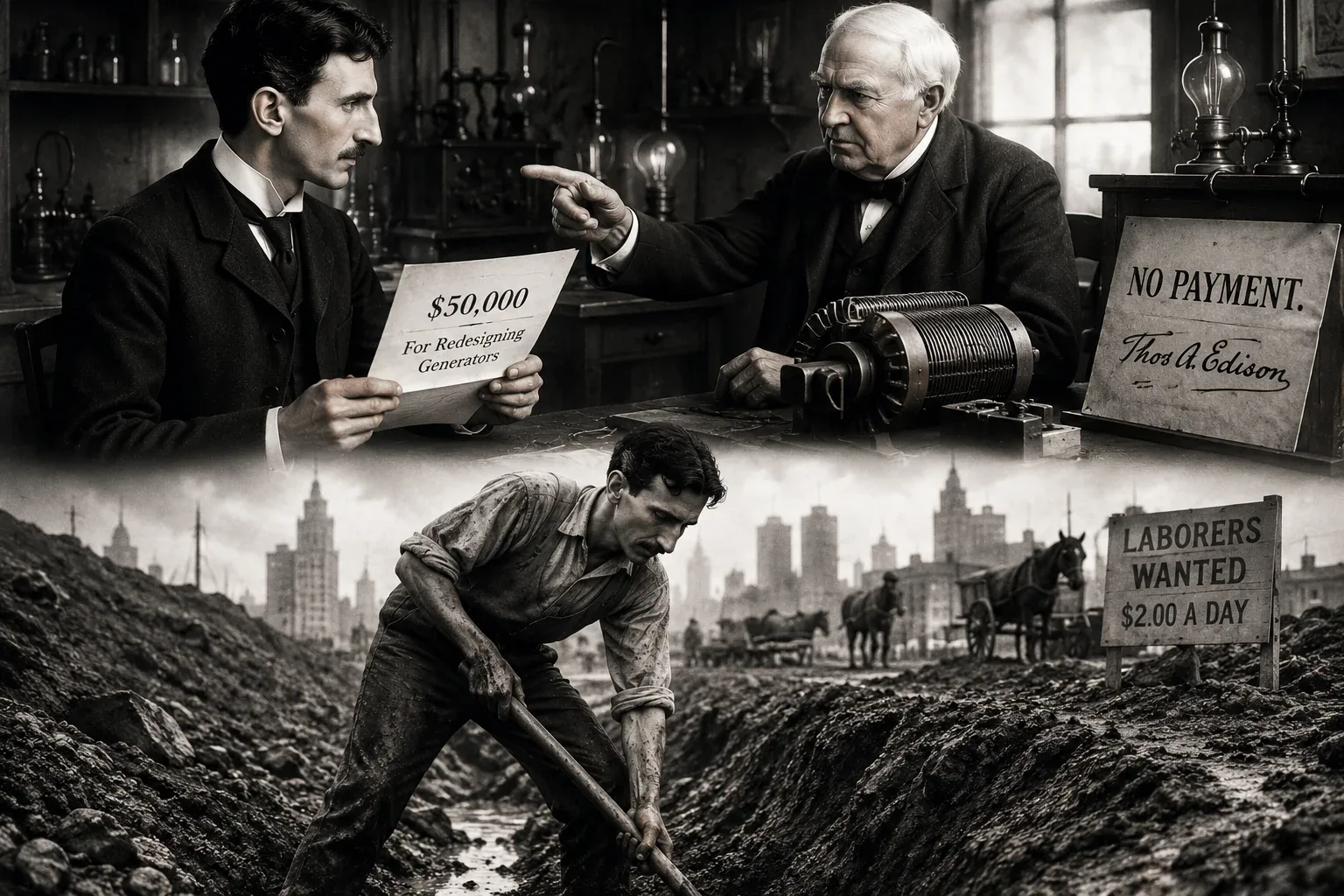
When Tesla first arrived in America, he worked directly for Thomas Edison. After Edison allegedly reneged on a promise to pay Tesla $50,000 for redesigning his inefficient direct current (DC) generators, Tesla quit in disgust. Penniless and blacklisted by Edison’s powerful allies, the brilliant inventor was forced to survive by digging ditches for two dollars a day to feed himself.
13. He Chose a Life of Celibacy
Tesla was a tall, incredibly handsome, and sharply dressed man who frequently caught the attention of wealthy socialites. However, he made a conscious, lifelong decision to remain entirely celibate. He firmly believed that romantic relationships and marriage would be a massive distraction, claiming that absolute chastity was the secret to maintaining his intense scientific focus and creativity.
14. The Wardenclyffe Tower Failure
Tesla’s ultimate dream was to provide free, unlimited wireless electricity to the entire world. He convinced J.P. Morgan to fund the construction of Wardenclyffe Tower in New York to achieve this goal. However, once Morgan realized that wireless, free energy could not be easily metered or monetized, he completely withdrew his funding, causing the project to collapse and pushing Tesla into severe debt.
15. He Died Penniless and Alone
Despite his patents literally illuminating the globe and powering the industrial revolution, Tesla possessed terrible business acumen and frequently tore up lucrative contracts to help out his friends. He spent his final decade living on credit in room 3327 of the New Yorker Hotel. He died completely broke and alone in 1943 at the age of 86, leaving behind a legacy that the world would not fully appreciate until decades later.
Sources & References
This AI-assisted post was rigorously curated and fact-checked for accuracy by:
 Martin Roháček
How fun was this article? 🤔
Tap a star to rate it
🧠 Quiz: How closely were you paying attention?
10 questions — all answers are in the article above!
Enjoyed these facts? There's more! 💌
Fresh fun facts in your inbox. No spam, ever.