The Golden Legacy: 15 Fascinating Facts About the Nobel Prize
Established in the late 19th century through a surprising turn of fate, the Nobel Prize remains the ultimate mark of global excellence in science, literature, and peace efforts. From dissolved gold medals escaping wartime Nazis to bizarre rejections and political bans, the story of these prestigious awards is filled with intrigue. Discover the fascinating history, unusual rules, and legendary laureates that have shaped the world's most famous accolades.
1. The Premature Obituary That Sparked the Prizes
In 1888, Swedish industrialist and dynamite inventor Alfred Nobel opened a French newspaper to find his own premature obituary titled "The Merchant of Death is Dead." The headline was actually written for his brother Ludvig who had passed away in Cannes, but the mistaken identity deeply shaken Alfred. Horrified that he would be remembered solely for developing military explosives and violent weapons, Nobel secretly rewrote his last will and testament in 1895. He earmarked roughly 94 percent of his immense personal fortune to establish international awards honoring those who conferred the "greatest benefit on mankind." This sudden existential pivot successfully transformed a legacy of destruction into the world's most prestigious celebration of human achievement.
2. The Mysterious Absence of a Mathematics Category
Contrary to popular urban legend, Alfred Nobel did not exclude mathematics because a rival mathematician stole his mistress or wife. Nobel was never married, and historical records offer zero evidence that he harbored any personal grudge against prominent Swedish mathematician Gösta Mittag-Leffler. In reality, Nobel was a pragmatic inventor whose focus remained heavily anchored in applied sciences and practical discoveries with immediate physical applications. He viewed mathematics as a theoretical tool rather than a standalone discipline that directly improved everyday human welfare. Consequently, top mathematicians must set their sights on accolades like the Fields Medal or the Abel Prize instead.
3. Dissolving Medals in Acid to Outsmart the Nazis
When Nazi forces occupied Denmark in 1940, Hungarian chemist George de Hevesy faced a life-or-death dilemma at Niels Bohr's lab in Copenhagen. German physicists Max von Laue and James Franck had sent their solid gold Nobel medals to Denmark for safekeeping, which was an act punishable by death under Nazi law prohibiting gold export. Rather than burying the physical medals where metal detectors could easily locate them, Hevesy dissolved the precious trophies in a harsh mixture of nitric and hydrochloric acid known as aqua regia. The resulting orange liquid sat unnoticed in an ordinary laboratory beaker on a shelf throughout the entire German occupation. After the war ended, Hevesy precipitated the gold out of the solution, and the Nobel Foundation recast the original gold into identical replacement medals for both scientists.
4. Hitler Banned All Germans From Accepting Awards
Adolf Hitler grew furious in 1935 when the Nobel Peace Prize was bestowed upon imprisoned German pacifist and journalist Carl von Ossietzky. Ossietzky had exposed secret German rearmament efforts in defiance of the Treaty of Versailles, making his award a massive international humiliation for the Nazi regime. In retaliation, Hitler issued an official decree forbidding all German citizens from accepting any future Nobel Prizes. As a direct result, three German scientists—Gerhard Domagk, Adolf Butenandt, and Richard Kuhn—were forced to reject their respective awards in medicine and chemistry between 1938 and 1939. While all three were eventually granted their formal Nobel diplomas and gold medals after World War II, they forever lost the original prize cash allocations.
5. The Peculiar Division Between Sweden and Norway
While four of the original Nobel Prizes are presented in Stockholm, Sweden, the Nobel Peace Prize is uniquely awarded in Oslo, Norway. Alfred Nobel never documented his exact reasoning for splitting the prize ceremonies across two separate nations in his famous 1895 will. At the time the will was written, Sweden and Norway were still unified under a single legal union governed by the Swedish crown. Historians speculate Nobel believed Norway's Parliament possessed a less militaristic national reputation and would prove less susceptible to geopolitical bias. Even after Norway peacefully dissolved the union in 1905, the tradition endured, keeping the Peace Prize firmly rooted in Oslo.
6. Jean-Paul Sartre Rejected the World's Highest Literary Honor
French existentialist philosopher and writer Jean-Paul Sartre created an international sensation in 1964 when he officially declined the Nobel Prize in Literature. Sartre famously declared in a written public statement that a writer must refuse to let himself be transformed into an institutionalized figurehead. He maintained that accepting official state honors would compromise his intellectual independence and diminish the raw objectivity of his philosophical works. Despite his refusal, the Swedish Academy made it clear that their selection was final and that declining the honor did not erase his status as an official laureate. Sartre also turned down the massive cash prize, ensuring his uncompromising commitment to his philosophical principles remained absolute.
7. Marie Curie's Unprecedented Double Victory Across Two Disciplines
Marie Curie made history in 1903 as the first woman ever to win a Nobel Prize when she shared the Physics award with her husband Pierre Curie and Henri Becquerel. Eight years later in 1911, she shattered records again by winning the Nobel Prize in Chemistry for her discovery of radium and polonium. This extraordinary feat established her as the first person in history to win two Nobel Prizes. To this day, Curie remains the only individual ever honored across two distinct scientific disciplines. Her groundbreaking research laid the fundamental foundation for modern nuclear physics and modern cancer treatments.
8. The Curie Family Holds a Record 5 Nobel Laureates
The Curie family remains the undisputed power dynasty in the long history of the Nobel Prize, claiming five separate awards across two generations. Marie Curie claimed two individual prizes, while her devoted husband Pierre Curie shared her first award in Physics in 1903. Decades later, their eldest daughter Irène Joliot-Curie followed in her parents' exact footsteps by winning the 1935 Chemistry prize alongside her husband Frédéric Joliot-Curie. Adding to the family legacy, Marie's younger daughter Eve Curie wrote a bestselling biography of her mother and married diplomat Henry Labouisse. Labouisse accepted the Nobel Peace Prize on behalf of UNICEF in 1965, cementing the family's astounding legacy of public service and brilliant research.
9. Albert Einstein Didn't Win for His Famous Theory of Relativity
Albert Einstein is universally famous for his revolutionary Special and General Theories of Relativity, yet neither earned him his Nobel Prize. During the early 1920s, the Nobel Committee for Physics remained heavily conservative and hesitant to endorse theoretical physics that lacked definitive laboratory proof. To avoid mounting political controversy while still recognizing Einstein's genius, the committee awarded him the 1921 Physics Prize specifically for his discovery of the law of the photoelectric effect. The official citation cautiously noted that the prize was given without taking into account his celebrated theories of relativity and gravitation. Ironically, the photoelectric effect proved crucial to quantum mechanics, making his actual award-winning work equally foundational to modern physics.
10. Strict Posthumous Rules Exclude Deceased Geniuses
The Nobel Foundation rules explicitly dictate that prizes cannot be awarded posthumously unless the laureate dies after the official announcement is made. Prior to a strict rule revision in 1974, only two individuals had ever received posthumous awards because they had died while the nomination process was underway. This rigid policy meant famous figures like Mahatma Gandhi, who was nominated five separate times, never received a Peace Prize before his assassination in 1948. In 2011, Canadian immunologist Ralph Steinman was awarded the Nobel Prize in Physiology or Medicine three days after his actual death. The committee chose to preserve the award because they had made the selection in complete ignorance of his recent passing.
11. Malala Yousafzai Made History as the Youngest Laureate
In 2014, Pakistani activist Malala Yousafzai became the youngest Nobel Prize laureate in history at just 17 years old. She was targeted and shot in the head by Taliban gunmen on a school bus in 2012 due to her vocal campaign for girls' education. Miraculously surviving the assassination attempt, Malala intensified her global human rights advocacy alongside her father. She shared the 2014 Nobel Peace Prize with Indian children's rights advocate Kailash Satyarthi for their tireless struggle against the suppression of young people. Her historic achievement demonstrated that age is no barrier to profound global impact and courageous activism.
12. The Precise Choreography of the Nobel Banquet
Every year on December 10, the Stockholm City Hall hosts a spectacular multi-course Nobel Banquet for roughly 1,300 distinguished guests. Executing this grand feast demands military-level precision and intense physical preparation from over 400 waitstaff members. Waiters undergo rigorous rehearsal sessions using stopwatches to ensure that every single dish touches the tables in absolute unison. The kitchen staff operates under strict, secret culinary directives, preparing thousands of exact courses using local Swedish ingredients. Even the vast dining hall's physical layout is mapped out down to the millimeter to prevent awkward bottlenecks during silver-service delivery.
13. Linus Pauling's Unmatched Record of Two Unshared Prizes
American chemist and activist Linus Pauling holds a singular distinction that no other human being in history has ever matched. He won the 1954 Nobel Prize in Chemistry for his pioneering work on the nature of chemical bonds and complex molecular structures. Eight years later, Pauling was awarded the 1962 Nobel Peace Prize for his relentless global campaign against atmospheric nuclear weapons testing. While four other individuals have won multiple Nobel Prizes, Pauling remains the only person ever to win two completely unshared Nobel awards. His rare combination of scientific genius and moral courage solidified his reputation as one of the 20th century's most impactful figures.
14. Bob Dylan's Controversial Ghosting of the Academy
When American singer-songwriter Bob Dylan was announced as the winner of the 2016 Nobel Prize in Literature, he reacted with unprecedented silence. For nearly two full weeks, Dylan failed to return persistent telephone calls from the Swedish Academy or make any public acknowledgment of the honor. His total radio silence prompted one senior committee member to publicly label his nonchalant behavior as impolite and arrogant. Dylan eventually broke his silence to accept the award, but he skipped the official December awards ceremony in Stockholm citing prior tour commitments. He ultimately delivered the required Nobel lecture via a private audio recording several months later to secure his monetary prize.
15. The Immense Value and Auction Fate of Gold Medals
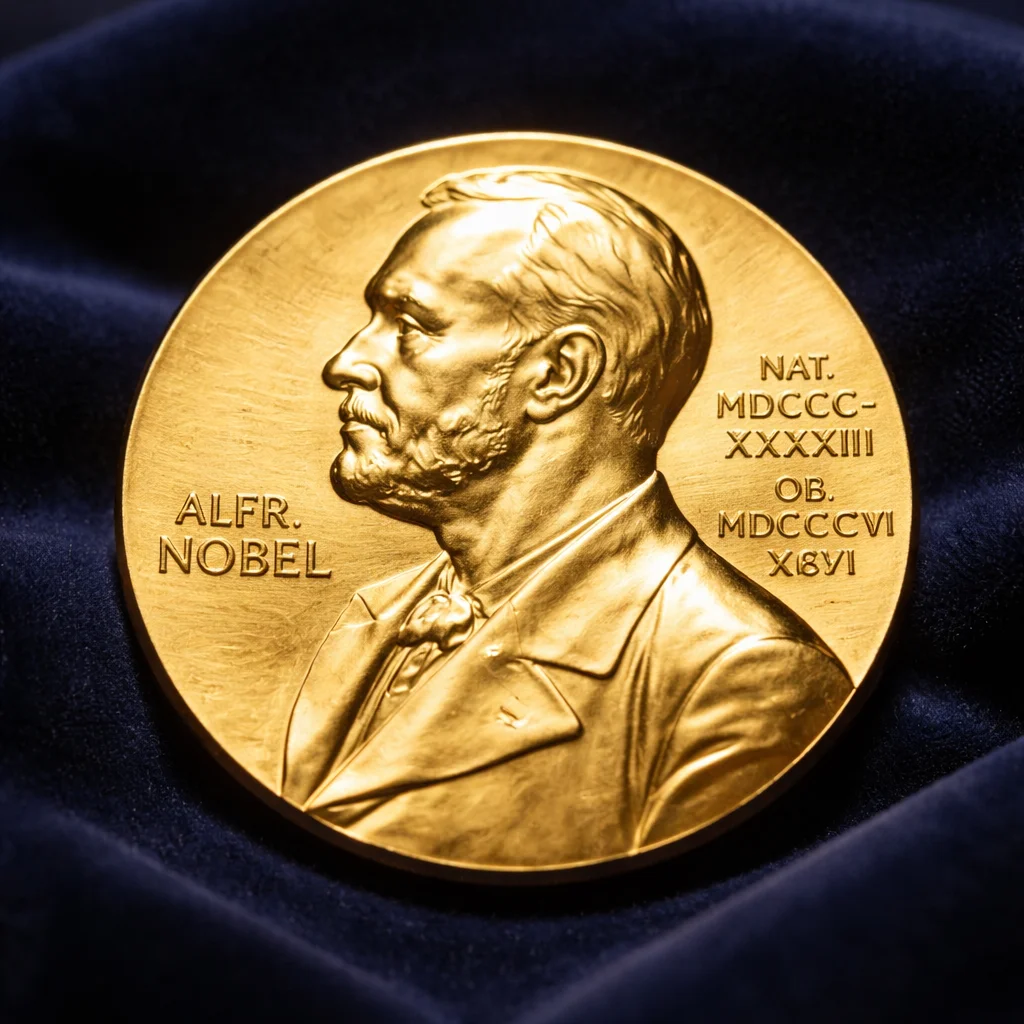
Each official Nobel Prize medal is struck in 18-karat green gold plated with 24-karat gold, weighing around 175 grams. Beyond their metallic value and substantial cash prize—currently around 11 million Swedish kronor—the historic prestige of these physical medals makes them priceless auction items. In 2014, DNA co-discoverer James Watson became the first living laureate to auction off his Nobel medal, which fetched an astounding $4.76 million. Billionaire buyer Alisher Usmanov purchased the medal at auction and immediately returned it to Watson, stating the scientist deserved to keep his honor. In 2022, Russian journalist Dmitry Muratov sold his Peace Prize medal for a record $103.5 million to directly benefit Ukrainian child refugees.
Sources & References
This AI-assisted post was rigorously curated and fact-checked for accuracy by:
 Martin Roháček
How fun was this article? 🤔
Tap a star to rate it
🧠 Quiz: How closely were you paying attention?
10 questions — all answers are in the article above!
Enjoyed these facts? There's more! 💌
Fresh fun facts in your inbox. No spam, ever.