The Enigmatic Mystic: 15 Fascinating Facts About Grigori Rasputin
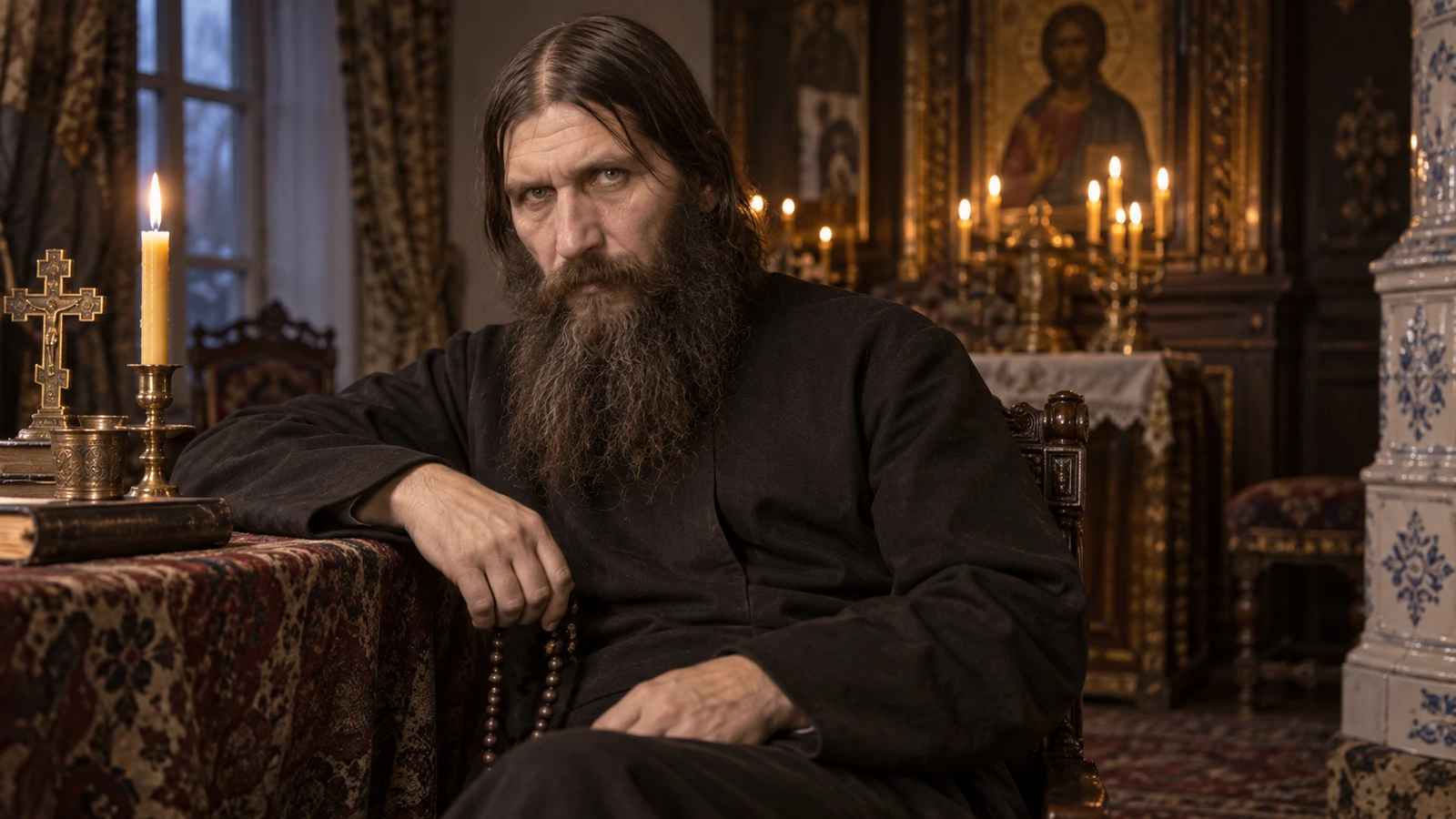
Grigori Rasputin remains one of the most enigmatic figures in world history, a Siberian peasant who rose from total obscurity to influence the highest levels of the Russian Empire. While popular culture paints him as an immortal dark magician who survived poison, gunshots, and icy waters, the historical truth is far more complex and fascinating. From his surprising diplomatic views to the extraordinary post-revolution circus career of his daughter, his real life was stranger than fiction. Here are 15 fascinating facts that separate the real Grigori Rasputin from the sensational myths and legends.
1. He Was Never Actually an Ordained Monk
Despite his famous pop-culture moniker, The Mad Monk, Grigori Rasputin was never ordained by the Russian Orthodox Church. He was technically a strannik, a holy wanderer or pilgrim who traveled between holy sites without taking official monastic vows. Rasputin spent years roaming across Russia and visiting the sacred monasteries of Mount Athos in Greece, collecting religious ideas along the way. While he presented himself as a deeply spiritual holy man, church authorities frequently viewed him with suspicion and investigated him for heresy. His lack of official credentials did not stop him from winning over high-society elites in Saint Petersburg, who were fascinated by his mystical persona.
2. He Was Completely Illiterate Until His Late Twenties
Rasputin grew up as a peasant in the remote Siberian village of Pokrovskoye, where formal education was virtually non-existent. For the first several decades of his life, he worked as a farmer and teamster without knowing how to read or write. It was only after a religious awakening in his late twenties that he learned basic literacy to study religious texts. His handwriting remained clumsy and filled with grammatical errors throughout his life, which contrasted sharply with the polished prose of the imperial court. Nevertheless, his crude notes to Tsar Nicholas II and Tsarina Alexandra carried enormous weight, proving that charisma mattered far more than formal education in his meteoric rise to power.
3. A Woman Without a Nose Stabbed Him in the Gut in 1914
Long before his legendary assassination in 1916, Rasputin narrowly survived a violent attack in his home village in 1914. A peasant woman named Khioniya Guseva, whose nose had been disfigured by syphilis, ambushed Rasputin in the street and stabbed him directly in the stomach with a dagger. Guseva was a devoted follower of a rival fanatic named Iliodor, who believed Rasputin was a false prophet corrupting the empire. Rasputin held his entrails in with his hands while fleeing, barely surviving the resulting surgery and infection. Many historians believe this traumatic injury permanently altered his health and greatly increased his reliance on alcohol and painkillers.
4. He Likely Saved Tsarevich Alexei by Stopping His Medication
Imperial Russia's young heir, Tsarevich Alexei, suffered from severe hemophilia, a genetic condition that caused life-threatening internal bleeding. Rasputin earned the eternal gratitude of Tsarina Alexandra when he repeatedly managed to stop the boy's bleeding episodes when doctors failed. Modern medical historians suspect his success was not miraculous, but rather a result of ordering the imperial physicians to stop administering aspirin. Aspirin was a newly invented wonder drug at the time, but doctors did not yet realize it acts as a blood thinner, which drastically worsened hemophilia bleeds. By demanding the doctors stay away and using soothing talk to lower the boy's blood pressure, Rasputin effectively saved Alexei's life.
5. His Last Name Does Not Mean Licentious or Debauched
A widespread historical myth claims that the surname Rasputin was derived from the Russian word rasputnik, which translates to debauched or dissolute. However, linguists and historians have debunked this claim, noting that Rasputin was a common family name in his native region of Siberia. The name actually originates from the Russian word rasputye, which means crossroads or a place where two roads meet. Rasputin's ancestors likely lived at an intersection of country roads or near a river fork. While his notoriously wild lifestyle certainly matched the concept of debauchery, his family name was simply an ordinary geographical description.
6. He Begged the Tsar Not to Enter World War I
Although Rasputin is often remembered as an agent of political chaos, he was a fierce advocate for peace during the diplomatic crises of the 1910s. In 1914, while recovering in a Siberian hospital from his stomach wound, he sent frantic telegrams to Tsar Nicholas II begging him not to enter World War I. Rasputin prophetically warned that joining the war would lead to the total destruction of Russia and the tragic downfall of the imperial crown. Nicholas II ignored the advice and mobilized the Russian army, plunging the nation into a catastrophic conflict that destabilized society. Rasputin's initial opposition to the war earned him bitter enemies among nationalist politicians and military commanders.
7. There Is No Evidence He Ever Had an Affair with the Empress
Popular culture, including the famous 1978 pop song by Boney M, often depicts Rasputin as the secret lover of Empress Alexandra Feodorovna. In reality, serious historians have found zero credible evidence to support the claim of a romantic or physical affair between them. Alexandra viewed Rasputin strictly as a saintly holy man sent by God to protect her sickly son, treating him with deep religious reverence. Scandalous rumors of an affair were invented and circulated by political enemies, revolutionaries, and aristocrats eager to discredit the monarchy. Erotic caricatures and forged letters flooded Saint Petersburg to damage the royal family's reputation during the war.
8. Contemporaries Were Terrified and Transfixed by His Piercing Eyes
Almost every historical account written by those who met Rasputin remarks on his striking, pale blue eyes. Friends and foes alike reported that his gaze felt strangely heavy and penetrating, giving many the sensation that he could read their inner thoughts. Rasputin actively cultivated this hypnotic presence, using long pauses and unblinking eye contact during conversations to dominate those around him. Several aristocratic women claimed that looking into his eyes induced a state of deep emotional trance or religious ecstasy. Modern psychologists suggest he possessed an extraordinary natural charisma combined with acute psychological intuition.
9. His Personal Hygiene Shocked Even His Ardent Supporters
Despite moving in the highest circles of imperial society, Rasputin deliberately maintained the unwashed, rustic appearance of a Siberian peasant. He rarely bathed or washed his clothes, often emanating a foul body odor that shocked aristocratic court members. Witnesses described him routinely eating with his hands, licking spoons before dipping them into shared serving dishes, and allowing bits of food to rot in his long, unkempt beard. Rasputin took pride in his wild appearance, viewing physical cleanliness as a form of aristocratic vanity that detracted from spiritual humility. His grotesque table manners were both a genuine reflection of his peasant roots and a deliberate provocation against polite society.
10. The Story of the Poisoned Cakes Might Be Complete Fiction
According to Prince Felix Yusupov's famous account of the murder, conspirators served Rasputin sweet cakes and wine laced with lethal doses of potassium cyanide, which strangely failed to kill him. Scientists have long debated why the poison failed, proposing theories that sugar in the cakes neutralized the cyanide or that heat degraded the toxin. However, modern forensic experts and historians suspect that Yusupov simply made up the entire poison story. The original autopsy performed by Dr. Dmitry Kosorotov found no trace of poison in Rasputin's stomach or blood. Conspirators likely invented the tale of his supernatural immunity to justify the brutal, chaotic gun violence that actually took place.
11. Autopsy Records Prove He Did Not Die by Drowning
Another persistent legend surrounding Rasputin's murder is that after being shot and beaten, he was thrown into the icy Malaya Nevka River while still alive and ultimately drowned. Popular tales point to ice found beneath his fingernails as proof that he tried to claw his way out of the freezing water. However, official autopsy records from December 1916 thoroughly debunk this romantic myth. The medical examiner concluded that Rasputin died almost instantly from three fatal gunshot wounds, including a point-blank shot directly into his forehead. There was no water present in his lungs, indicating that he was already dead before his body was dumped into the river.
12. He Correctly Predicted the Violent Fall of the Royal Family
In December 1916, just weeks before his assassination, Rasputin penned a chilling letter to Tsar Nicholas II containing a dire prophecy. He wrote that if he were killed by ordinary peasants, the Tsar would remain on the throne and the monarchy would endure for centuries. However, Rasputin warned that if Russian aristocrats or members of the royal family carried out his murder, the Tsar's family would be killed by the Russian people within two years. Remarkably, Rasputin was murdered by Prince Yusupov and Grand Duke Dmitri Pavlovich, both high-ranking nobles. Less than nineteen months later, in July 1918, Tsar Nicholas II and his entire family were executed by Bolshevik revolutionaries.
13. Bolsheviks Exhumed and Incinerated His Remains in 1917
After his murder, Empress Alexandra had Rasputin buried in a secret chapel on the grounds of the Tsarskoye Selo palace estate. However, his peaceful rest lasted only a few months. Following the February Revolution of 1917, soldiers discovered his grave and dug up his coffin, fearing that royal loyalists would turn the burial site into a sacred shrine. A group of revolutionary soldiers loaded his body onto a truck and drove it to the nearby forests of Saint Petersburg. They built a massive bonfire and burned Rasputin's remains to ashes, scattering them into the wind to ensure no physical trace of the controversial holy man remained on Earth.
14. His Daughter Escaped to America and Worked as a Lion Tamer
Following the Russian Revolution, Rasputin's eldest daughter, Maria Rasputin, fled her homeland and lived an extraordinary life in Western exile. After working as a cabaret dancer in Europe, she moved to the United States and joined the Ringling Bros. and Barnum & Bailey Circus as a professional animal trainer. Maria performed in circus arenas across America, stepping into cages with wild lions and tigers. Circus promoters capitalized heavily on her famous lineage, billing her as The Daughter of the Mad Monk Whose Gaze Tamed Wild Beasts. She maintained until her death in Los Angeles in 1977 that her father was a misunderstood and saintly martyr.
15. The Infamous Preserved Artifact in St. Petersburg Is a Hoax
One of the most bizarre urban legends surrounding Rasputin involves a pickled body part allegedly preserved in a glass jar at the Museum of Russian Erotica in Saint Petersburg. The museum claims to display Rasputin's remarkably preserved ten-inch phallus, which was purportedly severed during his autopsy or exhumation. Medical experts and historians have thoroughly investigated these claims and concluded that the artifact is almost certainly a hoax or the dried reproductive organ of a sea creature, such as a sea cucumber or whale. While Rasputin's hypersexual reputation made such stories popular tabloid fodder, no authentic biological remains of the Siberian mystic survived the 1917 incineration.
Sources & References
This AI-assisted post was rigorously curated and fact-checked for accuracy by:
 Martin Roháček
How fun was this article? 🤔
Tap a star to rate it
🧠 Quiz: How closely were you paying attention?
10 questions — all answers are in the article above!
Enjoyed these facts? There's more! 💌
Fresh fun facts in your inbox. No spam, ever.