Tahiti captures the imagination like few other places on Earth. While many people picture it as a single small island, it actually serves as the beating heart of a massive territory that spans an area as large as Europe. For instance, the local alphabet is so efficient it uses only thirteen letters to create a rich and melodic language. Furthermore, the island itself is shaped like a figure-eight, consisting of two distinct volcanic ranges connected by a narrow isthmus. Prepare to journey to the land where the word "tattoo" was born.
Tahiti
The national flower works like a relationship status update. If you wear a Tiare flower behind your left ear, you signal that you have a partner. However, if you place it behind your right ear, you tell everyone that you are single and available.
The word “tattoo” comes directly from the Tahitian language. The word “tatau” means to strike or mark. Captain James Cook and his crew brought the word and the concept back to Europe after they witnessed the intricate ink patterns on the locals.
Absolutely no poisonous snakes exist on the island. You can hike through the densest jungles and explore the deepest valleys without worrying about venomous serpents. The only things that might bite you are the mosquitoes and the “nono” sandflies.
A land bridge connects the two sections of the island. Geographers divide Tahiti into Tahiti Nui, the big section, and Tahiti Iti, the small peninsula. From above, the island looks exactly like a turtle swimming toward the west.
Missionaries banned the famous hip-shaking dance for decades. When British missionaries arrived in the 19th century, they considered the “Ori Tahiti” to be too provocative. Locals practiced their culture in secret until the government legalized it again years later.
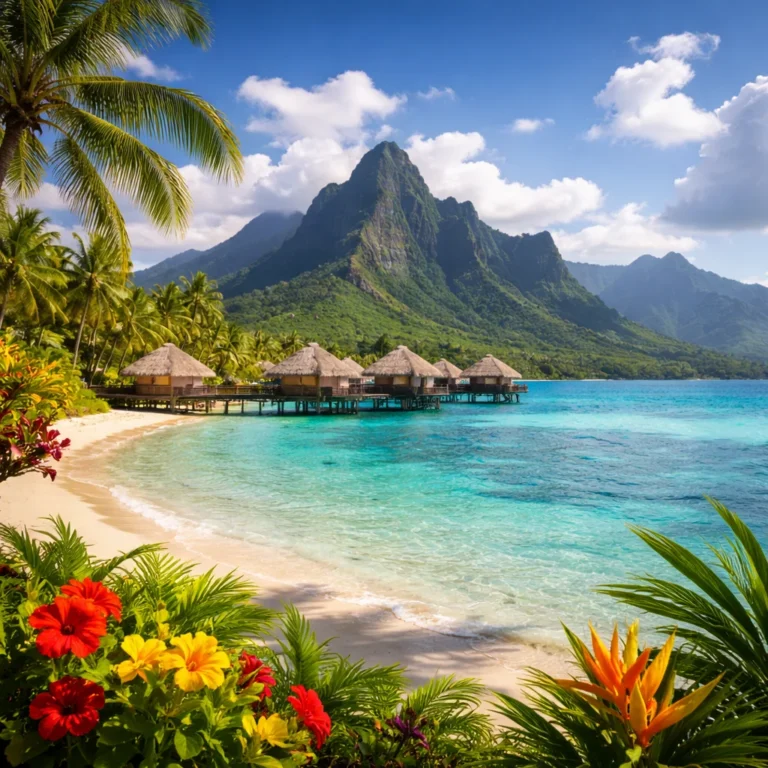
Three Americans invented the overwater bungalow here. The “Bali Hai Boys” wanted to attract tourists to their hotel on a nearby island but had no sandy beach. They solved the problem when they built rooms directly on stilts over the lagoon, which changed luxury travel forever.
Tahitians hold full French citizenship. Because French Polynesia functions as an overseas collectivity of France, locals vote in French elections. This means you are just as likely to find a fresh baguette in Papeete as you are in Paris.
The black pearls you find here rarely look actually black. While dealers sell them as “black pearls,” they actually come in a spectrum of colors including green, blue, eggplant, and peacock. A truly jet-black pearl remains exceptionally rare and valuable.
Breadfruit motivated the Mutiny on the Bounty. Captain Bligh came to Tahiti specifically to collect breadfruit plants to feed slaves in the Caribbean. However, his crew enjoyed the island lifestyle so much that they rebelled rather than return to England.
Locals cook food underground in a traditional oven. The “ahima’a” method involves heating volcanic stones in a pit and covering the food with banana leaves. They leave it to slow-cook for hours, which creates a smoky, tender feast for Sunday gatherings.
The written language contains only thirteen letters. The Tahitian alphabet consists of the vowels A, E, I, O, U and the consonants F, H, M, N, P, R, T, and V. Despite this limited set, the language remains incredibly expressive and complex.
Most people do not receive home mail delivery. Because street names and numbers can be inconsistent or non-existent in rural areas, many residents rent a box at the post office. They must travel to town to pick up their letters and packages.
Families often bury the umbilical cord under a fruit tree. Parents follow a long-standing tradition to put a newborn’s cord in the earth and plant a tree over it. This ritual connects the child to the land forever and ensures they always have a place to call home.
The island slowly sinks back into the ocean. Like all volcanic islands, the weight of the rock pushes down on the earth’s crust. Eventually, millions of years from now, erosion will reduce Tahiti until it becomes a coral atoll.
Finally, locals view “Mana” as a real and tangible force. Tahitians believe a spiritual energy exists in people, places, and objects. You maintain Mana when you live with respect, courage, and honor, but you lose it if you act shamefully.
How useful was this post?
Click on a star to rate it!
This AI-assisted post was rigorously curated and fact-checked for accuracy by: